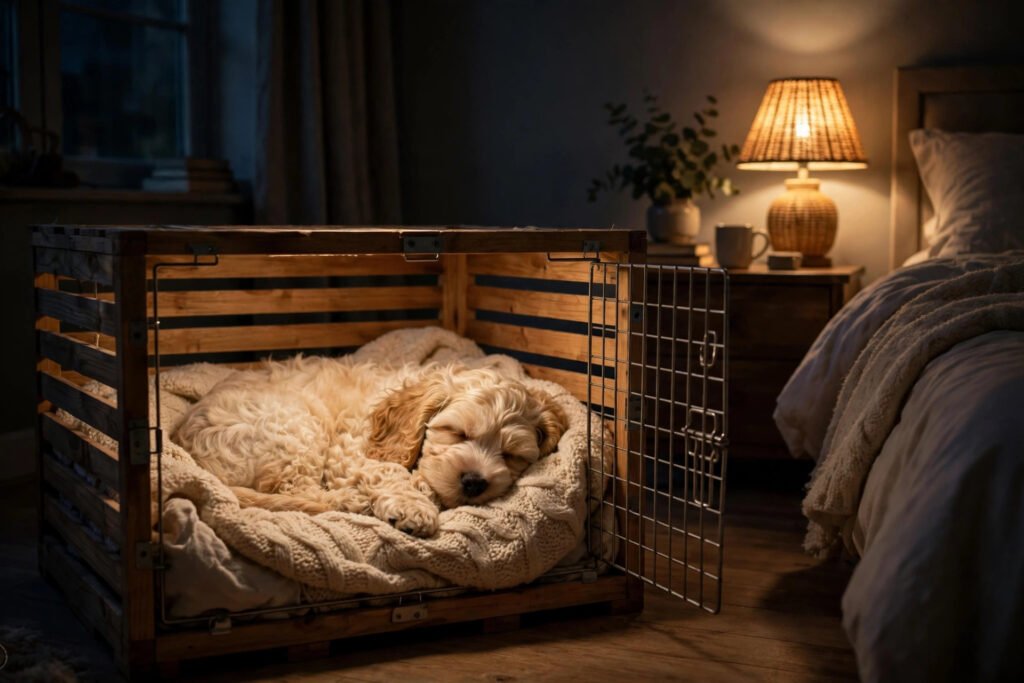
A step-by-step Cockapoo puppy bedtime routine: last meal and potty timing, the wind-down hour, the crate settle, night wakings, and fixing the 5 a.m. wake-up.
Quick answer: Last meal 2 to 3 hours before bed, play done 60 to 90 minutes before, a calm wind-down in the last hour, a last potty trip before lights out, then into the crate with a cue word. Expect 1 to 2 night trips at 8 to 10 weeks; most puppies sleep 6 to 8 hours by 16 weeks.
The first nights with a Cockapoo puppy are the hardest part of owning one. Your puppy has just left its mother and littermates, it is sleeping in a strange room, and it has no idea that nighttime means sleep. So it cries. It wakes at 2 a.m. It wakes again at 5 a.m., wide awake and ready to play, while you are running on three hours of broken sleep and wondering what you have done.
It gets better — faster than most new owners expect — but only if the nights look the same every single time. Puppies do not learn bedtime from one good night. They learn it from the same sequence, in the same order, at roughly the same time, night after night. This guide is that sequence: the clock-by-clock routine, what to do when your puppy wakes in the night, and how to fix the early-morning wake-up that catches so many owners out.
The Routine at a Glance
Here is the whole evening in one table. The rest of this article explains each step — but if you want the short version, this is it.
 CockapooDaily
| Time before bed | What to do |
|---|---|
| 2 to 3 hours before | Last meal of the day |
| 60 to 90 minutes before | Last active play or short training session |
| 60 minutes before | Wind-down starts: lights low, voices low, no wild games |
| 30 minutes before | Calm chew or gentle cuddle; pick up the water bowl about 2 hours before bed |
| Right before bed | Final potty trip — boring, quiet, straight back in |
| Lights out | Into the crate with your cue word, room dark and quiet |
The exact clock time matters less than the consistency. A 9:30 p.m. bedtime works just as well as a 10:30 p.m. one, as long as it is the same every night. Pick a bedtime you can keep seven days a week, including weekends, and build the evening backward from it.
Step 1: Time the Last Meal
Feed the last meal 2 to 3 hours before bedtime. That gap matters for two reasons. First, it gives your puppy time to digest and to need a potty trip before bed rather than at 1 a.m. Second, a puppy fed right before lights out is a puppy with energy to burn and a full bowel at exactly the wrong moment.
If your bedtime is 10 p.m., the last meal lands around 7 to 7:30 p.m. If you feed later than that, move the meal earlier rather than moving bedtime later — a late bedtime does not solve a late meal, it just shifts the night waking later too.
Water follows the same logic. Pick up the water bowl about 2 hours before bed. Your puppy should always have had plenty of water during the day — never restrict water in the daytime — but removing it in the last couple of hours before bed reduces the chance of a middle-of-the-night wee. If your puppy is thirsty at bedtime, a few laps are fine; the point is to stop the casual drinking that fills a small bladder right before sleep.
Step 2: Last Play, Then Wind Down
This is the step most owners get backwards. A hyper puppy in the evening does not need more exercise — it usually needs less. Cockapoo puppies are sensitive, busy little dogs that stay switched on for long periods, and when they get overtired they do not get sleepy. They get frantic: zoomies, biting, barking, pacing, and an inability to lie down for more than a few seconds. Owners often describe it as their puppy “fighting sleep,” and that is exactly what it looks like.
So get the active play done early in the evening, not late. A short play session, a gentle walk, or a few minutes of training 60 to 90 minutes before bed burns off the last of the day’s energy at the right time. Then stop. The last hour before bed is wind-down, and wind-down means:
- Lights dimmed and voices lowered
- No fetch, no tug, no chasing games
- No new visitors, no exciting arrivals
- A calm chew (a puppy-safe chew or a stuffed Kong) or a quiet cuddle
- Less roaming around the house — a smaller, quieter space
A calm chew in the last hour is genuinely useful. Chewing and licking release calming signals and help a puppy’s nervous system settle, which is why so many trainers recommend a Kong or a LickiMat as part of the bedtime wind-down. Give it in the crate or on the puppy’s bed, so the calm feeling gets attached to the sleeping place.
If your puppy has the evening zoomies, do not try to tire it out further with more ball-throwing. That usually makes it worse. Bring the evening down instead: dimmer lighting, calmer voices, earlier rest.
Step 3: The Final Potty Trip
Take your puppy out for a last wee right before bed — every night, without exception. Keep the trip boring on purpose. Go to the same spot, on the lead if that keeps your puppy focused, with minimal light and minimal fuss. When your puppy goes, praise quietly, then go straight back inside. No play, no excitement, no wandering around the garden. Your puppy needs to learn that a night-time trip outside means one thing only.
This is also the moment the daytime potty routine pays off. A puppy that has been taken out after every meal, nap, and play session during the day is far more likely to empty its bladder on this last trip. If your daytime schedule is patchy, the nights will be too — our cockapoo potty training schedule lays out the hour-by-hour daytime pattern that makes the last trip of the day reliable.
Step 4: The Crate Settle
Now the crate. The goal is a puppy that walks into its crate willingly and settles — not a puppy that is carried in protesting and left to cry. That only works if the crate already feels like a safe den during the day, which is why the crate work matters before the first bedtime. If you have not done it yet, our crate training guide covers the day-by-day plan for building that value; this article assumes the crate is already a place your puppy likes, and focuses on the nightly settle itself.
For the first few weeks, keep the crate in or beside your bedroom. Your puppy can hear you breathing and know it is not alone — and you can hear it when it genuinely needs to go out. A puppy left alone in a far-off room on its first nights will cry longer and louder, and for good reason: it has just lost its entire family and is now alone in the dark. Proximity is not spoiling. It is the fastest route to a puppy that sleeps confidently on its own later.
The settle itself should look the same every night:
- Give the cue. Pick one word — “bedtime” is the obvious one — and use it every night, in the same calm tone, as your puppy goes into the crate.
- Add the comfort item. A blanket or soft toy that smells of you, or a worn t-shirt placed in the crate, gives a lonely puppy something familiar to curl against. Some owners also use a ticking clock wrapped in a blanket, which mimics a heartbeat.
- Offer the settle chew if you use one. A small stuffed Kong or a safe chew, given in the crate, turns bedtime into something worth looking forward to.
- Close the door, dim the lights, and leave. Do not hover, do not keep talking, and do not go back to check every five minutes. Your puppy needs the room to go dark and quiet so sleep can happen.
One more practical point: the crate should be just big enough for your puppy to stand, turn around, and lie down comfortably. A crate that is too large invites your puppy to use one end as a toilet, which undoes the whole point of crating at night.
If your puppy cries, stay calm. A little whimpering in the first few minutes is normal, especially in the first week, and many puppies settle within 5 to 10 minutes if the room stays dark and boring. If the crying escalates or goes on past 10 to 15 minutes, check quietly — lights off, no social occasion. Rule out the obvious: does it need the toilet, is it too hot or too cold, is the bedding tangled? Then settle it back down and leave again.
What you should not do is let your puppy cry it out night after night as a policy. It rarely works, it teaches your puppy that crying brings nobody, and it is miserable for everyone in the house. The first weeks are about building trust that you will come when it needs you. That trust is what later lets your puppy settle on its own.
Step 5: Night Wakings — When to Go Out, When to Wait
Your puppy will wake in the night. That is not a failure of the routine; it is biology. A young puppy’s bladder is small, and a common rule of thumb is that a puppy can hold it for roughly one hour per month of age, plus one. An 8-week-old puppy manages about 3 hours, a 3-month-old about 4 hours — which is why 1 to 2 night trips are normal at 8 to 10 weeks, and why most puppies can manage 6 to 8 hours by around 16 weeks.
You have two choices when your puppy wakes: go out, or wait. Here is how to decide.
Go out when:
- Your puppy is under about 12 weeks old — it almost certainly needs the toilet.
- The crying is sudden, urgent, and different from the settling whimper at bedtime.
- It has been 3 to 4 hours since the last trip, which is at or past what your puppy’s bladder can hold.
- Your puppy has already had an accident in the crate recently — it may be telling you it needs to go before it happens again.
Wait a few minutes when:
- Your puppy is over 12 weeks old and has been sleeping longer stretches already.
- The waking is a soft whimper that stops and starts, rather than urgent crying.
- It has only been an hour or two since the last trip.
If you decide to wait, wait quietly. Do not talk to your puppy or turn the lights on — that teaches it that waking gets attention. Give it 5 minutes. If it settles, it did not need anything. If it escalates, go out.
And when you do go out, keep it boring. This is the most important rule of night wakings. No lights, no talking, no play, no cuddles, no treats. Out to the potty spot, quiet praise when it goes, straight back into the crate. A night trip that turns into playtime teaches your puppy that waking at 2 a.m. is the most fun part of the day — and it will keep waking at 2 a.m. for weeks.
A useful trick for the first week: set a quiet alarm and take your puppy out before it starts crying. If bedtime is 10 p.m. and your puppy can hold it for about 3 hours, set the alarm for 1 a.m. Push it later by 15 to 30 minutes every few nights until the trip drops away on its own.
| Puppy age | Bladder hold (rough guide) | Night trips to expect |
|---|---|---|
| 8 to 10 weeks | About 3 hours | 1 to 2 trips |
| 11 to 12 weeks | About 3 to 4 hours | 1 trip |
| 13 to 16 weeks | About 4 to 5 hours | 0 to 1 trips |
| 4 to 6 months | 6 to 8 hours | Most sleep through; occasional early wake-ups |
These are rough guides, not guarantees. Smaller puppies and puppies that drank a lot in the evening will need to go out sooner. And any sudden change — a puppy that was sleeping through and suddenly starts waking every night — is worth a vet check, because urinary infections and upset stomachs show up first as night waking.
Step 6: The 5 A.M. Wake-Up Problem
The 5 a.m. wake-up is the most common complaint after the first week, and it has a different cause from the 2 a.m. waking. At 2 a.m., your puppy needs the toilet. At 5 a.m., your puppy is often simply awake — and it has learned that waking up gets something good: breakfast, play, and your company.
- First, rule out the toilet. Take your puppy out, boringly, exactly as you would at 2 a.m. If it goes, it needed to go. Put it straight back in the crate afterward — do not start the day.
- Then, do not start the day. This is the hard part. If your puppy wakes at 5 a.m. and you get up, feed it, and play with it, you have just taught it that 5 a.m. is morning. The next day it will wake at 4:55 a.m. Instead, put it back in the crate, keep the room dark, and wait. Give it 10 to 15 minutes of quiet. Many puppies grumble, circle, and then go back to sleep — especially if they are genuinely tired.
- Push the wake-up later, gradually. Once your puppy is reliably going back to sleep after the 5 a.m. toilet trip, start delaying your own response by 10 to 15 minutes every few days. You are stretching the night, not cutting it short.
- Check the evening. A puppy that wakes at 5 a.m. wide awake may have slept too much in the late afternoon. If your puppy naps from 6 p.m. to 8 p.m., it has already banked two hours of sleep before bedtime. Keep the last couple of hours before bed gently awake — not wild play, just awake — so the sleep pressure is real at lights out.
- Check the light and noise. Cockapoos wake with the dawn. If the crate is near a window and the sun rises at 5 a.m., your puppy will wake at 5 a.m. Blackout curtains, or moving the crate away from the window, can buy you an extra hour. The same goes for early-morning noise: the first bin lorry, a neighbour’s dog, or birdsong through an open window.
What not to do: do not feed your puppy at 5 a.m. to buy quiet. A 5 a.m. breakfast is a reward for a 5 a.m. wake-up, and it locks the habit in place. Breakfast comes at the proper wake-up time, whenever you have decided that is — 6:30 a.m., 7 a.m., whatever fits your household — and not a minute earlier.
Most puppies outgrow the early wake-up by 4 to 6 months, once they can hold their bladder through the night and have learned that morning starts when you say it does. Until then, patience and consistency are the whole strategy.
What the First Week Looks Like
The first week is the hardest, and it helps to know that in advance. Your puppy is adjusting to a new home and sleeping without its littermates for the first time. Expect crying, expect broken nights, and expect it to get noticeably better by night 4 or 5 if the routine stays the same.
Here is a sample first-week schedule for an 8-week-old puppy, built around a 10 p.m. bedtime and a 6:30 a.m. wake-up. Adjust the clock times to your household — the pattern is what matters.
| Time | What happens |
|---|---|
| 6:30 a.m. | Wake up, straight outside for a wee |
| 7:00 a.m. | Breakfast, then outside again |
| 7:30 a.m. to 12:00 p.m. | Play, short training, naps in the crate, potty after every nap and meal |
| 12:00 p.m. | Lunch, then outside |
| 12:30 p.m. to 5:00 p.m. | Play, socialization, naps, potty after every nap and meal |
| 5:00 p.m. | Dinner — this is the last full meal of the day |
| 6:00 p.m. | Gentle walk or garden play, then outside |
| 7:00 p.m. | Last meal is done; a small training session or calm play |
| 7:30 p.m. | A snack-sized chew or a stuffed Kong — not a full meal |
| 8:00 p.m. | Water bowl picked up |
| 8:30 p.m. | Wind-down: lights low, voices low, calm cuddle or chew in the crate |
| 9:45 p.m. | Final potty trip — boring, quiet, straight back in |
| 10:00 p.m. | Crate, cue word, lights out |
| 1:00 a.m. | Planned alarm trip (first few nights only) |
| 6:30 a.m. | Wake up, straight outside |
Two things to notice in that schedule. First, the puppy naps constantly during the day — that is normal, and it is necessary. Puppies need 18 to 20 hours of sleep a day, and a puppy that does not nap enough during the day is the puppy that goes wild in the evening. Second, the evening is deliberately boring after 8:30 p.m. The fun happened earlier. Bedtime is the quiet end of a quiet hour.
For the full day-by-day picture of the first week — what to expect on day 1 versus day 5, and how the first vet visit fits in — our first week home guide covers it in detail. This article is the nightly routine; that one is the whole week.
Mistakes That Make Bedtime Harder
- Playing wildly in the last hour. The single most common mistake. A puppy wound up at 9:30 p.m. will not be asleep at 10 p.m.
- Feeding too late. A meal at 9 p.m. means a puppy that needs the toilet at midnight and is full of energy at bedtime.
- Making night trips fun. Lights on, chatting, playing, treats — every one of those rewards waking up.
- Giving in at 5 a.m. Feeding or playing at 5 a.m. teaches your puppy that 5 a.m. is morning. It will keep happening.
- Moving the crate too soon. A puppy that was settling in your bedroom and is suddenly alone downstairs will cry, and you will lose a week of progress.
- Expecting too much too soon. An 8-week-old puppy cannot physically sleep through the night. Expecting it to is a recipe for frustration on both sides.
- Inconsistency between family members. If one person does the boring night trip and another turns it into a cuddle session, your puppy gets two different lessons. Agree the routine together and stick to it.
If the crying is constant, distressed, and not improving after a week or two of a consistent routine, look wider than bedtime. A puppy that cannot settle may be overtired from too little daytime sleep, anxious about being alone, or uncomfortable — too hot, too cold, or unwell. Our guide to separation anxiety covers the signs that the problem is anxiety rather than routine. And if your puppy’s sleep suddenly changes after weeks of sleeping well, call your vet: a sudden change in sleep is worth checking.
Frequently Asked Questions
How long does it take for a Cockapoo puppy to sleep through the night?
Most puppies manage 6 to 8 hours by around 16 weeks, and many sleep through by 4 to 6 months. At 8 to 10 weeks, expect 1 to 2 night trips — that is normal, not a problem. What speeds it up is a consistent routine: the same bedtime, the same wind-down, and boring night trips that never turn into playtime.
What time should a Cockapoo puppy go to bed?
There is no single right time. Pick a bedtime you can keep every night, including weekends — 9:30 p.m. and 10:30 p.m. both work. What matters is the sequence leading up to it: last meal 2 to 3 hours before, active play done 60 to 90 minutes before, wind-down in the last hour, and a final potty trip right before lights out.
Should my Cockapoo puppy sleep in my bedroom?
Yes, for the first few weeks at least. Keeping the crate in or beside your bedroom helps your puppy settle faster and lets you hear it when it genuinely needs the toilet. You can move the crate gradually once your puppy is sleeping through the night, usually around 4 to 6 months.
Why does my Cockapoo puppy wake up at 5 a.m. every day?
Usually because 5 a.m. has become morning in your puppy’s mind — either it needs the toilet and then stays awake, or it has learned that waking gets breakfast and play. Take it out boringly, put it straight back in the crate, and do not start the day. Push your response later by 10 to 15 minutes every few days, and check that your puppy is not napping too much in the late afternoon or being woken by light and noise.
Should I let my Cockapoo puppy cry it out at night?
No, not as a policy in the first weeks. A little whimpering that settles within 5 to 10 minutes is normal. But leaving a young puppy to cry for long stretches teaches it that crying brings nobody, and it rarely works — it usually makes the crying louder and longer. Check quietly for a genuine need first (toilet, too hot or cold, tangled bedding), settle your puppy back down, and leave the room dark and boring.
Conclusion
A Cockapoo puppy’s bedtime routine is not complicated, but it is exact: last meal 2 to 3 hours before bed, active play done 60 to 90 minutes before, a calm wind-down in the last hour, a final potty trip right before lights out, and the same cue word into the same crate every night. Night wakings are normal at 8 to 10 weeks and should stay boring — out, business, back in, no lights, no play. And the 5 a.m. wake-up is fixed by not starting the day at 5 a.m., however tempting that is at the time.
The first week is the hardest, and it gets noticeably better by night 4 or 5 if the routine does not change. Keep the evenings small and quiet, keep the nights boring, and keep the same sequence every single night. Your puppy will learn it — and then you will both sleep.



Leave a Reply