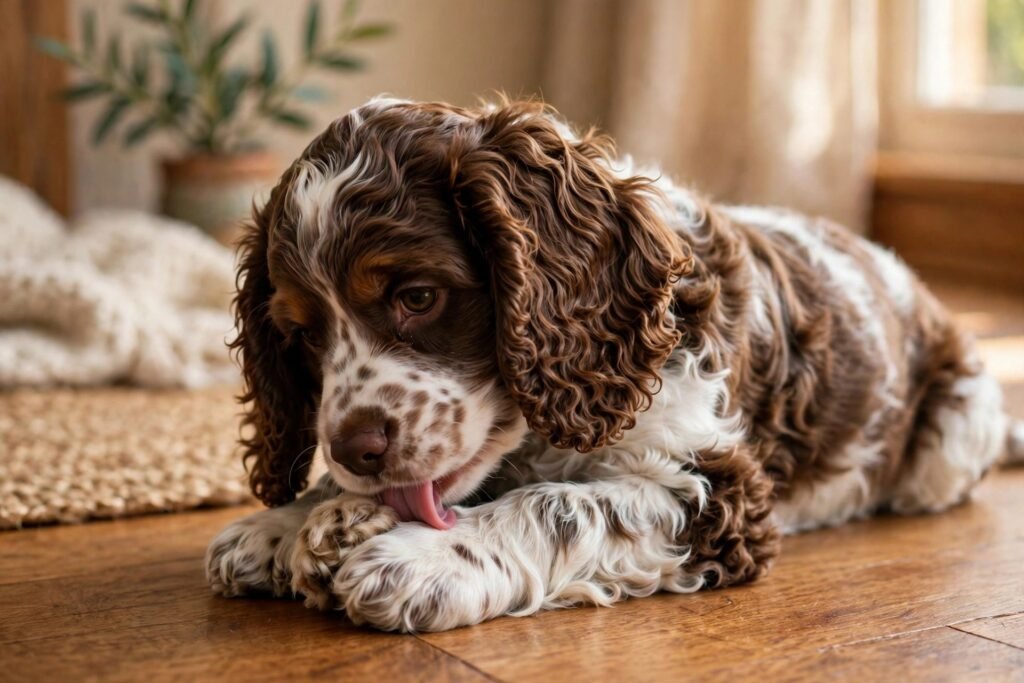
Why does your cockapoo lick its paws so much? The clue-reading diagnostic: which paws, what smell, what staining — and what each combination means. Ranked causes, home protocol, vet triggers.
Quick answer: Occasional paw licking is normal grooming. Excessive licking — minutes-long sessions, one focused spot, returning right after distraction, or causing redness — usually means allergies (the #1 cause in cockapoos), yeast overgrowth, contact irritants, anxiety/boredom, or injury. Read the clues: one paw points to injury; all four with a corn-chip smell points to yeast; seasonal flare-ups point to environmental allergies.
Your cockapoo’s paws are telling you something — you just need to learn the language. This guide teaches you to read the clues like a vet tech would, ranks the likely causes for this specific breed, and gives you a clear 48-hour home protocol with the exact point where you call the vet.
Normal vs Excessive: The Threshold
First, the reassurance: dogs lick their paws the way cats groom — briefly, casually, a few licks after a walk or before sleep. That’s normal.
It becomes excessive when you see any of these:
– Sessions lasting several minutes, not seconds
– Fixation on one spot, licking it raw
– Returns to licking immediately after being distracted (the best home test — call their name; if they’re back at the paw in 10 seconds, it’s compulsive or irritated, not casual)
– Interferes with sleep or play
– Causes redness, hair loss, swelling, or sores
Casual licks = grooming. The list above = a symptom. Everything below is about the second kind.
Read the Clues: The Diagnostic Table
No page on the internet puts this together — but vets narrow causes with exactly these questions. Answer them about your dog:
| Clue | What it suggests |
|---|---|
| One paw only | Injury — thorn, grass seed, torn nail, cut, blister, or sting. Inspect immediately. |
| All four paws | Allergy or yeast — systemic causes hit everywhere |
| Front paws mostly | Often anxiety/boredom (self-soothing) — or allergies |
| Sudden onset (fine yesterday, obsessed today) | Irritant, injury, or foreign body |
| Gradual onset (building over weeks) | Allergy or yeast developing |
| Seasonal pattern (worse in spring/fall) | Environmental allergies — pollen, dust mites |
| Corn-chip / Frito smell | Yeast (Malassezia) overgrowth — the classic tell |
| Brown/rust staining on light fur | Yeast + porphyrins from chronic licking |
| Worse after walks | Contact irritant — pollen on grass, lawn chemicals, winter salt |
| Worse at night | Often just noticeability (quiet house, nothing to distract) — but also when anxiety-driven licking surfaces |
| Limping too | Pain — injury, arthritis, or interdigital cyst |
One clue rarely convicts; two or three together usually do. “All four paws + corn-chip smell + gradual onset” is yeast until proven otherwise. “One paw + sudden + limping” is injury — go look now.
 CockapooDaily
Ranked Causes for Cockapoos
Flat cause-lists don’t help you prioritize. For this allergy-prone breed, ranked by likelihood:
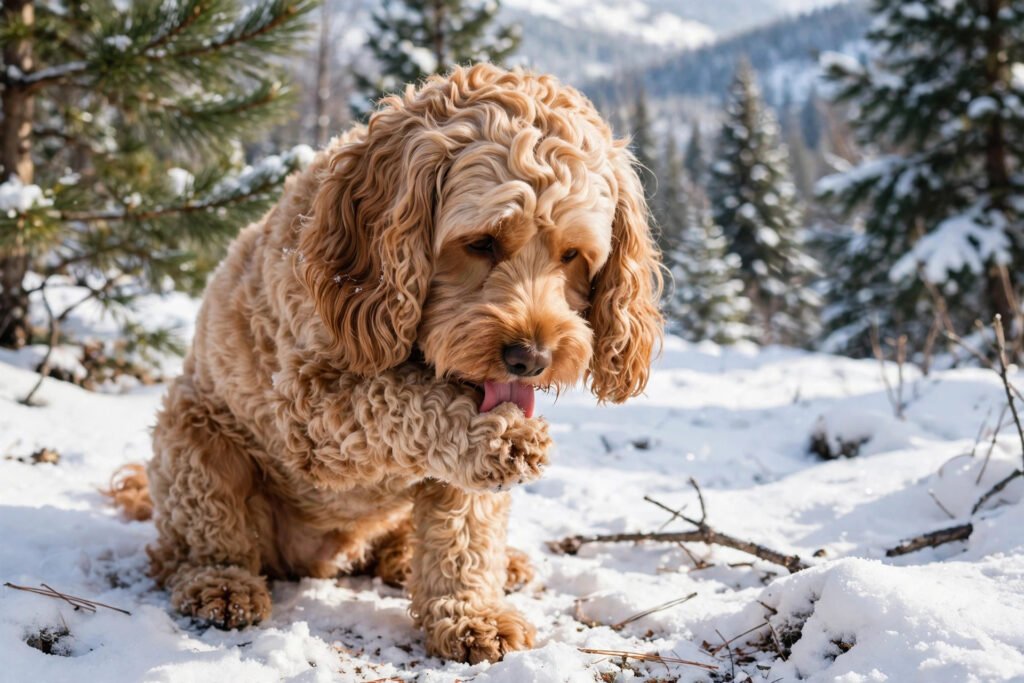
1. Environmental allergies — the #1 cause. Pollen, dust mites, and grasses trigger atopic dermatitis, and paws (which touch everything) show it first. Typically all four paws, seasonal or year-round, often paired with itchy ears — if your cockapoo also gets ear infections, suspect allergies driving both.
2. Yeast overgrowth — usually secondary to allergies. Allergic inflammation changes the skin environment; Malassezia yeast moves into the warm, moist spaces between the toes. Corn-chip smell + brown staining + all four feet = the classic picture.
3. Contact irritants — lawn chemicals, fertilizers, road salt and ice melt in winter, hot pavement in summer. Clue: worse right after walks, better on rest days.
4. Anxiety or boredom — licking releases endorphins; it’s self-soothing. Clue: front paws, happens when alone or under-stimulated, no smell or staining, often at night.
5. Injury or foreign body — thorn, grass seed between the toes, torn nail, cut pad, bee sting. Clue: one paw, sudden, sometimes limping.
6. Pain — arthritis in older dogs can present as licking the painful leg’s paw. Clue: senior dog, licking near a specific joint, stiffness.
The Yeast Question, Answered Properly
Yeast deserves its section — it’s the most common and most misunderstood cause:
- The smell test: “Frito feet” — that corn-chip odor — is yeast and bacteria metabolizing oils on the skin. No other cause smells like this.
- The staining: chronic licking deposits porphyrins (the same molecules behind tear stains), turning light fur rust-brown between the toes.
- The company it keeps: yeast paw-licking plus recurring ear infections plus itchy skin = the allergy-yeast trio. Treat the yeast, then chase the allergy behind it.
- The moisture trap: cockapoos grow dense fur between their paw pads, holding moisture against the skin — a yeast incubator. Keep that fur trimmed (more below).
Yeast is almost never the root cause — it’s the opportunist. Killing the yeast without addressing the allergy behind it buys weeks, not a cure.
The Allergy Workup: What Your Vet Will Actually Do
If the clues point to allergies, here’s the sequence to expect — no mysteries:
- Exam + rule-outs — injury, parasites, and foreign bodies eliminated first.
- Cytology — a tape or swab sample under the microscope confirms yeast vs bacteria and guides treatment.
- Treat the flare — antifungal/antibacterial topicals or short medications to calm the current episode.
- Find the trigger — food trial (8+ weeks on a novel protein, strictly — the “long, grueling” part) or environmental management, depending on the pattern.
- Long-term control — targeted options like Apoquel (daily) or Cytopoint (injection every 4–8 weeks, ~$150+ per shot) as bridges while the root cause is managed — not as the permanent answer on their own.
- Referral — a veterinary dermatologist for stubborn or complex cases. Worth it; skin is their whole specialty.
Knowing this path in advance turns an anxious vet visit into a project plan.
The Apple Cider Vinegar Debate, Settled
Two camps, both loud: “diluted ACV soaks cure yeast” vs “ACV is dangerous.” The synthesis:
- On intact skin: a diluted ACV rinse is a mild antifungal and generally fine — it can help as part of a routine.
- On broken, raw, or lick-damaged skin: never. It stings badly, disrupts pH on wounded tissue, and damages trust. If the paws are red, raw, or sore, ACV is off the table.
One paragraph, debate over. When in doubt, skip it and use the vet-approved route.
 CockapooDaily
The 48-Hour Home Protocol
Do this the moment licking crosses into excessive — while you observe the clues above:
Hour 0 — inspect. Check every paw: between the toes, pads, nails. Look for thorns, grass seeds, cuts, torn nails, swelling, redness. One-paw licking with something visible = remove carefully or vet if embedded.
Hour 0 — wash and dry. Rinse paws with a pet-safe cleanser (or plain lukewarm water), then dry thoroughly between the toes — moisture is the enemy. A paw washer by the door makes this a 30-second habit after every walk.
Hours 0–48 — interrupt the cycle. An E-collar or booties for short periods breaks the lick-itch-lick loop while skin calms. Redirect with a lick mat (peanut butter, xylitol-free) or snuffle mat — same oral fixation, no damage.
Trim the inter-pad fur. Cockapoo paw fur traps moisture between the toes. Carefully trim the excess with rounded-tip scissors for airflow. Small job, real difference.
Monitor 48 hours. Improving → continue the routine and watch for recurrence. Not improving, or any trigger below → vet.
Vet-Visit Triggers: Don’t Wait
- Bleeding, open sores, or pus
- Swelling of the paw or toes
- Limping or crying when the paw is touched
- Licking focused on one paw with no visible cause (possible deep foreign body)
- Strong odor with discharge
- Hair loss or thickened, elephant-like skin (chronic damage)
- No improvement after 48 hours of the home protocol
- Senior dog with new, persistent licking (pain workup needed)
⚠️ Lick Granuloma: Why Chronic Licking Can’t Wait
Nobody on page 1 mentions this, and it’s the most important consequence: chronic licking damages the skin it targets. The licked spot thickens into a raised, hairless sore — an acral lick granuloma — which itches and hurts, which triggers more licking. It’s a self-perpetuating cycle that’s far harder to break than the original itch. This is why “he’s always licked, it’s just his thing” is the most dangerous sentence in paw care. Early intervention prevents the granuloma; late intervention treats two problems.
When It Gets Worse: Timing Patterns
Night licking: usually just noticeability — quiet house, no distractions, so you finally see (and hear) it. But genuinely worse-at-night licking with no daytime signs leans behavioral: anxiety or habit. More daytime enrichment + a calming bedtime routine.
Seasonal flares: spring and fall pollen surges are the classic environmental-allergy pattern. Paw washing after every walk during pollen season, wiping down the coat, and keeping windows closed during high-pollen days all help. If it’s clockwork every fall, that’s diagnostic gold — tell your vet.
Winter: road salt and ice melt are chemical irritants. Booties or post-walk paw washing isn’t optional in salted areas — it’s the season’s whole prevention strategy. Also rinse: salt residue keeps irritating long after the walk.
Prevention Routine
- Paw wash + thorough toe-drying after every walk (pollen season and winter especially)
- Keep inter-pad fur trimmed for airflow
- Weekly paw check: pads, between toes, nails
- Manage the allergy behind recurrent episodes — not just the licking
- Enough exercise and mental stimulation (boredom lickers need jobs, not scolding)
- Booties for salt, chemicals, or extreme heat
This article is for information only and isn’t a substitute for veterinary advice. Persistent, worsening, or single-paw licking deserves a professional look — paws are small, but the causes range from trivial to serious.
Frequently Asked Questions
Why does my cockapoo lick its paws at night? Night licking usually means the itch or discomfort is worse when the house is quiet and there is nothing to distract them — allergies, a yeast infection between the toes, or anxiety that surfaces at bedtime. Check the paws for redness, smell, and staining first; if the licking is nightly and the paws look sore, book a vet check rather than trying another home remedy.
Why do my cockapoo’s paws smell like corn chips? That yeasty, corn-chip smell comes from yeast and bacteria growing in the warm, damp space between the toes — it is the classic sign of a yeast overgrowth, and it usually comes with red-brown staining on the fur. A yeasty smell that does not clear with a paw wash needs a vet visit: the vet checks for the organism and prescribes the right wash or drops.
Can boredom make my cockapoo lick its paws? Yes — a Cockapoo with nothing to do will lick its paws the way a bored child bites its nails. If the paws look healthy (no redness, no smell, no staining) and the licking starts when the house goes quiet, add mental work first: a lick mat, a snuffle mat, or a short training session. If the licking does not stop once the dog is busy, look for a medical cause.
Why does my dog lick his paws at night?
Usually because the quiet house makes it noticeable — but truly night-only licking leans toward anxiety or habit. Try more daytime enrichment and see if nights calm down.
What does it mean when my dog’s paws smell like corn chips?
Yeast (and bacterial) overgrowth — the “Frito feet” smell is microbial metabolism. Brown staining between the toes confirms it. Vet visit for proper treatment.
How do I know if paw licking is caused by yeast?
The triad: corn-chip smell + brown staining + all four paws (often with concurrent ear infections). Cytology at the vet confirms it definitively.
Is apple cider vinegar safe for paw licking?
On intact skin, a diluted rinse is generally fine. On raw, red, or broken skin — never. When in doubt, skip it.
Can a change in diet stop paw licking?
If food allergy is the driver, yes — but a proper elimination diet takes 8+ weeks of strict compliance. It’s a slow fix, not a quick one.
Should I use Apoquel or Cytopoint?
Both are legitimate vet-prescribed tools for allergic itch — best used as bridges while the underlying trigger is identified and managed, not as permanent solo solutions. Discuss with your vet.
Why is my dog licking just one paw?
Almost always local: thorn, grass seed, cut, torn nail, sting, or interdigital cyst. Inspect carefully; vet if you can’t find it or if limping develops.
The Bottom Line
Paws are diagnostic instruments — which paws, what smell, what staining, and when it happens will point you at the cause faster than any generic list. For cockapoos, think allergies first, yeast second, and always check the simple stuff (a thorn, winter salt) before assuming the complex. Run the 48-hour protocol, respect the vet triggers, and never let “it’s just his thing” become a lick granuloma.
Next: Allergies show up in the bowl too — see cockapoo food allergy symptoms.


Leave a Reply