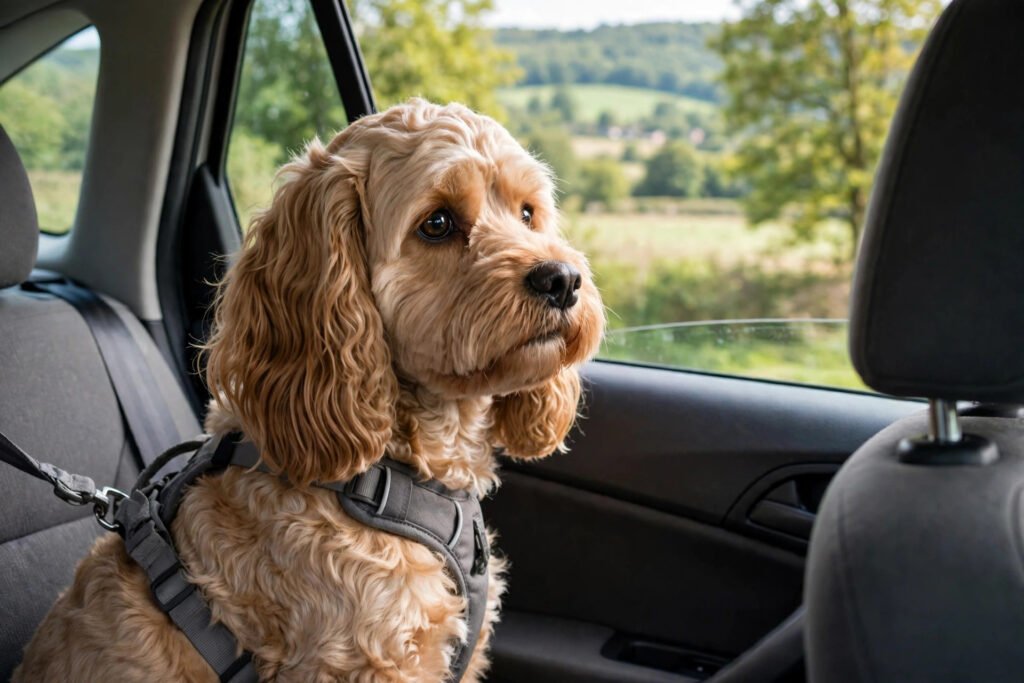
Many Cockapoos get car sick, especially puppies. Learn the signs, how motion sickness differs from anxiety, and the training and vet options that help.
Quick answer: Yes. Many Cockapoos get car sick, and puppies are worst affected — most outgrow it by 12 months. The signs are drooling, lip licking, restlessness and vomiting. Check whether it is motion sickness or anxiety — the fixes differ: short trips, fresh air and no food before travel help, and a vet can suggest medication if it keeps happening.
You buckle your Cockapoo in, pull out of the driveway, and within minutes the drooling starts. By the end of the street, your dog has thrown up. If that sounds familiar, you are not alone.
Cockapoos get car sick for the same reasons any dog does, and puppies get it worst of all. Most cases are fixable: some dogs need their stomachs settled, some need their fear unlearned, and many need a bit of both. The fix starts with working out which problem you have — motion sickness and car anxiety look the same from the driver’s seat and need different answers.
Why Cockapoos Get Car Sick
Motion sickness starts in the inner ear: the balance organs tell the brain the body is moving, while the eyes, looking at the still interior of the car, report that it is not. The brain gets two contradictory accounts and responds with nausea — the same mismatch that makes people seasick.
Puppies are hit hardest because those balance structures are still developing — a puppy can be sick on every ride and then, seemingly overnight, start coping. Most improve a lot by about 12 months, and many stop being sick. A small number keep the problem into adulthood and usually need a vet involved.
The second cause has nothing to do with the inner ear: anxiety. A Cockapoo that felt sick on its first few rides learns that the car means feeling awful. After that, fear alone can cause drooling, shaking and vomiting — even before the car moves. The two causes feed each other: sickness creates fear, and fear makes the next ride worse.
Cockapoos are not more prone to car sickness than other breeds — vets report all breeds seem equally susceptible — but this breed’s anxious streak makes the anxiety half very common. A Cockapoo that panics in the car is not being stubborn — it is scared, and it remembers.
Motion Sickness or Anxiety? How to Tell
This is the most useful question here — the fixes differ. Motion sickness is treated with training plus, sometimes, medication. Anxiety is treated with training alone, slowly — nausea medication will not fix it.
| Clue | Motion sickness | Anxiety |
|---|---|---|
| When signs start | Once the car is moving | Before it moves — in the driveway, at the sight of keys |
| What triggers it | Bends, bumps, stop-start traffic | The car itself, the engine sound, the driveway |
| Age pattern | Puppies and young dogs, improving with age | Any age; often a dog that was fine, then got worse |
| Between rides | Normal, happy dog | Avoids the car, hides, trembles |
| Response to medication | Medication stops the vomiting | Vomiting continues anyway |
Watch your dog for a week and note when drooling starts. If it begins the moment you open the car door, or when you pick up the keys, that is anxiety. If your Cockapoo hops in happily and only starts drooling five minutes down the road, that is motion sickness. Many dogs have both: the sickness came first, and the fear grew around it. Treat the nausea first, with your vet’s help, so training has a chance to work — a dog that feels sick every session cannot learn that cars are safe.
The Signs of Car Sickness
Vomiting is the last step, not the first. By the time your Cockapoo throws up, it has usually felt unwell for a while. Catch the early signs and you can pull over, open a window and end the trip before it gets worse.
Early signs: excessive drooling, repeated lip licking and swallowing, yawning that is not tiredness, and going oddly still. A dog that suddenly stops looking out the window and stares at the floor is often already nauseous.
Middle signs: whining, panting, pacing or circling, restlessness, and a hunched posture. Some dogs yawn over and over; some lick the seat or the air.
Late signs: retching, vomiting (sometimes on an empty stomach), then exhaustion — a dog that sleeps heavily for hours after a short ride was not just tired.
One real case shows how typical this is: on JustAnswer, an owner wrote about a 1-year-old Cockapoo adopted a week earlier: “every time she rides in the car, she starts drooling like a faucet and eventually throws up.” That is the textbook pattern — a young dog, drooling first, vomiting second, on every ride.
The Desensitisation Ladder
For anxiety — and for the fear that grows around motion sickness — the fix is gradual exposure paired with good things: desensitisation and counterconditioning. Vets and behaviourists recommend it, and it takes weeks, not days. Rushing it backfires: forcing a frightened dog to stay in the car until the fear “wears off” usually makes it worse.
Work through the steps in order, moving up only when your Cockapoo is relaxed — taking treats, loose body, no drooling. If a step causes drooling or fear, drop back one step for a few more days.
Step 1 — The parked car. Open the car door and let your Cockapoo sniff. Treat for approaching, then for paws on the seat, then for sitting inside with the doors open. No engine, no movement — a few minutes at a time.
Step 2 — Meals in the car. Feed a meal or a long-lasting chew in the parked car with the doors open — a few days of this changes the association faster than anything else.
Step 3 — Engine on, going nowhere. Sit in the car with your Cockapoo, start the engine, and just sit there treating calmly. Turn it off after a couple of minutes.
Step 4 — The end of the driveway. Drive to the end of the street and back, or around the block — under five minutes. End with a treat or a short walk somewhere pleasant.
Step 5 — Short trips to somewhere fun. Drive five to ten minutes to a park or a drive-through for a treat — the destination matters: if every trip ends at the vet, the car stays a bad place. Our traveling with a Cockapoo guide has more on making trips comfortable.
Step 6 — Build distance slowly. Add a few minutes at a time, always ending on a good note. If your dog is sick on a longer trip, go back to the last distance that worked.
For motion sickness rather than anxiety, the same ladder still helps: short, successful trips teach the inner ear to cope. One survey of 900-plus owners found travel problems in 6.3 percent of dogs habituated to car travel as puppies, against 24.1 percent of the rest.
 CockapooDaily
Practical Rules for Every Trip
No food just before travel. Feed your Cockapoo three to four hours before a trip, not right before it — a full stomach makes vomiting more likely. But do not fast the dog all day: some dogs bring up yellow bile on an empty stomach, and a long fast is unsafe for puppies.
Fresh air and a cool car. Crack a window for fresh air and keep the car cool — heat makes nausea worse. Facing forward rather than watching the world blur past sideways also helps. Do not let your Cockapoo hang its whole body out of the window, but a nose in the breeze is fine at low speed.
Stop often. On any trip over an hour, stop every hour or two for a short walk, water and a toilet break — the break resets stomach and stress at the same time.
Secure restraint, every ride. A loose dog in a car is a danger to itself and to you — and a sliding, tumbling dog feels sicker. Use a crash-tested car harness clipped to a seatbelt, or a secured crate your dog knows. Our guide to how to crate train a Cockapoo puppy covers getting a puppy comfortable in a crate before you ever use it in the car. The middle of the back seat, low down, moves less than a perch by the window.
Keep it calm. No loud music, no sudden braking if you can help it, no excited goodbyes before you leave. Keep a clean-up kit in the car too — towels, paper towels, a plastic bag and a spare blanket — so one sick trip does not turn into a stressful one for you.
Medication: What to Ask Your Vet About
If training and trip rules are not enough, medication can break the cycle — especially for motion sickness. Never dose a dog yourself from the human medicine cabinet; ask your vet about these options:
Dimenhydrinate (Dramamine). An over-the-counter antihistamine vets sometimes recommend for motion sickness in dogs. It can cause drowsiness, and some human formulations contain ingredients toxic to dogs — use it only on your vet’s direct instruction, with the formulation they approve.
Maropitant (Cerenia). A prescription anti-nausea drug, and the only medication approved specifically for preventing vomiting due to motion sickness in dogs — vets consider it the most reliable option for dogs that vomit on every ride. Your vet works out the dose and timing — do not use leftover tablets from a stomach upset, because the travel dose is different.
A vet may also suggest anti-anxiety medication when fear, not nausea, is the main problem. It works best paired with the ladder, not instead of it.
Two warnings: test any medication on a short trip first. Second, if your Cockapoo still vomits on a drug that reliably prevents motion sickness, the cause is probably not motion — tell your vet. If vomiting happens outside the car too, read our guide to Cockapoo vomiting and upset stomach first.
Will My Cockapoo Outgrow It?
Probably, if your dog is still a puppy. Most puppies outgrow motion sickness by about 12 months as the inner ear matures, and the odds are better if you keep doing short, positive trips through that first year instead of avoiding the car — avoiding the car avoids the sickness, but it also avoids the learning.
Adolescence can bring a wobble: a Cockapoo that coped fine at eight months may go backwards at ten or twelve months, as hormones and a rewiring brain make everything feel new and scary again. That is normal for the Cockapoo teenage phase — go back a step on the ladder. Our guide to when Cockapoos calm down covers the age-by-age pattern.
If your Cockapoo is over a year old and still vomiting on every ride despite training and the trip rules, involve your vet. Some adult dogs keep motion sickness for life and do fine on medication for travel days — that is a workable life, not a failure.
When to Call the Vet
Most car sickness is a training problem, but call your vet promptly if: vomiting happens outside the car as well as in it; your dog is lethargic, off its food, or has diarrhea too; there is blood in the vomit; your puppy is under four months old and cannot keep water down; or the drooling and vomiting started suddenly in an adult that used to travel fine. Sudden change in an adult is worth checking — ear infections can look like car sickness.
What Not to Do
Do not fast your puppy all day before a trip. A long fast risks a blood-sugar crash in puppies and toy breeds — a few hours without food is enough.
Do not use human travel-sickness pills on your own say-so. Doses for people are not doses for dogs, and some formulations contain decongestants or sweeteners dangerous to dogs. Only what your vet approves.
Do not force it. Holding a panicking dog in a moving car until it “gets used to it” teaches the dog that cars are inescapable — the opposite of training.
Do not stop traveling altogether. It is tempting to leave the dog home, and sometimes that is right for a long trip. But a dog that never rides never learns to ride — short, fun trips are the treatment, so keep doing them.
Frequently asked questions
Do Cockapoos get car sick?
Yes, many do — especially puppies. Motion sickness comes from the inner ear, and young dogs are worst affected because their balance structures are still developing. Most outgrow it by about 12 months. Some cases are anxiety, and the two need different fixes.
Why does my Cockapoo drool in the car?
Drooling is the earliest sign of nausea, and it often starts well before vomiting. It can also be a fear response: a dog that drools the moment it sees the car is usually anxious, while one that starts drooling a few minutes into the drive is usually motion sick.
How can I stop my Cockapoo being sick in the car?
Feed three to four hours before travel, keep the car cool with fresh air, stop every hour or two, and secure your dog. Then work through the desensitisation ladder: parked car, engine on, around the block, then short trips to somewhere fun. If vomiting keeps happening, ask your vet.
What medication helps a Cockapoo with car sickness?
Ask your vet about dimenhydrinate (Dramamine) or maropitant (Cerenia) — maropitant is the only drug approved specifically for preventing vomiting due to motion sickness in dogs. Never give human medication without your vet’s instruction, and never guess a dose.
At what age do Cockapoos stop getting car sick?
Most puppies improve a lot by about 12 months as their inner ears mature. A few dogs keep the problem into adulthood — those usually do well with medication on travel days plus this training.
Conclusion
Yes, Cockapoos get car sick — most often as puppies, because the inner ear is still developing, and sometimes because a few bad rides taught them fear. Work out which problem you have: drooling before the car moves points to anxiety, drooling once you are driving points to motion sickness. Then use the ladder — parked car, engine on, around the block, short trips to somewhere fun — with fresh air, a light stomach and a secure harness. Most puppies outgrow it by about 12 months. If yours does not, ask your vet about dimenhydrinate or maropitant. A Cockapoo that loves the car is a few patient weeks away.
Leave a Reply