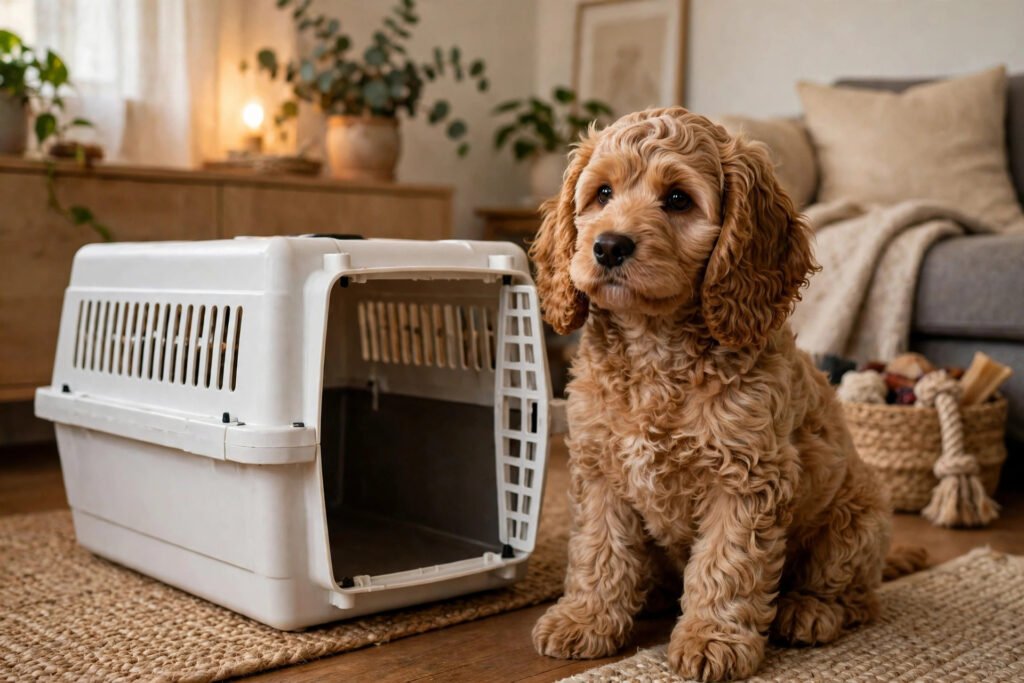
Crate train your cockapoo puppy the calm way: the right crate size by variety, a day-by-day first-week plan, the night protocol, and the whining rules that work.
Quick answer: Yes — crate training suits cockapoos well, and most puppies accept the crate within 1–2 weeks when it’s built in minutes, not hours. The rules that matter: right size (snug, with a divider), door open for the first days, meals inside, never as punishment, and pre-emptive toilet breaks at night so you never have to choose between sleep and reinforcing crying.
A cockapoo puppy is a small, people-obsessed shadow with a tiny bladder. The crate solves both problems at once — it gives the puppy a den of its own (the first step toward independence for a velcro breed) and it makes potty training dramatically faster, because puppies instinctively avoid soiling where they sleep. Done badly, though, a crate becomes a crying box that teaches the puppy the house is stressful. The difference is entirely in the pacing — and pacing is what this plan is.
Why a Crate Suits Cockapoos Specifically
- Independence training. Cockapoos are prone to separation anxiety precisely because they never want to be away from you. A crate the puppy chooses to rest in is daily practice at being content alone — the cheapest anxiety prevention there is.
- Potty training acceleration. The crate turns the potty schedule from hourly vigilance into a rhythm: out of crate → straight outside → praise. Most crate-trained puppies have far fewer accidents.
- Safety. An unsupervised cockapoo puppy will chew cables, shoes, and skirting boards, roughly in that order of expense. The crate is the safe place for the moments you genuinely can’t watch.
- Life admin. Vet stays, groomers, travel, and recovery from spaying/neutering all involve crates. A puppy that already loves one finds all of that boring instead of terrifying.
Choosing the Crate: Size by Variety
The rule: big enough to stand up, turn around, and lie down stretched — no bigger. Extra space invites a sleep-at-one-end, toilet-at-the-other layout that defeats the whole purpose. Buy the adult size and shrink it with a divider while the puppy grows.
| Cockapoo variety | Adult weight | Adult crate size | Notes |
|---|---|---|---|
| Toy | Up to ~12 lbs | 24″ | Divider essential — puppies start tiny in this crate |
| Miniature | 13–18 lbs | 24–30″ | 30″ if your puppy’s parents were at the big end |
| Standard | 19–30+ lbs | 30–36″ | Measure the parents, not the puppy, if unsure |
Type: a wire crate with a divider and two doors is the practical default — ventilated, foldable, and the divider is included. Plastic airline crates feel more den-like and suit nervous puppies and car travel. Soft-sided crates are for already-trained dogs — a determined puppy chews through one in an afternoon. Skip the furniture-style crate until training is done.
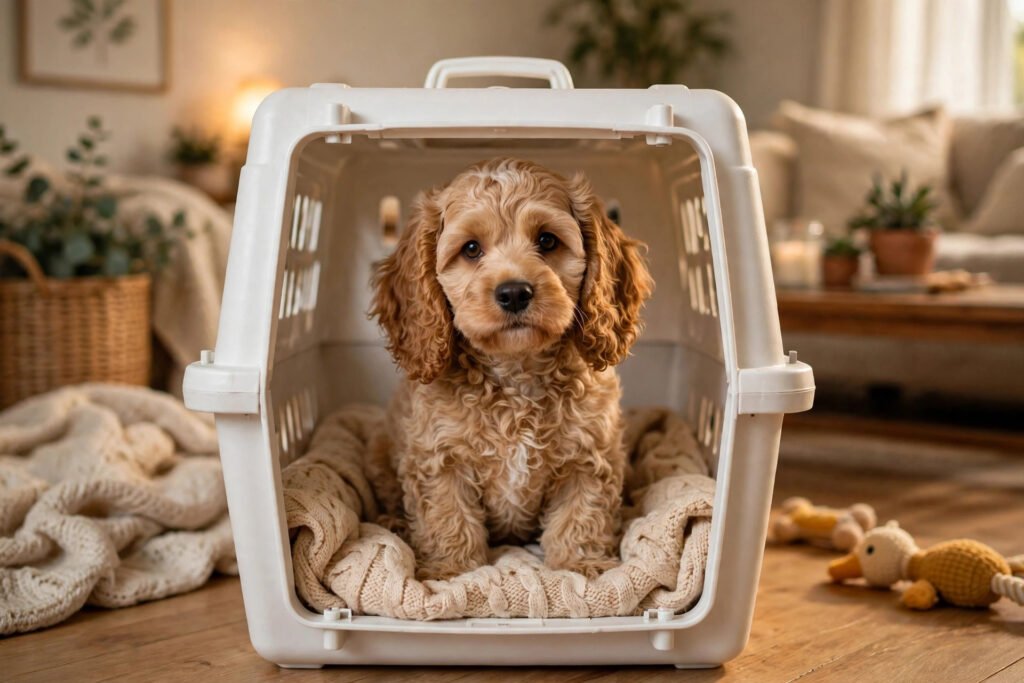
Set it up like a bedroom, not a cage: washable bedding, one safe chew, positioned in the family living area by day (the puppy should feel included, not exiled). A blanket draped over the top and sides makes it den-like — leave the front open for airflow.
 CockapooDaily
The Day-by-Day First-Week Plan
The one rule under all of this: the puppy should never be pushed to a step it’s distressed by. Calm curiosity → next step. Crying and scrabbling → you went one step too fast; drop back a step, it costs you a day at most.
| Day | What you do | Goal by day’s end |
|---|---|---|
| Day 1 | Crate assembled in the living room, door tied open. Toss high-value treats inside throughout the day. Say nothing, force nothing | Puppy walks in on its own to check for treats |
| Day 2 | Treat games continue. Feed breakfast near the crate, lunch at the entrance | Puppy enters confidently, lingers inside |
| Day 3 | All meals inside, bowl at the back, door still open. Puppy may eat and leave — fine | Puppy goes in at mealtimes expecting food |
| Day 4 | Meals inside — and while the puppy is eating, close the door. Open it before the puppy finishes | Door closed for the length of a meal, zero fuss |
| Day 5 | Short closed sessions outside meals: a stuffed Kong inside, door closed 2–5 minutes, you sitting beside the crate reading | Puppy settles with a chew while the door is shut |
| Day 6 | Build to 10–15 minutes. Start leaving the room for a minute at a time mid-session | Puppy stays calm when you step out briefly |
| Day 7 | First real nap in the crate, door closed, you nearby. Try a 20–30 minute session while you do chores | A full nap cycle completed in the crate |
Week 2: extend sessions toward an hour, mix in being out of sight most of the time, and start using the cue — a cheerful “kennel” or “crate” as the puppy goes in for a treat — so the word predicts good things. Week 3: short real absences (5–20 minutes out of the house), low-key exits and returns, exactly as in the separation anxiety ladder.
A typical day once the plan is running: morning toilet trip straight from the crate, meals in the crate, two or three crate naps matched to the puppy’s natural sleep crashes, and play/training outside it. Puppies sleep 18–20 hours a day — the crate simply gives that sleep an address.
 CockapooDaily
The Night Protocol (the Part That Decides Everything)
Nights are where crate training is won or lost, and where generic guides go quiet. Do it this way:
- Week 1–2, the crate sleeps in your bedroom. Not forever — for now. A puppy that can hear and smell you settles in minutes; the same puppy alone in a kitchen can cry for hours and learn that nighttime is when the panic happens. Move the crate out gradually in week 3+ if you want it elsewhere.
- Last toilet trip last thing. Out at ~10–11pm, boring and business-only, then straight into the crate with a small treat.
- Pre-empt the 2am cry. Puppies under ~12 weeks can’t hold it all night. Set a quiet alarm for roughly 3–4 hours after bedtime (adjust to your puppy): toilet trip in silence — out, wee, back in, no play, no fuss, minimal light. You’re teaching “night trips are boring,” not “night is cancelled.”
- Shrink the gap. As the puppy grows, stretch the alarm by 15–30 minutes every few nights. Most cockapoo puppies sleep through by 14–16 weeks; smaller Toys often take a little longer.
- Never let a crying puppy “win” a play session — but never ignore a puppy that needs the toilet. The distinction is timing: if the alarm is near or the puppy has been quiet for hours and starts up, it’s the toilet. If the puppy went out 20 minutes ago and is protesting the general concept of bedtime, wait for a pause in the crying — even 3 seconds of quiet — then let it out calmly if you must, so quiet is what opened the door.
The Whining Rules
Whining is communication, and the crate works when you answer the right messages:
| Cry pattern | Likely meaning | Response |
|---|---|---|
| Starts the moment the door closes, escalates when you look | “Let me out, this is new” | Wait for any quiet gap, then release between cries — or drop back one step in the plan tomorrow |
| After 2+ hours of sleep, sudden onset | Toilet | Out immediately, silently, boring trip, straight back in |
| Rhythmic, panicky, with drooling or scrabbling at the door | Genuine distress | Let the puppy out and slow the plan down — this is panic, not protest, and it isn’t trained through |
| Only when you leave the room | Normal stage-6 wobble | Shorten absences, rebuild in smaller increments |
What never works: shouting through the door, banging the crate, or “cry it out” for hours with a young puppy. A puppy that cries itself to sleep hasn’t learned calm — it has learned the crate is where crying happens until exhaustion. The wait-for-quiet rule handles protest; the plan’s pacing prevents panic.
Crate training at a glance
- Size: stand, turn, stretch — no bigger; buy the adult size with a divider
- Acceptance: most puppies accept the crate within 1–2 weeks on the day-by-day plan
- Nights: crate in your bedroom for weeks 1–2; pre-empt the 2am cry with a quiet toilet trip
- Max stretch: ~1 hour at 8–10 weeks, up to 4 hours at 4–6 months, never as punishment
- Sleeping through: most cockapoos by 14–16 weeks; smaller Toys take a little longer
How Long Is Too Long? Maximum Crate Times by Age
| Age | Max single stretch (awake schedule) | Night stretch |
|---|---|---|
| 8–10 weeks | ~1 hour | 3–4 hours, then a toilet trip |
| 10–12 weeks | 1–2 hours | 4–5 hours |
| 3–4 months | 2–3 hours | 5–6 hours |
| 4–6 months | 3–4 hours | Usually through the night |
| 6+ months | 4 hours, 5 at a push | Through the night |
Working a full day away from home with a young puppy? The answer is not a longer crate stretch — it’s a playpen setup (crate with the door open inside a pen, water, and a toilet area away from the bed) or a midday walker. A puppy forced to soil its crate unlearns the den instinct the whole system depends on.
The 6 Mistakes That Ruin Crate Training
- Using the crate as punishment. One “bad dog, in your crate” can undo a week. The crate must stay the best address in the house.
- Skipping the open-door days. Shutting a new puppy in on day one is the flooding version — protest or panic, both rehearsed nightly.
- Too-big crate, no divider. The puppy toilets in the far corner and sleeps happily — and your potty training goes backwards.
- Releasing mid-cry. If screaming opens doors, you’ll be trained beautifully within a week. Wait for the quiet gap, every time.
- Crate marathons. Hours beyond the age table teach a puppy that the crate is its life, not its bedroom — expect hyperactivity the second it’s out.
- Treating the crate as an anxiety cure. A crate contains an anxious dog’s damage, not its anxiety. If your puppy panics when left — drooling, escape attempts, destruction aimed at the door — the crate is the wrong tool until the calm-alone training has done its work; a panicking dog can injure itself on crate bars.
If Your Puppy Hates the Crate Anyway
A small minority of puppies — often rescues or puppies with early confinement experiences — never relax in a crate despite correct pacing. That’s not failure, yours or theirs. Swap to the pen setup above, or a puppy-proofed room with a baby gate, and use the same graduated alone-time training. The goal was never the crate itself; it’s a dog that rests calmly when you can’t supervise. Any safe setup that achieves it counts.
Frequently Asked Questions
How long can a cockapoo puppy stay in the crate during the day? The rough rule is one hour per month of age, up to about 3–4 hours for a puppy under six months — a puppy that young cannot hold its bladder longer, and an accident in the crate is a scheduling failure, not a training failure. Overnight is different: a settled puppy sleeps longer because its body slows down.
What should I put inside the crate? A soft blanket or bed, one safe chew or toy, and nothing else. Water goes outside the crate during the day (a bowl inside gets spilled and soaks the bedding); at night the crate is for sleeping, and the last drink goes down about two hours before bed.
When can I stop using the crate? When the dog is reliably house-trained and can be left alone without chewing or panicking — usually somewhere between 12 and 18 months for a Cockapoo. Stop gradually: first the door open while you are home, then short absences with the door open, and only then put the crate away. Some adult Cockapoos keep using it as a den for life.
Should I cover the crate at night? A light cover over the top and sides helps many puppies settle — it makes the crate feel like a den and cuts out visual distractions. Leave the front partly open for airflow and so the puppy can see out; if the puppy pulls the cover in or pants, take it off and try again another night.
My puppy only cries in the crate when I leave the room — what do I do? That is usually separation distress, not a crate problem: the puppy is fine in the crate while you are there and panics when you leave. Go back to shorter absences — seconds, not minutes — and build up the time you are out of sight separately from the crate work; if the panic is severe (drooling, escape attempts, destruction aimed at the door), the crate is the wrong tool until the anxiety is treated.
How long does crate training a cockapoo take?
Basic acceptance — going in willingly, settling, napping — takes 1–2 weeks on the day-by-day plan for most puppies. Sleeping through the night typically lands at 14–16 weeks of age. Full ease with longer absences builds across weeks 3–6.
What size crate does a cockapoo need?
Match the adult variety: 24″ for Toys, 24–30″ for Miniatures, 30–36″ for Standards — with a divider to shrink it to puppy size (stand, turn, stretch, no more). When in doubt, size by the parents’ weights.
Should the crate be in the bedroom at night?
For the first 1–2 weeks, yes — a puppy that can sense you settles far faster and cries far less. Move it out gradually afterward if you prefer. Plenty of cockapoos happily keep a bedroom crate for life; there’s no rule that they must graduate to another room.
Is crate training cruel?
No — a properly introduced crate is a den, and dogs are denning animals; most crate-trained cockapoos choose it for naps with the door open. It becomes cruel only through misuse: punishment, marathon hours, or containing a panicking dog. The age table and the whining rules exist to keep you on the right side of that line.
My puppy cries in the crate at night — what do I do?
First ask the timing question: hours of quiet then crying usually means toilet — go, silently. Crying from minute one is protest — wait for a quiet pause before any release, and make tomorrow’s daytime steps smaller. Crying with drooling or door-scrabbling is distress — let the puppy out, sleep it near you, and slow the whole plan down a step.
The Bottom Line
Crate training a cockapoo is a pacing exercise dressed as a training exercise: door open before door closed, minutes before hours, a boring 2am toilet trip instead of a 2am surrender. Follow the week, respect the whining rules, and keep the crate the best address in the house — and you’ll get the two things every cockapoo owner wants: faster potty training, and a puppy learning that being alone is safe. That second one pays off for the dog’s whole life.
Next: The crate is step one of alone-time confidence — the full picture is in cockapoo separation anxiety: signs & the calm-alone plan.



Leave a Reply