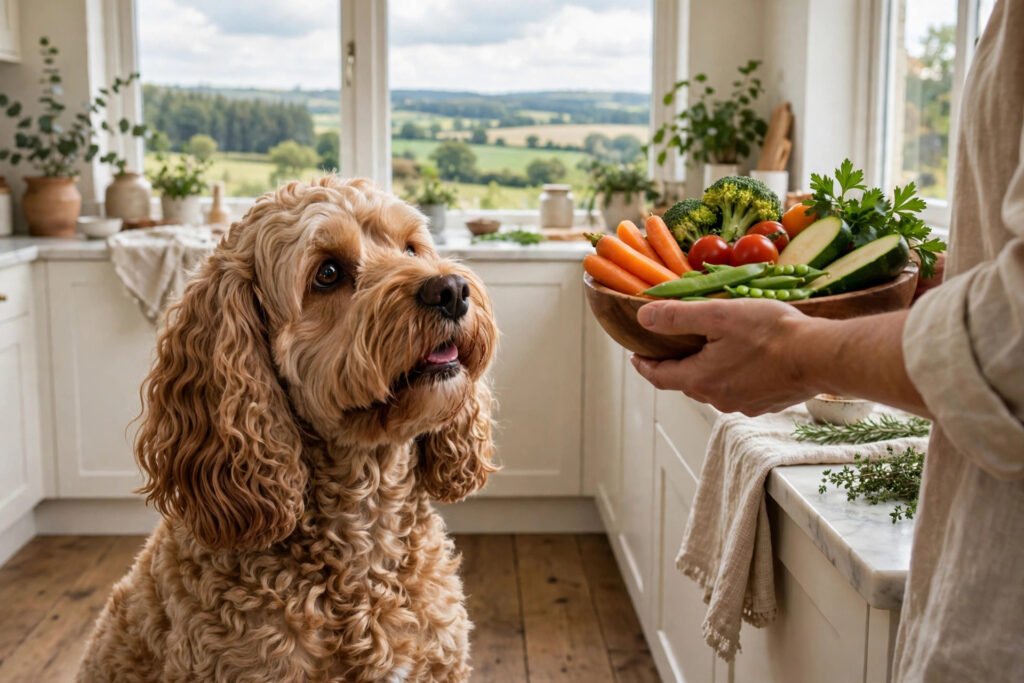
What human foods can cockapoos eat? The traffic-light guide: safe foods with serving sizes, moderation foods with limits, toxic foods with the science, and the emergency protocol.
Quick answer: Many human foods are safe for cockapoos — plain cooked chicken, turkey, eggs, most fruits and vegetables — as long as they’re unseasoned, boneless, and kept under 10% of daily calories. Toxic: chocolate, grapes/raisins, xylitol, onions/garlic, macadamia nuts, alcohol, and cooked bones. When in doubt, check the lists below — and the red list first.
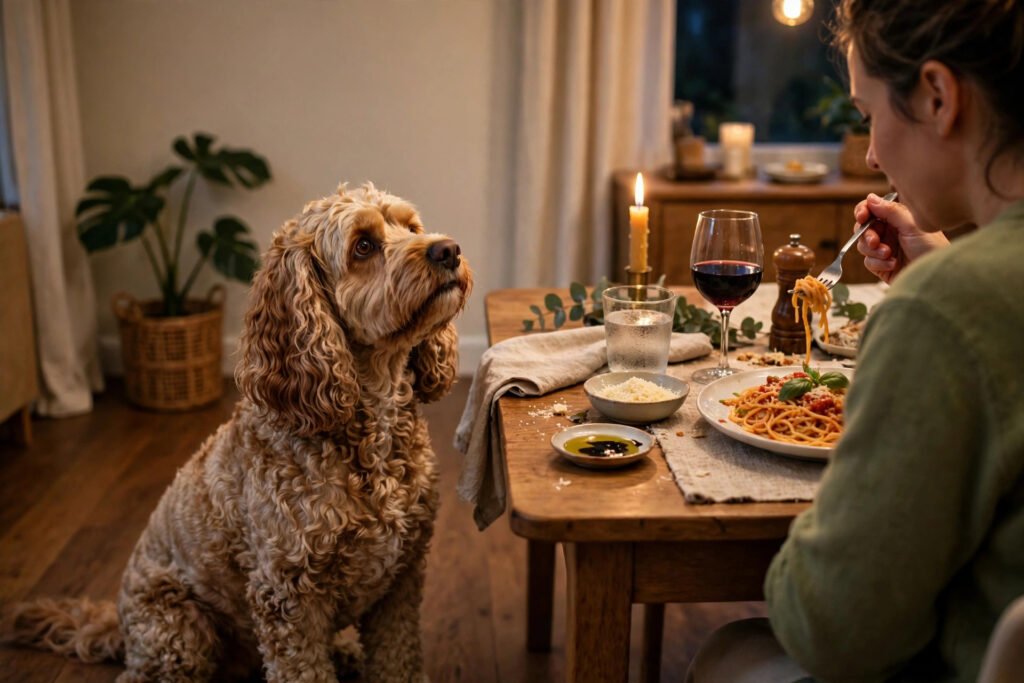
Those eyes at the dinner table are hard to resist. The good news: plenty of human food is genuinely fine for your cockapoo. The bad news: a few common foods can kill. This guide gives you all three tiers — safe, moderation, toxic — with serving sizes, the science behind the danger list, and exactly what to do if your dog eats something it shouldn’t.
How to Use This Guide: The Traffic Light
- 🟢 Green — safe as regular treats, with the serving sizes given
- 🟡 Yellow — safe in moderation, with concrete limits (this is where most mistakes happen)
- 🔴 Red — toxic. Never. The why is included so you remember.
Everything below assumes: plain preparation (no salt, butter, sauces, seasoning), appropriate size pieces, and the 10% rule (human food + treats stay under 10% of daily calories).
 CockapooDaily
🟢 Green: Safe Foods
Lean proteins (fully cooked, boneless, skinless, unseasoned):
| Food | Serving for a cockapoo | Notes |
|---|---|---|
| Chicken breast | 1–2 tablespoons, diced | The classic safe treat |
| Turkey (plain) | 1–2 tablespoons, diced | No skin, no bones, no seasoning |
| Eggs (boiled/scrambled plain) | Half to one egg | Excellent protein; no butter or salt |
| Salmon (cooked) | 1 tablespoon | Omega-3s for skin/coat — never raw (salmon poisoning risk) |
| Lean beef | 1 tablespoon, trimmed | Watch fat content |
| White fish (cod, tilapia) | 1 tablespoon, boneless | Fully cooked, no batter |
Fruits (washed, seeds/pits/cores removed):
| Food | Serving | Notes |
|---|---|---|
| Blueberries | 3–5 berries | Antioxidant powerhouse, perfect training treat |
| Strawberries | 1, hulled and halved | |
| Apple slices | 2–3 thin slices | No seeds or core (seeds contain cyanide compounds) |
| Watermelon | 2–3 small cubes | No seeds or rind |
| Banana | 2–3 thin slices | Higher sugar — small amounts |
| Pineapple | 1–2 small chunks | Fresh, not syrup-packed |
| Pear | 2 thin slices | No seeds or core |
Vegetables (plain, cooked fork-tender or raw as noted):
| Food | Serving | Notes |
|---|---|---|
| Green beans | Small handful | Low calorie, fiber-rich — great diet treat |
| Carrots | 2–3 baby carrots or sticks | Crunchy teeth-cleaner |
| Sweet potato | 1–2 tablespoons, cooked | No marshmallows, no pie filling |
| Pumpkin (plain canned) | 1 tablespoon | NOT pie filling — plain only; great for digestion |
| Cucumber | 3–4 slices | Hydrating, near-zero calories |
| Zucchini | 2–3 slices | |
| Peas | 1 tablespoon | |
| Broccoli | 1–2 small florets | Large amounts cause gas |
Grains & dairy:
| Food | Serving | Notes |
|---|---|---|
| Plain white rice | 1–2 tablespoons, fully cooked | Good for upset stomachs |
| Oatmeal | 1 tablespoon, plain cooked | No sugar, no flavoring |
| Plain yogurt | 1 tablespoon | Live cultures; unsweetened, xylitol-free |
| Cottage cheese | 1 tablespoon | Low-fat preferred |
🟡 Yellow: Moderation Foods (With Limits)
Safe — but only within these boundaries:
- Peanut butter: 1 teaspoon max — and check the label for xylitol (also listed as birch sugar). Xylitol is lethal; some “natural” and sugar-free brands contain it. When in doubt, skip.
- Cheese: thumbnail-sized piece, occasionally. Most dogs are somewhat lactose intolerant — expect gas or soft stools if overdone. Low-fat mozzarella or cottage cheese are gentlest. Never blue cheese (may contain onion/garlic flavoring).
- Banana: already in the green list, but the sugar adds up — a few slices, not a whole banana.
- Plain popcorn: small handful, air-popped, no butter/salt. Unpopped kernels are a choking hazard.
- Bread: a small piece of plain bread is fine; nutritionally empty, so don’t make it a habit.
- Turkey/chicken skin: technically edible, practically a pancreatitis invitation — trim it off (see the warning box below).
- Pork: plain cooked pork in small amounts is fine; fatty cuts are not.
 CockapooDaily
🔴 Red: Toxic Foods (Never — and Why)
| Food | Why it kills/harms |
|---|---|
| Chocolate | Theobromine + caffeine — dogs can’t metabolize them. Dark and baking chocolate are worst. Symptoms: vomiting, diarrhea, rapid breathing, seizures. |
| Grapes & raisins | Acute kidney failure. No safe amount exists — sensitivity varies wildly between dogs. |
| Xylitol (sugar-free gum, candy, some peanut butters, baked goods) | Triggers massive insulin release → blood sugar crash within 30 minutes, then liver failure. One of the fastest killers on this list. |
| Onions & garlic (all forms — raw, cooked, powder) | Damages red blood cells → anemia. Powder is concentrated; “a little in the sauce” counts. Damage accumulates over repeated small doses. |
| Macadamia nuts | Weakness, tremors, vomiting within 12 hours. Mechanism still not fully understood — which is reason enough. |
| Alcohol | Same effects as in humans, at a fraction of the dose. Never. |
| Avocado | Persin — vomiting and diarrhea; the pit is also a choking/blockage hazard. |
| Cooked bones | Cooking makes bones brittle — they splinter into sharp shards that puncture the esophagus, stomach, or intestines. (Raw bones are a separate debate; cooked are unanimously dangerous.) |
| Yeast dough | Expands in the warm stomach (bloat risk) and produces alcohol as it ferments. |
| Caffeine/coffee | Same stimulant toxicity as chocolate. |
Never on the menu
- Grapes & raisins — can cause kidney failure, even in small amounts
- Chocolate — the darker it is, the more dangerous it gets
- Xylitol (birch sugar) — hides in sugar-free gum and some peanut butters — check every label
- Onions & garlic — damage red blood cells, fresh or powdered
- Macadamia nuts & cooked bones — toxic nuts, and bones that splinter — never worth the risk
The Calorie Math (Why Portions Matter for This Breed)
Cockapoos run 12–25 lbs, and the Cocker Spaniel half brings legendary food motivation — this breed will happily eat far more than it should. The numbers make it concrete:
- A 15-lb cockapoo needs roughly 400–500 calories/day
- The 10% treat budget = 40–50 calories
- One slice of cheese ≈ 110 calories — that’s two days of treat budget in one begging success
- One tablespoon of peanut butter ≈ 95 calories — same story
- Five blueberries ≈ 4 calories — this is why blueberries are the perfect training treat
Small dog, small budget. Every human-food treat spends from the same tiny account.
The 10% Rule
90% of daily calories from complete, balanced dog food. 10% max from treats and human food combined. This isn’t about being strict — it’s about nutrition. Dog food is formulated; human food isn’t. A cockapoo raised on table scraps gets an unbalanced diet no matter how “healthy” the scraps are. Human food is a supplement and a joy, never the foundation.
Prep Rules (Non-Negotiable)
- Plain. No salt, butter, oil, sauces, garlic, onion — nothing. Cook it like hospital food.
- Fully cooked (proteins). No raw meat, no raw salmon, no raw eggs.
- Boneless. All bones removed — and cooked bones never, per the red list.
- Small, soft pieces. Chunks are choking hazards for a small breed; dice or mash.
- Seeds, pits, cores, rinds out. Apple seeds, cherry pits, watermelon rind — all removed.
- New food? Thumbnail first. One tiny taste, then watch 24–48 hours before it becomes a regular treat.
One New Food at a Time: The Introduction Protocol
Don’t debut three new foods in one week — if something disagrees, you’ll never know which:
- Pick one new food.
- Offer a thumbnail-sized amount.
- Watch 24–48 hours for: itching, ear redness, vomiting, diarrhea, gas, lethargy.
- Clear? It joins the rotation. Reaction? That food is out — and note it in case a pattern emerges (see cockapoo food allergies symptoms).
⚠️ Pancreatitis: The Holiday Warning
Fatty table scraps — turkey skin, bacon grease, gravy, buttery sides — can trigger pancreatitis: a painful, potentially fatal inflammation of the pancreas. Small breeds are at higher risk, and it spikes every Thanksgiving and Christmas when well-meaning relatives share the feast. Symptoms: repeated vomiting, hunched back, belly pain, lethargy, refusing food — emergency vet visit. The rule that prevents it: no fatty scraps, ever, no matter how much the dog (or your uncle) insists.
Emergency: “My Dog Ate X” — What to Do
| Ate | Do this |
|---|---|
| Chocolate | Call your vet immediately with: the type (dark/milk), estimated amount, and your dog’s weight. Don’t wait for symptoms. |
| Grapes/raisins | Vet immediately — always. No safe amount, no watch-and-wait. Time matters enormously. |
| Xylitol | Emergency vet NOW. Blood sugar can crash within 30 minutes. Bring the packaging. |
| Onion/garlic | Call your vet — they’ll calculate the dose vs. your dog’s weight. A tiny taste may just need monitoring; a meal needs treatment. |
| Macadamia nuts | Call your vet; monitor for weakness/tremors over 12 hours. |
| Cooked bones | Don’t induce vomiting (shards going up are worse). Call your vet; monitor for choking, drooling, belly pain, bloody stool. |
| Alcohol | Vet immediately. |
| One chocolate chip / one bite of cheese | Monitor calmly. Note the time, watch for symptoms over 24 hours, call the vet if anything develops. |
US poison control: ASPCA Animal Poison Control (888) 426-4435 — 24/7, expert toxicologists, a consultation fee applies but it’s the definitive answer at 2 AM. Save it in your phone now.
Do NOT induce vomiting unless your vet or poison control tells you to. Wrong method or wrong substance makes things worse.
The Single-Grape Question
“My dog ate ONE grape — is it an emergency?” The honest answer: yes, call. Grape toxicity is wildly idiosyncratic — some dogs eat a bunch with no effect, others go into kidney failure from a few. There is no known safe dose and no way to know your dog’s sensitivity without the experiment you never want to run. One call, one vet visit, versus kidney failure. Always call.
Holiday Danger Foods (The Seasonal Watch List)
- Christmas: chocolate (everywhere), macadamia nuts, alcohol, rich fatty foods
- Easter: chocolate, xylitol candy
- Summer BBQs: corn cobs (blockage hazard), fatty scraps, alcohol, onion-heavy sides
The pattern: holidays concentrate every red-list item in one house with distracted humans. Brief the guests — “please don’t feed the dog” said with a smile, once, at the door.
Thanksgiving: what goes on your Cockapoo’s plate
Yes: a little plain turkey breast — skinless, boneless, unseasoned, 1–2 tablespoons diced. Plain green beans, plain sweet potato and plain pumpkin from the table are fine too, in the same small amounts as the green list above.
No: turkey skin, cooked turkey bones, gravy, stuffing (onion/garlic), cranberry sauce with xylitol, chocolate desserts, and any dish cooked with onion or garlic. Brief the guests at the door — “please don’t feed the dog” — because the fatty scraps are what send small breeds to the emergency vet every Thanksgiving (see the pancreatitis warning above).
Frequently Asked Questions
Can cockapoos eat cheese? Yes, in small amounts — plain cheese is safe for most Cockapoos, but it is high in fat and some dogs are lactose-intolerant, so a large piece can bring on diarrhoea or a pancreatitis flare in a sensitive dog. Use pea-sized pieces as training treats, not as a meal, and skip it entirely if your dog has a known dairy sensitivity.
Can cockapoos eat peanut butter? Yes — plain peanut butter with no xylitol (birch sugar) is safe, and it is one of the best lick-mat fillers. Check the label every time: xylitol is the danger, and it hides in “sugar-free” and some “natural” peanut butters. One teaspoon is plenty for a Cockapoo.
Can cockapoos eat turkey at Thanksgiving?
Yes — plain turkey breast only: skinless, boneless, unseasoned, 1–2 tablespoons diced, inside the 10% treat budget. No turkey skin, no cooked bones, no gravy, no stuffing, and no onion- or garlic-heavy dishes — the fat in skin and gravy can trigger pancreatitis. If your cockapoo gets into the fatty scraps, watch for repeated vomiting, a hunched back, belly pain or lethargy, and call the vet — do not wait it out.
What’s the best food to feed a cockapoo?
A high-quality complete dog food as the 90% base (see how much should I feed my cockapoo). Human foods are treats and toppers, not the diet.
Can cockapoos eat scrambled eggs?
Yes — plain, no butter, salt, or milk. Half to one egg is a great protein treat.
Can cockapoos eat rice?
Yes — plain white or brown rice, fully cooked. A tablespoon or two; useful for settling upset stomachs.
Can cockapoos eat peanut butter?
Yes, only if xylitol-free — check the label every time (it’s also called birch sugar). One teaspoon max; it’s calorie-dense.
Can cockapoos eat cheese?
Small amounts occasionally. Most dogs are somewhat lactose intolerant, so expect gas if overdone. Never blue cheese.
What fruits can cockapoos not eat?
Grapes and raisins (kidney failure), avocado (persin), cherry pits, and excess citrus. Everything else on the green list is fair game.
How do I know if my cockapoo is allergic to a food?
Itchy skin, recurring ear infections, or GI upset appearing after introduction — use the one-food-at-a-time protocol above, and see cockapoo food allergies symptoms for the full workup.
The Bottom Line
The traffic light is the whole article: green foods freely (within the 10% budget), yellow foods with their limits respected, red foods never — with the why memorized so the rule sticks. Respect the calorie math for a small, food-motivated breed, save the poison-control number, and brief the holiday guests. Those dinner-table eyes get their blueberries — and everybody stays safe.


Leave a Reply