
Most Cockapoos have dark nails, so you cannot see the quick. Learn the safe dark-nail method, clipper vs Dremel trade-offs, and a fear-free routine.
Quick answer: Trim your Cockapoo’s nails every 3 to 4 weeks, cutting 1 to 2 millimeters at a time. On dark nails, stop when the cut surface turns smooth with a dark gray or pinkish center dot — that dot means you are near the quick. A Dremel grinds more gradually than clippers, but clippers are faster and quieter.
If you have been putting off nail trims because your Cockapoo’s nails are black and you are afraid of cutting the quick, you are not alone — and you are right to be careful. The good news is that dark nails are not harder once you know what to look for. You do not need to see the quick to avoid it. You need a method that stops before it, a tool you can control, and a dog that is calm enough to let you work.
This guide covers all three: the dark-nail method step by step, an honest comparison of clippers and a Dremel, a desensitization ladder for fearful dogs, and the details competitors usually skip — dewclaws, overgrown nails, and how walking surface changes frequency.
Why Nail Trims Matter More Than They Look
Long nails change how a dog walks. Instead of the paw sitting flat, long nails push the toes up and back, shifting weight onto the heels and straining the joints over time. Very long nails can also snag, split, or break painfully, and they click loudly on hard floors — which is usually the sign owners notice first.
The click test is a useful rule of thumb: if you can hear your Cockapoo’s nails clicking on a hard floor during a normal walk across the room, they are overdue. Nails should be short enough that they barely touch the ground when your dog is standing.
There is a second reason to trim regularly rather than waiting: the quick grows with the nail. If you let nails get very long, the quick extends too, and you cannot cut the nail short in one session without hitting it. Regular small trims make the quick recede gradually, so the nail can get shorter over time. That is why consistency beats heroic one-off sessions.
Before You Start: Tools and Setup
You do not need an expensive kit. You need the right tool, a way to stop bleeding if you nick the quick, and good light.
- Scissor-style clippers sized for a small to medium dog (the most common choice for Cockapoos; guillotine-style clippers also work but are harder to control on thick nails).
- A rotary grinder (Dremel-style tool) with a fine-grit sanding band, if you choose the grinding route — see the comparison below.
- Styptic powder or a styptic pencil — keep it within arm’s reach before you start, not in another room. Plain cornstarch works as a backup.
- High-value treats cut small, so you can reward often without overfeeding.
- Good lighting, ideally daylight or a bright lamp, plus a flashlight for backlighting dark nails if needed.
- A non-slip surface and a calm moment — after a walk or play session, when your dog is settled, not wound up.
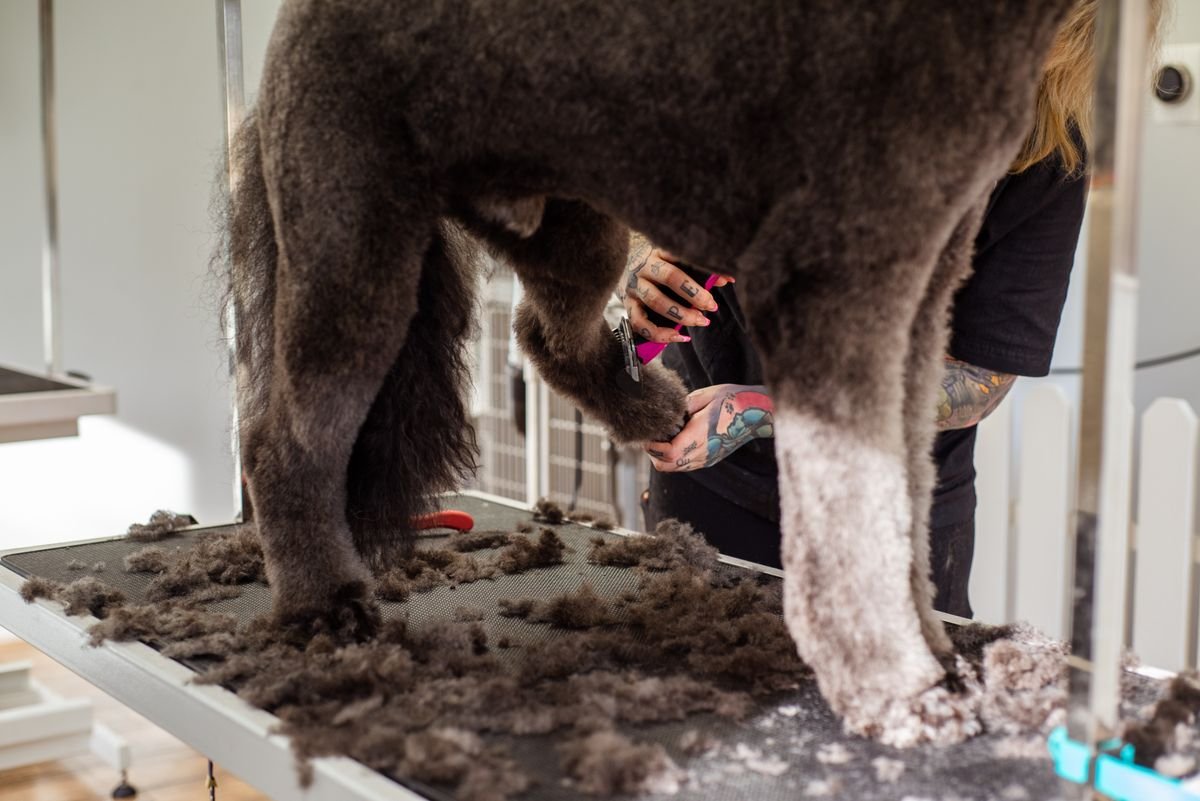
Hold the paw gently but firmly, and press the pad slightly so the nail extends. Work on one paw at a time, and reward after each nail at first — speed comes later, calm comes first.
The Dark-Nail Method: How to Trim Without Seeing the Quick
Most Cockapoos have dark nails, and on dark nails the quick is invisible from the outside. Competitor guides that say “look for the pink quick” are describing light nails, and that advice is useless — or dangerous — for dark-nailed dogs. Here is the method that actually works.
Step 1: Cut tiny slices, not chunks
Cut just 1 to 2 millimeters at a time from the tip. After each cut, look at the freshly cut surface before cutting again. This is the whole method: small cuts, check, repeat. Never try to take a long nail down to final length in one cut.
Step 2: Read the cut surface
The cut surface tells you how close you are:
- Dry, crumbly, and light-colored inside: you are still in safe, dead nail. You can take another small slice.
- Smooth, solid, and slightly darker, with a gray or pinkish dot appearing in the center: you are approaching the quick. Stop on this nail.
- A moist, shiny, or dark center spot: you are very close to the quick. Stop immediately.
That center dot is the key signal for dark nails. You do not need to see through the nail — you read each fresh cut like a progress report.
Step 3: Check the underside too
On dark nails, the underside gives a second clue. Look at the groove under the nail: the quick typically ends where that groove flattens out. If you are unsure, a flashlight held behind the nail can sometimes reveal the shadow of the quick inside. This backlighting trick does not work on every nail, but when it does, it is a useful confirmation — never your only check.
Step 4: Round the edges
After cutting, file or lightly grind the sharp edges so the nail does not snag on fabric or scratch your skin. A few gentle strokes with a nail file are enough if you used clippers. This step also gives you a final chance to notice if any nail is shorter than the rest or looks uneven.
Work through all four paws, including the dewclaws (see below). If your dog gets restless, stop after a paw or two and finish the rest tomorrow. A half-finished trim done calmly is far better than a complete trim done in a struggle — and your dog will remember the difference next time.
 CockapooDaily
Clippers vs Dremel: An Honest Comparison
There is no single best tool. There is a best tool for your dog and your confidence level, and the trade-offs are real on both sides.
| Clippers | Dremel / grinder | |
|---|---|---|
| Speed | Fast — one snip per nail | Slower — several seconds per nail |
| Control near the quick | Lower — one cut removes a chunk | Higher — material comes off gradually, ideal for dark nails |
| Finish | Can leave sharp or split edges; needs filing | Smooth, rounded finish with no filing step |
| Noise and vibration | Silent, no vibration | Noisy with vibration; some dogs hate it |
| Risk if the dog jerks | Higher — a jerk mid-snip can cut too far | Lower — a jerk usually just means a shorter grind |
| Best for | Calm dogs, confident owners, quick maintenance trims | Nervous owners, dark nails, dogs that tolerate noise, smoothing after clipping |
Many experienced owners use a hybrid: clip the bulk of the length safely with clippers, then finish with a few seconds of grinding to smooth the edge and approach the final length gradually. That combination gives you the speed of clippers and the precision of a grinder where it matters most — near the quick.
If you choose a grinder, use a low speed at first, work in bursts of 5 to 10 seconds per nail so the nail does not overheat, and keep long coat hair away from the spinning band — Cockapoo leg feathering tangles easily. Introduce the sound and vibration over several days before you ever grind a nail (see the ladder below).
If you choose clippers, make sure they are sharp. Dull clippers crush rather than cut, which hurts and can split the nail. Replace them when cuts start to feel effortful rather than clean.
The Fear-Free Desensitization Ladder
If your Cockapoo pulls away, trembles, lip-licks, or shows the whites of their eyes when you touch their paws, do not push through it. Fear learned at nail time lasts, and every forced session makes the next one harder. This ladder builds cooperation over days, not minutes. Move to the next rung only when your dog is relaxed at the current one.
- Touch and treat. Touch a paw briefly, treat, release. Repeat until your dog offers the paw willingly. Keep sessions to a few minutes.
- Hold and treat. Hold the paw for a few seconds, touch individual toes, treat, release. Gradually extend the hold time.
- Tool introduction, no cutting. Let your dog sniff the clippers or grinder while it is off, treat. Turn the grinder on nearby (not touching), treat. Touch the tool to a nail without cutting or grinding, treat.
- One nail, then stop. Trim or grind a single nail, give a jackpot of treats, and end the session on that success.
- Build up slowly. Add one or two nails per session over the following days until you can do a full paw, then all four paws in one calm session.
Use high-value treats your dog does not get at other times, and keep your own body language relaxed — dogs read tension. If you hit a rung where your dog freezes or struggles, drop back one rung for a day rather than forcing progress. For dogs with deep-seated fear, or for owners who are anxious themselves, a groomer or vet can do the first few trims while you work the ladder at home — there is no shame in that, and it protects the trust you are building.
Don’t Forget the Dewclaws
Dewclaws are the small nails on the inner side of each leg, higher up than the other toes. Most Cockapoos have them on the front legs, and some have them on the back legs too. Because dewclaws never touch the ground, they never wear down naturally — which means they are the nails most likely to overgrow, curl into the pad, or snag and tear.
Check dewclaws at every trim, and trim them with the same dark-nail method: tiny slices, reading the cut surface. They are easy to miss precisely because they sit out of sight, so make them the first nails you check, not an afterthought. A dewclaw that has curled into the pad needs veterinary attention — do not try to cut a fully embedded nail at home.
How Often? Frequency by Walking Surface
The standard advice — every 3 to 4 weeks — is a starting point, not a rule. How fast nails wear depends heavily on what your dog walks on.
| Walking surface | Typical trim interval | Why |
|---|---|---|
| Mostly pavement and sidewalks | Every 4 to 6 weeks | Hard surfaces file nails naturally with every walk |
| Mixed pavement and grass | Every 3 to 4 weeks | Moderate natural wear; the standard interval for most owners |
| Mostly grass, carpet, and indoors | Every 2 to 3 weeks | Almost no natural wear, so nails grow unchecked |
| Senior or less active dogs | Every 2 to 3 weeks | Less movement means less wear, and older nails can be brittle |
Puppies and young dogs may need more frequent checks because their nails grow quickly and they are still learning to accept handling — but trim less per session while they learn. Overgrown nails need a different plan: trim a tiny amount every few days, letting the quick recede between sessions, rather than trying to fix months of growth in one sitting. If a nail is split, broken, bleeding heavily, or curled into the pad, see your vet or groomer instead of handling it at home.
Season matters too. Dogs that walk less in winter, or that spend more time indoors during hot summers, will need trims more often during those periods. The click test above is your best guide: check weekly, trim when you hear clicking, and you will rarely go wrong.
If You Nick the Quick
It happens to almost every owner sooner or later, and it is not a disaster — but how you react matters, because your dog will remember it.
- Stay calm. Your dog takes cues from you; panicking makes the next trim harder.
- Press styptic powder firmly onto the nail tip for 30 to 60 seconds. If you do not have styptic powder, press plain cornstarch on the same way.
- If bleeding has not slowed after 5 minutes of pressure, call your vet.
- Give treats and reassurance, keep activity gentle for a few hours, and do not try to finish the remaining nails in the same session.
Then, before your next trim, ask what went wrong: did you cut too much at once, skip reading the cut surface, or work when your dog was already stressed? Fix that one thing. One nick handled calmly rarely causes lasting fear; repeated rushed sessions do.
When to Let a Professional Do It
Home trimming is a great skill, but it is not mandatory. Hand the job to a groomer or vet if your dog is extremely fearful despite the ladder, if nails are severely overgrown or deformed, if a nail is broken or infected, or if you simply do not feel confident — an anxious owner with dull clippers is a worse combination than a calm professional. Professional nail trims are also a sensible add-on to a grooming appointment; if cost is part of that decision, see our breakdown of Cockapoo grooming cost.
Between professional visits, you can still practice paw handling and the early ladder rungs at home, so your dog gets easier to handle over time rather than harder. And since nail day often pairs naturally with bath day, check how often bathing actually helps versus dries the coat in our guide to how often you should bathe a Cockapoo. For the rest of the haircut — face, body, and coat shaping around those freshly trimmed paws — see Cockapoo haircut styles.
Frequently Asked Questions
How often should I trim my Cockapoo’s nails?
Every 3 to 4 weeks for most dogs, but walking surface changes this: pavement walkers may go 4 to 6 weeks, while dogs mostly on grass or indoors often need trims every 2 to 3 weeks. Use the click test — if nails click on hard floors, they are overdue.
How do I cut black Cockapoo nails without cutting the quick?
Cut 1 to 2 millimeters at a time and read each fresh cut surface. Stop when the surface turns smooth with a dark gray or pinkish dot in the center — that dot means you are near the quick. Never try to take a long nail down in one cut.
Is a Dremel or clippers better for Cockapoos?
A Dremel gives more control on dark nails and a smoother finish, but it is noisy and slower. Clippers are faster and silent but remove a chunk per cut, so they demand more care near the quick. Many owners clip the bulk, then grind to finish — the best of both.
What should I do if I cut the quick?
Stay calm, press styptic powder or cornstarch onto the nail tip for 30 to 60 seconds, and keep activity gentle for a few hours. If bleeding has not slowed after 5 minutes, call your vet. Do not try to finish the remaining nails in the same session.
Do Cockapoo dewclaws need trimming?
Yes — and they need it most. Dewclaws never touch the ground, so they never wear down naturally and can curl into the pad if ignored. Check and trim them at every session, using the same small-slice dark-nail method.
Conclusion
Trimming Cockapoo nails at home is a learnable skill, not a talent — and dark nails are not the obstacle they first appear to be. Cut tiny slices, read each cut surface for the center dot that signals the quick, and stop there. Choose clippers for speed, a Dremel for gradual control, or both in combination, and build calm with the desensitization ladder if your dog is fearful. Check the dewclaws every time, adjust frequency to your walking surface, and keep styptic powder within reach just in case.
Done regularly and calmly, a nail trim takes a few minutes and becomes just another part of the grooming routine — not the dreaded event it was the first time.


Leave a Reply