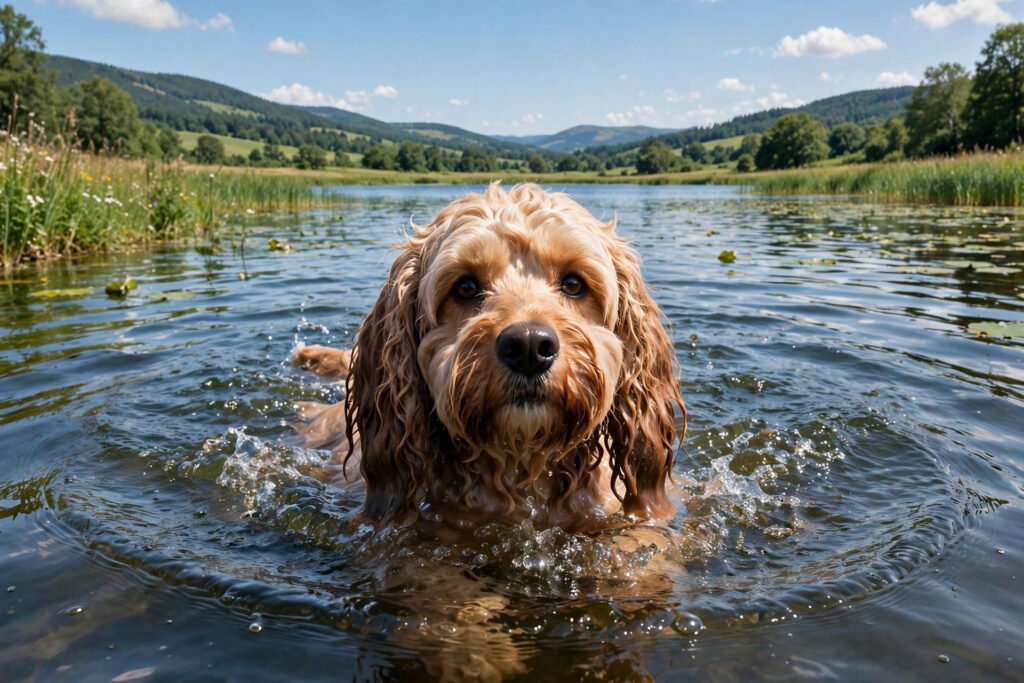
Can cockapoos swim? Most can and many love it — both parent breeds worked in water. But the heavy wet coat, ear infections, algae and pool exits matter. Full guide.
Quick answer: Yes — most cockapoos can swim, and many genuinely love water: the Poodle was bred as a water retriever and the Cocker Spaniel as a flushing gun dog. But “can swim” is not “is safe unsupervised.” A cockapoo’s dense coat gets heavy when wet, their ears trap water and infect easily, and no dog — however water-bred — should ever be in water without a taught exit and a watching human.
Of all the questions cockapoo owners ask in summer, this is the one with the most misleading standard answer. “They’re natural swimmers!” is true the way “they’re natural hunters” is true — the heritage is real, the individual variation is huge, and the safety details decide whether water becomes your dog’s favorite thing or its worst day. Here’s the full picture.
Why the Heritage Says Yes
- The Poodle wasn’t a lapdog that got lucky — it was a working water retriever, developed to fetch shot ducks from cold European lakes. The name comes from the German pudeln, “to splash,” and even the famous pom-pom clip was originally functional: shaved for streamlining, with hair left over the joints and chest for warmth. Webbed feet and a water-resistant, single coat came standard.
- The Cocker Spaniel worked mostly on land, flushing game from dense cover — but its work regularly involved marsh, ditches, and retrieves at the water’s edge, and spaniels generally take to water willingly.
Put together, most cockapoos have both the build and the inclination: a compact, athletic body, more-than-adequate buoyancy, and a breed-typical enthusiasm for joining whatever you’re doing — especially if it involves splashing.
 CockapooDaily
The Three Cockapoo-Specific Catches
1. The coat works against them. That famous low-shedding coat is dense and absorbent. A long, full cockapoo coat soaks up water like a sponge, adding real weight and drag — a dog that swims happily for five minutes can be a tired, low-riding swimmer by minute fifteen. Practical rule: dogs that swim often should wear a shorter cut in swim season, and all swimmers need watching for the moment enthusiasm outlasts stamina. Small Toys tire and chill fastest of all.
2. The ears trap the water. Floppy spaniel ears over hairy poodle ear canals are this breed’s #1 water problem. Water that goes in during a swim doesn’t drain — it sits in a warm, dark canal, which is precisely what yeast and bacteria order for dinner. Post-swim ear care (below) is not optional garnish for cockapoos; it’s the difference between a swimming dog and a recurring ear infection patient.
3. Instinct is a paddle reflex, not a safety certificate. Most dogs, held over water, will paddle. That reflex is not efficient swimming, and some individuals — anxious dogs, heavy-coated dogs, dogs with short muzzles or joint issues — paddle vertically, splash frantically, tire in minutes, and panic. “He’ll figure it out” is how accidents happen. The first swims should be taught, not discovered.
Teaching a Cockapoo to Swim: The Shallow-First Ladder
- Start with a paddling pool or shoreline shallows. Let the dog walk in and out at will, chase a floating toy in ankle-deep water, get gloriously wet on its own terms. Goal of session one: water = playground, zero pressure.
- Go deeper together. Wade in yourself — cockapoos follow their person almost anywhere — and let the dog venture to belly, then chest depth, always able to turn back to the shallows.
- Support the first real swims. In swimming depth, support under the belly for the first attempts so the dog finds its level, horizontal paddling position. Keep the first true swims to a few meters, ending back at the shallows it knows.
- Teach the exit before anything else. In a pool, this is the whole game: dogs cannot climb ladders. Guide the dog to the steps or ramp, over and over, until “swim → exit” is its own habit. A dog that knows the exit can be calm; a dog that can’t is a dog clawing at walls.
- Add a life jacket for deep water, boats, and learners. Look for a top handle (for lifting), a snug fit that doesn’t twist, and bright color. Even strong swimmers wear one on boats — a knocked-out or panicked dog doesn’t swim at all.
- Keep sessions short and end on joy. Ten to twenty minutes of swimming is a serious workout for a small dog. Finish while the dog still wants more.
Never throw a dog into water, drag it in by the collar, or let children “teach” it unsupervised. One frightening first experience can install a water phobia that takes a season to undo.
The Real Risk List (What the Reassuring Articles Skip)
| Risk | Where | What to do |
|---|---|---|
| Blue-green algae (cyanobacteria) | Lakes/ponds, summer blooms — looks like green paint or pea soup | Potentially fatal and fast; no antidote. If water looks scummy or a local advisory is posted, the swim is cancelled — no exceptions |
| Water intoxication | Anywhere a dog obsessively fetches from water | Swallowed water dilutes blood sodium: wobbling, vomiting, glazed eyes, seizures. Limit continuous fetch games, force rest breaks, see a vet at the first signs |
| Pool entrapment | Backyard pools | If the dog can’t find the steps, it will swim until exhausted against a wall. Teach the exit, fence or cover the pool, never leave access unsupervised |
| Salt water | Ocean | Discourage drinking it (vomiting, diarrhea, and in quantity, salt poisoning); watch currents — a 15-lb dog has no vote in a rip current |
| Cold water | Spring lakes, cold seas, late season | Small dogs lose heat fast; shivering = out, dry, warm. (Winter rules are in our cold-weather guide.) |
| Chlorine & chemicals | Pools | Safe at normal pool levels for play, but rinse the coat afterward and don’t let the dog drink pool water as its water bowl |
 CockapooDaily
The 10-minute post-swim routine
- Rinse — chlorine, salt and lake residue come out now, not at the next bath
- Dry the ears with a vet-approved drying solution — the true cockapoo step
- Brush through while damp — a wet curly coat mats as it dries
- Fresh water and rest — swimming dogs are thirstier and tireder than they look
After Every Swim: The 10-Minute Routine
- Rinse with clean water — chlorine, salt, and lake residue all come out of the coat now, not at the next bath.
- Dry the ears properly. This is the cockapoo step. Use a vet-approved ear-drying solution after every swim (it acidifies and dries the canal), and gently dry the outer ear. Full prevention routine in the ear infections guide.
- Towel and brush before the coat sets. A wet curly coat left to air-dry in tangles will mat as it dries. A quick brush-through while damp saves a de-matting session later.
- Fresh drinking water and a rest. Swimming dogs are thirstier and more tired than they look.
Swimming as Exercise: the Bonus Chapter
Swimming is the cockapoo’s best low-impact workout — roughly comparable to running for energy burn (a few minutes of swimming works a small dog like a much longer trot), with zero joint impact. That makes it the exercise of choice for three groups: dogs recovering from patella or joint issues (with your vet’s go-ahead), seniors whose joints dislike pavement, and overweight dogs who need calorie burn their knees can forgive. It counts fully toward the daily totals in our exercise guide — just respect the tiring-faster rule and build duration over weeks, not days.
Frequently Asked Questions
Can cockapoos swim in cold water? They can, but they should not swim in very cold water: small dogs lose heat fast, and prolonged cold exposure can lead to hypothermia. Swim only in water you would swim in yourself, keep the session short, and dry and warm them immediately afterwards.
Do cockapoos have webbed feet? Some do — the webbed feet come from the Poodle parent, and some Cockapoos inherit them while others do not. Webbed feet help, but a Cockapoo without them swims just fine; it is not something to check for before letting them in the water.
What should I do if my cockapoo is scared of water? Never force them in — being thrown into water can create a lasting fear. Let them approach at their own pace: shallow edges first, treats and praise for every step in, and short sessions. Many Cockapoos that are shy on the first visit learn to love swimming with a bit of training and time.
Can cockapoos swim in a chlorinated pool? Yes, in a clean pool with supervision — but do not let them drink the pool water (chlorine upsets their stomach) and rinse them with fresh water afterwards. Chlorine dries the coat and can irritate the skin and ears, so the post-swim rinse in the article’s 10-minute routine matters even more after a pool.
How do I dry my cockapoo’s ears after swimming? Gently dry the outer ear with a towel or cotton ball, then use a vet-approved ear-drying solution (it acidifies and dries the canal) and let the dog shake the rest out. Never put a cotton bud inside the ear canal. Wet ears left damp are the single biggest reason a swim turns into an ear infection.
Do all cockapoos like water?
No. Most take to it, many adore it — and a genuine minority never enjoy more than a paddle, usually because of a scary early experience or simple temperament. A cockapoo that prefers the shoreline is not broken; forcing the issue creates the phobia you’re trying to avoid.
At what age can a cockapoo puppy start swimming?
Paddling in a home paddling pool or bathtub can start young, in tiny supervised sessions. Natural bodies of water and public dog-swim areas should wait until the vaccine series is complete (around 16 weeks) and your vet is happy — young puppies chill fast and their immune systems are unfinished.
Can cockapoos swim in the sea?
Yes, with rules: calm conditions only, watch for currents, keep sessions short, discourage drinking the water, and rinse the salt out afterward. A life jacket is smart at the beach for small dogs — wave action surprises even confident swimmers.
Why does my cockapoo go crazy after swimming (zoomies)?
Completely normal — a mix of relief, exhilaration, and the physical urge to dry off and warm up. Let them zoom in a safe area, then do the rinse-dry-ears routine. A dog that instead goes quiet, shivers hard, or seems wobbly needs warmth, rest, and — if it doesn’t bounce back quickly — a vet call.
Do cockapoos need a life jacket if they can swim?
For boats, deep or moving water, long swims, senior dogs, and learners: yes. Swimming ability assumes a conscious, calm dog with energy left. A life jacket covers the cases where that assumption fails — and the handle makes hauling a wet, wriggly 18-lb dog back aboard actually possible.
The Bottom Line
Can cockapoos swim? Most can, many love it, and the water-retriever blood is real. But a responsible owner hears the full sentence: most can swim if taught gradually, given an exit they know, protected from algae and exhaustion, dried at the ears, and never left to it alone. Meet those conditions and swimming becomes one of the best things you’ll ever share with this breed — exercise, cooling, and pure joy in the same ten minutes.
Next: Swimming is one piece of the activity picture — how much exercise do cockapoos need covers the full daily picture by age.



Leave a Reply