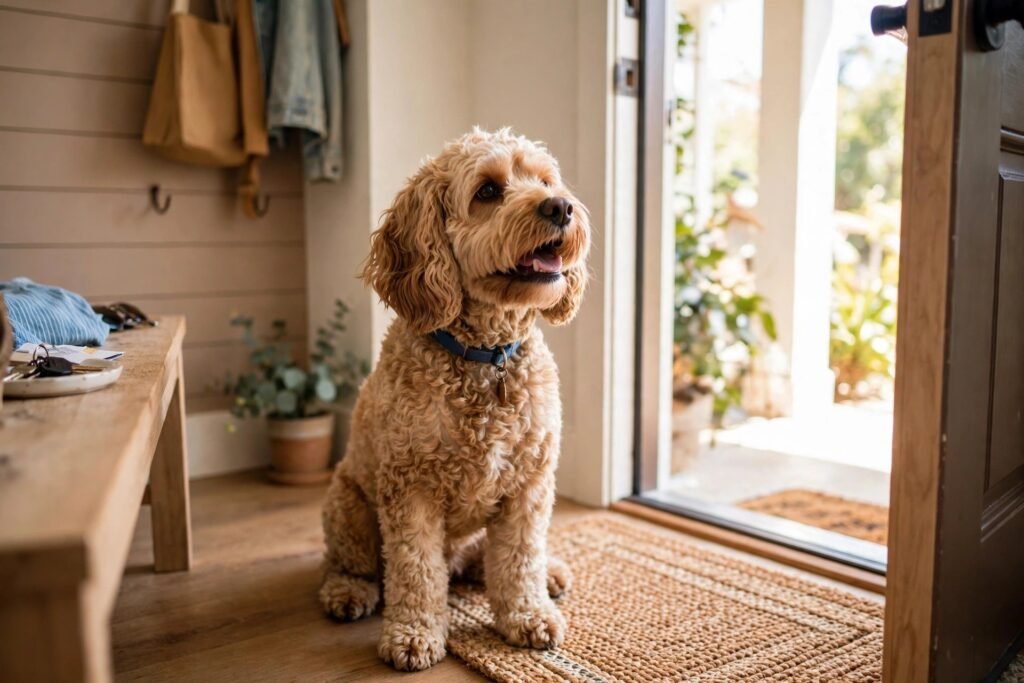
Cockapoo jumping up at every greeting? Teach the four-paws rule with a calm greeting protocol for visitors, children, and walks — plus what not to do.
Quick answer: Stop rewarding the jump and reward the alternative instead. When your Cockapoo jumps, turn away calmly — no eye contact, no talking, no touching. The instant all four paws hit the floor, give attention, praise, or a treat. Teach sit-to-greet as the default and keep everyone consistent; most families see clear improvement within a few weeks.
Your Cockapoo is not being naughty. Jumping up is how a friendly, people-focused dog says hello — it puts their face where yours is, and it has worked for them every single time someone laughed, petted them, or talked to them mid-jump. That is the whole problem in one sentence: jumping has always paid off. The fix is not punishment. It is changing the pay-off so that four paws on the floor earns everything jumping used to earn, and jumping earns nothing at all.
Why Cockapoos Jump Up in the First Place
Jumping is a greeting behavior, not a dominance behavior. Cockapoos are social, excitable dogs bred from two people-oriented parent breeds, and most jump for one of three reasons: excitement at seeing someone, attention-seeking (any reaction counts, including scolding), or frustration at not being able to reach someone. Puppies jump because it works and nobody has taught them otherwise yet. Adolescents jump more because excitement peaks before self-control catches up — if your Cockapoo’s jumping got worse around 8 to 14 months, that is normal development, not a training failure.
Understanding the reason matters because it tells you what to replace. A dog jumping for attention needs attention withheld, then given for calm behavior. A dog jumping from overexcitement needs calmer greetings and lower-arousal practice first. A dog jumping on walks at joggers or strangers needs distance management and focus work before any greeting practice. All three versions use the same core rule below — only the setup changes.
The Core Rule: Four Paws on the Floor Earns Everything
This is the one rule every person in the house must follow, with no exceptions:
- Jumping earns nothing. Turn away calmly the moment paws leave the floor. No eye contact, no talking, no pushing, no knee. Be boring. You are a statue.
- Four paws on the floor earns everything. Within a second or two of all four paws landing, give calm attention, a treat, or a toy — whatever your dog was jumping for. Speed matters: the reward must land while the paws are still down.
- Repeat every single time. If jumping works even once in ten greetings, your Cockapoo will keep gambling. Consistency is the training; the turn-away is just the mechanism.
Teach a default behavior to fill the gap jumping leaves behind. “Sit” is the easiest: ask for a sit before any greeting, and reward the sit, not the jump. Some owners prefer a “four paws” cue — say “floor paws” or “off” only when all four feet are already down, so the word becomes associated with the calm position rather than with the jump itself. Do not use “down” for this: “down” already means lie down, and mixing the two cues confuses the dog.
Practice in easy setups first. Have a family member walk in, stay boring through the jump, and reward the landing. Do five short repetitions, then stop — short, successful sessions beat long, frustrated ones. Only add real visitors once your Cockapoo can succeed with family members most of the time.
What NOT to Do (and Why Competitors Get This Wrong)
Several older pages still recommend raising a knee into the jumping dog or pushing the dog away. Do not do either. A knee is contact, and contact is attention — for an attention-seeking jumper, it rewards the behavior it is meant to punish. Pushing has the same problem, and it can also frighten a sensitive dog or escalate excitement into mouthing. Shouting “no” or “down” mid-jump is also attention, and it adds arousal to an already aroused dog.
The same logic applies to the well-meaning stranger who says “oh, I don’t mind!” while petting your jumping dog. They do not live with the consequences, and one rewarded jump undoes a week of consistent boring responses. It is your job to advocate for your dog: “Please ignore her until she sits — then you can say hello.” Most people are happy to help once they know the rule.
One more distinction worth making: jumping up at people is a different problem from jumping on furniture or jumping off high objects. Small dogs can injure themselves jumping down from beds and couches, so if your Cockapoo is allowed on furniture, a ramp or steps are worth having. That is a safety setup, not a greeting problem, and it is not covered here.
The Visitor Protocol: Door Greetings That Actually Work
The front door is where most jumping training falls apart, because the excitement level is highest and the visitor is untrained. Set it up so your Cockapoo can succeed:
- Manage before you open. Put your Cockapoo on a leash, or behind a baby gate, before the door opens. A dog who cannot reach the visitor cannot rehearse jumping on them.
- Let the excitement drop first. Wait behind the gate or on the leash until your dog’s feet are on the floor and their body softens. This can take a minute or two at first. That waiting is the training.
- Greet on your terms. Let the visitor in, ask your dog to sit, and only then allow the greeting — calm petting on the chest or side, not excited high-pitched fussing overhead (hands coming down from above invite jumping).
- End the greeting the moment paws lift. Visitor turns away, you wait for four paws, then the greeting resumes. Two or three cycles of this in one visit teach more than a week of hallway lectures.
- Brief your visitors in one sentence. “Ignore her until she sits, then pet her.” Put a note on the door if it helps: “Training in progress — please wait for a sit before saying hello.”
If your Cockapoo cannot stay calm enough to practice, increase distance instead of repeating failures: practice greetings in the yard, or with the visitor across the room first. A dog who is too aroused to learn is not being stubborn — the setup is too hard, and the setup is your responsibility to adjust.
Children, Elderly Visitors, and Anyone Who Could Get Knocked Over
This is where jumping stops being embarrassing and starts being a safety issue. Children are exciting to dogs — small, loud, fast-moving, and at face height for a jumping Cockapoo — and an elderly visitor or someone recovering from surgery can genuinely be hurt by a knock. Competitors mention children only in passing; this section exists because the stakes are different.
For children, rehearse with a calm, older child first, never a toddler as the first practice partner. The child folds their arms, turns away, and stays quiet when the dog jumps — the same boring response, in a smaller package. Keep your Cockapoo on a leash for every child greeting until the sit-to-greet is reliable, and reward the sit generously. Teach children the rule too: crouching down to the dog’s level, squealing, or running away all invite jumping and chasing.
For elderly or vulnerable visitors, do not practice on them at all until the behavior is solid with other adults. Use the gate or leash setup from the visitor protocol, and let the visitor greet a sitting dog only. If your Cockapoo is still in the jumping phase, it is kinder to everyone — dog included — to keep greetings brief and managed rather than letting a jump happen and apologizing afterward.
Outdoors: Joggers, Strangers, and Walk Greetings
Jumping at joggers, cyclists, and strangers on walks is the same behavior with higher arousal and less control, and it is the variant owners find most stressful. The fix has two parts, and the order matters:
- Management first. Keep your Cockapoo on a leash around people until the greeting behavior is reliable, and create distance the moment you see a jogger or stranger approaching. Every jump your dog lands on a stranger is a rehearsal you cannot take back, and a stranger has no obligation to follow your training plan.
- Focus before greeting. Teach your dog to check in with you — eye contact, a name response, a treat for turning toward you — before any stranger greeting is allowed. If your dog cannot offer focus at a given distance, you are too close; increase distance and try again. A long training line (not a retractable leash) in a safe open space lets you practice recall and focus with a safety net.
Never allow off-leash greetings with strangers while jumping is still happening. If your dog jumps on a stranger, apologize, leash up, and move on — then go back to practicing with known people at lower excitement levels. If your Cockapoo’s walk behavior also includes pulling, that is a separate skill; our leash training article covers the calm-walk method, and it pairs naturally with this greeting work.
Troubleshooting: When It Is Not Working
“It got worse before it got better.” That is normal, and it has a name: an extinction burst. When a behavior that always worked suddenly stops working, most dogs try harder for a few days — higher jumps, more persistence — before giving up. If jumping spikes in week one or two of consistent training, that is usually a sign the training is working, not failing. Stay boring and wait it out.
“She only jumps on one person.” That person is rewarding it, usually without realizing it — eye contact, laughing, petting, or talking to the dog mid-jump all count. Watch a greeting and spot the reward, then brief that person on the one-sentence rule. Dogs are excellent at learning “jumping works on Grandma but not on Mom,” so every person must follow the same rule.
“He is perfect at home but jumps on walks.” Arousal is higher outdoors, so the behavior is harder there. That is a setup problem, not a dog problem: go back to distance management and focus work, and practice greetings with known people outdoors before expecting success with strangers.
“She jumps and mouths at the same time.” Excitement jumping and mouthing often arrive together, especially in puppies and adolescents. The turn-away handles both — all attention stops when teeth or paws make contact — and the same sit-to-greet alternative applies. For the biting side in detail, see our puppy biting article rather than trying to fix both behaviors with one protocol.
“Nothing works and it has been months.” Check three things honestly: is every person consistent (including visitors), are you rewarding the landing within a second or two, and are you practicing in setups your dog can actually succeed in? If all three are genuinely true and jumping is still severe — or if jumping comes with growling, snapping, or stiff body language — get a certified professional dog trainer or behaviorist involved. Jumping plus aggression signals is a different problem from friendly jumping, and it deserves professional eyes.
How Long Does It Take?
With daily short practice and household consistency, most families see clear improvement within a few weeks: fewer jumps, faster landings, and a dog who starts offering a sit unprompted at greetings. Full reliability — calm greetings with excited visitors, children, and strangers — takes longer, often a few months, and it needs maintenance: if everyone relaxes the rule, jumping creeps back, because jumping is self-rewarding the moment it works again. Puppies learn fastest because the habit is newest; adolescent and adult dogs can absolutely still learn, they just need more repetitions to overwrite a longer habit.
Frequently Asked Questions
Should I use a knee to stop my Cockapoo jumping?
No. Kneeing gives the dog contact and attention, which rewards the jump, and it risks frightening or hurting a small dog. Turn away calmly instead, and reward four paws on the floor.
Why does my Cockapoo only jump on visitors, not on me?
Because visitors are more exciting, and because visitors usually reward the jump with attention before you can intervene. Manage the door setup with a leash or gate, brief visitors in one sentence, and practice with known people first.
My Cockapoo jumps on my children. Is that dangerous?
It can be — children are at face height for a jumping dog and can be knocked over or scratched. Keep greetings on-leash, rehearse with a calm older child first, and teach children to fold their arms and turn away when the dog jumps.
Does neutering or spaying stop jumping?
No. Jumping is a learned greeting behavior, not a hormonal one. Training the alternative behavior is what changes it, whatever your dog’s neuter status.
My puppy jumps on the couch, not on people. Is that the same problem?
Not quite. Furniture jumping is about access and safety — small dogs can hurt themselves jumping down — so use ramps or steps, or teach an invitation-only rule for furniture. People-jumping is about greeting and attention, and it needs the protocol in this article.
Conclusion
Jumping up is not defiance; it is a greeting that has always worked. Change what works — boring responses for jumps, instant rewards for four paws on the floor and a sit — and keep every person in the house on the same rule. Set up visitors, children, and walks so your Cockapoo can succeed, expect a brief extinction burst, and give it a few weeks of daily practice. The calm greeting you want is already in your dog; this protocol just makes it the behavior that pays.


Leave a Reply