How much exercise does a cockapoo need? 60 minutes daily for the average adult — but the real answer needs calibrating. Age tables, intensity tips, and the settle test.
Quick answer: The average adult cockapoo needs about 60 minutes of exercise per day — ideally split into two sessions plus mental stimulation. Puppies follow the 5-minute rule (5 minutes per month of age, twice daily); seniors need 30–45 gentler minutes. But no fixed number fits every dog: use the settle test below to calibrate up or down for yours. Cockapoos are moderate-high energy, not a marathon breed — about 60 minutes suits most adults.
Search “how much exercise does a cockapoo need” and you’ll find everything from 30 minutes to 2 hours. They’re not all wrong — they’re all answering without telling you which dog they mean. Here’s the resolution, then the full guide.
The Number: 60 Minutes (And Why Sources Disagree)
| Source says | What they mean |
|---|---|
| 30 minutes | The minimum floor — below this, most cockapoos develop problems |
| 60 minutes | The average adult baseline — right for most pet cockapoos ✅ |
| 1–2 hours | The breed-guide maximum — high-energy individuals, working lines |
| An hour twice a day | The working-dog ideal — not a pet requirement |
The honest number for the average pet cockapoo: about 60 minutes daily, split into sessions, plus brain work. Then calibrate — because your dog isn’t the average dog.
Find Your Dog’s Number: The Calibration Framework
Forget fixed numbers. Run these three checks for a week:
1. The settle test. After exercise, can your dog relax within ~30 minutes of coming home? Settles easily → you’re at or above the right amount. Still bouncing off walls an hour later → add intensity or time. Crashes into exhausted sleep every time → you may be overdoing it.
2. The rib check. Run your hands along the ribs monthly — you should feel them easily under a thin fat layer without seeing them. Ribs disappearing → the exercise/food balance is off (usually needs more activity, not just less food).
3. The restlessness dial. Destructive chewing, nuisance barking, stealing items, inability to settle in the evening — the classic quartet of the under-exercised cockapoo. These are data, not disobedience.
Adjust in 10-minute increments. Small dial, big results.
Exercise by Age
| Age | Daily amount | Notes |
|---|---|---|
| Under 6 months | 5 min per month of age, up to 2x daily | A 4-month-old gets ~20 min walks. Structured exercise only — free backyard play doesn’t count (puppies self-regulate and rest when tired). No forced running, no jumping. |
| 6–12 months | 30–45 min | Add fetch, swimming, longer walks as growth allows |
| 12–18 months (adolescent) | 45–60 min, structured | High energy and testing boundaries. Keep the routine and the training; energy often peaks before it settles. |
| 1–7 years | ~60 min (up to 90 for high-energy individuals) | The full menu — see ranked activities below |
| 7+ years | 30–45 min, gentler | Goal shifts from wearing out to keeping mobile. Shorter, more frequent walks; swimming is ideal for stiff joints |
Puppy month by month (structured walks, twice daily):
| Age | Each walk |
|---|---|
| 2 months | ~10 minutes |
| 3 months | ~15 minutes |
| 4 months | ~20 minutes |
| 5 months | ~25 minutes |
| 6 months | ~30 minutes |
| 6–12 months | 30–45 min total per day |
Free play does not count toward these limits — puppies self-regulate and rest when tired, which is exactly why unstructured play is safe and forced exercise is not.
The puppy joint warning: growth plates don’t close until around 12 months. Until then, avoid high-impact activity — long-distance running, repetitive jumping, intense agility. Over-exercising a growing puppy risks joint problems (including hip dysplasia) that show up years later. When in doubt, less structured exercise and more free play.
Senior dogs and stiff joints: for a slowing senior, measure minutes, not distance — speed drops, but the need for daily movement does not. Choose flat surfaces with good traction, shorter and more frequent walks, and swimming where possible. Tell pain apart from normal slowing: lagging behind, difficulty rising, or reluctance on stairs deserves a vet check, not just a shorter walk.
When Can My Puppy Go for Walks?
Short public walks usually start about 2 weeks after the first course of vaccinations, which is often around 12 weeks old — but follow your vet’s advice for your puppy, since vaccine schedules vary. Before that point, garden or yard play, carrying your puppy out to watch the world, and short socialisation outings cover the need without the disease risk of public ground. And remember the distinction in the table above: a trip out for a toilet break is not a structured walk, and free play at home does not count toward the 5-minute-rule limit.
Size Matters: Toy vs Miniature vs Maxi
| Size | Typical daily need |
|---|---|
| Toy (under 12 lbs) | 45–60 min — small doesn’t mean calm; intensity per pound runs high |
| Miniature (12–25 lbs) | ~60 min — the baseline dog |
| Maxi (Standard Poodle parent) | 60–90 min — bigger engine, longer legs, more stamina |
Intensity Beats Duration
Here’s the insight nobody on page 1 develops: a tired cockapoo is about intensity, not just minutes. An hour of slow leashed plodding around the block delivers less than 30 minutes of the right stuff. Before adding time, upgrade intensity:
- Let them sniff (see the sniffari below) — mental effort multiplies physical
- Add hills — terrain changes everything; a hilly 20 minutes beats a flat 40
- Fetch intervals — sprint, return, repeat beats steady walking
- Off-leash bursts where safe — free running uses different muscles and more brain
If your dog gets 60 minutes and still bounces, don’t add a third walk — add intensity to the existing two.
 CockapooDaily
Ranked: What Actually Tires a Cockapoo Fastest
- Swimming — full-body, zero-impact, exhausting. Ten minutes of real swimming ≈ a long walk.
- Nose work / scent games — hiding treats, “find it,” snuffle mats. Brain fatigue is the deepest fatigue.
- Fetch with intervals — sprint-recover cycles drain energy fast.
- Agility / obstacle play — thinking + moving simultaneously.
- Tug-of-war — with rules (drop it = game continues).
- The sniffari — a walk where the dog leads and sniffs freely. Ten intense sniffing minutes ≈ 30 minutes of running, mentally.
- Hiking varied terrain — hills, streams, new smells.
- Leashed neighborhood walk — necessary baseline, lowest intensity per minute. Fine as one session, insufficient as the only one.
Mental Exercise: The Other Half
A cockapoo has one of the brightest brains in dogdom (Poodle heritage) bolted to a spaniel’s energy supply. Skip the mental half and no amount of walking fixes the restlessness:
- Puzzle feeders at mealtimes — make every meal a job (Kong Classic, Nina Ottosson puzzles)
- Frozen Kongs — 20 minutes of problem-solving per Kong
- Trick training — 10-minute sessions; “which hand” game, new cues weekly
- Toy rotation — put half the toys away; swap weekly. Novelty is enrichment.
- Scent games — hide treats around the house; graduate to outdoor “find it”
Fifteen focused minutes of nose work tires most cockapoos more than a 30-minute walk. That’s not an exaggeration — it’s the single most useful ratio in this article.
 CockapooDaily
A Sample Day (Adult Cockapoo)
- Morning (30 min): brisk walk with sniffari sections + 5 minutes of trick training
- Midday (10 min): puzzle feeder lunch or frozen Kong
- Evening (20–30 min): fetch, tug, or a second walk — vary it daily
- Before bed: 5-minute settle practice (mat training) — teaches the off-switch
Total: ~60 minutes of activity, half of it interesting. Adjust to your dog’s calibration.
Indoor & Rainy-Day Exercise
Cockapoos don’t accept “it’s raining” as an answer. The indoor toolkit:
- Hide-and-seek — you hide, dog finds. Scent + thinking + movement.
- Flirt pole — a giant cat-teaser for dogs; 10 minutes = a workout (keep it low-impact for puppies).
- Kibble-in-towel game — scatter kibble in a rolled towel; unrolling + sniffing = 15 occupied minutes.
- Stair-free fetch down a hallway (avoid stairs for puppies).
- Trick-training sessions — new cue every week keeps the brain hungry.
Apartment owners: this section is your daily life, not a backup plan. (See are cockapoos good apartment dogs.)
Heat Safety Protocol
Summer exercise needs rules — cockapoos overheat, and their enthusiasm outruns their judgment:
- Walk early morning or evening. Midday summer walks are for no one.
- The 7-second pavement test: press your hand on the asphalt for 7 seconds. Too hot for you = too hot for paw pads.
- Water always — carry it, offer it, watch intake.
- Shade breaks on longer outings.
- Know the signs: excessive drooling, glazed eyes, staggering, vomiting — that’s heatstroke, and it’s an emergency. Better to cut a walk short than risk it.
- Fluffy summer coats: keep the coat maintained (see cockapoo haircut styles) — matted fur traps heat.
Cold-Weather Exercise
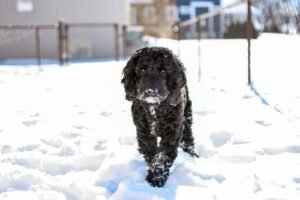
Winter walks need their own rules. Shorten walks in bitter cold, wipe paws after every outing to clear salt and grit, and dry the coat thoroughly afterward — a wet cockapoo coat chills fast. If your dog is shivering, lifting paws, or lagging, the walk is over, whatever the step count says. A warm indoor play or nose-work session beats a miserable forced march.
Running, Hiking and Off-Leash — When Each Is OK
Jogging is an adult activity: wait until growth plates have closed, around 12 months, then build distance gradually over weeks — never from the couch to a 5K. Hiking works the same way: the fit adult figure of 3–5 miles is earned over weeks, not started there. Off-leash time needs reliable recall first, in a safe enclosed space; dog parks and playdates are excellent exercise once recall holds, and a tired cockapoo from a good playdate often sleeps better than one from a longer leashed walk.
Under-Exercised vs Over-Exercised: The Signs
Too little:
– Destructive chewing, digging, shredding
– Excessive barking, especially demand barking (see also cockapoo separation anxiety)
– Stealing items / attention-seeking mischief
– Can’t settle in the evening; night zoomies
– Weight gain (ribs hard to feel)
Too much:
– Lagging behind on walks they usually enjoy
– Excessive, labored panting that won’t resolve
– Limping, stiffness, or reluctance to continue
– Refusing walks altogether
– Sleeping excessively after activity (beyond normal rest)
Puppies and seniors live closer to the “too much” line — watch them hardest.
Overweight or out-of-shape dogs: check with your vet before starting a fitness plan, then build up gradually. Overweight dogs tire faster and are more vulnerable to injury, so the settle test matters even more — add 10 minutes at a time, not a whole new walk at once.
The Exercise–Sleep Connection
Well-exercised puppies sleep 16–20 hours; well-exercised adults settle deeply at night. The corollary matters more: night zoomies and 5 AM chaos are often an exercise deficit, not a personality trait. And the trap on the other side — an overtired puppy gets hyper, not sleepy, like a toddler fighting a nap. If evenings are chaos, check both directions: not enough during the day, or no enforced rest to process it.
When to See the Vet (Exercise Red Flags)
Normal tiredness resolves with rest. See the vet if:
– Sudden reluctance to exercise in a previously keen dog
– Limping or stiffness lasting more than 24–48 hours
– Coughing during or after exercise
– Fainting, collapse, or extreme intolerance
– Exercise intolerance that worsens over weeks (not days)
Don’t train through medical problems.
Frequently Asked Questions
How many walks a day does a cockapoo need? Two walks of 20–30 minutes, topped up with free play or training at home. One walk alone rarely covers a Cockapoo’s daily needs — the second walk is what keeps the evening zoomies and the chewing in check.
Is one walk a day enough for a cockapoo? For most Cockapoos, no. A single 30-minute walk can meet the needs of many small dogs, but Cockapoos usually require more: one walk rarely fulfils the total daily requirement, and a second walk — or the same time split into two sessions with play — makes a visible difference to behaviour.
Is a 30-minute walk enough for a cockapoo?
As the only daily exercise, rarely — it’s the minimum floor, not the target. One 30-minute walk plus play, training, and mental work can be enough for a calm adult; for most, aim for ~60 minutes total.
How long should I walk a cockapoo puppy?
The 5-minute rule: 5 minutes per month of age, up to twice daily, of structured walking. A 4-month-old gets two 20-minute walks max. Free backyard play is extra and doesn’t count toward the limit.
Can you over-exercise a cockapoo?
Yes — especially puppies (growth-plate/joint risk) and seniors. Watch for lagging, limping, stiffness, and reluctance. More isn’t always better; right is better.
How do I tire out my cockapoo when it’s raining?
Hide-and-seek, flirt pole, trick training, kibble-in-towel sniffing games, indoor fetch down a hallway. Fifteen minutes of nose work beats thirty of walking.
How far can a cockapoo walk?
A fit, conditioned adult handles 3–5 miles — build up gradually. Don’t start there; earn it over weeks.
Why does my cockapoo get zoomies after a walk?
Usually a release of leftover arousal — normal. But regular post-walk zoomies can also mean the walk under-delivered (too slow, too boring) or the puppy is overtired. Try more intensity, or an earlier bedtime.
My puppy is still hyper after walks — am I under-exercising? Often the opposite: overtiredness. Evening wildness, frantic zoomies, nipping and barking without obvious reason are classic overtired-puppy signs, and trying to tire the puppy out more usually makes evenings harder. Puppies need 18–20 hours of sleep — enforce rest, cut stimulation, and watch evenings calm down.
Do potty trips count as exercise? No. Toilet trips are separate from the 5-minute-rule walks. A puppy may go out eight times a day for potty breaks and still need its structured walks on top.
The Bottom Line
Sixty minutes for the average adult — then calibrate with the settle test, ribs, and the restlessness dial. Puppies get the 5-minute rule, seniors get gentler half-hours, and everybody gets brain work alongside leg work. Intensity beats duration, sniffing counts double, and the dog in front of you outranks every number in this article — including the 60.
Next: Exercise is easier with the right fuel — see how much should I feed my cockapoo.
Leave a Reply