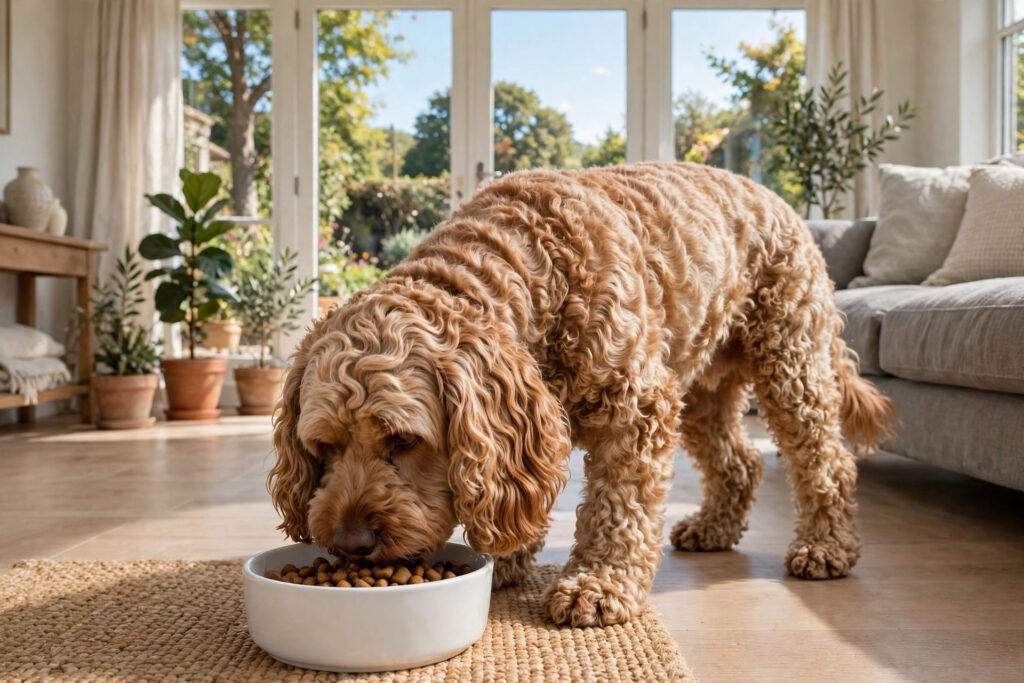
How much should I feed my cockapoo? The calorie-first framework: 30–40 calories per pound, feeding charts by age and weight, the bag-label trap, and the treat budget.
Quick answer: Feed by calories, not cups — about 30–40 calories per pound of body weight daily for an average adult (a 15-lb cockapoo ≈ 450–600 calories). Cup amounts vary wildly between brands because kibble density differs, which is why feeding charts disagree. Puppies need roughly double per pound, split into 3–4 meals; adults do best on 2 measured meals. Then calibrate with the body-condition check below.
Every feeding chart on the internet gives you a different number of cups — ½ to 1, 1 to 2, ¾ to 1½ for the same dog. They’re not all wrong. They’re all measuring with a rubber ruler. Here’s the framework that makes them agree.
The Real Unit: Calories, Not Cups
A “cup” of kibble isn’t a unit of nutrition — it’s a unit of volume. Dense kibble packs 450+ kcal per cup; airy kibble barely 300. So “1 cup a day” means completely different nutrition depending on the brand. That’s the entire reason the charts conflict.
The fix: find the kcal/cup on your food’s label (it’s always there, usually in small print), and do the math from calories. One framework, every brand, no contradictions.
The 30–40 Calorie Rule (With Worked Example)
For an average, moderately active adult cockapoo: 30–40 calories per pound of ideal body weight per day.
Worked example — a 15-lb adult:
– 15 × 30 = 450 calories (low end: less active, easy keeper)
– 15 × 40 = 600 calories (high end: very active, hard keeper)
– Food label says 380 kcal/cup → that’s 1¼ to 1½ cups per day, split into 2 meals
Adjust within the range by activity and body condition (below), not by guessing. Puppies need roughly double per pound (~60–80 cal/lb) because they’re building a whole dog; seniors need 20–30% less than their adult amount.
 CockapooDaily
Adult Feeding Table
Using the 30–40 cal/lb rule at a typical 380 kcal/cup kibble (adjust cups for your food’s actual kcal):
| Weight | Daily calories | ≈ Cups/day (380 kcal/cup) |
|---|---|---|
| 10 lbs | 300–400 | ¾–1 |
| 12 lbs | 360–480 | 1–1¼ |
| 15 lbs | 450–600 | 1¼–1½ |
| 20 lbs | 600–800 | 1½–2 |
| 25 lbs | 750–1,000 | 2–2½ |
Two measured meals a day. Same times daily — routine regulates digestion.
 CockapooDaily
Puppy Feeding Chart (With the Weigh-and-Adjust Loop)
| Age | Meals/day | Daily amount (typical kibble) | Notes |
|---|---|---|---|
| 8–12 weeks | 4 | ½–1 cup total | Tiny stomach, huge growth — frequent small meals |
| 3–6 months | 3 | ¾–1¼ cups total | Growth peak; watch body condition weekly |
| 6–12 months | 2–3 | ¾–1½ cups total | Growth slowing — this is where overfeeding starts |
| 10–12 months | 2 | Transition to adult food | Switch to adult formula around 10–12 months |
The weigh-and-adjust loop (what no chart teaches): weigh your puppy weekly (bathroom scale: hold puppy, subtract your weight). Healthy growth is steady, not explosive. Combine with the body-condition check below — if ribs are disappearing under padding, trim the portions now, not at the next vet visit. Charts are starting points; the scale and your hands are the truth.
The Bag-Label Trap
“Just follow the bag,” say the thin articles. Here’s what they don’t say: bag labels systematically overfeed. They’re written for intact, highly active dogs — the maximum plausible customer — because no brand wants to be blamed for a thin dog. Your spayed, apartment-dwelling, moderately-walked cockapoo is not that dog.
Use the bag as a ceiling, not a target. Start from the calorie rule above, then verify with body condition. If the bag says 2 cups and the calorie math says 1¼, trust the math — then trust the ribs.
Cups vs Kitchen Scale
A “cup” of kibble varies 20–40% by weight between brands — and most owners’ “cups” are heaped, not level. If you’re serious about portions (weight management, diet trials, a puppy’s growth curve), weigh in grams. A $15 kitchen scale removes the single biggest variable in home feeding. Convert once: weigh what your “cup” actually holds, write the grams on the bag with a marker, and you’re calibrated for life.
Body Condition Score: The 30-Second Method
Charts get you close; this gets you right. Monthly, hands-on:
- Ribs: run flat hands along the ribcage. You should feel ribs easily under a thin fat layer — not see them, not dig for them. Can’t feel them = too heavy. Prominent with no cover = too light.
- Waist: look from above. There should be a visible waist behind the ribs — an hourglass, not a barrel.
- Tuck: look from the side. The belly should tuck up behind the ribcage, not hang level.
Score honestly — owners consistently underestimate their own dog’s weight. This check outranks every chart, label, and calculator. If the ribs say “trim 10%,” trim 10%.
The 10% Treat Budget (Worked Example)
Treats and human food combined stay under 10% of daily calories. Here’s what that actually means:
- 500-calorie dog → 50-calorie treat budget
- That’s ≈ 5 small training treats, or 1 tablespoon of peanut butter, or a handful of blueberries
- One slice of cheese (~110 cal) = two full days of treat budget
The budget is why the treat type matters: blueberries and green beans (near-zero calories) stretch the budget; cheese and peanut butter spend it in one go. (Full lists: what human foods can cockapoos eat.)
Hidden calories that owners forget: dental chews (count them), training treats (count them), the “just a bite” of dinner (count it), lick mats (count them).
Why Cockapoos Get Fat (And How to Defend)
This breed is engineered to overeat pleasantly. The cocker spaniel half brings legendary food motivation — enthusiastic eating, world-class begging, the ability to look starved ten minutes after dinner. Most cockapoos will “happily eat more than they need if given the chance,” and owners consistently mistake begging for hunger.
The defenses:
– Measured meals, never free-feeding — see below
– Treat budget enforced — pre-portion the day’s treats each morning; when they’re gone, they’re gone
– Begging is not hunger — a begging cockapoo is usually a bored cockapoo. Redirect with play or training, not food.
– Monthly rib checks — catch the creep at ½ lb, not 5 lbs
The Adolescent Cutback (9–14 Months)
Nobody talks about this window, and it’s where most cockapoo weight gain begins. Growth slows dramatically around 9–12 months, but owners keep feeding puppy portions on puppy schedules. The dog that needed 700 calories at 6 months needs 500 at 12 months — same dog, 30% less food, and nobody told the bowl.
The move: at 9–10 months, transition to adult food and recalculate portions from the adult table. Then run the body-condition check monthly through age two. The adolescent waistline you protect now is the adult metabolism you keep.
Spay/Neuter Adjustment
Metabolism drops after desexing — typically 20–30% fewer calories needed for the same weight. Most owners never adjust, and the post-surgery pounds arrive quietly over 2–3 months. Recalculate from the 30–40 rule at the low end (30) after recovery, then verify with the rib check at 4 and 8 weeks post-surgery.
Senior Feeding (7+ Years)
- Fewer calories — metabolism slows; use the low end of the range or 20% below the adult amount
- Keep protein up — seniors need protein to hold muscle; don’t cut protein, cut calories
- Joint support — omega-3s and joint-friendly nutrients earn their place now
- Softer options — dental issues may call for smaller kibble or softened food
- More frequent, smaller meals — 2–3 small meals can suit aging digestion better than 2 large ones
Switching Foods: The 7-Day Plan
New food, same stomach — transition gradually or expect digestive protest:
| Days | Old food | New food |
|---|---|---|
| 1–2 | 75% | 25% |
| 3–4 | 50% | 50% |
| 5–6 | 25% | 75% |
| 7+ | — | 100% |
Sensitive stomachs: stretch to 10 days. Loose stool during transition = slow down a phase, not panic.
Free-Feeding: Don’t (The Cockapoo-Specific Why)
Leaving food out all day fails this breed three ways:
1. No intake tracking — you can’t manage what you don’t measure, and this breed self-serves enthusiastically
2. Masks appetite changes — a dog that suddenly eats less is often a dog getting sick; free-feeding hides the signal for days
3. Kills food motivation for training — a dog that’s never hungry is a dog that won’t work for treats
Measured meals, picked up after 20–30 minutes. Uneaten food is information — note it.
Overfeeding vs Underfeeding: The Signs
Too much:
– Ribs hard to feel; waist disappearing from above
– Weight creeping up month over month
– Lethargy beyond normal; reluctance on walks they used to enjoy
– Begging intensifies (the stomach stretches; satiety signals lag)
Too little:
– Ribs visible with no fat cover; prominent spine/hip bones
– Low energy, dull coat
– Constant food-seeking beyond normal begging
– Slow growth in puppies (vet visit — don’t just add food)
When in doubt, the vet scale settles it — most clinics will weigh your dog free and give you an honest body-condition score.
Frequently Asked Questions
How many cups of food should a cockapoo eat a day? Most adults eat ¾–2½ cups of kibble a day, split into two meals: roughly ¾–1 cup for a dog under 12 lb, 1–2 cups for 12–20 lb, and 1½–2½ cups for 20–25 lb. The bag label is a starting point, not a prescription — the bag’s numbers are written for the average dog of that weight, and your dog’s activity and metabolism move the real number up or down.
How many times a day should I feed my cockapoo puppy? Four meals a day at 8–12 weeks, three meals at 3–6 months, two to three meals at 6–12 months, then two adult meals from about 12 months. Puppies cannot eat enough in one sitting to cover a day’s growth, which is why the meals stay small and frequent until the first birthday.
Should I feed my cockapoo once or twice a day as an adult? Twice. Two meals keep blood sugar steadier, cut the risk of bilious vomiting (the empty-stomach bile vomit many Cockapoos get in the early morning), and make the daily portion easier to measure. One big meal a day also leaves a long hungry stretch that drives begging and counter-surfing.
How do I know if I am overfeeding my cockapoo? Feel the ribs: you should feel them easily under a thin fat layer without pressing hard, and the waist should tuck in when viewed from above. If you cannot feel the ribs, or the waist has vanished, cut the daily portion by about 10% and re-check in two weeks — do not cut by a third overnight.
What is the ideal daily food portion for a cockapoo?
30–40 calories per pound of ideal weight for an average adult — a 15-lb dog ≈ 450–600 calories/day, roughly 1¼–1½ cups of typical kibble, split into 2 meals. Calibrate with the rib check.
How can I tell if my cockapoo is at a healthy weight?
Feel the ribs (easy under thin cover), look for a waist from above, check the belly tuck from the side. Monthly, hands-on, honest.
How often should I feed my cockapoo?
Puppies: 4 meals (8–12 wks) → 3 meals (3–6 mo) → 2–3 (6–12 mo). Adults and seniors: 2 measured meals daily.
Can I give my cockapoo table scraps?
As treats within the 10% budget, if they’re from the safe list — see what human foods can cockapoos eat. Never as meal replacements.
Should I consult a vet about my dog’s diet?
For puppies, seniors, weight issues, or any medical condition — yes. A vet visit for a feeding plan is cheap; obesity-related vet bills are not.
My cockapoo is always hungry — am I underfeeding?
Almost certainly not — you’re describing the breed. Check the ribs: if they’re right, the hunger is enthusiasm, not need. Redirect begging with play, not portions.
This article is for information only and isn’t a substitute for veterinary advice — especially for puppies, seniors, weight-loss plans, or dogs with medical conditions.
The Bottom Line
Calories are the unit, the 30–40 rule is the math, the rib check is the judge. Start from the table, distrust the bag, weigh the kibble, budget the treats, and cut back at adolescence. Do that and the feeding question answers itself every month — hands on ribs, eyes on waist, bowl adjusted accordingly.



Leave a Reply