
Most Cockapoos shed very little, but coat and generation change everything. Learn what to expect, how to cut loose hair, and when to call a vet.
Quick answer: Most Cockapoos shed very little, but no Cockapoo is truly non-shedding. Curly coats shed least because loose hair stays trapped in curls, wavy coats shed lightly, and straight coats shed most. Expect more loose hair during the 6–12 month puppy coat change, and see a vet promptly for bald patches, sores, or sudden heavy shedding.
If you are asking this before bringing a Cockapoo home, you are asking the right question — but the honest answer is not a simple yes or no. Shedding depends on the individual dog in front of you, not just the breed name. This guide explains what normal looks like, why two Cockapoos can shed very differently, and when extra hair loss deserves a vet visit.
The Short Answer: Yes, a Little — But Rarely a Lot
Every dog sheds. Old hairs fall out and new hairs grow in, just as human hair does. What makes Cockapoos different is how much of that loose hair actually reaches your floor.
Most Cockapoos shed lightly. Owners often notice hair mainly on a brush, on dark clothing after a cuddle, or in the bathtub after a bath — not in drifts across hardwood floors or thick layers on the sofa. That is very different from heavy seasonal shedders, where a single brushing can fill a bag.
There is one important trade-off behind that good news. In curly and wavy coats, much of the shed hair does not fall out. It stays caught in the coat. Your home looks cleaner, but the coat needs regular brushing, or that trapped hair turns into tangles and mats. Low shedding, in other words, does not mean low maintenance. It often means the maintenance moves from vacuuming to grooming.
No breeder can honestly guarantee a non-shedding Cockapoo. Cockapoos are a mixed breed — a Cocker Spaniel crossed with a Poodle — and puppies in the same litter can inherit different coats. Anyone promising zero shedding for every puppy is overselling the breed.
Shedding by Coat Type: Curly, Wavy, and Straight
Coat type is the single biggest predictor of how much hair you will see around the house.
Curly coats shed least
A tight, Poodle-like curly coat traps almost all loose hair. Many owners of curly Cockapoos say they only notice shedding when they brush. That makes curly coats the easiest on furniture and clothing, and often the best fit for homes where allergies are a concern.
The catch is grooming. Tight curls mat quickly, especially behind the ears, under the collar, around the legs, and in the armpits. Daily brushing down to the skin, followed by a metal comb check, is the realistic routine for many curly-coated dogs. Skip it for a week or two and small mats can tighten into painful clumps that must be clipped out.
Wavy coats shed lightly
The wavy coat is the most common Cockapoo coat, sitting between the two parent breeds. It sheds lightly: a few hairs on clothes and bedding, a modest amount in the brush, but rarely a visible problem in the home.
Wavy coats are also the most forgiving to live with. Brushing three to four times a week is usually enough to keep loose hair under control and prevent most tangles, provided the coat is kept at a manageable length. This is the coat most prospective owners picture when they imagine a classic teddy-bear Cockapoo.
Straight coats shed most
A straight, silky, Cocker Spaniel-like coat is the least common Cockapoo coat, and it sheds the most of the three. The hair is freer to fall, so you will see more of it on floors, furniture, and clothing — though usually still less than a purebred Cocker Spaniel.
Straight coats are the easiest to brush, because there are fewer curls to trap hair and fewer mats to form. The trade-off is simply more visible shedding and more frequent vacuuming. For households with significant allergies, a straight-coated Cockapoo is usually the least suitable choice of the three.
| Coat type | Typical shedding | What you will notice | Brushing needed |
|---|---|---|---|
| Curly | Very low | Hair mainly in the brush | Daily, plus comb check |
| Wavy | Low to light | A few hairs on clothes and bedding | 3–4 times per week |
| Straight | Light to moderate | More visible hair on floors and furniture | 2–3 times per week |
Shedding by Generation: F1 vs F1b vs F2
Generation labels describe parentage, and parentage shifts the odds — but it does not decide the outcome for an individual puppy.
F1 means a first-generation cross: 50% Cocker Spaniel and 50% Poodle. F1 coats are the most variable. One puppy may be curly and barely shed, while a littermate is straighter and sheds noticeably. If you meet an F1 puppy, judge the coat you can see and feel, not the label alone.
F1b means an F1 Cockapoo bred back to a Poodle: about 75% Poodle and 25% Cocker Spaniel. F1b dogs are the most consistently low-shedding group, because the extra Poodle influence usually produces tighter curls that trap loose hair. For allergy-sensitive homes, F1b is generally the safest bet — still not a guarantee, but the odds are better.
F2 means two Cockapoos bred together, and multigenerational dogs come from Cockapoo-to-Cockapoo lines over several generations. F2 shedding is the hardest to predict from the label alone, because each puppy can inherit a different mix of traits from both parents. Some established multigenerational lines are quite consistent, while other F2 litters vary widely. Ask the breeder about the parents’ coats and previous litters, and meet the puppy if you can.
Coat type × generation at a glance
This combination is what most competitor guides miss: they list coat types in one section and generations in another, but never join them up.
- Curly + F1b: the lowest-shedding combination in most cases. Expect very little visible hair, but the highest grooming workload.
- Wavy + F1: the most common combination, and the most variable. Shedding is usually light, but you cannot predict it from the generation label alone.
- Straight + F1 or F2: the highest-shedding combination. Still manageable for most homes, but the least allergy-friendly.
- Any coat + F2: treat the individual puppy, not the label, as the evidence. Two F2 littermates can shed quite differently.
The practical lesson is simple: generation improves your odds, coat type shows you the reality. If low shedding matters a great deal to you, prioritize meeting the puppy and seeing its coat, and ask how the parents shed as adults — not just as puppies.
The Puppy Coat Blow: Why Shedding Spikes at 6–12 Months
Many owners are caught off guard by this phase, because it is the one time a normally low-shedding Cockapoo can shed noticeably more — and it is usually completely normal.
Between about 6 and 12 months, most Cockapoos lose their soft puppy coat and grow their adult coat. The puppy coat is finer and silkier; the adult coat is denser, and often curlier or coarser. During the changeover, loose puppy hair comes out in larger amounts, and the coat can look uneven for weeks: fluffy in places, thinner in others, with a different texture emerging underneath.
Here is what to expect, week by week in broad terms:
- Early signs: more hair in the brush than usual, and a coat that feels less soft or starts to wave or curl differently, especially on the body and ears.
- Peak shedding: a period of several weeks when brushing produces noticeably more loose hair. This is not usually hair falling in clumps off the body — it is hair coming away readily when brushed.
- Settling down: the adult texture becomes clearer, shedding returns toward the dog’s normal level, and the new coat is easier to judge. The full adult coat may not be obvious until after the first adult haircut.
The biggest risk during this phase is not the shedding itself. It is matting. Loose puppy hair tangles easily with incoming adult hair, especially behind the ears, under a harness, and around the legs. Brushing more often during the blow — daily for curly coats, every other day for wavy coats — prevents a shedding phase from becoming a matting problem.
Do not try to shortcut this phase by shaving the coat down to the skin. A very short clip can make the coat look tidier for a few weeks, but it does not stop the coat change, and it can leave the skin more exposed to sun and cold. If the coat is badly matted, talk to a groomer about a safe, humane trim. For timing and what to expect from that first appointment, see our guide to a Cockapoo’s first haircut. Regular trims in a style that suits the coat — see Cockapoo haircut styles — keep the adult coat manageable without drastic cuts.
One honest caveat: the adult coat can surprise you. A soft, wavy puppy can grow into a curlier adult, and a fluffy puppy coat can settle into something straighter. That is why a breeder’s prediction about an 8-week-old puppy’s adult shedding is an educated guess, not a promise.
Seasonal Shedding: Spring, Fall, and Indoor Life
Cockapoos do not usually have the dramatic twice-a-year coat blow of double-coated breeds. Most show only a mild, brief increase in spring and fall as daylight and temperature shift.
Indoor dogs in the United States often shed even more evenly through the year, because central heating in winter and air conditioning in summer keep indoor temperatures fairly steady. That means you may not see a clear seasonal pattern at all — just a steady, low level of loose hair, with perhaps a slight uptick in spring.
A brief seasonal increase is normal and should settle within a few weeks; a sudden, heavy increase that does not settle is covered below.
 CockapooDaily
How to Keep Shedding Under Control
You cannot stop shedding, and you should not try to. You can keep it at its normal, low level with a steady routine.
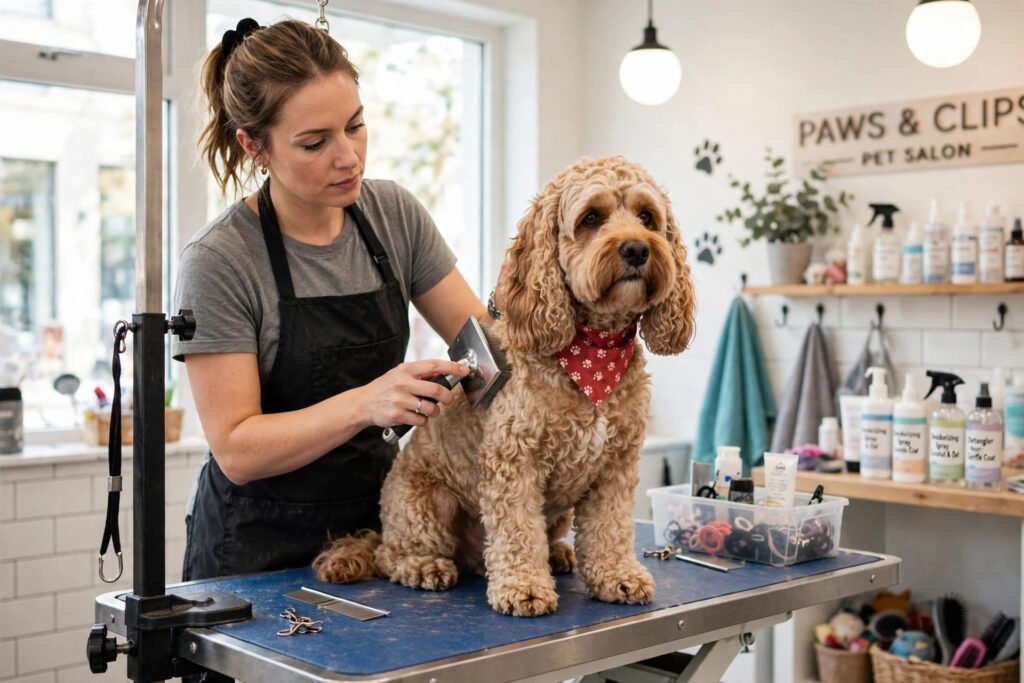
Brush on a schedule, not when you notice hair. Brushing removes loose hair before it reaches your furniture, and it is the single most effective shedding control. Use a slicker brush down to the skin for curly and wavy coats, then check with a metal comb: if the comb glides through, the coat is mat-free; if it snags, there is a tangle to work out gently.
| Coat type | How often | Tool |
|---|---|---|
| Curly | Daily, 10–15 minutes | Slicker brush, then a metal comb check |
| Wavy | 3–4 times a week | Slicker brush, then a metal comb check |
| Straight | 1–2 times a week | Pin brush, then a metal comb check |
| Puppy coat blow (6–12 months) | Daily for curly, every other day for wavy | Slicker brush + comb; check behind the ears, under the harness, and around the legs |
Bathe every 3–4 weeks, not every few days. A bath with a gentle, dog-safe shampoo removes loose hair, dander, and dirt. Over-bathing strips natural oils, dries the skin, and can actually increase shedding and flaking. Always dry and brush lightly after a bath, since damp curls tangle easily.
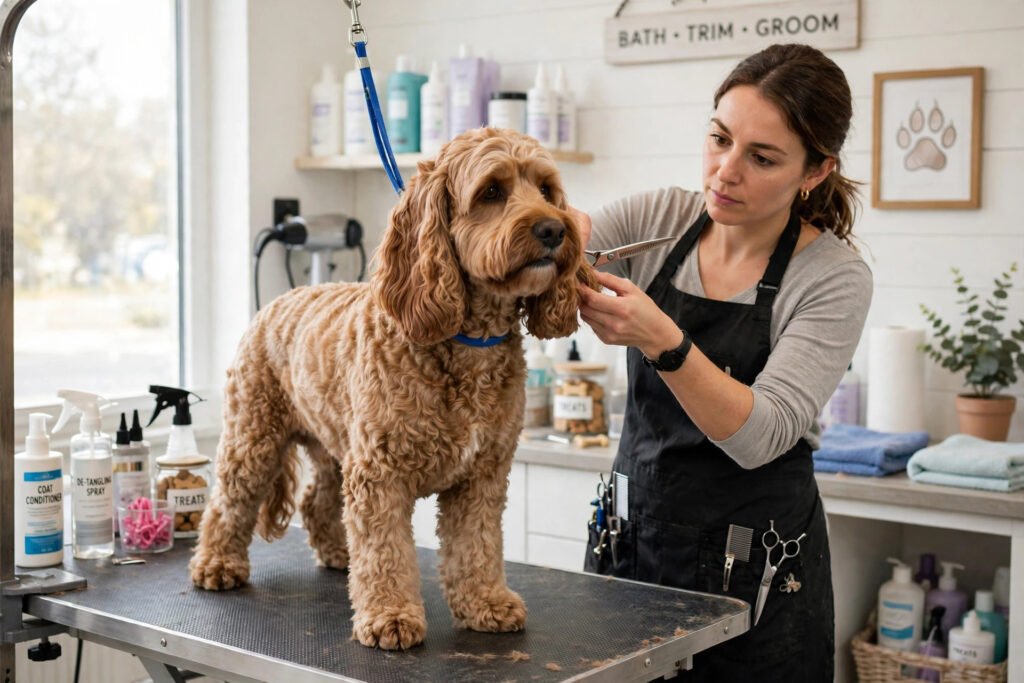
Keep grooming appointments every 6–8 weeks. A professional groomer removes built-up loose hair and dander, keeps the coat at a length you can maintain at home, and spots skin problems early. If cost is a factor in planning that schedule, see our breakdown of Cockapoo grooming cost.
Feed for skin health, and change food slowly. A complete, balanced diet supports a healthy coat; dry, flaky skin sheds more. If you suspect food is involved — especially alongside itching, ear problems, or stomach upset — do not keep switching foods at random. Read about Cockapoo food allergies and their symptoms and talk to your vet before an elimination diet.
Clean the home, not just the dog. Washable throws on favorite resting spots, regular vacuuming of rugs and upholstery, and washing the dog’s bedding weekly catch the hair that does fall. For allergy-sensitive homes, a vacuum with a HEPA filter and keeping the bedroom as a lower-allergen zone help more than any single grooming product.
Watch for stress. Moving house, a new baby, a change in routine, or long periods alone can increase shedding in some dogs, just as stress affects human hair. If shedding rises alongside pacing, restlessness, or destructive behavior, the cause may be anxiety rather than coat type — and routine, exercise, and enrichment matter as much as brushing.
 CockapooDaily
When Extra Shedding Signals Illness: Normal vs Warning Signs
This is the section most short competitor answers skip or reduce to a single sentence. The distinction matters, because normal shedding and problem hair loss look different once you know what to check.
Likely normal shedding
- Loose hair increases mildly and evenly, especially in spring or fall, or during the 6–12 month puppy coat change.
- Hair comes away mainly when brushing, not in clumps from untouched coat.
- The skin underneath looks normal: no redness, sores, scabs, or strong odor.
- The dog is eating, drinking, playing, and behaving normally, with no new itching or licking.
See your vet promptly if you notice
- Bald patches or thinning in one area, especially if the skin is visible, symmetrical thinning appears on the body, or hair pulls out easily in handfuls.
- Sores, scabs, redness, flaking, or a bad smell on the skin, or constant scratching, biting, or licking at one spot.
- Sudden, heavy shedding over days to a few weeks in an adult dog whose shedding was previously stable, particularly if it comes with tiredness, weight change, or appetite change.
- Hair loss plus other symptoms: increased thirst and urination, lethargy, weight gain or loss, or a dull, dry coat that breaks easily.
These patterns can point to several different problems, and only a vet can separate them: food or environmental allergies, skin infections (bacterial or fungal), parasites such as fleas or mites, hormonal conditions including hypothyroidism and Cushing’s disease, nutritional problems, or the hormonal shifts after spaying or neutering. Do not try to diagnose from shedding alone, and do not start supplements or medicated washes without veterinary advice — the wrong treatment can worsen skin problems.
A practical step before the visit helps your vet enormously: note when the shedding changed, whether it is all over or in patches, and take clear photos of the skin and coat over a few days. Bring a note of any recent food changes, new shampoos, medications, or stressful events. That timeline often narrows the cause faster than the shedding itself.
Cockapoos, Allergies, and Shedding: What Low-Shedding Does Not Mean
Low shedding helps allergy sufferers, but it does not make a dog hypoallergenic in the absolute sense. No dog is completely hypoallergenic. Allergic reactions are mostly triggered by proteins in dander (tiny skin flakes), saliva, and urine — not by the hair itself. Hair carries those proteins around the house, so less loose hair usually means fewer allergens spread, but a low-shedding Cockapoo still produces dander and saliva.
That is why two allergy-sensitive people can react differently to the same dog, and why spending time with a Cockapoo before committing is the most reliable test. Regular brushing, bathing every few weeks, and keeping bedding clean reduce allergens further. For the full picture, see Are Cockapoos Hypoallergenic?.
Coat color, by the way, does not change shedding. A black, apricot, or chocolate Cockapoo with the same coat type and generation will shed about the same — color affects what you notice on your clothes, not how much hair falls. If you are choosing by color, see our guide to Cockapoo colors for how shades change as dogs mature.
Frequently Asked Questions
Can omega-3 help my Cockapoo shed less? A diet with omega-3 and omega-6 fatty acids supports skin health and coat quality, and a dog with dry, unhealthy skin sheds more — so the right food helps, but it will not turn a straight-coated Cockapoo into a non-shedder. Look for a complete food that already lists fish oil or flaxseed, and ask your vet before adding any supplement such as salmon oil.
What is the best brush for a shedding Cockapoo? A slicker brush for curly and wavy coats, and a pin brush for straight coats — followed in every case by a metal comb check: if the comb glides through, the coat is mat-free; if it snags, there is a tangle to work out gently. Brushing is the single most effective shedding control, because it removes loose hair before it reaches your furniture.
Do straight-coated Cockapoos shed like Cocker Spaniels? They shed the most of the three Cockapoo coat types, but usually still less than a purebred Cocker Spaniel, thanks to the Poodle side of the mix. A straight coat is the least allergy-friendly combination — if low shedding matters a great deal, meet the puppy and see its adult coat rather than trusting the generation label alone.
When should I worry about my Cockapoo’s shedding? Normal shedding is light, even, and unchanging. See your vet promptly for heavy clumpy hair loss, bald patches, itching, redness, flaking, or a sudden increase alongside lethargy or appetite change — those point to skin disease, allergy, or illness, not to normal coat turnover.
How much hair on the furniture is normal for a Cockapoo? Very little for a curly coat, a light dusting for a wavy coat, and noticeably more for a straight coat — but never clumps coming off the body daily. If you are finding clumps, first check the brushing routine (daily for curly, 3–4 times weekly for wavy), then book a vet check if the routine is already right.
Do Cockapoos shed a lot?
Most do not. Most Cockapoos are low shedders, especially curly-coated dogs. Straight-coated Cockapoos shed the most of the three coat types, but usually still less than many common breeds. Heavy, clumpy hair loss is not typical and deserves a vet check.
Which Cockapoo generation sheds the least?
F1b Cockapoos (about 75% Poodle) are the most reliably low-shedding generation, because tighter curls trap loose hair. F1 dogs vary more, and F2 dogs vary most from puppy to puppy. Generation improves the odds; the individual coat is the final answer.
Do Cockapoos shed more in summer?
Some shed slightly more in spring and early summer as the coat adjusts, but Cockapoos do not usually have a heavy seasonal blow. Indoor dogs often shed fairly evenly all year. A sudden summer spike with itching, redness, or bald patches is more likely allergy or skin-related than seasonal.
Do Cockapoo puppies shed?
Yes, and more than adults during the coat change at roughly 6–12 months, when the soft puppy coat gives way to the adult coat. Expect several weeks of extra loose hair in the brush and a higher matting risk. Shedding usually settles back to the dog’s normal level once the adult coat is in.
How do I reduce my Cockapoo’s shedding?
Brush on a coat-appropriate schedule (daily for curly, 3–4 times weekly for wavy), bathe every 3–4 weeks with a gentle shampoo, keep professional grooming every 6–8 weeks, feed a complete balanced diet, and address stress and skin health. You cannot eliminate shedding, but this routine keeps it at its normal low level.
Conclusion
Do Cockapoos shed? Yes — a little, and usually very manageably. Curly coats shed least, wavy coats shed lightly, and straight coats shed most; F1b dogs are the most consistently low-shedding generation, while F1 and F2 dogs vary more. Expect a temporary increase during the 6–12 month puppy coat change and a mild seasonal lift, and treat sudden, patchy, or sore-associated hair loss as a reason to call your vet.
If you are choosing a puppy and low shedding matters to you, look past the label: meet the puppy, feel its coat, ask how the parents shed as adults, and be honest about the grooming time you can give. A low-shedding Cockapoo is a wonderful companion — as long as you are ready to brush the hair that never reaches your floor.


Leave a Reply