
Most Cockapoos can live with cats, but the introduction matters. Follow the scent-swap to supervised-meetings protocol and set up cat escape routes.
Quick answer: Yes, most Cockapoos are good with cats when introductions are done slowly. They are friendly and social, but playful and prone to chasing, which cats dislike. Expect 2 to 4 weeks of gradual steps, from scent swapping to supervised meetings, and give the cat escape routes and a dog-free safe room from day one.
Ask ten Cockapoo owners whether their dog likes cats and you will get ten versions of “yes, mostly, except when he chases her.” That contradiction is the whole story. Cockapoos are among the friendlier breeds toward cats, but friendliness and good housemate behavior are not the same thing. A bouncy dog that wants to play can still terrify a cat, and a terrified cat can scratch, hide for days, or stop eating. This guide covers the introduction properly, step by step, and then treats cats, other dogs, and small pets as the separate cases they are, because the advice for each is genuinely different.
Why Cockapoos Usually Do Well With Cats
Cockapoos combine two parent breeds that are both generally social. Cocker Spaniels are companionable and people-oriented, and Poodles are intelligent and responsive to training. The result is a dog that usually wants to be friends, reads human cues well, and can learn to leave a cat alone on command. Unlike some terrier or herding breeds, Cockapoos were not bred to chase and kill small animals as a job, so their interest in a cat is usually playful curiosity rather than predatory focus.
That said, the Cocker Spaniel side does bring a chase instinct. Movement triggers it: a cat that runs across the room looks like a game to a young Cockapoo, and the chase itself is rewarding, so it repeats. The goal of training is not to remove that instinct, which you cannot do, but to teach the dog that ignoring the cat earns better rewards than chasing it. That lesson takes weeks, not a single afternoon, and it works best when the cat never has to be the lesson.
Individual variation matters here too. A Cockapoo puppy raised with cats will usually accept them easily. An adult dog that has never met a cat, or that has rehearsed chasing neighborhood cats for years, will need a longer, more careful protocol. Age, history, and temperament beat breed reputation every time.
Before You Start: Set Up the Cat’s Side First
Do this before the animals meet, ideally before the new pet even arrives. The cat’s confidence depends on its territory being secure, and a confident cat introduces far more smoothly than a cornered one.
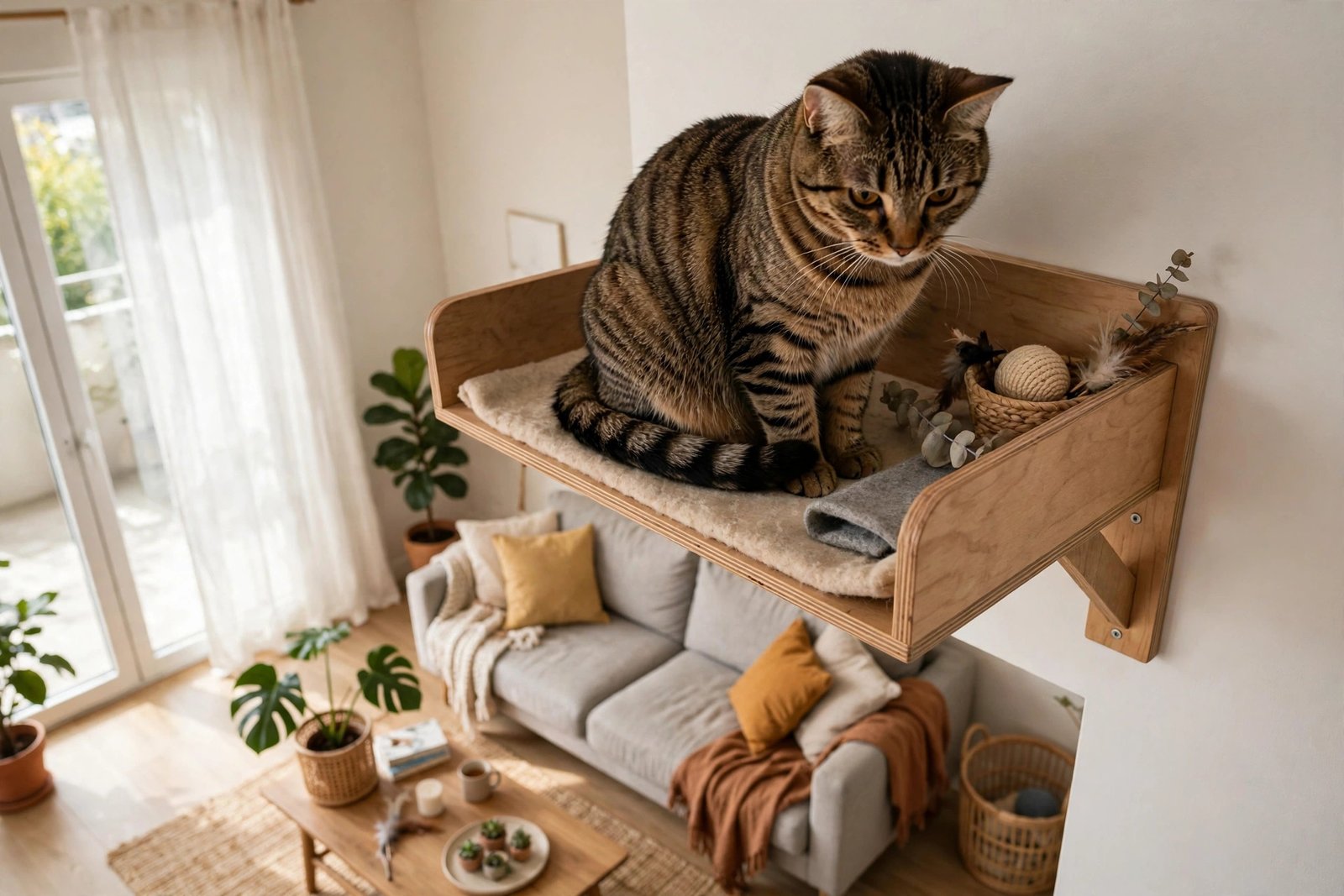
Give the cat a safe room. Pick one room the dog cannot enter, fitted with the cat’s food, water, litter box, scratching post, bed, and a hiding spot such as a covered bed or a box with a small entrance. The cat should be able to eat, drink, use the litter box, and sleep without ever crossing the dog’s path. Keep the door closed at first, then use a baby gate the cat can jump or slip through but the dog cannot, once the animals are ready for the next stage.
Build escape routes in shared rooms. In every room the cat will eventually use, provide at least one high perch or shelf the cat can reach but the dog cannot, and at least two exit routes so the cat is never trapped in a corner. Cat shelves, tall cat trees, and a baby gate with a cat-sized opening all work. Check the routes yourself: can the cat get from the food bowl to a high perch without passing the dog’s bed or a dead end?
Protect cat resources from the dog. Put the litter box behind a gate or in a room the dog cannot enter, because many dogs will eat cat litter and harass a cat mid-use. Raise cat food bowls onto a counter, shelf, or gated area so the dog cannot steal the food or guard it. A cat that must defend its food and toilet from a dog will not relax around that dog.
Exercise the dog before every meeting. A tired Cockapoo is a calmer Cockapoo. A walk and a short play session before each introduction takes the edge off the bounciness that cats hate most. Never introduce a fresh, bursting-with-energy puppy to a nervous cat and expect calm.
 CockapooDaily
The Introduction Protocol: Five Steps, at the Cat’s Pace
Move to the next step only when both animals are relaxed at the current one: eating normally, moving normally, and showing no prolonged hiding, hissing, or fixation. If either animal regresses, drop back a step for a few days. That is progress, not failure.
Step 1: Scent swap (days 1 to 3)
Keep the animals completely separate. Swap blankets or beds between the cat’s safe room and the dog’s area so each animal can investigate the other’s scent without any pressure. Rub a soft cloth on one animal’s cheeks, where scent glands are concentrated, and place it near the other animal’s food bowl. Feed both animals near the scented cloth so the new smell starts to predict good things. If either animal avoids the cloth, hisses at it, or refuses food near it, stay at this step and move the cloth farther from the bowl until eating is relaxed again.
Step 2: Feeding on opposite sides of a closed door (days 3 to 7)
Feed both animals at the same time on opposite sides of the closed safe-room door, so they hear and smell each other while eating. Start with bowls several feet from the door and move them closer over several meals, but only as far as both animals stay relaxed while eating. If either animal stops eating, eats frantically, or paws at the door, move the bowls back. This step teaches the most important association of the whole protocol: the other animal’s presence predicts dinner, not danger.
Step 3: Barrier meetings (days 7 to 14)
Replace the closed door with a sturdy baby gate, a screen door, or a crate for the dog, so the animals can see each other but cannot make contact. Keep sessions short, 5 to 10 minutes, and pair them with treats for calm behavior on both sides. A second person helps enormously here: one person with the dog, one with the cat, so neither animal is left to cope alone. End every session before excitement builds, while both animals are still calm. If the dog fixates, barks, or lunges at the gate, increase the distance, shorten the session, or drop back to step 2.
Step 4: Supervised meetings on a leash (weeks 2 to 3)
Let the cat enter a shared room with its escape routes open, and bring the dog in on a leash, already exercised and calm. Keep the leash loose; a tight leash raises arousal and teaches the dog that cats mean tension. Reward the dog for looking at the cat and then looking away, for sitting, and for any calm disinterest. Let the cat leave whenever it wants, and never let the dog follow it out of the room. Keep the first meetings to a few minutes and build up gradually. A swat on the nose from a cat that feels cornered is a normal correction, not a disaster, but it is a sign the meeting went on too long or the cat had no exit.
Step 5: Supervised off-leash time, then trust (weeks 3 to 4 and beyond)
When several leashed meetings have gone calmly, drop the leash but keep it attached and trailing, so you can step on it if needed without grabbing the dog. Then progress to fully off-leash sessions with an adult actively present. Only consider leaving them unsupervised together after several weeks of calm supervised coexistence with no chasing, fixation, or cat hiding, and keep the cat’s safe room and escape routes in place permanently. Some pairs reach this point in 3 weeks; others, especially with a nervous cat or an adult dog new to cats, take 2 to 3 months. Both timelines are normal.
| Step | What happens | Typical timing | Move on when |
|---|---|---|---|
| 1. Scent swap | Blankets and cloths exchanged; separate rooms | Days 1–3 | Both eat and rest normally near the scent |
| 2. Closed-door feeding | Meals on opposite sides of a door | Days 3–7 | Both eat relaxed with bowls near the door |
| 3. Barrier meetings | Baby gate or screen; treats for calm | Days 7–14 | Both can see each other without fixation or panic |
| 4. Leashed meetings | Cat free to leave; dog on loose leash | Weeks 2–3 | Dog looks away calmly; cat moves freely |
| 5. Supervised off-leash | Trailing leash, then free, adult present | Weeks 3–4+ | Weeks of calm coexistence, no chasing |
Training That Makes the Difference
Two commands carry most of the weight. Teach “leave it” away from the cat first, using treats and toys, until the dog reliably turns away on cue. Then practice it at a distance from the cat behind a barrier, and only later in the same room. Teach a strong recall and a “place” cue, so you can call the dog to its bed when excitement builds. Reward calm disinterest more than you reward excited greeting: the dog that glances at the cat and looks back at you for a treat is learning exactly the right lesson.
Also train the dog to settle on a bed while the cat moves around the room, starting behind a barrier and building up duration. This is the skill that turns “tolerates the cat” into “lives peacefully with the cat,” because daily life is mostly a cat walking past a resting dog, not a formal introduction session.
For the full socialization picture, including how early exposure shapes adult behavior, see our guide to Cockapoo puppy socialization. And if the dog struggles to settle when left alone, which can spill over into pestering the cat for attention, our guide to Cockapoo separation anxiety covers the underlying issue.
When the Cat Is the Worried One
Most introduction advice focuses on the dog, but in most Cockapoo-cat homes the cat is the animal that needs more help. Signs a cat is not coping include hiding for most of the day, refusing food or using the litter box less, over-grooming, aggression toward people, or spraying. These are stress signals, not spite, and they mean the protocol moved too fast.
If you see them, go back to full separation for several days, refresh the safe room, add a second high perch or hiding spot, and consider a calming pheromone diffuser in the cat’s room. Reintroduce more slowly, with shorter sessions and greater distance. If the cat still cannot settle after several weeks, or stops eating for more than a day, talk to your vet: prolonged appetite loss in cats can become a medical emergency, and a vet or behaviorist can check for pain or anxiety that the introduction alone did not cause.
A useful rule of thumb: the introduction proceeds at the cat’s pace, not the dog’s and not yours. The dog may be ready in days; the cat decides the timeline.
Cockapoos and Other Dogs
Other dogs are a different case from cats, and usually an easier one. Cockapoos are typically social with other dogs, enjoy play, and adapt well to multi-dog homes, especially when introductions happen on neutral ground such as a walk together rather than in the existing dog’s territory. Let the dogs meet on leashes in an open area, walk together for a while, and then move indoors with separate food bowls, beds, and toys to prevent resource guarding.
Watch for the same bounciness problem in a different form: a young Cockapoo can overwhelm an older or smaller dog with constant play invitations, and an older dog’s corrections can frighten a puppy. Supervise play, enforce rest breaks, and give each dog its own retreat space. Puppies in particular calm down gradually over their first 1 to 2 years, so a household with an excitable puppy and a senior dog needs more management than two settled adults.
Cockapoos and Small Pets: A Clearer Warning
Rabbits, hamsters, guinea pigs, gerbils, and birds are not small cats, and the advice is stricter. A Cockapoo’s chase instinct, harmless when directed at a cat that can climb away, can be dangerous or fatal to a small animal that cannot escape. Many Cockapoos can learn to ignore a caged rabbit or hamster, but that is coexistence at a distance, not friendship, and it should never be tested by free-roaming contact.
Practical rules for small-pet homes:
- Keep enclosures dog-proof and out of reach. A sturdy cage on a stable table or stand, in a room the dog does not enter unsupervised, beats a floor-level cage the dog can nose, paw, or knock over.
- Never allow free-roaming contact. Do not let a rabbit, hamster, or guinea pig roam the floor while the dog is in the room, even on a leash and even if the dog “seems gentle.” One lunge is enough, and prey drive can override training in a split second.
- Train calm ignoring of the enclosure. Reward the dog for lying calmly near the cage and looking away, and remove the dog if it fixates, paws, or barks at the enclosure. The goal is boredom, not fascination.
- Supervise every second of any closer contact, and ask whether it is needed at all. For most small pets, it is not. They gain nothing from meeting the dog, and they risk a great deal.
- Watch birds especially carefully. A bird out of its cage is a fast-moving trigger, and even a playful swat can injure it. Keep flight time and dog time completely separate.
If your Cockapoo fixates intensely on small animals outdoors, stalking, freezing, and ignoring recall, treat that as useful information about the indoor risk too, and keep management, not trust, as your plan.
Troubleshooting: When It Is Not Going Smoothly
The dog chases the cat every time. Go back to barrier meetings, increase distance, and work on “leave it” and recall away from the cat until they are reliable. Check that the dog is getting enough exercise and play, since an under-exercised Cockapoo chases more. Never punish chasing after the fact; interrupt calmly in the moment and manage the environment so the chase cannot rehearse itself.
The cat hides all day. The cat’s safe room may not feel safe, or introductions moved too fast. Return to separation, add hiding spots and high routes, and rebuild from scent swapping. A cat that hides for weeks needs a vet check as well as a slower protocol.
They were fine, then it fell apart. Regression after a good start usually has a trigger: a move, a new baby, a vet visit, a change in routine, or the dog reaching adolescence. Drop back two steps in the protocol, restore the safe room, and rebuild. Regression is common and recoverable; it is not proof the pairing can never work.
One animal guards food, beds, or doorways. Feed separately, permanently, and give each animal its own resting places and routes through the house. Resource guarding between species is a management problem first and a training problem second; remove the competition before you try to train through it.
When to get professional help. Contact a certified behaviorist or your vet if there is any bite that breaks skin, if the dog fixates and cannot be redirected, if the cat stops eating or using the litter box, or if the situation has not improved after 2 to 3 months of a careful protocol. These cases are uncommon, but they need expert eyes rather than more of the same steps.
Frequently Asked Questions
Are Cockapoos good with cats?
Most are, with a slow introduction. Cockapoos are friendly and trainable, but they are playful and love to chase, which cats dislike. A scent-swap to supervised-meetings protocol over 2 to 4 weeks, plus cat escape routes and a safe room, gives most pairs a good start.
How long does it take a Cockapoo and a cat to get along?
Many pairs are comfortable within 2 to 4 weeks, but nervous cats and adult dogs new to cats can take 2 to 3 months. Judge by behavior, not the calendar: relaxed eating, free movement, and calm disinterest matter more than any date. Do not leave them unsupervised until they have had weeks of calm supervised time together.
Will my Cockapoo ever stop chasing my cat?
Usually the chasing fades a great deal with training and maturity, but it may never vanish entirely in exciting moments, such as a cat sprinting across the room. Manage it with recall, “leave it,” exercise before meetings, and permanent escape routes, rather than expecting the instinct to disappear completely.
Is a Cockapoo puppy or an adult dog better with an existing cat?
A puppy is usually easier, because it is smaller, less threatening, and still learning, but puppies are also bouncier and mouthier, so supervision must be tighter. An adult dog with a known history of living with cats can be just as good a choice, and sometimes better, because its temperament is already visible.
Can I leave my Cockapoo and cat alone together?
Eventually, yes, for most pairs, but only after weeks of calm supervised coexistence with no chasing or hiding, and with the cat’s safe room and escape routes still available. Until then, separate them whenever you leave the house, and keep separate feeding and resting areas permanently.
Conclusion
Are Cockapoos good with cats? For most homes, yes, and the reasons are genuine: a social, friendly temperament, a trainable mind, and no strong guarding instinct. But the good outcome is earned, not automatic. It comes from setting up the cat’s safe room and escape routes before the first meeting, moving through scent, barrier, and supervised stages at the cat’s pace, training “leave it” and calm disinterest, and being honest about the limits: other dogs are usually easier, and small pets should never be tested with free-roaming contact.
Give the pair 2 to 4 weeks, often longer, and judge success by the cat’s confidence as much as the dog’s friendliness. A cat that moves freely, eats normally, and chooses to share a room is the real sign of success, and it is worth every slow step it took to get there.


Leave a Reply