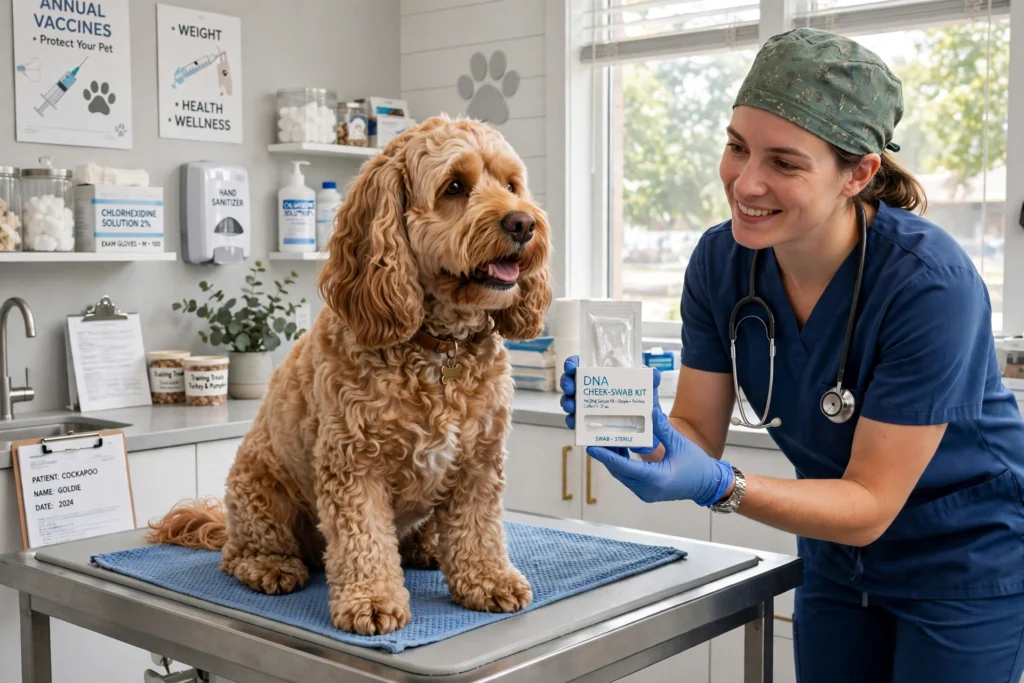
Cockapoo DNA panel: the 7 tests to ask for — FN, PRA, vWD1, DM, NEWS, AMS — what clear, carrier and affected mean, and the honest limit of a clear result.
Quick answer: A Cockapoo DNA panel screens the parents for seven inherited conditions — FN, prcd-PRA, rcd4-PRA, vWD1, DM, NEWS and AMS — by cheek swab. Results read clear, carrier or affected: a carrier bred to a clear dog cannot produce an affected puppy. But a clear panel is not a health guarantee — it covers only the conditions tested.
“DNA tested” is one of the first things a good Cockapoo breeder will tell you — and one of the least explained. It sounds like a promise. It is narrower, and still useful: proof the parents were checked for a short list of inherited conditions, and that the mating could not produce an affected puppy.
A Cockapoo inherits risks from both parent breeds: the Cocker Spaniel side brings FN and AMS; the Poodle side brings NEWS and one form of PRA; both sides share the other PRA form, von Willebrand disease and degenerative myelopathy. A panel covering all seven is the standard ask.
What a DNA Panel Is — and What It Is Not
A DNA panel is a laboratory test, run once, on a cheek swab. The lab checks the dog’s DNA for specific known mutations — single faulty genes behind specific inherited conditions. The result for each condition is permanent: the dog’s DNA does not change.
That permanence separates DNA testing from the other kinds of health testing. Panjo Pets puts it plainly: DNA tests are definitive and permanent, while screening schemes — hips, elbows, eyes, heart — grade a dog at a point in time. An eye certificate is annual, so a three-year-old one tells you about a three-year-old dog.
What a panel is not: a general health check, a diagnosis, or a guarantee. It tests only for the mutations on the list — a dog clear for all seven can still develop hip dysplasia, heart disease, cancer or allergies.
The Panel: Seven Tests in Plain Words
The reference panel is Laboklin’s Cockapoo DNA bundle: AMS, DM, NEWS, vWD1, FN, prcd-PRA and rcd4-PRA — one cheek swab, results in 2–3 weeks. Other labs differ slightly, so check which tests are on the panel you are shown; Pet Genetics Lab’s £149 panel adds EIC and OCD but lists only prcd-PRA. In the US, many breeders use a broad Embark panel (270+ conditions) instead.
| Test | Gene | What it is |
|---|---|---|
| FN | COL4A4 | Inherited kidney failure |
| prcd-PRA | PRCD | Slow blindness |
| rcd4-PRA | — | Late-onset PRA |
| vWD1 | VWF | Bleeding disorder |
| DM | SOD1 | Progressive hind-leg weakness |
| NEWS | ATF2 | Fatal puppy brain disease |
| AMS | GDNF | Loss of pain feeling in paws |
FN — Familial Nephropathy (COL4A4)
The kidney test. In FN, the kidneys fail in a young dog — onset is usually between 6 months and 2 years, and it is fatal. It comes from the Cocker Spaniel side: just over 10% of English Cocker Spaniels in the UK carry the mutation, according to the British Cockapoo Society. There is no treatment — which is why the test matters: two clear parents cannot produce an affected puppy.
Our Cockapoo kidney disease guide covers FN in full — the signs, the DNA test, and daily care for affected dogs.
prcd-PRA and rcd4-PRA — Progressive Retinal Atrophy (PRCD)
Two different DNA tests for the same disease family. In PRA, the light-sensing cells of the retina gradually break down; the dog goes blind slowly — night vision first, then day vision. There is no treatment.
prcd-PRA is the form most breeders test for first. rcd4-PRA is a second mutation causing a late-onset form — sometimes called LOPRA — so a good panel tests for both: a dog clear for prcd-PRA can still carry rcd4-PRA. It pairs with the annual eye examination — a DNA test plus a current eye certificate, not one or the other. Our eye problems guide covers PRA in full.
vWD1 — Von Willebrand Disease Type 1 (VWF)
A bleeding disorder: von Willebrand factor helps blood clot, and a dog with too little of it bleeds longer than it should. Most affected dogs live normal lives — the problem only shows up at the worst moment: surgery, injury, or spaying. That is why the test matters even though the disease is often silent: a vet who knows a dog has vWD1 plans surgery differently. Note the “type 1” — only type 1 is the Cockapoo-relevant one.
DM — Degenerative Myelopathy (SOD1)
A progressive spinal cord disease: weakness and loss of coordination in the back legs, slowly getting worse. No cure. Two honest caveats: the SOD1 test shows risk, not a diagnosis — some dogs with two copies never develop DM — and DM is a disease of older dogs, so a clear result on a puppy’s parents is about the long term, not the first year. Still worth having on the panel. Our joint problems guide covers the conditions that overlap with DM’s early signs.
NEWS — Neonatal Encephalopathy with Seizures (ATF2)
The Poodle-side test. NEWS is an autosomal recessive developmental brain disease. Affected puppies are extremely weak from birth; those that survive the first week generally develop progressively worse unsteadiness and a whole-body tremor, and do not survive to adulthood. It is rare but entirely preventable: two clear parents cannot produce an affected puppy. If a breeder’s panel is missing NEWS, ask why.
AMS — Acral Mutilation Syndrome (GDNF)
An inherited sensory neuropathy from the Cocker Spaniel side: the nerves that carry pain signals from the paws do not work, so an affected dog cannot feel pain in its feet — and will chew or injure its own paws without noticing, usually as a young dog. Like FN and NEWS, it has no cure and DNA testing can prevent it outright.
Clear, Carrier, Affected — What the Results Mean
This is the part most buyers misunderstand, and the part that matters most. Almost every condition on the panel is autosomal recessive: a dog needs two copies of the faulty gene — one from each parent — to develop the condition. One copy is not enough. That gives three possible results, recorded by the Kennel Club as clear, carrier or affected.
Clear (N/N). No copies of the mutation: the dog will not develop the condition and cannot pass it on.
Carrier (N/Mut). One copy. The dog is healthy — the normal copy compensates — and will almost certainly never develop the condition, but it can pass the faulty copy to about half its puppies. A carrier is not a sick dog or a bad breeding dog.
Affected (Mut/Mut). Two copies. The dog will likely develop the condition — for DM, is at risk of it — and passes a faulty copy to every puppy.
The pairing table is the whole point of testing:
| Pairing | Puppies |
|---|---|
| Clear × Clear | 100% clear — no risk |
| Clear × Carrier | 50% clear, 50% carrier — safe, no affected puppies |
| Carrier × Carrier | 25% clear, 50% carrier, 25% affected — avoid |
| Clear × Affected | 100% carrier — no affected puppies, all carriers |
| Carrier × Affected | 50% carrier, 50% affected — never breed this pairing |
Two rules. First, the only pairing that must never happen is carrier-to-carrier (or worse) — the one that produces affected puppies. Second, a carrier is not a reason to remove a dog from breeding: the Kennel Club’s advice says carriers can be bred to clear dogs, and warns that breeding only from clear dogs shrinks the gene pool and makes new inherited diseases more likely. Carrier on one parent, clear on the other: responsible breeding. Two carriers mated together: walk away.
How the Test Is Done
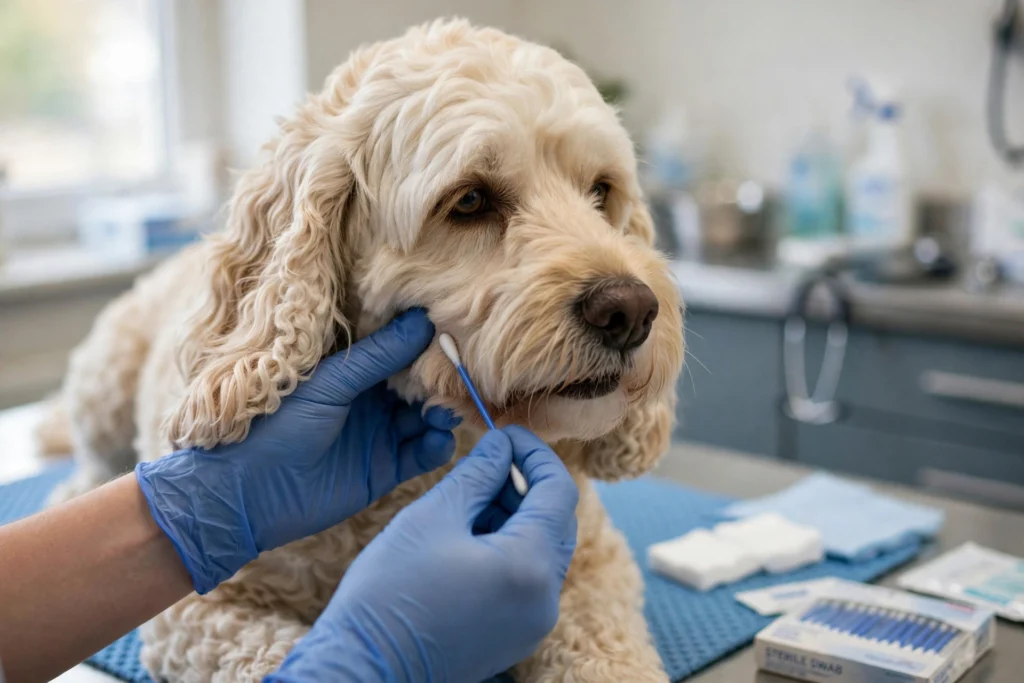
The lab sends a cheek-swab kit: a small brush rubbed inside the dog’s cheek for a few seconds. No blood, no vet visit, no pain. Results arrive in 2–3 weeks for a breed panel (Laboklin’s bundle) or 2–4 weeks for a broad US panel (Embark Breed + Health, about $159–$199). The result is permanent.
Ask for the parents’ results before you buy, not the puppy’s: a puppy’s panel tells you about the puppy; the parents’ panels tell you the mating was safe.
 CockapooDaily
What to Ask the Breeder — the Certificate Checklist
“DNA tested” on a website is a claim. A certificate is proof:
1. The lab certificates for both parents, for all seven tests. Each certificate should show the dog’s registered name, the test name, the result, the date, and the lab’s name. A screenshot of a spreadsheet is not a result.
2. Both parents, not one. One clear parent plus one untested parent is half a job — the pairing table needs both sides.
3. The eye certificate, current. DNA covers PRA; the annual eye examination covers everything else that can go wrong with eyes, including conditions with no DNA test. If it is three years old, it tells you about a three-year-old dog.
4. Patellas and hips. Petful lists a patella evaluation alongside the DNA panels, and Panjo Pets adds a hip score — physical screenings no DNA test covers. Our breeder questions guide has the full list — this article is the explainer for the DNA half of it.
5. What the breeder does with a carrier. The right answer is “bred only to a clear dog.” Wrong answers: “we don’t breed carriers” and “we didn’t check the other parent.”
If asking feels awkward, that is information about the breeder. A good breeder sends the certificates unprompted, before you visit.
Testing Your Own Dog
You do not need a breeder to test a dog: a home kit gives a rescue, a rehome, or a puppy from an untested litter the same information. In the US, the usual choice is Embark Breed + Health (about $159–$199, results in 2–4 weeks), screening 270+ conditions including the Cockapoo-relevant ones. In the UK, the Laboklin bundle or the Pet Genetics Lab panel covers the seven breed tests directly.
Three things to know. First, order the health version of the kit, not the breed-only version. Second, share the results with your vet: a vWD1 result changes how surgery is planned, a prcd-PRA result changes how vision is monitored. Third, a result is not a diagnosis — a DNA test flags risk; a dog that tests “at risk” for DM may never develop it, and a dog with symptoms and a clear panel still needs a vet.
Thinking of breeding your Cockapoo? Read our should-I-breed guide first, and test both parents before mating.
The Honest Limit: A Clear Panel Does Not Guarantee a Healthy Dog
A clear panel means the dog is clear for the conditions tested — not free from every inherited disorder, structurally sound, or genetically superior. Seven boxes are ticked.
What a panel cannot see: hip and elbow dysplasia (dozens of genes plus weight, exercise and environment); most heart disease, including the mitral valve disease Cockapoos are prone to; most cancers; allergies and skin disease; and temperament, which has no test at all. It also cannot see conditions nobody has found a gene for yet — the panel only tests known mutations.
Panjo Pets says it best: testing tells you the breeder is engaging with the known risks. That is a floor, not a guarantee — a fully tested litter can still produce a dog with a condition nobody screens for. So use the panel as it is meant to be used: a check that the breeder did the known, preventable work — alongside vet checks, eye and hip screenings, and the breeder’s honesty. Our common health problems guide covers what a panel cannot test for, and our vet visit schedule covers the check-ups that catch the rest.
A clear panel from a breeder who skips everything else is worth less than one from a breeder who does it all. The DNA test is one piece of evidence, not the whole case.
Red Flags
- “DNA tested” with no certificates. A claim without paperwork.
- Only one parent tested. The table needs both sides.
- A panel missing FN, PRA or NEWS. These are the core three; a panel without them is not a Cockapoo panel.
- Two carriers mated together. A 25% chance of affected puppies.
- “Clear panel, guaranteed healthy.” No honest breeder promises that.
- A carrier parent hidden — or presented as sick. Carriers are healthy dogs; hiding a result is worse than having one.
Frequently asked questions
What DNA tests should a Cockapoo breeder do?
The seven-test Cockapoo panel: FN, prcd-PRA, rcd4-PRA, vWD1, DM, NEWS and AMS — plus an annual eye certificate, a patella evaluation and a hip score. The DNA half is one cheek swab per parent; the rest are physical screenings no DNA test replaces.
What does carrier mean on a dog DNA test?
A carrier has one copy of a faulty gene and one normal copy. For the recessive conditions on the panel, a carrier is healthy and will almost certainly never develop the condition — but can pass the faulty copy to about half its puppies. Bred to a clear dog, it produces no affected puppies.
Can two carrier Cockapoos be bred?
They should not be. A carrier-to-carrier mating gives each puppy a 25% chance of being affected for every condition both parents carry. The safe pairings are clear-to-clear and clear-to-carrier. If a breeder mated two carriers, walk away.
How much does a Cockapoo DNA test cost?
A breed-specific panel runs about £149–£180 in the UK (Pet Genetics Lab £149; Laboklin’s bundle £180 including VAT), results in 2–3 weeks. In the US, a broad panel such as Embark Breed + Health runs about $159–$199, results in 2–4 weeks, and screens 270+ conditions. One cheek swab covers the whole panel, and the result is permanent.
Does a clear DNA panel mean my Cockapoo will be healthy?
No. It means the dog is clear for the seven conditions tested — not hip dysplasia, heart disease, most cancers, allergies or temperament, and not conditions nobody has found a gene for yet. A clear panel is the floor of responsible breeding, not a guarantee.
Conclusion
A Cockapoo DNA panel screens the parents for seven inherited conditions — FN, prcd-PRA, rcd4-PRA, vWD1, DM, NEWS and AMS — from one cheek swab, with results that read clear, carrier or affected. Clear is ideal; a carrier must only be bred to a clear partner; carrier-to-carrier is the pairing to avoid. Ask for both parents’ lab certificates by name, plus a current eye certificate, patellas and hips. A clear panel means seven known risks are covered, not that the dog is guaranteed healthy. It is the floor of responsible breeding; the rest — vet checks, screenings, raising and honesty — is what makes a breeder worth buying from.
Leave a Reply