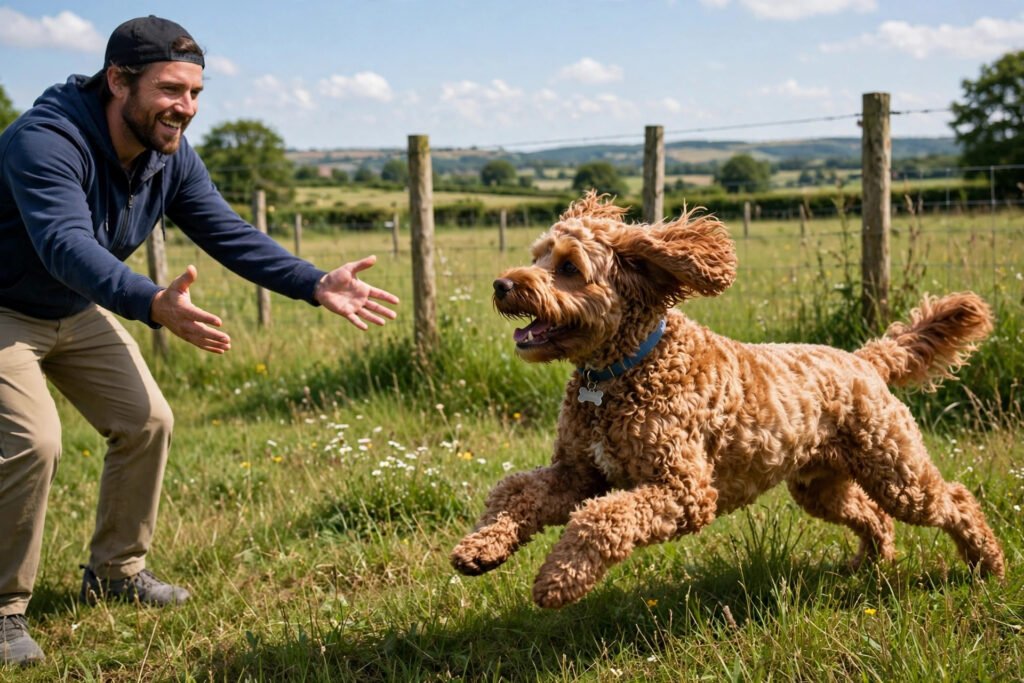
Teach your Cockapoo a recall that holds up around squirrels, dogs, and dropped sandwiches — a staged ladder from indoors to off-leash, with a pass rule.
Quick answer: Build recall in stages, and do not skip one. Start indoors with a cheerful “come” and a big reward, then the yard, then a 15–30 foot long line, then distractions one level at a time. Move up only when your dog responds fast 8 times out of 10. Never punish a return, and never call when you cannot enforce it.
Recall is the most important thing you will ever teach your Cockapoo. It is the difference between a relaxed off-leash walk and a dog sprinting toward a road. It is also the skill owners most often say “works at home but not at the park” — and that sentence tells you everything about what went wrong. The dog did not learn recall. The dog learned to come when nothing interesting was happening. Real recall is built where the distractions are, one level at a time, with a safety net underneath until the habit is solid.
What Recall Really Is (and Why Cockapoos Fail at It)
Recall is not a word. It is a habit: your dog hears the cue, turns away from something interesting, runs to you, and lets you hold them — every time, without weighing the options. That habit is built from hundreds of repetitions where coming back was the best deal on offer, never from a single training session.
Cockapoos fail at recall in two distinct ways, and the fix depends on which one you have:
- The chaser. Squirrels, rabbits, birds, cats — the prey drive kicks in and the dog is gone before you finish the word. This dog needs distance work, a long line, and a reward that competes with a chase. If your Cockapoo is a serious chaser, our prey drive guide explains the instinct you are working against — recall training does not remove prey drive, it outbids it.
- The greeter. Other dogs, children, joggers, anyone who might say hello. This dog is not running away from you; they are running toward something social. This dog needs greeting impulse control and distraction work around people and dogs specifically, plus the same staged ladder.
Many Cockapoos are both, on different days. The ladder below handles both, because it builds the habit before it tests it.
The Rules Before You Start
These five rules are non-negotiable, and breaking any one of them is how most recalls get ruined:
- Never punish a dog for coming back. No matter how long it took, no matter what they rolled in, no matter how angry you are — if they came, they get rewarded. Scolding a returning dog teaches them that coming back is dangerous, and next time they will stay away longer.
- Say the cue once. Repeating “come, come, come, COME!” teaches your dog that the first four calls mean nothing. Say it once, in a cheerful voice, and then make it happen (with the long line, if needed).
- Never call when you cannot enforce it. If your dog is off-leash in an open field and you have no way to make the recall happen, do not call. Every ignored call teaches them that “come” is optional. Go get them instead, calmly, and go back a stage in training.
- Pay like it matters. In the early stages, coming back should be the best-paying job your dog has. Use high-value rewards — small pieces of real meat or cheese, a favorite game, whatever your dog values most — and save the very best rewards for recall only.
- Keep a separate emergency cue. Pick a special word you almost never use — “pronto,” “emergency,” a whistle pattern — and pair it with a jackpot reward (a whole handful of treats, a big game) every single time. Practice it rarely, reward it massively, and keep it in reserve for the day you truly need it.
One more equipment rule: use a flat long line, 15 to 30 feet, clipped to a back-clip harness — not a retractable leash. Retractable leashes teach pulling and give you no clean way to guide a dog in. A long line is a safety net, not a dragging tool: you step on it or pick it up to prevent a failure, and you reel gently, never yank.
Stage 1: Indoors — Build the Word
Start in a quiet room with no distractions. This stage usually takes a few days, and it is the foundation everything else stands on.
- Say your dog’s name, then “come,” in a happy, upbeat voice. Crouch slightly and open your arms — be inviting, not stern.
- The moment your dog reaches you, reward heavily and make a fuss. Then add the collar grab: gently hold their collar or harness for a second, feed a treat, and release. This one habit prevents the most frustrating recall failure of all — the drive-by, where the dog runs past you at full speed and keeps going.
- Repeat from different spots in the house. Call from another room. Call when your dog is mildly distracted by a toy. Keep sessions to five minutes, several times a day.
- Add a release: after the reward, say “go play” or “free” and let them return to what they were doing. This teaches the most important lesson of recall training — coming back does not mean the fun is over. Dogs that believe recall ends the fun will stop coming.
Move on when your dog comes promptly at least 8 or 9 times out of 10 indoors, including from another room.
Stage 2: The Yard — Add Distance
The yard adds space, smells, and mild distractions, but it is still a controlled environment. Use the same sequence, now with distance:
- Start close, then gradually call from farther away. Do not jump from 5 feet to 50 feet in one session.
- Play the ping-pong game: two people stand apart, take turns calling the dog, and reward each arrival. Dogs love this game, and it builds speed — the dog learns that running to a person pays, fast.
- Practice recall-and-release here too: call, reward, send them back to sniffing. The yard is where most owners accidentally teach “come means we go inside,” and that lesson kills recall. Break it deliberately, every session.
- If your dog hesitates or wanders, do not repeat the cue. Walk calmly to them, guide them in, reward, and shorten the distance next time. A failure is information: the step was too big.
Move on when recall is prompt at full yard distance, 8 or 9 times out of 10, including when your dog is sniffing something interesting.
Stage 3: The Long Line — Your Safety Net
This is the stage most owners skip, and it is the reason most recalls fail at the park. The long line bridges the gap between on-leash and off-leash: your dog gets freedom, and you keep the ability to enforce the cue.
- Use a 15–30 foot flat line on a back-clip harness. Let your dog wander and sniff for a few minutes first — do not call the instant you arrive somewhere exciting.
- Call once. If your dog does not respond within a few seconds, gently reel in the slack while repeating nothing — just guide them to you, then reward heavily the moment they arrive. The line guarantees that every call ends in success, which is exactly how the habit gets built.
- Practice in several locations: a quiet park at off-peak times, a friend’s yard, a trail. A recall that only works in your yard is not a recall.
- When your dog is responding promptly on the line in multiple places, let the line drag on the ground behind them. They have the feeling of freedom, but you can still step on the line if they ignore a call. This is the last step before true off-leash work, and many owners stay here for weeks. That is correct — there is no prize for rushing.
Move on only when your dog responds fast at least 9 times out of 10 on the long line across multiple locations.
Stage 4: The Distraction Ladder
Proofing means testing recall against the specific distractions your dog will actually face, one level at a time. Do not jump levels.
| Level | Setting | Typical distractions |
|---|---|---|
| 1 | Quiet room at home | None |
| 2 | Yard, hallway, quiet garden | Mild smells, a toy |
| 3 | Front yard or driveway | People or dogs in the distance |
| 4 | Park at quiet times | Other dogs 50+ feet away, joggers |
| 5 | Park at busy times | Dogs, children, bikes, squirrels up close |
The rules of the ladder: only move up when your dog responds fast at least 8 times out of 10 at the current level. If your dog fails twice in a row at a level, drop back one level — that is information, not failure. Use your highest-value rewards only at the higher levels, so the pay scales with the difficulty. And set up controlled versions of hard distractions where you can: a friend with a calm dog at a distance, a helper dropping a treat trail, a ball rolling past. Controlled practice beats hoping the real world cooperates.
For the greeter dog, spend extra time at levels 3 and 4 with people and dogs at a distance, shrinking that distance gradually. For the chaser dog, spend extra time with movement distractions — a rolling ball, a helper jogging past — always on the long line, always with a reward that competes.
Stage 5: Off-Leash — The Readiness Checklist
Do not remove the line because training feels good. Remove it because your dog passes this checklist:
- [ ] Responds fast at least 9 times out of 10 on a dragging long line, in at least three different locations.
- [ ] Recalls away from other dogs and from wildlife at a distance, on the line.
- [ ] Comes even when you are not holding food visibly (rewards can be unpredictable by now, but they must still happen often).
- [ ] Lets you hold the collar or harness on arrival, every time.
- [ ] You have a separate emergency cue, practiced and jackpot-rewarded.
First off-leash sessions should be in a fenced area — a secure dog park at a quiet time, a friend’s fenced field — not an open trail. Keep the first sessions short, call a few times, reward generously, and leash up while things are going well rather than waiting for a failure. And know your local rules: off-leash is only an option where it is legal and safe. Near roads, livestock, wildlife areas, or cliffs, the long line stays on no matter how good the recall is. A reliable recall is a safety net, not a force field.
Recall Games That Build Speed
Training sessions should feel like games, not drills. Three that build real speed:
- Ping-pong recall. Two people, one dog, take turns calling. Reward every arrival. Add distance gradually. Dogs run faster to a game than to a command.
- Hide and seek. While your dog is distracted, duck behind a tree or a door and call. The surprise element builds urgency — your dog learns that finding you quickly pays.
- Restrained recall. Have a helper hold your dog gently while you back away excitedly with a treat or toy, then release on your cue. The brief restraint builds drive to run to you. Keep it short and joyful, never frustrating.
Play these for a few minutes at the end of a walk or training session, when your dog is already warmed up and happy. A fast recall is a happy recall — if your dog trots back slowly, the reward is not valuable enough or the distraction level is too high. Fix one of those two things, not the dog.
Retraining a Ruined Recall
If your dog has already learned that “come” means “maybe, if I feel like it,” you have a poisoned cue — and the fix is not to repeat it louder. It is to start over with a clean cue:
- Pick a new word (“here,” “close,” “to me”) or a whistle. Whistles carry farther than voices, cut through wind and distance, and have no frustrated tone attached to them — which is why many trainers prefer them for the final version of recall.
- Rebuild from Stage 1 with the new cue, exactly as above, and do not use the old word at all during the rebuild.
- Do not use the new cue in situations where your dog can ignore it until it is solid on the long line. Protect the new cue the way you should have protected the old one.
This takes weeks, not days, and it is worth it. A dog with one reliable cue is safer than a dog with a word they have learned to discount.
When Recall Fails in the Moment
It will happen, even with good training. Do not chase — your dog will treat it as a game and run faster, and a Cockapoo that thinks running away starts a game is a dog that will keep running. Instead:
- Run away from your dog, crouch down, and sound excited. Most dogs will chase you back.
- Use a squeaky toy or an interesting sound if you have one.
- If your dog is on a long line, step on it calmly and guide them in — no scolding, no drama.
- When you have them back, reward. Yes, even though they ignored you. Punishing a return is how you guarantee the next failure is worse.
Then, afterward, diagnose honestly: was the distraction level too high? Was the reward too low? Did you call when you could not enforce it? Fix the setup, not the dog, and go back one stage for a few sessions.
Troubleshooting the Common Failures
“She comes close, then dodges past me.” You skipped the collar grab. Go back to Stage 1 and practice hold-the-harness-then-treat on every single arrival until grabbing is part of the arrival, not an interruption of it.
“He comes indoors but ignores me outside.” The distraction ladder was skipped. Your dog has a living-room recall. Go back to Stage 3 on the long line and climb the ladder properly, one level at a time.
“She comes, but slowly, sniffing everything on the way.” The reward does not beat the environment. Upgrade the reward — higher value, faster delivery, a game instead of a biscuit — and shorten the distance until speed returns.
“He only comes when he sees the treat.” You made the treat a bribe instead of a reward. Start calling with empty hands sometimes, and reward from a pocket or pouch after arrival. Keep rewards frequent but unpredictable — every recall pays, but not always with the same thing.
“Recall was perfect until adolescence.” Normal. Adolescent dogs test boundaries and their excitement outruns their training for a few months. Go back to the long line, rebuild through the ladder, and do not take it personally. Most dogs come out the other side with a stronger recall than before, because it was rebuilt deliberately instead of assumed.
Frequently Asked Questions
What age should I start recall training?
As early as possible — puppies can start Stage 1 indoors from their first week home, and the earlier the habit forms, the easier it is. But it is never too late: adult and senior dogs learn recall the same way, just sometimes more slowly if they have practiced ignoring a cue for years.
Is a whistle better than the word “come”?
A whistle has real advantages: it carries farther, it sounds the same every time, and it cannot sound angry. Many owners use “come” for everyday recall and a whistle as the emergency cue. Either works if it is trained properly — the consistency matters more than the sound.
How long until my Cockapoo’s recall is reliable?
The basics indoors take a week or two of short daily sessions. A recall that holds up around real distractions usually takes months of regular practice, and the long line should stay in use in open spaces until your dog responds fast at least 8 times out of 10 at that difficulty level. There is no shortcut past the ladder.
Can I ever trust my Cockapoo off-leash near roads?
No — not on recall alone. Near roads, livestock, wildlife, or cliffs, keep the long line on regardless of how good the recall is. Recall is a safety net for accidents, not permission to gamble with traffic.
My dog only comes when I have treats. Is that a problem?
Not at this stage — it is the training working. Over time, shift from a treat every time to unpredictable rewards: sometimes a treat, sometimes a game, sometimes just huge praise and a release back to play. What you must never do is stop rewarding altogether. Even a fully trained dog should be paid for recall regularly, for life.
Conclusion
A Cockapoo that comes when called is not a naturally obedient dog — it is a dog whose owner built the habit properly, one stage at a time, and protected the cue from ever becoming optional. Start indoors this week, get a long line before you need it, climb the distraction ladder without skipping levels, and keep paying for every return. The payoff is the thing every Cockapoo owner wants most: a dog you can trust with freedom, because freedom was earned in stages rather than gambled on in one afternoon. If your recall has already been poisoned, start over with a new word — it is weeks of work, and it is worth every session.


Leave a Reply