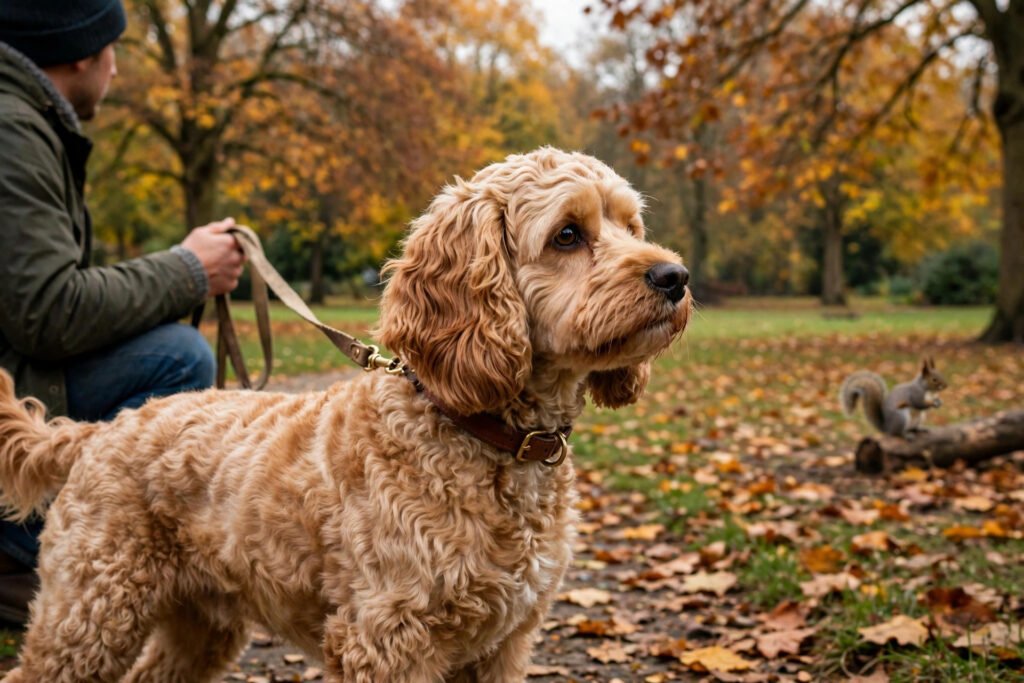
Yes, most Cockapoos have a moderate to high prey drive. Learn why they chase squirrels, how to build recall, and when to keep your dog on leash.
Quick answer: Yes, most Cockapoos have a moderate to high prey drive, inherited from two hunting breeds. Expect sudden lunging at squirrels, birds, rabbits, and fast-moving small animals, especially on walks. You cannot train the instinct away, but you can manage it with a strong recall, impulse-control games, and honest leash rules.
If you have ever watched a calm, cuddly Cockapoo turn into a lunging, barking missile at the sight of a squirrel, you have seen prey drive in action. One second your dog is walking politely; the next it is straining at the leash, eyes locked, body tense, completely deaf to its name. Owners often worry this means their dog is aggressive or badly trained. Usually it means neither. It means your dog is doing exactly what its ancestors were bred to do.
Competitor coverage of this topic is almost entirely anecdotal: one Cockapoo-only page tells a funny story about chasing squirrels and stops there. This guide gives you the part owners actually need — why the drive exists, which animals trigger it most, how to train around it, and when to accept that a leash is the kindest option.
What Is Prey Drive, Exactly?
Prey drive is the instinct to notice, chase, and sometimes grab something small that moves quickly. It is a sequence, not a single behavior: orient (freeze and stare), stalk (creep forward), chase (run after it), and, in some dogs, grab or shake. Most pet Cockapoos show the first three steps strongly and rarely complete the last one, which is why a squirrel chase usually ends with the squirrel up a tree and the Cockapoo barking at the trunk, unsure what it would have done next.
Prey drive is not aggression. An aggressive dog wants to threaten or harm another animal out of fear, guarding, or conflict. A prey-driven dog is excited, not angry, and the same dog that lunges at a squirrel is usually gentle with people and friendly with other dogs. That distinction matters for training: you do not punish prey drive out of a dog, you redirect and manage it, because punishment for an instinctive response usually adds frustration and makes the lunging worse.
Prey drive also varies by individual. Some Cockapoos barely glance at a squirrel. Others lose all self-control at the sight of a falling leaf. Age, exercise, and training all shift the intensity, but the underlying instinct does not disappear. A realistic goal is a dog that notices prey, checks in with you, and can be called back — not a dog that never notices prey at all.
Why Cockapoos Have It: Two Hunting Parents
A Cockapoo inherits prey drive from both sides, which is why it is so common in the cross.
The Cocker Spaniel side was bred to flush game birds from cover: push through brush, startle birds into flight, and retrieve them. That job rewards exactly the traits that frustrate owners today: a strong nose, a love of rustling undergrowth, and explosive excitement at sudden movement.
The Poodle side was originally a water retriever, bred to find and fetch birds from water. Poodles are often pictured as fancy show dogs, but underneath the haircut is a working retriever with a keen eye for movement and a strong desire to chase and carry.
Combine those two histories and you get a small dog with a big hunting instinct, a sharp eye, and a body built for quick bursts. The same traits that make a Cockapoo fun — alertness, energy, enthusiasm — are the traits that fire when a squirrel runs across the path. Understanding that history does not excuse dangerous chasing, but it does explain why “just ignore the squirrel” is not realistic advice on its own.
What Cockapoos Chase Most
Squirrels. The number one trigger, by far. Squirrels are the perfect prey-drive target: small, fast, erratic, and everywhere in parks and neighborhoods. Most Cockapoo owners report squirrel lunging as the first and most persistent prey-drive problem.
Birds. Pigeons, ducks, and garden birds trigger the same response, especially when they take off suddenly from the ground. A Cockapoo that ignores a bird on a branch may still bolt at one that flushes from underfoot.
Rabbits and chipmunks. Less common in cities, but very strong triggers where they live. A rabbit bolting across a trail can override even a well-trained recall in an untrained dog.
Cats and small pets. This is the trigger with the highest stakes, because the “prey” may be a neighbor’s cat or a family pet. Many Cockapoos learn to live peacefully with a familiar cat while still chasing unfamiliar cats outdoors, because familiarity and training change the response even when the instinct stays. For the full picture of Cockapoo-cat introductions, see our guide to are Cockapoos good with cats.
Moving objects. Some Cockapoos generalize prey drive to joggers, cyclists, skateboards, and even cars. If your dog chases wheels or runners, treat it with the same training plan, and keep the dog on leash near roads regardless of progress.
Can You Train Prey Drive Away?
Honestly, no — and any trainer who promises to eliminate it is overselling. What you can do is build a competing set of behaviors that are stronger than the chase in most situations: a recall your dog loves, an impulse-control habit, and a leash routine that prevents rehearsal of the chase. Think of it as management plus training, not a cure.
The biggest mistake is practicing only in easy places. A recall that works in your living room is not a recall that works when a squirrel crosses the trail. Training must progress in stages, from no distractions to mild distractions to real prey triggers at a distance, and each stage must be solid before the next one starts. Rushing to the park and hoping for the best is how dogs learn that ignoring you pays off.
The second mistake is relying on punishment. Yelling, jerking the leash, or scolding a lunging dog usually adds arousal to arousal: the dog is already over threshold, and the owner’s shouting becomes part of the excitement. Calm, planned training — rewarding the dog for looking at you instead of the squirrel — works better and keeps your dog’s trust intact.
 CockapooDaily
Building Recall That Works Around Distractions
Recall is the single most valuable skill for a prey-driven Cockapoo, and it is built in layers.
Step 1: Make recall pay, indoors. Use a happy, distinct recall word (your dog’s name plus “come,” or a whistle if you prefer). Call once, reward immediately with a high-value treat — real meat, cheese, or a favorite toy — every single time. Indoors, recall should be the best deal your dog ever gets.
Step 2: Add distance and mild distractions. Practice in the yard, then in a quiet park, then in busier places. Reward every successful recall, and do not call your dog for something unpleasant (a bath, leaving the park) immediately after a recall, or the word will lose its value.
Step 3: Practice at a distance from prey. Find a place where squirrels are visible but far away — across a field, for example. The moment your dog notices the squirrel but before it lunges, call and reward for looking back at you. This is the “look at that” game: dog looks at trigger, dog looks back at you, dog gets paid. Over many repetitions, looking back becomes a habit.
Step 4: Use a long line before going off leash. A 20 to 30 foot long line in a safe, open area lets your dog practice recall with real freedom while you still have a safety net. If the dog bolts, the line — not a chase through traffic — stops it. Only go fully off leash in enclosed areas until recall around squirrels is reliable, not just good on quiet days.
Step 5: Never punish a slow recall. If your dog finally comes back after chasing a squirrel, reward the return. Punishing a dog for coming back teaches it that returning is risky, which is the opposite of what you want. The chase itself is managed by prevention next time, not by scolding after the fact.
For the leash skills that support this training, see our Cockapoo leash training guide, which covers pulling, loose-leash walking, and the equipment that helps most.
Impulse Control Games That Actually Help
Recall is the emergency brake; impulse control is the daily practice that makes the brake work. These games are short, fun, and directly relevant to prey drive:
“Look at me.” In a calm setting, reward your dog for making eye contact on cue. Build duration gradually, then practice with mild distractions, then with distant squirrels. A dog that can look at you on cue has an alternative to staring at prey.
“Leave it.” Teach your dog to turn away from a treat on the ground in exchange for a better reward from your hand. Start easy, then generalize to dropped toys, then to moving toys, then to real-life distractions at a distance. “Leave it” is the verbal version of impulse control.
“Wait” at doors and gates. A dog that bolts through every open door is rehearsing the same impulsive launch that causes squirrel chases. A short wait before going out, rewarded calmly, builds the habit of pausing before rushing.
Flirt pole play, with rules. A flirt pole (a toy on a rope attached to a pole) lets your dog chase in a controlled way, with built-in stops: chase, stop, drop, wait, chase again. It satisfies the chase sequence safely and teaches the dog that stopping mid-chase earns another chase. Keep sessions short, on soft ground, and stop before your dog gets overexcited.
Sniff and search games. Hiding treats or toys for your dog to find uses the same nose and brain that hunting uses, but in a calm, controlled form. A dog that gets regular mental work is less frantic on walks, because its needs are already partly met. For how early socialization shapes these behaviors, see our Cockapoo socialization guide.
Leash Management and Safe Off-Leash Rules
Training takes time, and in the meantime your dog still needs walks. Honest leash rules keep everyone safe:
Near roads, always on leash. No recall is reliable enough to trust next to traffic, especially with a prey-driven dog. A squirrel across a road is a genuine danger, not a training test.
Use a harness and a comfortable grip. A front-clip harness or a well-fitted back-clip harness gives you control without choking, and a standard leash gives better control than a retractable leash, which teaches pulling and gives you no way to reel a lunging dog in quickly.
Scan ahead. Experienced owners of prey-driven dogs learn to read the environment: squirrels on a fence, birds on a lawn, a cat under a car. Spotting the trigger first lets you create distance or start a “look at me” game before your dog is over threshold.
Off leash only where it is safe and legal. Enclosed dog parks, fenced fields, and secure yards are the right places for off-leash practice. Open parks near roads, wildlife areas, and places with livestock are not, no matter how well your dog behaved last time.
If your dog escapes after prey, stay calm. Do not chase — you will lose, and chasing turns the event into a game. Instead, crouch, call happily, and offer a high-value reward, or run away from your dog so it chases you. If the dog is heading toward a road, alert others and call your dog’s name calmly rather than screaming.
When Prey Drive Is a Bigger Problem
Most prey drive is normal and manageable, but a few situations deserve extra help. If your dog has ever caught and injured a small animal, if it redirects frustration onto the leash or onto you when it cannot chase, if it fixates for long periods and cannot be interrupted even at a distance, or if it chases cars or cyclists, talk to a qualified, reward-based trainer or a veterinary behaviorist. These are not failures on your part; they are signs the dog needs a structured plan beyond general training advice.
Also watch for the overlap with barking. A dog that lunges at squirrels often barks at them too, and the two behaviors reinforce each other. If barking is a separate problem at home, it helps to address it on its own terms; see our guide to do Cockapoos bark a lot for that side of the picture.
Frequently Asked Questions
Do Cockapoos have a high prey drive?
Most do, at a moderate to high level, because both parent breeds were hunting dogs. Individual dogs vary, but squirrel, bird, and rabbit chasing is common and normal for the cross.
Can you train a Cockapoo to stop chasing squirrels?
You cannot remove the instinct, but you can greatly reduce chasing with recall training, impulse-control games, and leash management. The goal is a dog that notices prey and checks in with you, not a dog that never notices prey.
Is prey drive the same as aggression?
No. Prey drive is excitement and chasing instinct; aggression is threatening or harmful behavior driven by fear, guarding, or conflict. A prey-driven Cockapoo is usually gentle with people and other dogs.
Should I let my Cockapoo off leash if it chases squirrels?
Only in enclosed, safe areas until recall around squirrels is reliable, and never near roads. Use a long line for practice in open areas so you keep a safety net while training.
Do Cockapoos grow out of prey drive?
It often peaks in adolescence and young adulthood and may soften with age and training, but it rarely disappears entirely. Adult dogs still need management around strong triggers, especially squirrels.
Conclusion
A Cockapoo’s prey drive is not a flaw, a training failure, or a sign of aggression. It is the hunting heritage of two working breeds, showing up in a small, enthusiastic dog that loves to chase anything fast and small. You cannot train it away, but you do not have to live at its mercy either. Build a recall your dog loves, practice impulse control in small daily games, manage the leash honestly near roads and wildlife, and give the instinct safe outlets through play and sniffing games. Do that consistently, and the squirrel on the trail becomes a moment you handle, not a crisis you dread.


Leave a Reply