
Cockapoo separation anxiety: the signs checklist, the graduated calm-alone ladder that fixes it, what doesn’t work, and when to call the vet.
Quick answer: Yes — cockapoos are one of the breeds most prone to separation anxiety, because they were bred to be close companions and bond intensely. The good news: it’s a trainable condition. Most dogs improve dramatically with a graduated alone-time plan (seconds → minutes → hours) run consistently for 4–8 weeks. Severe cases — self-injury, total panic — need a vet and a certified behaviorist, not more willpower.
If your cockapoo follows you to the bathroom, sleeps pressed against your leg, and loses its mind when you pick up your keys, you don’t have a “spoiled” dog. You have a dog doing exactly what 60 years of breeding selected for — and struggling with the one part of modern life nobody bred it for: being alone.
Why Cockapoos Are Built to Struggle With Alone Time
Most anxiety-prone breeds have one risk factor. Cockapoos stack three:
- The Cocker Spaniel side is famously people-fixated — a breed developed to work with a handler all day, checking in constantly. Velcro is the factory setting.
- The Poodle side adds sensitivity. Poodles read human mood and routine changes fast — including the tiny pre-departure signals (keys, shoes, coat, bag) that most owners don’t even notice making.
- The companion breeding itself. Cockapoos weren’t selected for independence, guarding, or solo work of any kind. They were selected, generation after generation, for wanting to be near you.
Add a fourth, modern factor: many of today’s cockapoos were raised in homes where someone was around all day — pandemic puppies grew up to be pandemic adults, and a dog that has never practiced being alone hasn’t failed at it. It just never got the lesson.
The key reframe: separation anxiety is a panic response, not disobedience, spite, or bad training. You cannot punish a dog out of panic, and everything in the plan below works because it treats the panic, not the symptoms.
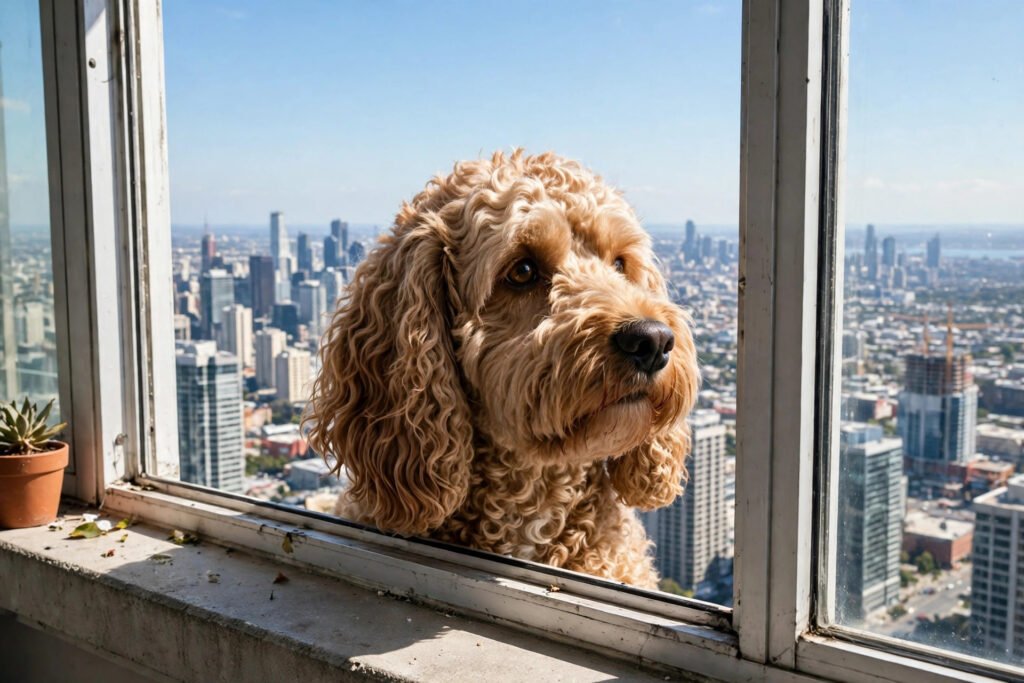 CockapooDaily
The Signs: Obvious, Subtle, and the Ones Owners Miss
| Sign | What it looks like | Notes |
|---|---|---|
| Vocalizing when alone | Barking, howling, or whining that starts within minutes of departure | Often the first sign — usually reported by neighbors, not seen by you |
| Destruction at exits | Scratched doors, chewed frames, damaged blinds | The location is the tell: exit points, not random objects |
| House soiling | A fully house-trained dog urinating or defecating when alone | Distress soiling — different from a training gap (see the table below) |
| Pacing & drooling | Restless circuits of the house, wet patches, panting on camera | Classic panic physiology |
| Escape attempts | Crate-bending, door-digging, sometimes self-injury | Red flag — this is severe-case territory |
| Refusing food when alone | The treat or Kong you left is untouched until you return | One of the most reliable subtle signs — a relaxed dog eats |
| Pre-departure anxiety | Shadowing, trembling, or clinging when you touch keys/shoes/bag | The dog has learned your leaving-routine better than you have |
| Over-the-top greetings | Frantic, prolonged, can’t-settle excitement when you return | A little joy is normal; 10 minutes of hysteria is information |
The camera test — do this before anything else. Set up a phone or tablet to record your dog for the first 30–60 minutes after a normal departure. Owners guess; cameras know. You’ll see one of three things: a dog that settles and sleeps (no anxiety — you may have a boredom problem instead), a dog that’s restless but copes, or a dog in genuine distress. The plan differs by what you find, and if you ever need a vet or behaviorist, that footage is the most useful thing you can bring.
Not Anxiety: The Look-Alikes
Treating the wrong problem wastes months. Check yours against this table first:
| Separation anxiety | Boredom | Incomplete training | |
|---|---|---|---|
| When | Only (or overwhelmingly) when alone | When alone or under-stimulated with you home | Any time — the skill was never finished |
| Targets | Doors, windows, exit points | Shoes, remotes, trash, anything fun | Random — often at “opportunity” moments |
| Eating | Often refuses food when alone | Eats everything, including your lunch | Eats normally |
| Body language | Panic signs: drooling, pacing, panting | Relaxed mischief; settles fine after | Normal |
| Fix | The calm-alone ladder below | Exercise + enrichment (see the boredom row in the bark types table) | Back to basics — e.g. the potty schedule for soiling |
The energy-vs-anxiety diagnostic in our calm-down guide is the companion check if your dog’s problem looks like general hyperactivity rather than departure distress.
The calm-alone ladder at a glance
- Stage 0 (3–5 days): make departure cues boring — keys, shoes and bag stop meaning goodbye
- Stage 1: seconds behind a closed door, building to 10 calm minutes in another room
- Stage 2: real departures in tiny, varied doses — 5 seconds, 30, 2 minutes, then back down
- Stage 3: build toward real durations — most dogs stall once around 20–40 minutes
- If the dog panics: drop back to the last dose that worked — that is the method, not a failure
- Honest timelines: 3–5 weeks for puppies, 4–8 for mild adult cases, to reach 4 calm hours
The Calm-Alone Ladder: The Step-by-Step Plan
This is graduated desensitization — the method with actual evidence behind it. The principle is simple: the dog practices being alone at doses too small to trigger panic, and the dose grows only as fast as the dog stays relaxed. Rush it and you rehearse panic instead.
Stage 0 — Decouple the triggers (3–5 days)
Your dog panics before you leave, at the signals. Break the signals’ meaning: pick up your keys and sit back down. Put on shoes and make coffee. Grab your bag and watch TV. Repeat randomly through the day until keys and coats become boring non-events.
Stage 1 — Absences inside the house (week 1)
Step behind a closed door for 2 seconds. Return calmly. No greeting ceremony — you’re just… back. Build to 1, 5, then 10 minutes in another room. Add a mat or bed as the dog’s “independent rest” spot and pay calm behavior there, including while you’re home.
Stage 2 — Real departures, tiny doses (weeks 1–2)
Out the front door for 5 seconds. Then 30. Then 2 minutes, 5, 10. Vary the numbers — 3 minutes, then 1, then 6, then 2 — so the dog can’t predict that every absence is longer than the last. If the dog panics at any step, drop back to the last dose that worked and rebuild in smaller increments. That isn’t failure; that is the method.
Stage 3 — The build (weeks 2–6)
Extend toward real durations: 20 → 40 → 60 minutes, then 90, then 2 hours. Leave a camera running. Most dogs stall once — commonly around 20–40 minutes — and need a week of patience at that rung. Typical honest timelines:
| Starting point | Realistic timeline to 4 calm hours |
|---|---|
| Puppy, starting fresh | 3–5 weeks (they have no bad history) |
| Adult, mild anxiety (restless, vocal, settles eventually) | 4–8 weeks |
| Adult, established anxiety (destruction, soiling) | 8–12+ weeks |
| Severe (escape attempts, self-injury) | Vet + behaviorist plan — months, and that’s normal |
The rules that make it work
- Boring exits, boring returns. No long goodbyes, no excited homecomings. Arrive and depart like you’re getting the mail. For the first minutes home, be dull.
- Exercise before, not after. A walked, fed, toileted dog starts the absence tired. A morning walk before work departures is the single highest-value schedule change most owners can make.
- Practice on days off. If the dog is only ever alone on your longest, hardest days, every absence is the deep end. Short practice absences on weekends build the skill.
- Never punish what you find. The chewed door happened hours ago, during panic. Punishing it teaches the dog that your return is also scary — now both ends of the absence are bad.
- One variable at a time. Don’t extend duration and change location and skip the exercise the same day.
 CockapooDaily
The Daily Structure That Supports the Plan
Training sessions build the skill; the daily routine protects it.
- Independent rest, daily. Even when you’re home all day, the dog should have periods settled on its own bed or mat — not touching you. Velcro 24/7 at home makes 8 alone hours impossible.
- Enrichment for absences. A frozen Kong, lick mat, or snuffle mat left at departure gives the brain a job. Note the diagnostic bonus: if the food is untouched when you return, anxiety is overriding appetite — useful information about which rung you’re really on.
- A consistent safe space. Some dogs settle better with free roam of one puppy-proofed room; others relax in a crate they’ve been properly trained to love. The right answer is whichever the camera shows your dog resting in. Never use a crate to contain a panicking dog that isn’t crate-trained — that’s how escape injuries happen.
- Sound cover. Low background audio (talk radio, calm TV) masks the silence and the hallway noises that trigger alert barkers in apartments.
By Age: Different Starting Lines
- Puppies (under 6 months): Alone time is a skill to build now, in minutes, alongside the potty training schedule. Hard limit: roughly an hour per month of age, and ~2 hours max for young puppies regardless. A puppy that never practices alone becomes the adult in the 8–12 week row of the table.
- Adolescents (6–18 months): The regression window. Dogs that were fine alone at 4 months sometimes unravel at 9. It’s developmental, not defiance — return to an earlier rung of the ladder without resentment.
- Adults: The full ladder as written. The most common failure is owners jumping from “fine for 10 minutes” to a full workday. The rungs between are the whole point.
- Seniors: New-onset separation distress in an older dog warrants a vet visit first — pain, cognitive dysfunction, and sensory loss all present this way. Senior plans run slower, with more frequent, shorter absences.
What Doesn’t Work (Save Your Money and Months)
- “Just get a second dog.” Sometimes a confident companion helps; often you get an anxious dog plus a puppy who learns from it. A second dog is a wonderful decision for other reasons — as an anxiety treatment, it’s a coin flip you can’t return.
- Cold-turkey long days. “He’ll get used to it” works for mild uncertainty. For genuine anxiety, flooding rehearses full panic for 8 hours — the dog doesn’t habituate, it sensitizes.
- Calming products as the whole plan. Pheromone diffusers, calming chews, and anxiety wraps have modest evidence as support. None replaces the ladder. If a product alone fixed separation anxiety, behaviorists would be out of work.
- Punishment and bark collars. The dog is panicking. Adding pain or fear to panic is how you build a dog that’s anxious and suppressed — quieter on camera, worse inside. (The barking protocol covers why symptom-suppression backfires.)
When It’s Beyond DIY: Vet & Behaviorist Time
Escalate — promptly, without guilt — when you see self-injury or escape attempts, refusal to eat for entire absences, panic that isn’t improving after 4 weeks of consistent ladder work, or any sudden onset in an adult or senior dog.
What professional help actually looks like: your vet rules out medical contributors and, for moderate-to-severe cases, may discuss daily anti-anxiety medication or situational meds for departures. Medication isn’t “drugging the dog” — it lowers panic enough for the training to land, and it’s often temporary. A certified behaviorist (CAAB, or a CSAT — Certified Separation Anxiety Trainer, who typically works remotely by camera) builds the ladder around your exact footage and schedule. This is one of the most treatable behavior problems in dogs when it’s treated as what it is.
Frequently Asked Questions
How long does it take to fix cockapoo separation anxiety? Weeks, not days — and the ladder in this article is the honest timeline. Owners typically see the first signs of improvement after a few days of graduated practice and a real change after about two weeks; most families film a sleeping dog within two months. Any method promising a fix in a weekend is selling suppression, not training.
Should I leave music or TV on for my cockapoo? Yes — soft background sound helps. A radio or TV left on gives the house a normal sound level and masks the outside noises that trigger alert barking, and a piece of your clothing nearby adds a familiar scent. It is comfort, not a cure: on its own it will not fix real separation anxiety, but it makes every rung of the ladder easier.
Is it OK to leave a cockapoo puppy alone for a full workday? No. Puppies under 6 months should not be left alone for more than 2–3 hours — small bladders, high anxiety, and a real need for company. Adolescents manage up to 4 hours with a proper setup; healthy adults 4–6 hours. A full workday alone is not realistic or fair for this breed at any age without a walker, daycare, or someone coming home at lunch.
What should I do before I leave to help my cockapoo settle? Walk them first, then give the brain a job: a frozen stuffed food toy, a lick mat, or a short training session before you go. A tired, mentally worked Cockapoo is far more likely to rest than one that has been asleep on the sofa all morning and is suddenly alone with a full battery. Then leave calmly — no long goodbyes, no drama at the door.
Will my cockapoo grow out of separation anxiety? Not reliably, no. Some dogs get more confident after age 2 and the anxiety eases, but separation anxiety does not always resolve on its own — and it can come back in seniors, who may need shorter alone times again for health and bathroom reasons. The fix is the graduated training in this article, not waiting; every month of waiting is a month the panic pattern gets stronger.
How long can a cockapoo be left alone?
A healthy, trained adult: 4–6 hours is the realistic ceiling for this breed — and it’s a ceiling to build toward, not a starting point. Puppies need far less (about an hour per month of age). Regularly need 8+ hours covered? That’s a dog-walker or daycare budget line, not a training failure.
Can separation anxiety be cured completely?
For most mild-to-moderate dogs, it improves to the point of being a non-issue: calm dog, boring footage. Severe cases usually become manageable rather than “cured.” Be suspicious of any program promising a fast total cure — the honest timelines are in the table above.
Does getting another dog fix separation anxiety?
Unreliably. If the anxiety is specifically about being without any company, a calm adult companion sometimes helps. If it’s about being without you, a second dog changes nothing except your workload. Test with a borrowed dog or a dog-sitter stay before committing.
Is a crate good or bad for an anxious cockapoo?
Neither, inherently. A crate-trained dog that naps in its crate voluntarily: great tool. A panicking dog shut in a crate it hasn’t been trained to accept: injury risk. The camera decides — film both setups and keep the one where the dog actually rests.
Do calming treats or diffusers work?
As mild support, for some dogs, a little. As a plan, no. Think of them as the comfortable shoes, not the marathon training. If your dog is in real distress, the vet conversation matters more than any product.
The Bottom Line
Cockapoo separation anxiety is the shadow side of the breed’s best trait — nothing loves you like a cockapoo, and nothing minds your leaving like one either. It’s panic, not naughtiness; it responds to graduated practice, not punishment or flooding; and the camera tells you the truth at every rung. Climb the ladder patiently — boring exits, tiny doses, one variable at a time — and most families film a sleeping dog within two months.
Next: Barking is often the loudest symptom — do cockapoos bark a lot? separates anxiety barking from the other six types and gives you the quiet-cue protocol.



Leave a Reply