Is your Cockapoo shaking at fireworks or thunder? Build a safe room, a before-during-after plan, and a weeks-ahead sound ladder — plus what never to do.
Quick answer: Do not try to fix fear on the night itself — manage it. Set up an interior safe room with a covered crate (door open), bedding, water, and background sound. Close the curtains, keep your Cockapoo leashed for potty breaks, and stay calm. Real improvement comes from sound training started weeks ahead, in tiny steps, below the fear threshold.
Your Cockapoo is not being dramatic. Dogs hear far more than we do, and they feel things we cannot — the thump of a firework through the floor, the drop in air pressure before a storm, the static in the air before lightning. A dog that was relaxed at dinner can be trembling under the bed an hour later, and it can feel like it came out of nowhere. It did not. Your dog simply noticed the storm before you did.
This article covers fireworks and thunder together because the fear is the same, but the planning is not. Fireworks are predictable: you know the date, so you can prepare for days. Thunder is not: a storm can roll in while you are at work. One protocol handles both, with two different kinds of preparation. That is the piece most existing pages miss — they cover one event or the other, and they leave you with a tip list instead of a plan.
Why Fireworks and Thunder Scare Dogs
A Cockapoo’s hearing is far more sensitive than yours, and sudden, loud, low-frequency sounds are genuinely startling to them. Fireworks add flashing light and ground vibration. Thunder adds barometric pressure changes, static electricity, wind, and rain noise — a full package of strange sensations, not just one bang. That is why some dogs react to storms before the first thunderclap: they are responding to the pressure drop and the static, not the sound.
There is no evidence that Cockapoos are more prone to noise fear than other breeds. Some Cockapoos sleep through fireworks; others panic. A dog can also be fine with one and terrified of the other — that is normal, and it tells you the trigger is specific, not a general “nervous dog” problem. Age matters too: noise fear often appears or worsens between 1 and 3 years old, and senior dogs can become more sensitive as their hearing and coping ability change.
How to Tell Fear From Excitement
Fear and excitement can look similar at first — both involve pacing and panting — but the body language is different, and it matters because the response is different.
| Sign | What it usually means |
|---|---|
| Trembling, tucked tail, ears pinned back | Fear |
| Hiding, trying to squeeze into small spaces | Fear — let them hide |
| Pacing, panting, drooling, wide eyes | Fear or high arousal |
| Clinginess, following you room to room | Fear — seeking safety |
| Refusing food or treats they normally love | Fear past the coping threshold |
| Trying to escape, scratching at doors, jumping fences | Panic — a safety emergency |
| Barking at each bang, running to the window | Arousal or alerting, not always fear |
The refusing-food test is the most useful one you have. A dog that will still eat treats is coping. A dog that will not touch a favorite treat is past the point where training can happen that night — your job switches from training to management, which means safety and comfort until it passes.
Fireworks vs Thunder: Why One Plan Needs Two Halves
Fireworks are scheduled. In the United States, the big nights are July 4, New Year’s Eve, and often the days around them, plus local events and neighbors setting off their own. Because you know they are coming, you can prepare: exercise early, feed early, set up the safe room, arrange to be home, and check ID tags days ahead.
Thunder is unscheduled. A storm can arrive while you are out, while your dog is in the yard, or in the middle of the night. The preparation for thunder is therefore a standing setup, not a one-night plan: a safe room that is always available, a storm routine your dog already knows, and a habit of checking the forecast. Many dogs also react to the pre-storm cues — pressure, wind, static — so a dog that starts pacing on a still, humid afternoon may be telling you a storm is coming before your weather app does.
The other difference is duration. A fireworks display lasts an hour or two. A storm system can rumble on and off all night, and dogs can stay anxious for hours after the last bang. Plan for a long night with thunder, not a short one.
The Safe Room: Build It Before You Need It
The safe room is the single most useful thing in this article, and it should exist before firework season or storm season starts — not be improvised at 9 p.m. on July 4.
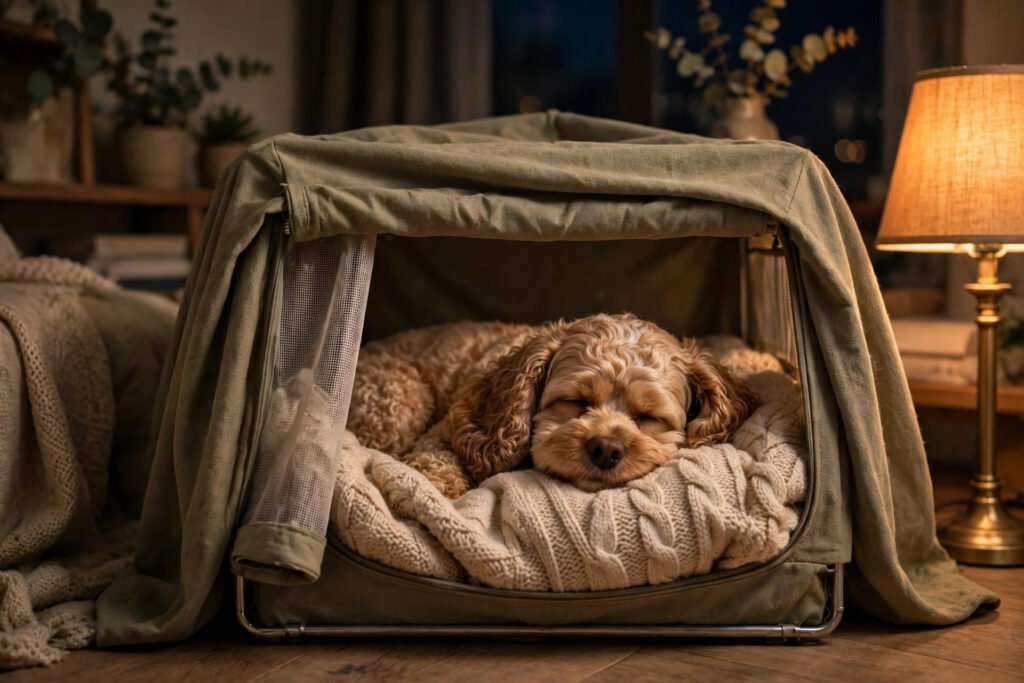
Pick the most interior room in your home, away from outside walls and windows if possible. A bathroom, walk-in closet, or interior bedroom works well. In it, place:
- A crate with the door left open, covered with a thick blanket to muffle sound and block flashes. The crate only helps if your dog already likes it — a dog that is not crate trained will not suddenly find a crate comforting during a panic. If your Cockapoo is not crate trained, a covered den made from blankets over a table or a cozy corner works the same way. Our crate training guide covers how to build that positive association before you need it.
- Familiar bedding and something that smells like you, such as a worn T-shirt.
- Fresh water. Anxious dogs pant and drink more.
- A long-lasting chew or a stuffed food toy, for dogs that will still eat.
- Background sound: a fan, white noise, music, or the television at normal volume. Start it before the noise begins, not after — it raises the background floor so individual bangs are less startling.
Close the curtains and blinds in the rest of the house too, to block flashes. And let your dog choose: if they want to hide under the bed instead of using the room you built, that is fine. Hiding is a coping strategy, not misbehavior. Never drag a dog out of a hiding place during a fear event.
One warning that matters: never confine a panicking dog in a closed crate or a locked room if you cannot monitor them. A dog in full panic can injure itself trying to escape confinement. The crate door stays open. The room door can be closed to muffle sound, but only if you are with the dog or checking on them regularly.
Before, During, and After: The Checklists
Before firework season (July 4, New Year’s Eve, local events)
- Check ID tags and microchip registration now, not on the day. Shelters see a marked spike in lost dogs after major firework nights, because panic overrides recall completely. A dog that would never normally run can bolt through a gate it has ignored for years.
- Walk and feed early on the day, so your dog is tired and settled before dark. A tired dog copes better than a restless one, and a dog that has already eaten will not need a late potty trip during the display.
- Set up the safe room in the morning, not in the evening rush.
- Arrange to be home, or arrange a trusted sitter who knows the plan. Leaving a noise-fearful dog alone on July 4 is the single most common avoidable mistake.
- Check your yard: gates latched, fences intact, no gaps a panicking dog could squeeze through.
- Keep your Cockapoo leashed for every potty break from dusk onward, even in a fenced yard. Fireworks can start at any moment, and a leash is the difference between a scare and a lost dog.
- Never take your dog to a fireworks display. This sounds obvious, but people do it every year, and it is one of the fastest ways to create a noise phobia in a dog that did not have one.
Before storm season (a standing routine)
- Keep the safe room set up all season, so it is familiar rather than new.
- Check the forecast each morning in storm season, the way you would check for rain before a walk.
- If storms are forecast, exercise and feed earlier, and plan to be home or have someone check in.
- Keep a flashlight handy for nighttime potty breaks during power outages, and keep those breaks short and leashed.
During the event
- Stay calm and act normal. Your dog reads your behavior: if you are pacing, checking the radar every minute, and fussing anxiously, you are signaling that something is wrong. Be boring. Sit, read, watch television.
- If your dog comes to you, comfort them. Let them lean on you, speak normally, pet them if they want it. Comfort does not reinforce fear — fear is an emotion, not a behavior, and you cannot reward an emotion into being stronger. This is the myth most older pages get wrong, and it causes owners to ignore a terrified dog for no reason.
- Offer food, chews, or a game, but do not force them. If your dog will not eat, they are past the coping threshold — just stay nearby and wait.
- Keep the background sound on and the curtains closed.
- Do not try to train during a real event. No sound recordings, no new exercises. Management only.
After the event
- Check the yard and gates before the next off-leash potty break — storms and fireworks can damage fences.
- Let your dog settle at their own pace. Some dogs bounce back in minutes; some stay jumpy for hours. A quiet evening, a familiar routine, and normal sleep help more than anything else.
- Note what worked. Did the safe room help? Did the background sound matter? Did your dog hide somewhere specific? Write it down for next time — your dog’s preferences are data, and next season you will start ahead instead of from scratch.
What NOT to Do
- Do not punish fear. Scolding, shouting, or spraying a trembling dog teaches them that the scary thing also brings punishment from you. It makes the fear worse and damages trust.
- Do not flood. Flooding means exposing the dog to the frightening sound at full volume in the hope they “get used to it.” In practice, it usually sensitizes them — it makes the fear worse, not better. Desensitization works precisely because it never crosses the fear threshold.
- Do not force a dog out of hiding. If they chose the closet, the closet is the safe place. Leave them there.
- Do not leave a fearful dog alone in the yard during fireworks or storms. Panic plus an open gate is how dogs get lost.
- Do not start sound training the week before July 4. Real desensitization takes 8 to 12 weeks minimum. Starting too late and rushing the volume steps is worse than not starting, because a bad session at too high a volume can undo weeks of progress.
- Do not rely on a single product. A pressure wrap or calming music can help at the margins, but neither replaces management and training. Anyone promising instant, drug-free elimination of fear is selling, not helping.
Sound Training That Actually Works
This is the only method with solid veterinary behaviorist support for genuinely reducing noise fear, and it has an honest timeline: expect 8 to 12 weeks minimum, and longer for severe cases. That is why this section comes after the management sections — management gets you through this season, training changes next season.
Step 1: Teach a settle first. Before any sound work, your dog should be able to relax on a mat or bed on cue. That relaxed posture becomes the anchor for everything else. If you do not have a settle yet, our calm-down guide covers the foundation.
Step 2: Start almost inaudibly. Use a fireworks or thunder recording played through a speaker. Begin at a volume so low you can barely tell it is playing. Most owners start far too loud — if your dog notices the sound at all in the first sessions, it is too loud.
Step 3: Pair sound with something exceptional. While the sound plays at that barely-audible level, feed high-value treats your dog gets at no other time. Sound plays, exceptional food appears. Sound stops, food stops. You are building a new association: this sound predicts wonderful things.
Step 4: Keep sessions short. Five to ten minutes, once or twice a day. Short, successful sessions beat long ones.
Step 5: Watch for any stress signal. Lip licking, ear position changes, yawning, stopping eating, leaving the mat — all mean you went up too fast. Drop back to the last comfortable level and stay there for several sessions before trying again.
Step 6: Increase in tiny increments, only when your dog is completely relaxed and eating happily at the current level. Weeks, not days, per stage. And train in a season when real fireworks or storms are unlikely — an accidental full-intensity exposure during training can erase weeks of progress.
Puppies are the exception that proves the rule. Puppies in the socialization window, roughly 3 to 14 weeks, can be introduced to recorded fireworks, thunder, traffic, and household bangs at low volume paired with food, and most will simply never develop a problem. If you have a young puppy, this is the highest-value use of your training time — prevention is dramatically easier than treatment. Our socialization guide covers how to structure that window.
Calming Aids, Honestly Assessed
Pressure wraps (thunder jackets). These apply gentle, constant pressure, like swaddling. The honest evidence: they help some dogs a bit, they do nothing obvious for others, and they are not a cure for a real phobia. If you want to try one, introduce it weeks before you need it — put it on during calm times paired with treats, so the wrap itself does not become a predictor of scary nights. Take it off for short breaks every hour or two to avoid irritation, and check with your vet first if your dog is elderly or unwell. Do not buy one on July 4 and expect it to work that night.
Background sound and music. Cheap, harmless, and genuinely useful as part of the safe room. It will not fix fear alone, but it reduces the startle effect of individual bangs.
Calming supplements and pheromone products. Evidence is mixed and individual. They are low-risk for most dogs, but treat them as a possible small addition, not a plan.
Veterinary support for severe cases. If your dog injures itself, tries to escape through windows or fences, panics for hours after the noise stops, or does not improve with management and training, talk to your vet. Vets can discuss situational anxiety support for severe cases and refer you to a veterinary behaviorist. This article deliberately does not name medications or doses — that conversation belongs with a vet who has examined your dog, not with a blog post.
When to Get Professional Help
Get help sooner rather than later if: your dog has injured itself during a panic; escape attempts are escalating; panic lasts for hours after the event ends; your dog has stopped eating, drinking, or toileting normally around storms; or the fear is spreading to other sounds such as traffic, appliances, or voices. A veterinary behaviorist can build a plan that combines training with medical support in a way a general article cannot. Noise fear that is getting worse year over year will not fix itself — but it is also one of the most treatable behavior problems when it is caught and worked on properly.
Frequently Asked Questions
Can I comfort my scared Cockapoo, or will that make it worse?
Comfort them. You cannot reinforce an emotion. A frightened dog that leans on you is seeking safety, and providing it lowers their stress. What you should avoid is frantic, high-pitched fussing that signals you are also alarmed — stay calm, speak normally, and let them stay close.
Do thunder jackets actually work?
For some dogs, a little. They are best understood as one small tool inside a bigger plan: safe room, background sound, management, and training. They work best when introduced weeks ahead during calm times, not first worn during a storm.
How long does desensitization take?
A minimum of 8 to 12 weeks of short, careful sessions for most dogs, and longer for severe cases. That is why it must start in a quiet season, not the week before July 4. Rushing it makes the fear worse.
My Cockapoo is fine with fireworks but terrified of thunder. Why?
Thunder is a package, not a single sound: pressure changes, static, wind, rain, and lightning flashes, often lasting for hours. Fireworks are shorter and more predictable. A dog can also learn to associate the pre-storm cues — the still air, the pressure drop — with the scary part, so they start reacting before the first bang.
What if fireworks start with no warning?
Get your dog inside and leashed immediately, move to the safe room or an interior room, put on background sound, close the curtains, and stay with them. Then, the next day, fix the preventable part: check the yard, confirm ID tags, and note the dates neighbors tend to set fireworks off so next time you are ready.
Conclusion
Your Cockapoo’s fear of fireworks and thunder is not a character flaw, and it is not something you fix in one night. Manage this season well — safe room, calm owner, leash, ID tags, never alone in the yard — and train for next season properly, with tiny sound steps over 8 to 12 weeks, starting in a quiet season. Most dogs improve substantially with that combination. The ones that do not are telling you they need veterinary help, and getting it is part of good ownership, not a failure. Start with the safe room this week, and the rest follows from there.


Leave a Reply