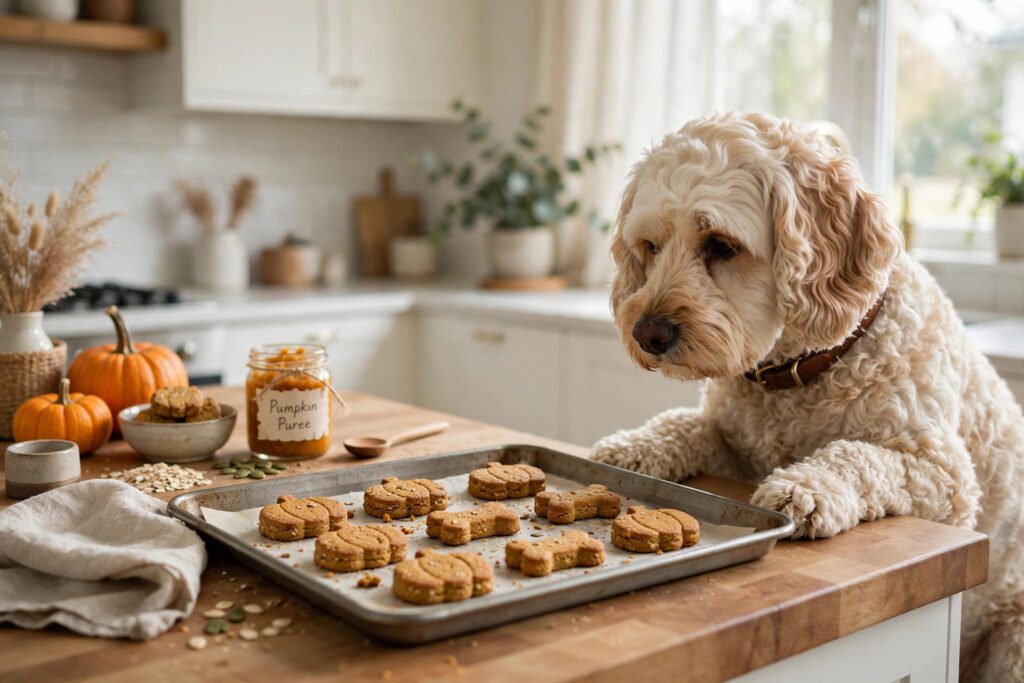
6 easy homemade treats for Cockapoos — pumpkin biscuits, frozen yogurt bites, sweet potato chews — plus the safety rules every owner must know.
Quick answer: Yes, homemade treats are safe for Cockapoos when they use dog-safe ingredients: xylitol-free peanut butter, pumpkin, oats, sweet potato, plain yogurt, banana, blueberries and chicken. Keep treats under 10% of your dog’s daily calories, introduce one new treat at a time, and never use xylitol, chocolate, grapes, onions or garlic. Puppies can start soft homemade treats from about 8 weeks.
Making treats at home is the simplest way to know exactly what your Cockapoo is eating. Store-bought treats hide long ingredient lists, added sugars and preservatives behind cute packaging, and for a breed with a famously sensitive stomach, that matters. A homemade biscuit has four ingredients you already own. A frozen yogurt bite takes five minutes. And because you made them, you know there is no xylitol, no chocolate and nothing your dog cannot digest.
This guide gives you six recipes that work for Cockapoos specifically: small-breed portions, soft options for puppies and teething dogs, and gentle choices for sensitive stomachs. Before the recipes, the safety rules — read them first, because one wrong ingredient turns a treat into a vet visit.
Before You Bake: The Safety Rules
Every recipe in this article follows these rules. If you ever adapt a recipe you found elsewhere, check it against this list first.
 CockapooDaily
The xylitol rule — the one that matters most
Xylitol is a sugar substitute that is extremely toxic to dogs, even in small amounts. It causes a rapid, dangerous drop in blood sugar and, in larger amounts, liver failure. It hides in peanut butter, so check the label of every jar, every time — xylitol is sometimes listed as “birch sugar”. Buy peanut butter whose ingredients list is just peanuts (and maybe salt). If a label lists xylitol, birch sugar, or any sweetener you do not recognise, do not use it. The FDA warns that even small amounts can cause a dangerous drop in blood sugar and liver damage in dogs.
What never goes in the bowl
Some foods that are harmless to us are dangerous to dogs. Never put any of these in a homemade treat:
| Never use | Why |
|---|---|
| Xylitol / birch sugar | Extremely toxic — rapid blood-sugar crash, liver failure |
| Chocolate and cocoa | Theobromine is toxic to dogs |
| Grapes and raisins | Can cause kidney failure, even in small amounts |
| Onions and garlic | Damage red blood cells |
| Macadamia nuts | Cause weakness, vomiting and tremors |
| Added sugar and salt | Dogs do not need them; they add calories and upset stomachs |
| Pumpkin pie filling | Contains sugar and spices — use plain pumpkin purée only |
Plain canned pumpkin is a different thing from pumpkin pie filling. The can should list a single ingredient: pumpkin. Pie filling has sugar, cinnamon in large amounts and other spices that do not belong in a dog treat.
The 10% rule
Treats of any kind — homemade or store-bought — should stay under about 10% of your Cockapoo’s daily calories. The rest of the diet should be a complete, balanced dog food. This is the single most useful number in this article, and there is a full worked-out table for it further down. If you remember one rule, remember this one.
One new treat at a time
Introduce one new recipe at a time and watch for 24 to 48 hours before trying the next one. If your Cockapoo gets soft stools, gas or an upset stomach, you will know exactly which recipe caused it. This matters most for puppies and for dogs with sensitive stomachs. Our guide to Cockapoo food allergies explains how to spot a real food sensitivity versus a one-off upset stomach.
Which human foods are safe?
The recipes below use only ingredients that are well established as dog-safe: pumpkin, oats, whole wheat flour, eggs, peanut butter (xylitol-free), sweet potato, banana, blueberries, plain yogurt and plain cooked chicken. If you want to experiment beyond these recipes, check our safe human foods list first — it covers what Cockapoos can and cannot eat, and in what amounts.
The 6 Recipes
Each recipe lists ingredients in US measures, a method, a yield, storage, and a rough calorie count per treat. Calories are approximate — they vary with the exact brands you use — so treat them as a guide, not a guarantee.
1. Peanut Butter & Pumpkin Biscuits
The classic, and the one to learn first. Three or four pantry ingredients, one bowl, and a tray of biscuits that keep for a week. Pumpkin is rich in fiber and gentle on sensitive stomachs, and peanut butter gives the flavour most Cockapoos go wild for.
You need: 2 cups whole wheat flour, 1 cup plain pumpkin purée (not pie filling), 1/2 cup natural peanut butter (xylitol-free), 1 egg, 1/2 teaspoon baking powder.
Method: Heat the oven to 350°F and line a baking sheet with parchment. Stir the flour and baking powder together, then add the pumpkin, peanut butter and egg and mix into a stiff dough. Roll it out to about 1/4 inch thick on a floured surface, cut into small shapes — Cockapoo-sized, about 1 inch across — and place them an inch apart on the sheet. Bake for 20 to 25 minutes until the edges firm up and the biscuits are golden. Cool completely on a rack before serving.
Yield and storage: About 24 small biscuits. Roughly 40 calories each. Keep in an airtight container for up to 1 week at room temperature, 2 to 3 weeks in the fridge, or up to 3 months in the freezer.
Best for: Everyday treats, training rewards, and dogs with sensitive stomachs — pumpkin is the gentlest base in this article.
2. No-Bake Pumpkin Oat Balls
No oven, ten minutes, and no baking at all. These are soft, chewy balls that work well for puppies and older Cockapoos with sore teeth, and they are the easiest recipe in this guide to make with a child helping.
You need: 1 cup plain pumpkin purée, 1/2 cup natural peanut butter (xylitol-free), 1 1/2 cups rolled oats, 1 tablespoon honey, a pinch of Ceylon cinnamon (optional).
Method: Mix everything in a large bowl until fully combined. Roll the mixture into small balls about the size of a grape — Cockapoo-sized, not golf-ball sized. Place them on a tray lined with parchment and chill in the fridge for at least 30 minutes until firm.
Yield and storage: About 15 balls. Roughly 45 to 55 calories each. Keep refrigerated in a sealed container and use within 2 weeks, or freeze for up to 3 months. These are a fridge treat, not a counter treat — they soften at room temperature.
Best for: Puppies, teething dogs and seniors. Soft texture, no crunch, nothing hard to chew.
3. Frozen Yogurt & Banana Bites
The summer recipe. Frozen treats are the one thing almost every Cockapoo loves on a hot day, and these take five minutes of actual work. A variation on the same idea — boiled chicken shredded fine and mixed with plain Greek yogurt, then frozen in cubes — is a favourite among Cockapoo owners on social media, and it works the same way.
You need: 1 cup plain Greek yogurt, 1 ripe banana, 2 tablespoons natural peanut butter (xylitol-free), a small silicone ice-cube tray or mini muffin tray.
Method: Mash the banana, stir in the yogurt and peanut butter until smooth, and spoon the mixture into the tray. Freeze for at least 3 hours until solid. Pop out one cube at a time and serve frozen.
Yield and storage: About 12 small cubes. Roughly 25 to 35 calories each. Keep frozen for up to 3 months. Serve straight from the freezer — they melt fast in a warm kitchen, so hand them over outside or on a tile floor.
Best for: Hot days, teething puppies (the cold soothes sore gums), and dogs who need a low-calorie reward. Note that a few dogs are sensitive to dairy — if your Cockapoo gets loose stools after yogurt, skip this recipe and use the sweet potato chews instead.
4. Sweet Potato Chews
One ingredient. Slice, bake low and slow, done. Sweet potatoes are a Cockapoo favourite, full of fiber, and these chews are the closest thing to a shop-bought chew that you can make at home — without the price tag or the preservatives.
You need: 2 large sweet potatoes.
Method: Heat the oven to 175°F — low is the point. Slice the sweet potatoes into thin strips, about 1/4 inch thick. Lay them on a baking tray lined with parchment and bake for 6 to 8 hours until they are dried out and chewy. Let them cool completely. Thicker slices stay chewy; thinner slices go crisp.
Yield and storage: About 20 strips. Roughly 25 calories each. Keep in an airtight container for up to 2 weeks, or refrigerate for longer. If they feel damp or soft after a few days, they need more drying time — pop them back in a low oven for an hour.
Best for: Dogs with sensitive stomachs (single ingredient, nothing to react to), chewers, and owners who want a treat with no measuring at all. The 6 to 8 hour bake time sounds long, but the work is five minutes — the oven does the rest.
5. Chicken & Sweet Potato Training Bites
Training treats need to be three things: small, soft, and gone in one second. These are pea-sized, soft-baked bites made from plain cooked chicken and sweet potato — high value enough to hold a Cockapoo’s attention, and gentle enough for a puppy’s stomach.
You need: 1 cup plain cooked chicken breast (boiled or baked, no seasoning), 1/2 cup cooked mashed sweet potato, 1 egg, 1/2 cup oat flour.
Method: Heat the oven to 350°F. Shred or finely chop the chicken, then mix it with the sweet potato, egg and oat flour into a soft dough. Roll the dough into pea-sized balls — about 1/2 inch across — and place them on a lined baking sheet. Bake for 15 to 18 minutes until just firm. Cool completely.
Yield and storage: About 30 small bites. Roughly 12 to 15 calories each. Refrigerate in a sealed container and use within 1 week, or freeze for up to 3 months. Because they are so small, they are easy to overfeed — count them out before a training session rather than reaching into the bag.
Best for: Training sessions and puppies. Use them with our puppy biting guide — a quick reward for the right behaviour works far better than a lecture for the wrong one.
6. Blueberry Oat Drops
The prettiest recipe in this guide, and the easiest to vary. Blueberries are safe for dogs, full of antioxidants, and small enough that a Cockapoo can eat them whole. These drops are soft-baked, oat-based, and done in under half an hour.
You need: 1 1/2 cups oat flour, 1/2 cup fresh or frozen blueberries, 1 egg, 1/4 cup plain Greek yogurt, 1 tablespoon honey (optional).
Method: Heat the oven to 350°F. Stir the oat flour, egg, yogurt and honey together, then fold in the blueberries gently — they burst if you stir hard. Drop teaspoon-sized spoonfuls onto a lined baking sheet and bake for 15 to 18 minutes until set. Cool completely.
Yield and storage: About 18 drops. Roughly 25 to 30 calories each. Keep in the fridge and use within 1 week, or freeze for up to 3 months.
Best for: A change from peanut butter — some Cockapoos go off peanut butter after a while, and these give you a second flavour in the rotation. Frozen blueberries work just as well as fresh, and they are cheaper out of season.
How Many Treats a Day? The 10% Rule in Numbers
“Under 10% of daily calories” is easy to say and hard to picture. Here it is in Cockapoo numbers. These are rough guides for a moderately active adult Cockapoo — check the exact daily amount for your dog in our feeding chart, because age, weight and activity all shift the numbers.
| Cockapoo size | Rough daily calories | 10% treat budget | What that looks like |
|---|---|---|---|
| Small, about 12 lb | 350–400 kcal | 35–40 kcal | 1 pumpkin biscuit, or 2–3 training bites |
| Medium, about 20 lb | 500–550 kcal | 50–55 kcal | 1 biscuit plus 1 frozen bite, or 4 training bites |
| Large, about 25 lb | 600–650 kcal | 60–65 kcal | 1–2 biscuits, or 1 no-bake ball |
Two things to notice. First, a single large biscuit can eat most of a small Cockapoo’s daily treat budget — that is why every recipe here is sized small. Second, training sessions add up fast: twenty pea-sized training bites at 15 calories each is 300 calories, which is more than half a small Cockapoo’s whole day. If you train a lot, use the chicken training bites and cut the next meal back slightly, or use part of the daily kibble ration as the training reward instead.
Puppies need the same rule applied more strictly, not less. A puppy’s daily calories are mostly going to growth, and treats are not a substitute for a complete puppy food. Keep puppy treats soft, pea-sized, and well under the 10% line.
Treats for Puppies: When to Start and What Changes
Most puppies can start soft, small treats from around 8 weeks, once they are fully weaned and eating solid food reliably. Start with tiny amounts, introduce one new treat at a time, and keep everything soft and pea-sized — a puppy’s baby teeth and small jaw cannot handle a hard biscuit, and a piece that is too big is a choking risk.
Three things change for puppies:
- Texture first. Until about 3 to 4 months, stick to soft treats: the no-bake pumpkin balls, the frozen yogurt bites, and the chicken training bites. Hard biscuits come later, once the adult teeth start coming in around 4 to 6 months.
- Teething changes the menu. Between roughly 3 and 6 months, puppies chew constantly to relieve sore gums. Frozen treats help — the cold soothes — which is why the yogurt bites are the best teething treat in this guide.
- Smaller is safer. Cut every treat down to pea-sized for a puppy, even if the recipe makes a bigger biscuit. You can always give two small pieces; you cannot un-give one piece that is too big.
If your puppy has diarrhoea, vomiting or unusual lethargy after a new treat, stop that recipe and call your vet if it does not settle within a day. Puppies dehydrate faster than adult dogs, so do not wait it out.
Sensitive Stomachs: The Gentle Recipes
Cockapoos are prone to sensitive stomachs — it is one of the most common complaints owners report, and rich or fatty treats are a frequent trigger. If your Cockapoo has a sensitive stomach, start with the two gentlest recipes in this guide and nothing else:
- Sweet potato chews — a single ingredient, nothing to react to.
- Peanut butter & pumpkin biscuits — pumpkin is rich in fiber and famously gentle on digestion, and the recipe has no dairy.
Introduce one recipe, feed it for a week, and only then try the next one. Skip the yogurt bites if dairy is a suspect — a few dogs are lactose-sensitive — and skip anything with honey until you know the stomach is settled. If your Cockapoo has recurring vomiting, diarrhoea or itchy skin after food, that is worth a vet visit rather than a new recipe: our food allergies guide covers the signs that point to a real sensitivity and what an elimination diet looks like.
How Long Do Homemade Treats Last?
Homemade treats have no preservatives, so they go off faster than shop-bought ones. The rules are simple:
- Baked biscuits: up to 1 week in an airtight container at room temperature, 2 to 3 weeks in the fridge, up to 3 months in the freezer.
- No-bake and soft treats: always refrigerated, use within 1 to 2 weeks, or freeze for up to 3 months.
- Frozen treats: keep frozen, use within 3 months.
- Sweet potato chews: up to 2 weeks airtight, longer if refrigerated.
Throw treats away if they smell off, feel damp or slimy, or show any mould — and if a batch has been sitting out in a warm kitchen for days, do not trust it. When in doubt, freeze half the batch the day you make it. Frozen treats keep for months, and you will always have a fresh supply.
FAQ
Can Cockapoo puppies eat homemade treats?
Yes, from around 8 weeks, once they are fully weaned and eating solid food. Keep treats soft and pea-sized, introduce one new recipe at a time, and stay well under 10% of daily calories. Hard biscuits should wait until the adult teeth start coming in, around 4 to 6 months.
Is peanut butter safe for Cockapoos?
Yes, as long as it contains no xylitol. Check the ingredient label every single time — xylitol is sometimes listed as “birch sugar”, and it is extremely toxic to dogs even in small amounts. Choose a natural peanut butter made from peanuts, with no added sugar or salt.
How many homemade treats can I give my Cockapoo a day?
It depends on size, but the rule is the same for every dog: all treats together should stay under 10% of daily calories. For a medium Cockapoo of about 20 lb, that is roughly 50 calories — about one pumpkin biscuit, or four pea-sized training bites. The table above works it out for small, medium and large Cockapoos.
Can I use regular flour instead of oat flour or whole wheat flour?
Yes. Whole wheat flour, oat flour and rice flour all work in these recipes. Avoid self-raising flour — it contains baking powder and salt in amounts you cannot control — and never use any flour with added sugar or flavouring.
How long do homemade dog treats last?
Baked biscuits last up to 1 week in an airtight container at room temperature, 2 to 3 weeks in the fridge, and up to 3 months in the freezer. Soft and no-bake treats should be refrigerated and used within 1 to 2 weeks. Frozen treats keep for up to 3 months. Throw away anything that smells off or shows mould.
What if my Cockapoo has a sensitive stomach?
Start with the two gentlest recipes — sweet potato chews and peanut butter & pumpkin biscuits — and introduce one at a time, a week apart. Skip dairy-based treats until you know the stomach is settled. If problems keep coming back, see your vet and read our food allergies guide rather than trying more recipes.
Conclusion
Homemade treats are the easiest upgrade you can make to your Cockapoo’s diet: four or five ingredients you already own, no preservatives, and portions sized for a small breed. Learn the peanut butter & pumpkin biscuits first, keep the frozen yogurt bites ready for summer, and remember the two numbers that matter — no xylitol ever, and treats under 10% of daily calories.
Start with one recipe this week, watch how your Cockapoo reacts, and build from there. And if you want the full picture of how much your dog should be eating overall, our feeding chart works out daily amounts by age and weight.


Leave a Reply