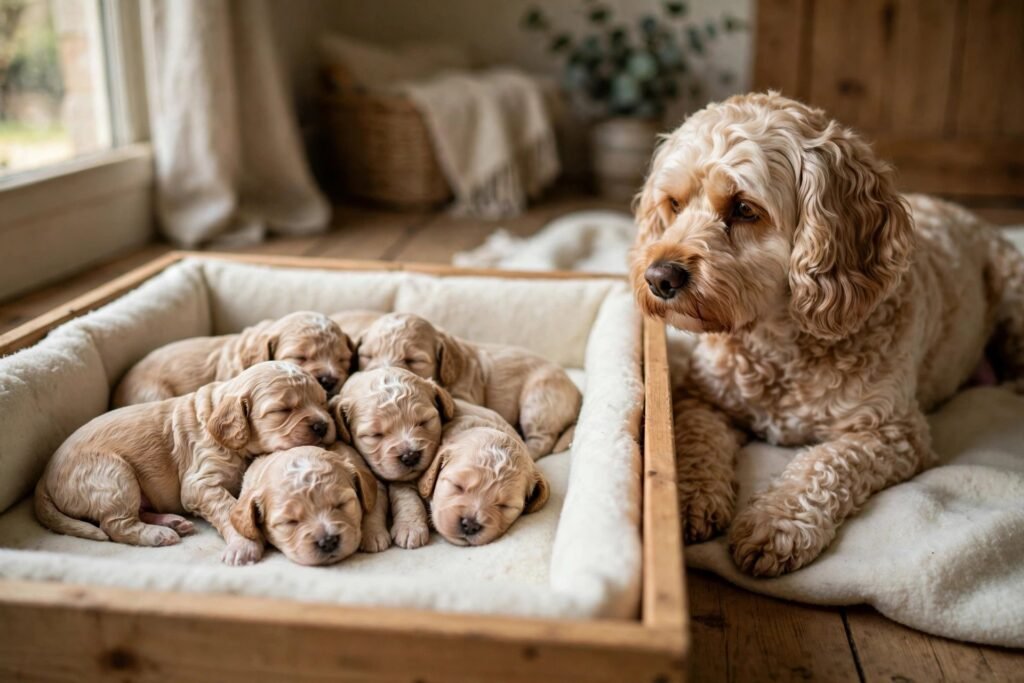
Newborn Cockapoo care, birth to 8 weeks: whelping-box warmth, daily weighing, eyes opening, weaning, first vet visit, and fading-puppy warning signs.
Quick answer: Newborn Cockapoo puppies need warmth, their mother’s milk, and daily weighing for the first 8 weeks. Keep the whelping box at 85–90°F for the first 4 days, dropping to about 72°F by week 4. Eyes open at 10–14 days, weaning starts at 3–4 weeks, and puppies go home at 8 weeks after a vet check.
Those first eight weeks look quiet from the outside — mostly sleeping and nursing — but they decide almost everything about the adult dog. A puppy that stays warm, gains weight every day, and meets the world gently in weeks 3 to 8 grows into the confident, healthy Cockapoo everyone wants. This guide walks through it week by week: what is normal, what to do, and when to call the vet.
Before birth: set up the whelping box
Everything is easier if the box is ready a week before the due date, and the mother has had time to settle into it. A Cockapoo whelping box should be big enough for the mother to lie stretched out on her side with room for the puppies beside her — roughly 36 by 36 inches for a miniature Cockapoo, larger for a standard-sized mother — with sides low enough for her to step over but high enough to keep newborns in.
Fit pig rails, the low bars fixed a few inches above the floor around the inside walls. They stop the mother rolling back against the wall and trapping a puppy, which is one of the commonest causes of newborn loss in the first days. Line the box with washable vet fleece over waterproof pads: fleece wicks moisture away and gives tiny paws grip, while the pads underneath keep the box dry. Change bedding daily, or immediately when soiled — newborns cannot regulate temperature, and damp bedding chills them fast.
Warmth is the single most important job in week one: newborn puppies cannot shiver or regulate their own body temperature for the first two weeks. Keep the whelping box at 85–90°F for the first 4 days, about 80°F by day 7–10, and about 72°F by the end of week 4. Use a heating pad under half the box only, never the whole floor, so puppies can crawl away from the heat. Check the temperature at puppy level with a room thermometer, not at your eye level. Puppies piled in a heap are cold; sprawled apart and crying, they are too hot. A contented litter sleeps side by side, loosely touching.
Keep a small kit beside the box before labor starts: clean towels, a bulb syringe, iodine for cord stumps, a kitchen scale that reads in grams, a weight chart, and your vet’s phone number written down — not just in your phone.
Week 1: warmth, milk, and weighing (days 1–7)
The first week is almost entirely nursing and sleeping — healthy newborns eat or sleep about 90% of the time. The mother should spend most of her time in the box; your job is to watch, weigh, and keep things clean and warm.
Colostrum, the mother’s first milk, matters more than anything else this week. It carries the antibodies that protect puppies until their own immune systems develop, and puppies absorb it best in the first 12–24 hours. Every puppy should latch and nurse within the first few hours. One that cannot latch, or keeps sliding off the nipple, needs help: guide it on, and if it still cannot feed, call your vet the same day. Puppies nurse every 1–2 hours at this age, for about 15 minutes at a time.
Weigh every puppy every day, at the same time, on the same kitchen scale, and write it down. This is the most reliable early warning system you have. A healthy newborn should gain 5–10% of its body weight every day and roughly double its birth weight by about day 10. A Cockapoo puppy is typically born weighing 4–8 ounces, so the trend matters more than the absolute number: steady daily gain is good, a flat line for a day is a warning, and any weight loss after day one is a reason to call the vet.
Handle the puppies briefly and gently — a few minutes each, once or twice a day — to check them over and get them used to human touch, but do not pass them around the family in week one. Check that each puppy is warm, has a round (not sunken) belly after feeding, and is wriggling and rooting for the nipple. The mother stimulates urination and bowel movements by licking; if she does not, dab the puppy’s belly and bottom with a warm, damp cloth after feeding.
Watch the mother too. She needs constant fresh water and plenty of food — a nursing Cockapoo should be free-fed a high-quality puppy food, because milk production is enormously demanding. Foul-smelling discharge, fever, lethargy, refusal to eat, or a hot, hard mammary gland are vet-visit signs the same day.
Week 2: eyes and ears open (days 8–14)
Around day 10–14, the eyes begin to open — slowly, one at a time, looking cloudy blue at first. Hearing follows at about the same time. Do not try to open a puppy’s eyes, and do not worry if littermates differ by a few days. If an eye is still shut at 16–17 days, or looks swollen or weepy, ask your vet.
Puppies still cannot regulate their temperature well, so keep the heat on, though you can start easing the box temperature down toward 80°F. They still spend most of their time sleeping and nursing, but you will see the first wobbly attempts to crawl further, and the first little yips. Start the first deworming at 2 weeks of age — your vet will advise the product and dose, typically repeated every 2 weeks until 12 weeks.
This is also the week to start gentle handling: hold each puppy for a few minutes a day, touch its ears, paws, and belly, and let it hear normal household sounds from a distance. These small exposures are the foundation of the socialization that continues after 8 weeks.
Weeks 3–4: weaning begins and the world opens up
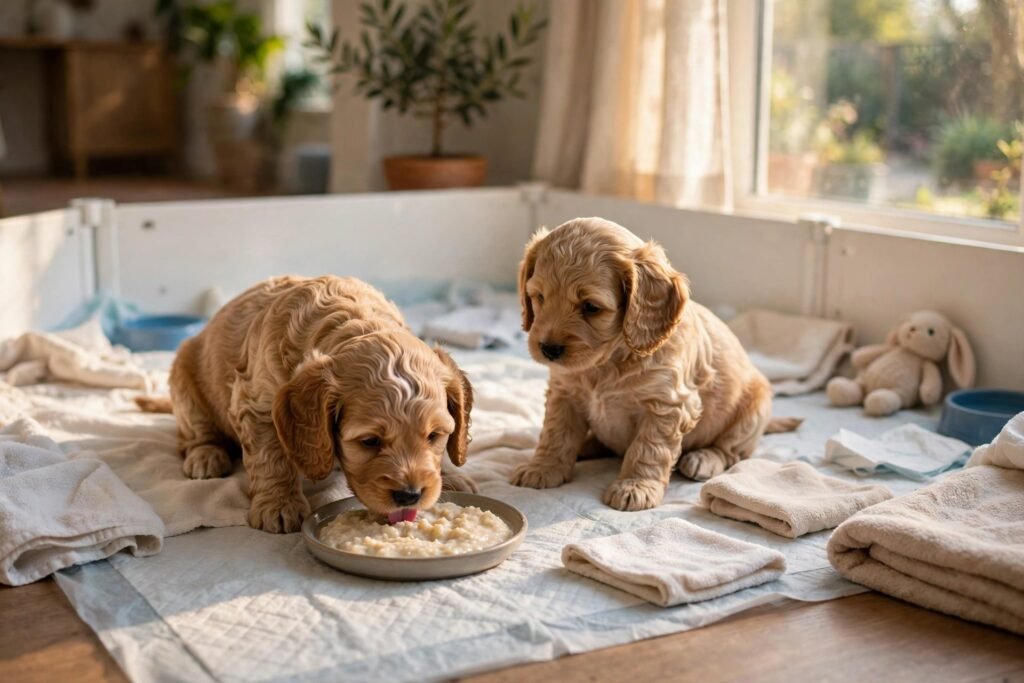
Week 3 is when everything changes. Puppies start to walk properly instead of crawling, their milk teeth begin to come in, and they try to climb out of the box. They also start to urinate and defecate on their own, which means you can introduce a potty area — a shallow tray with pads or pellets at the far end of the pen, away from the sleeping area. Most puppies learn surprisingly fast to move away from the bed to toilet.
Weaning starts at 3–4 weeks. Offer a gruel of high-quality puppy food soaked in warm water or puppy milk replacer, in a shallow dish, three to four times a day. Expect a mess — puppies walk through it and wear more than they eat at first. Over days, thicken the gruel to softened kibble, and by 8 weeks most puppies eat dry puppy food.
With the mother present, puppies still nurse between gruel meals — weaning is gradual, not a switch. Continue weighing every other day, and watch that every puppy gets to the dish. A puppy that hangs back may need a separate dish or a vet check.
Start introducing new experiences in small doses from week 3 onward: different floor textures, household noises like the vacuum from another room, gentle visitors, and short play sessions. This window — roughly 3 to 12 weeks — is when puppies form their attitudes to the world. Our cockapoo socialization guide picks up at 8 weeks.
 CockapooDaily
Weeks 5–6: play, learning, and the first vet visit
By week 5, you have a litter of very independent little dogs that run, play-fight, and explore everything. Give them a larger pen with distinct zones for sleeping, toileting, playing, and feeding. Add safe toys and different surfaces to walk on, and start short, gentle grooming — a soft brush for a minute a day so the coat, ears, and paws become familiar rather than scary.
Deworm again at 4 and 6 weeks, and book the first vet visit for around 6–7 weeks. At that visit the vet will do a full nose-to-tail check — heart, eyes, ears, mouth, belly, and joints — and talk through the vaccination schedule. First vaccinations are usually given at 6–8 weeks, covering distemper, parvovirus, adenovirus, and parainfluenza (the DHPP combination). Your vet will also advise on microchipping, which in many US states is required before sale or by a certain age, and on flea prevention if needed.
Between weeks 5 and 6, separate puppies for a few minutes at a time so they learn to be comfortable without littermates — this prevents distress on their first night in a new home. Begin simple recall games: call a puppy and reward it with a tiny treat when it comes.
Weeks 7–8: vet check, vaccinations, and handover
Week 7 is preparation week. The first vet visit, or the second if your vet splits the vaccines and health check, usually happens at 7–8 weeks. Puppies should be fully on solid food by now — dry puppy kibble, fed 3–4 times a day — and drinking water confidently. Deworm again at 8 weeks.
The handover to a new owner at 8 weeks is a milestone, not just a date. Eight weeks is the minimum age most US states allow puppies to leave their mother, and for good reason: puppies learn bite inhibition, dog manners, and confidence from their mother and littermates right up to this point. A puppy taken home at 6 weeks misses that teaching and is more likely to struggle with biting and anxiety. If you are buying, be wary of any breeder offering a Cockapoo younger than 8 weeks — it is a red flag. Our questions to ask a breeder covers what else to check before you commit.
A responsible handover includes: the vet health record and vaccination certificate, deworming dates, microchip paperwork, a small bag of the food the puppy has been eating, a blanket that smells of the litter, and feeding instructions. Our first-week-home guide walks through the crying, night waking, and accidents of that first week day by day.
For the new owner, the first vet visit of your own should happen within the first week at home, and the vaccination series continues every 3–4 weeks until about 16 weeks. Our vet visit schedule lays out the full first-year timetable, and our feeding guide covers amounts by age and size once the puppy is home.
Fading puppy syndrome: the warning signs
Most litters sail through the first eight weeks, but every breeder and owner should know the signs of a puppy in trouble. “Fading puppy syndrome” describes a newborn that fails to thrive — it stops gaining weight, grows weak, and fades over hours or days. It is an emergency, and the earlier you act, the better the odds.
Call your vet the same day — immediately if the puppy is cold or limp — if you see any of these:
- Not gaining weight or losing weight after day one, or failing to double birth weight by about day 10.
- Constant crying or, worse, silence. A healthy newborn cries when hungry or cold and settles after feeding. A puppy that cries nonstop, or goes quiet and limp, is in trouble.
- Cold to the touch, especially cold paws and belly, or a puppy that cannot stay warm even in a heated box.
- Weak or absent suckling reflex, or a puppy that keeps falling off the nipple.
- Diarrhea, vomiting, or a bloated belly, or discharge from the eyes or nose.
- A puppy that separates itself from the litter and lies alone.
While you wait for the vet, keep the puppy warm — skin-to-skin against your chest under a blanket is the fastest way — and do not try to bottle-feed a cold puppy. A chilled puppy cannot digest milk, and feeding it can make things worse. Warm first, then feed, and only on your vet’s advice. A puppy milk replacer (such as Esbilac or PetLac) is the only safe substitute; never give cow’s milk.
Caring for the mother
Newborn care is also mother care. A nursing Cockapoo needs roughly two to four times her normal calories, constant fresh water, and a quiet place to rest away from the puppies for short breaks. Watch for eclampsia (low blood calcium) in the first weeks after whelping: restlessness, panting, trembling, stiffness, or fever are emergency signs — call your vet at once. Check her mammary glands daily for heat, hardness, or pain.
Frequently asked questions
How long should newborn Cockapoo puppies stay with their mother?
At least 8 weeks. Puppies learn bite inhibition, dog manners, and confidence from their mother and littermates in weeks 6–8, and most US states set 8 weeks as the legal minimum age for sale. Taking a puppy home earlier raises the risk of biting, anxiety, and poor social skills.
When do newborn Cockapoo puppies open their eyes?
Eyes usually open at 10–14 days, with hearing following at about the same time. Littermates can differ by a few days. Never try to open a puppy’s eyes yourself; if an eye is still shut at 16–17 days, or looks swollen or weepy, ask your vet.
How often should I weigh newborn Cockapoo puppies?
Daily for the first two weeks, at the same time each day, on a kitchen scale that reads in grams. Healthy puppies gain 5–10% of their body weight daily and roughly double their birth weight by day 10. After week 2, weighing every other day is enough.
When do Cockapoo puppies start eating solid food?
Weaning starts at 3–4 weeks with a thin gruel of soaked puppy food, thickening over days to softened kibble. Most puppies are fully on solid food by 6–7 weeks and eating dry puppy kibble by 8 weeks, fed 3–4 times a day.
What temperature should the whelping box be?
85–90°F for the first 4 days, about 80°F by day 7–10, and about 72°F by the end of week 4. Heat only half the box so puppies can crawl away from the warmth, and always check the temperature at puppy level.
Conclusion
The first eight weeks pass in a blur of night feeds, weigh-ins, and laundry — but they shape the dog: warmth and milk in week one, eyes and ears in week two, first foods and first experiences in weeks three and four, and confidence and vet care in weeks five to eight. Get those right, and know the fading-puppy signs well enough to act fast, and the puppy that goes home at eight weeks has the best possible start.
Leave a Reply