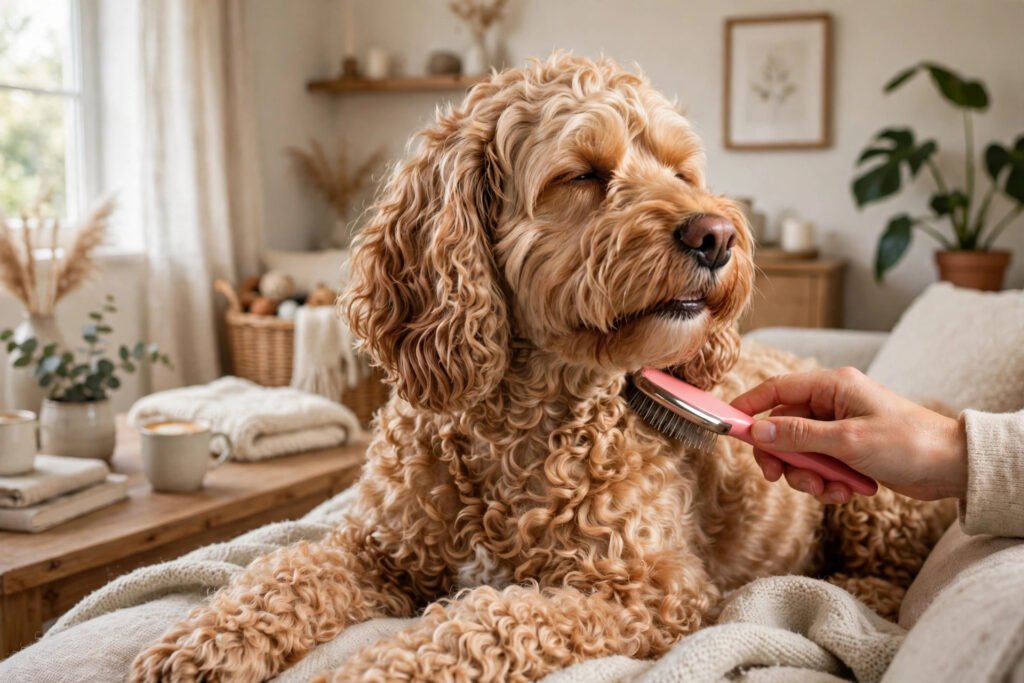
The best brush for a Cockapoo depends on its coat. Our 6 honest US picks: long-pin slicker, steel comb and dematting tool, $12–$55 — plus a coat-type chooser.
Quick answer: The best brush for a Cockapoo is a long-pin slicker brush for daily work, plus a steel comb to check your work. Curly coats need brushing 3–4 times a week, wavy coats 2–3 times, straight coats once. Our top pick is the Chris Christensen Big G (around $55); the best budget slicker is the Andis self-cleaning slicker (around $12).
A Cockapoo’s coat is the reason most owners fall for the breed — and the reason most owners end up at the groomer with a matted dog and a shave-down bill. The coat is a mix of Cocker Spaniel and Poodle hair, it tangles fast, and the wrong brush makes the job harder than it needs to be. The right brush, used the right way, keeps the coat soft, keeps mats from forming, and turns a chore your dog dreads into five calm minutes a day.
This guide is an independent comparison, not a brand’s sales page. Every dedicated page ranking for this query is either selling its own brush or more than two years old, and two of the top results are UK pages recommending products US readers cannot easily buy. The six tools below are all sold on Amazon in the US, with real prices, and each one earns its place for a different coat or a different job. None of the brands here runs an open direct affiliate program, so every product link in this article is an Amazon retailer link.
The Short Answer: Three Tools, Not One
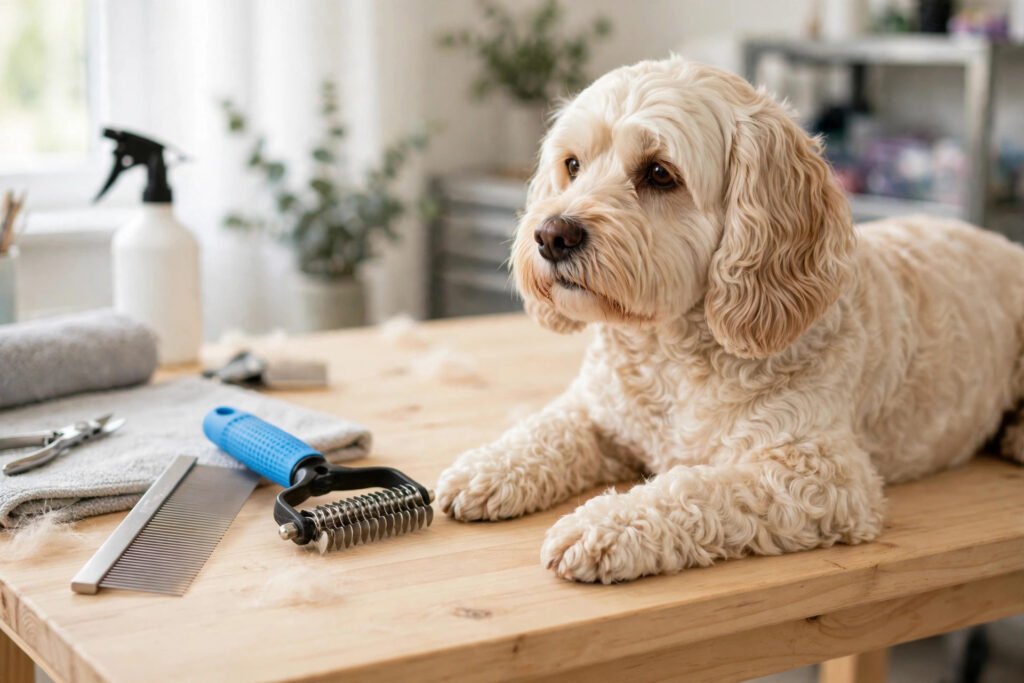
No single brush does the whole job on a Cockapoo coat. Owners who buy one brush and expect it to do everything are the ones who end up with mats. A Cockapoo needs three tools, each with a different job:
 CockapooDaily
- A slicker brush does the daily work. Its fine, bent wire pins reach through the coat, pull out loose hair, and work through light tangles before they become mats. This is the brush you will use most.
- A steel comb checks the work. After slicker brushing, the comb glides through the coat and finds the small tangles the slicker missed — especially behind the ears, under the collar, and in the armpits, where mats start. If the comb snags, the section is not finished.
- A dematting tool is for mats only. It has curved blades that cut through a mat without cutting the skin. It stays in the drawer most of the time, and it comes out only when a mat has already formed.
That is the whole kit. A slicker, a comb, and a dematting tool cover every Cockapoo coat, and buying the right version of each one matters more than buying a drawer full of brushes. The rest of this guide helps you pick the right version for your dog’s coat, then shows you how to use it without hurting your dog.
If you are still deciding how short to keep the coat, the brush you need changes with the cut — our guide to Cockapoo haircut styles shows the nine most popular cuts, and a short puppy cut needs far less brushing than a long teddy bear cut.
What Coat Does Your Cockapoo Have?
Cockapoos do not have one coat type. A puppy can look wavy at 12 weeks and curly at 12 months, because the adult coat comes in during the coat change at around 8 to 12 months — and the adult coat is usually curlier and thicker than the puppy coat. Before buying a brush, work out which coat your dog has now, and expect it to change if your dog is still a puppy.
| Coat type | What it looks like | How it tangles | What it needs |
|---|---|---|---|
| Curly | Tight ringlets, like a Poodle; springs back when pulled | Mats fastest, especially at the roots; tangles hide under the curls | Long-pin slicker, brushed 3–4 times a week; comb check every time |
| Wavy | Loose waves with some curl at the ends; the most common Cockapoo coat | Tangles at the friction points — collar, harness, behind the ears | Medium-pin slicker, brushed 2–3 times a week; comb check after |
| Straight | Mostly straight hair with a slight wave; looks more like a Cocker Spaniel | Tangles least, but sheds more visibly and knots behind the ears | Any good slicker or pin brush, once a week; comb check weekly |
Two practical points follow from that table. First, pin length matters more than brand. A curly coat needs long pins that reach the skin through the curl; a short-pin slicker only brushes the top of the coat and leaves the roots to mat. The Chris Christensen Big G and the Freshly Bailey Doodle Brush both have long pins for exactly this reason. Second, the comb is not optional for curly coats. A slicker can make a curly coat look smooth on the surface while the roots are matting underneath, and the first sign of trouble is a groomer telling you the coat has to come off. Run the steel comb through after every slicker session — if it glides through, the coat is genuinely mat-free.
If your Cockapoo is still a puppy, start brushing now even though the puppy coat is easy. Puppies that learn to stand still for brushing at 10 to 12 weeks are far easier to groom as adults, and the first proper haircut is less stressful when the puppy already trusts the brush. Our guide to when a Cockapoo should have its first haircut covers the timing — the first introduction to grooming usually happens at 12 to 16 weeks, with the first full cut at 6 to 8 months.
The 6 Best Brushes for Cockapoos
The picks below are ordered by how well they fit a Cockapoo coat, not by price. Each one lists what it is best for, who should skip it, and what it costs on Amazon at the time of writing — prices change, so check the current price on the product page before buying.
As an Amazon Associate I earn from qualifying purchases.
1. Chris Christensen Big G Slicker Brush — Best Overall
The Big G is the brush professional groomers reach for on doodle coats, and it is the hero pick on the longest-running Cockapoo brush guide online. It has long, flexible pins set in a curved pad, and the pins are long enough to reach the skin through a curly coat — which is the single most important feature for a Cockapoo. The handle is coated in a grippy rubber that stops the brush slipping when your hands are damp, and the large head covers a big area, so a full brush-out takes less time than with a standard slicker.
It is the most expensive brush in this guide, at around $55, and that is a fair criticism — a $55 brush is a lot for a dog brush. But it is also the brush that owners keep for years: one owner posting on Facebook said she had used the same Big G for six years on her dogs and still reached for it first, praising the long pins for getting through dense coats without bending. If your Cockapoo has a curly coat, or you brush four times a week and want the tool to last, this is the one to buy.
Best for: curly coats, thick coats, owners who brush often. Skip it if: your budget is tight — the Andis slicker below does the same job for a quarter of the price, just with a shorter pin and a smaller head.
Chris Christensen Big G Slicker Brush, Large, on Amazon
2. Freshly Bailey Doodle Brush — Best Mid-Range Slicker
Freshly Bailey is a doodle-focused brand, and its slicker is built specifically for wavy and curly doodle coats. The pins are long — around half an inch — and made of stainless steel, so they reach through dense coats the way the Big G does, at about half the price, around $25. The head is a good size for a medium Cockapoo, and the rubber handle is comfortable for longer sessions.
Two honest caveats. First, Freshly Bailey’s own website is the top-ranking page for this query, and it recommends its own brushes — that is self-promotion, not independent testing, and it is the reason this guide exists. Second, the brush is sold in small and large sizes, and the small size suits a toy Cockapoo while the large suits a miniature or standard — check the size before ordering, because the wrong size makes the job slower.
Best for: wavy to curly coats, owners who want Big G performance at half the price. Skip it if: your Cockapoo is a toy — buy the small size, not the large.
Freshly Bailey Doodle Brush, Small, on Amazon
3. Hertzko Self-Cleaning Slicker Brush — Best Easy-Clean Slicker
The Hertzko is one of the best-selling pet brushes on Amazon, and the reason is the button on the back: press it, the pins retract, and the collected fur lifts off in one piece instead of needing to be picked out with your fingers. The pins are fine and slightly bent, which makes it gentle on the skin, and the brush is light enough for long sessions without wrist strain. It costs around $15 to $17.
The trade-off is pin length. The Hertzko’s pins are shorter than the Big G’s or the Freshly Bailey’s, so it is a maintenance brush rather than a deep-coat tool. On a curly Cockapoo it will keep a well-maintained coat tidy, but it will not reach the roots of a thick curl the way a long-pin slicker does — so pair it with the steel comb, and do not expect it to work through an established mat. It is also the best choice in this guide for a sensitive-skinned dog, because the fine pins and light touch are the least likely to irritate the skin.
Best for: daily maintenance, sensitive skin, owners who hate cleaning the brush. Skip it if: your Cockapoo has a thick curly coat that is already tangling — you need longer pins.
Hertzko Self-Cleaning Slicker Brush on Amazon
4. Andis Self-Cleaning Slicker Brush, Large — Best Budget Slicker
Andis is a professional grooming brand, and its self-cleaning slicker is the cheapest proper slicker in this guide at around $12. The curved stainless-steel pins are firm enough to work through tangles, the head is large enough to cover a Cockapoo’s body quickly, and the self-cleaning button works the same way as the Hertzko’s — press, retract, lift the fur off. It is a straightforward, well-made tool at a price that makes it easy to recommend as a first brush.
The compromise is refinement. The pins are firmer than the Hertzko’s, so a heavy hand can scratch the skin — use a light touch, especially on the belly and inside the legs, where the skin is thinnest. And like the Hertzko, the pins are not as long as the Big G’s, so it is best on wavy and straight coats, or on a curly coat that is already well maintained.
Best for: first-time owners, tight budgets, wavy and straight coats. Skip it if: your Cockapoo has a dense curly coat — spend the extra on the Big G or the Freshly Bailey.
Andis Self-Cleaning Slicker Brush, Large, on Amazon
5. Andis Stainless-Steel Comb, 7.5-Inch — Best Finishing Comb
This is the tool that makes the difference between a coat that looks brushed and a coat that actually is brushed. The Andis 65730 is a 7.5-inch stainless-steel comb with coarse teeth on one half and fine teeth on the other: the coarse side finds tangles, the fine side confirms the coat is clear. It costs around $15, it will not wear out, and it is the single most recommended comb in groomer forums and doodle-owner groups.
Use it after every slicker session. Work it through the coat section by section — behind the ears, under the collar, in the armpits, around the tail — and anywhere it snags, go back to the slicker. If the comb glides through the whole coat, the job is done. It also doubles as a light dematting tool for the smallest knots: work the coarse teeth gently through a knot from the ends inward, and most small tangles come out without a blade.
Best for: every Cockapoo, every coat type — this is the one non-negotiable tool. Skip it if: there is no reason to skip it; at around $15 it is the cheapest insurance against a shave-down in this guide.
Andis Stainless-Steel Comb, 7.5-Inch, on Amazon
6. GoPets 2-Sided Dematting Comb — Best for Mats Only
When a mat has already formed, a slicker and a comb will not fix it — pulling at a mat with a slicker hurts the dog and tightens the mat. The GoPets 2-sided dematting comb is the tool for that job: one side has 12 curved blades for cutting through mats, the other has 23 finer blades for deshedding and finishing. The blades are rounded at the tips so they do not cut the skin, and the handle is ergonomic enough for the slow, patient work that dematting requires. It costs around $36 to $40.
Use it only on mats, and use it gently. Hold the base of the mat with your fingers so you are not pulling the skin, work the coarse side through the mat in short strokes from the outside edge inward, and stop the moment the mat loosens enough for the comb to pass through. Never use a dematting tool on the whole coat as a daily brush — the blades are designed to cut matted hair, and on a mat-free coat they will thin the coat for no reason.
Best for: owners dealing with mats, curly coats that mat between grooms. Skip it if: your Cockapoo’s coat is mat-free — buy the slicker and comb first, and add this only if mats appear.
GoPets 2-Sided Dematting Comb on Amazon
At a Glance: Prices and Best For
| Tool | Price band | Best for | Coat |
|---|---|---|---|
| Chris Christensen Big G slicker | $50–$60 | Best overall, deep coats | Curly, thick |
| Freshly Bailey Doodle Brush | ~$25 | Mid-range long-pin slicker | Wavy to curly |
| Hertzko self-cleaning slicker | $15–$17 | Easy cleaning, sensitive skin | Wavy, straight, maintained curly |
| Andis self-cleaning slicker | ~$12 | Budget first brush | Wavy, straight |
| Andis steel comb, 7.5-inch | ~$15 | Finishing and mat checks | All coats |
| GoPets dematting comb | $36–$40 | Mats only | Curly, mat-prone |
If you are buying just two tools, buy the slicker that matches your coat and the Andis steel comb. If your Cockapoo is curly and mats easily, add the GoPets dematting comb as the third. The full kit — Big G, comb, and dematting tool — costs roughly $105 and covers everything a Cockapoo coat will ever need.
How to Brush a Cockapoo Without Hurting It
A brush is only as good as the technique, and most Cockapoo owners brush wrong in the same two ways: they brush only the top of the coat, and they press too hard. Both cause problems — the first leaves mats at the roots, the second causes brush burn. The method below is the one groomers teach, and it takes about five minutes once you know it.
Line brushing, step by step. Work in small sections, one at a time, instead of sweeping the brush across the whole dog. Part the coat with your free hand so you can see the skin, then brush the exposed line of hair from the skin outward. Move to the next line. Work through the body in order — back, sides, chest, belly, legs, tail — and finish with the head and ears, where the coat is finest and the dog is most sensitive. The point of parting the coat is that the pins reach the roots, which is where mats form; brushing only the surface is the most common reason owners are surprised by mats at the groomer.
Use a light touch. Let the weight of the brush do the work. The pins should glide through the coat, not scrape the skin. If you hear a scratching sound, or the skin goes pink, you are pressing too hard. Short, gentle strokes beat long, hard ones, and a slicker should never be dragged across the same patch repeatedly — that is how brush burn happens.
Brush burn: what it is and how to avoid it. Brush burn is skin irritation caused by pressing a slicker brush too hard or brushing the same spot too many times. The skin goes red, the dog flinches or moves away, and in bad cases the skin can break and become sore. It is the most common grooming injury owners cause at home, and no rival brush guide in the top results warns about it. Prevent it with three rules: keep the pressure light, never brush the same patch more than a few strokes, and stop and check the skin if your dog flinches. If the skin is already red or sore, stop brushing that area entirely and let it heal — and if the skin is broken, flaking, or your dog is scratching at it, read our guide to Cockapoo itchy skin and dry skin before brushing again, because a skin problem and a brushing problem look alike and need different fixes.
A detangling spray helps. A light mist of detangling spray or conditioner on the coat before brushing reduces friction and makes the pins glide instead of catching. It is not essential, but on a curly coat it cuts the session time and the pulling noticeably. Never brush a soaking wet coat with a slicker — wet hair stretches and breaks more easily, so towel-dry first and brush when the coat is damp, not dripping.
How Often Should You Brush?
Frequency follows the coat, not the calendar. The table below is the schedule that keeps most Cockapoos mat-free; adjust it up if your dog swims, wears a harness daily, or is going through the puppy coat change.
| Coat type | Brushing frequency | Time per session | Comb check |
|---|---|---|---|
| Curly | 3–4 times a week | 10–15 minutes | Every session |
| Wavy | 2–3 times a week | 5–10 minutes | Every session |
| Straight | Once a week | 5 minutes | Weekly |
Puppies need brushing from the start, even though the puppy coat barely tangles. Short, gentle sessions of two to three minutes, a few times a week, teach the puppy that brushing is calm and safe — and a puppy that accepts brushing grows into an adult that stands still for it. Keep the sessions short and end with a treat while the puppy is still happy, not after it starts squirming.
Brushing and bathing work together: always brush before a bath, never after, because water tightens any tangles into mats. A five-minute brush-out before bath time saves a painful dematting session afterwards. Our guide to how often to bathe a Cockapoo covers the bathing schedule — most Cockapoos need a bath every 4 to 6 weeks, and the brush-out before each one matters more than the shampoo.
What About Mats?
Mats are the reason this article exists, and the honest truth is that a brush prevents them far better than any tool removes them. A mat starts as a small tangle at a friction point — behind the ears, under the collar, in the armpits — and tightens a little every day until it becomes a felted clump that pulls on the skin. Once a mat is tight against the skin, no brush will fix it safely, and cutting it out with scissors is dangerous because the skin is often pulled up into the mat.
If you find a small, loose mat, work it out with the dematting comb as described above, holding the base of the mat so you are not pulling the skin. If the mat is tight, large, or close to the skin, do not force it — that is a groomer’s job, and a groomer can remove it without hurting the dog. And if mats keep coming back in the same spots, the answer is more frequent brushing and a shorter cut, not a better brush.
Our full guide to Cockapoo matted fur covers the removal decision in detail — a small knot, a tight mat, and a felted coat each need a different action, and the guide walks through all three, including when to call a groomer and when to call a vet.
What Not to Buy
Three things to avoid, because they are the most common wasted purchases for Cockapoo owners:
- A blade deshedding tool. Tools with a stainless-steel blade edge, sold for heavy shedders, are designed to strip undercoat — and a Cockapoo does not have the kind of undercoat they are made for. On a curly or wavy Cockapoo coat, a blade tool cuts the topcoat, thins the curl, and can damage the coat permanently. It is the wrong tool for this breed, however good the reviews look. A slicker and a comb do the job without cutting hair.
- A cheap slicker with stiff, straight pins. The lowest-priced slickers in pet stores have short, rigid pins that scratch the skin and bend out of shape within weeks. A brush that hurts the dog teaches the dog to hate brushing, and a dog that hates brushing gets matted. Spend the $12 on the Andis instead — it is the cheapest brush in this guide for a reason, and it is still a proper grooming tool.
- A human hairbrush. Human brushes are made for a flat scalp, not a dog’s curved body, and the pins are too close together and too short for a Cockapoo coat. They glide over the top of the curls and do nothing underneath — which is exactly how mats form unnoticed.
Frequently Asked Questions
What is the best brush for a Cockapoo puppy? A soft slicker brush with a light touch, used for two to three minutes a few times a week. The puppy coat barely tangles, so the point at this age is training, not detangling — the puppy learns to stand still for brushing. The Andis self-cleaning slicker is a good first brush for a puppy because it is light, cheap, and gentle when used with a light hand.
How often should I brush my Cockapoo? It depends on the coat: curly coats 3 to 4 times a week, wavy coats 2 to 3 times a week, straight coats once a week. Run the steel comb through after every session — if it glides through, the coat is clear; if it snags, brush that section again. Dogs that swim, wear a harness daily, or are going through the puppy coat change need brushing more often.
Can I use a FURminator on a Cockapoo? No. Blade deshedding tools are made to strip undercoat from heavy shedders, and a Cockapoo does not have that kind of undercoat. On a curly or wavy Cockapoo coat, a blade tool cuts the topcoat, thins the curl, and can damage the coat. Use a slicker brush and a steel comb instead — they remove loose hair without cutting the coat.
Do I need a comb if I already have a slicker brush? Yes. The slicker does the surface work and the comb verifies it. A curly coat can look smooth on top while the roots are matting underneath, and only a comb finds that — run it through after every slicker session, especially behind the ears, under the collar, and in the armpits. The Andis steel comb costs around $15 and is the single most useful tool in this guide after the slicker itself.
What brush is best for a curly Cockapoo? A long-pin slicker brush — the pins need to be long enough to reach the skin through the curls. The Chris Christensen Big G is the best long-pin slicker in this guide, and the Freshly Bailey Doodle Brush is the best mid-range alternative. Short-pin slickers only brush the top of a curly coat and leave the roots to mat.
Conclusion
The best brush for a Cockapoo is not one brush — it is a small kit: a long-pin slicker for the daily work, a steel comb to check the work, and a dematting tool for the mats that slip through. Match the slicker to the coat — long pins for curly, any good slicker for wavy and straight — brush with a light touch using the line-brushing method, and run the comb through after every session. That routine, five to fifteen minutes a few times a week, is what keeps a Cockapoo coat soft, mat-free, and out of the groomer’s shave-down chair.
Next steps: work out your Cockapoo’s coat type from the table above, order the slicker that fits it plus the Andis steel comb, and start with a five-minute session tonight — short, calm, and ending with a treat. If you find a mat while you brush, stop and work it out gently with the dematting comb, or book the groomer if it is tight against the skin.

Leave a Reply