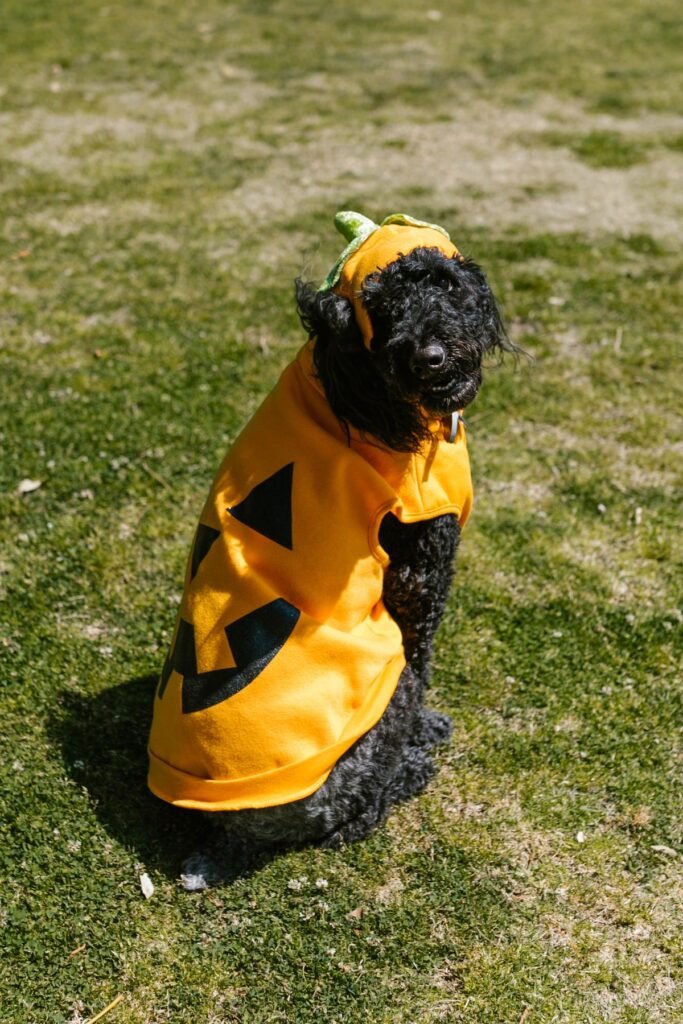
Keep your Cockapoo safe this Halloween: costume fit for curly coats, toxic candy to lock away, a calm safe room for doorbell chaos, and night-walk checks.
Quick answer: Keep your Cockapoo safe on Halloween with three moves: lock away chocolate, xylitol candy, raisins, and wrappers; set up a quiet room far from the door before trick-or-treating; and use only a light, well-fitting costume — or just a bandana — tested days ahead. If they eat candy, call your vet or ASPCA Poison Control at (888) 426-4435 right away.
Halloween is a strange night for a Cockapoo. Strangers in masks ring the bell for hours, the candy bowl sits at nose height, and someone wants to dress them as a pumpkin. Cockapoos feel all of it more than most dogs: they are velcro dogs who hate being shut out, barky dogs who answer every doorbell, and small dogs for whom a single fun-size bar matters more than it would for a big dog. This guide covers the night the Cockapoo way — costumes that fit their coat, candy locked down by body weight, and a doorbell plan that actually works.
Why Halloween Hits Cockapoos Harder Than Most Dogs
Three Cockapoo traits turn an ordinary Halloween into a stressful one. First, they are people dogs. A Cockapoo shut in a back room while the family greets visitors can feel punished rather than protected, so the safe room has to feel like a reward, not a banishment. Second, they are alert barkers. Every doorbell ring is an event, and on Halloween the bell can ring twenty times in an hour. Third, they are small. Toy Cockapoos can weigh as little as 6 to 12 pounds, so a dose of chocolate that a large dog might shrug off is proportionally much bigger for them. Add a curly coat that mats under a tight costume, and you have a dog that needs a plan built for them, not a generic dog plan.
Costumes: Fit for the Coat, Not Just the Size
A costume that fits a smooth-coated dog can be a problem on a Cockapoo. Curly coats trap heat and mat where straps rub. Wavy fleece coats snag on Velcro and rough seams. Straight, Cocker-leaning coats are thinner, so a heavy costume overheats them less but still restricts movement if it is tight. Size matters too: a costume sized for a “small dog” may still swamp a toy Cockapoo or squeeze a mini.
The fit test to run days before Halloween
Do not wait until Halloween night to discover a costume does not work. Run this test at least three days ahead:
- Put the costume on and watch for two minutes. Your Cockapoo should walk, sit, lie down, and turn around normally.
- Check the face. Eyes, nose, mouth, and ears must be fully clear so breathing, vision, and hearing are never blocked.
- Check the fastenings. Nothing should press on the throat, and no strap should sit where it rubs the armpits or belly.
- Remove anything small. Buttons, bells, beads, pom-poms, ribbons, and dangling pieces can be chewed off and swallowed. If it cannot be removed, the costume is not safe.
- Keep the first session short — five minutes, with treats — and build up only if your dog stays relaxed.
Signs the costume comes off now
Take the costume off immediately if you see any of these: freezing in place or refusing to walk, pawing or rolling to get it off, tucked tail, flattened ears, yawning or lip licking when not tired, panting when not hot, or hiding. Tolerating a costume is not the same as enjoying it. A dog that stands still and miserable for a photo is telling you to stop.
 CockapooDaily
The bandana option, and the matting warning
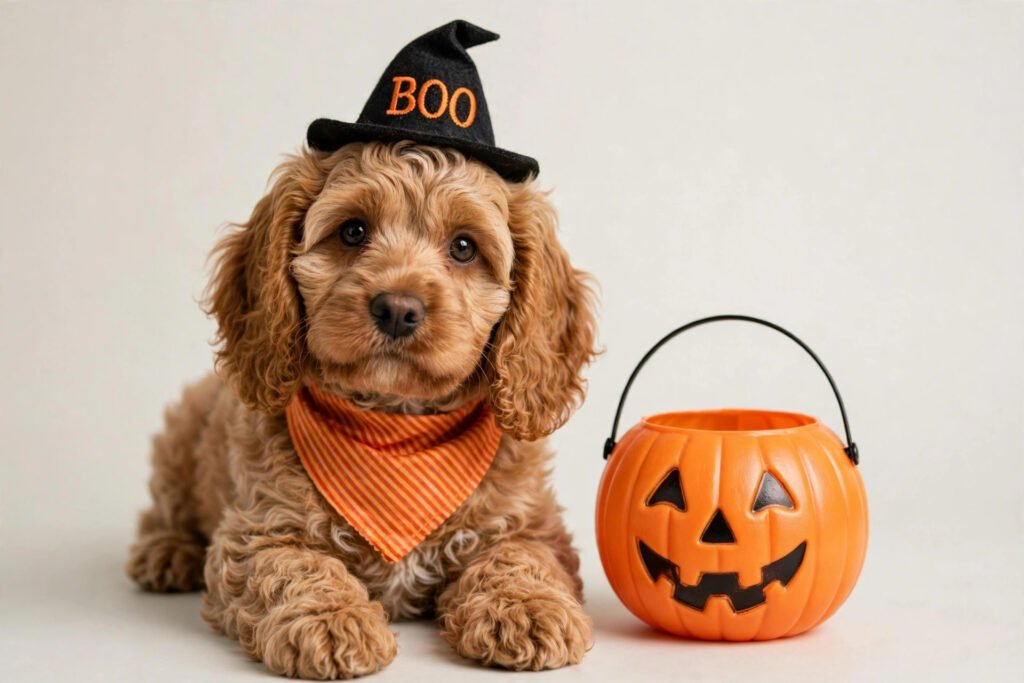
For most Cockapoos, a festive bandana or a light Halloween collar is the smarter choice. It reads as a costume in photos, it does not restrict anything, and it comes off in one second. One Cockapoo-specific warning: check under any costume after wear. Straps and tight fabric mat curly coats fast, so brush out the areas where the costume sat the same evening. Never leave a Cockapoo unsupervised in a costume, even for a few minutes — a chewed strap becomes a choking hazard quickly.
Candy: Lock It Away Like It Matters — Because It Does
Every piece of Halloween candy belongs out of your Cockapoo’s reach. The dangerous list is short and worth memorizing:
- Chocolate, especially dark and baking chocolate. Theobromine is toxic to dogs, and darker chocolate carries more of it. Milk chocolate is less concentrated but still dangerous, especially for a small dog.
- Sugar-free candy and gum with xylitol (also sold as birch sugar). Xylitol triggers a rapid insulin release in dogs that can crash blood sugar and damage the liver. Even a small amount is an emergency.
- Raisins and grapes. Toxic to dogs and can cause kidney injury. They hide in trail mix and in chocolate-covered raisins, which are doubly dangerous.
- Macadamia nuts. Can cause weakness and tremors.
- Wrappers, sticks, and lollipop handles. Foil and cellophane smell like food and can block the intestines if swallowed.
The small-dog difference
Because a toy Cockapoo weighs so little, amount matters more than it does for a big dog. Do not try to guess whether “just one piece” is safe. If your Cockapoo eats any chocolate, xylitol candy, raisins, or an unknown amount of anything from the bowl, treat it as urgent, not wait-and-see. Symptoms of chocolate poisoning — vomiting, diarrhea, restlessness, heavy panting, tremors, or a racing heart — typically appear within about 12 hours, but do not wait for symptoms to call.
What to do if your Cockapoo eats Halloween candy
- Stay calm and act fast. Do not wait to see if symptoms appear.
- Grab the wrapper if you can. Knowing what it was (chocolate? sugar-free?) and roughly how much helps the vet enormously.
- Call your vet or the ASPCA Animal Poison Control hotline at (888) 426-4435 right away. It is open 24 hours a day, every day.
- Do NOT induce vomiting on your own. Only do it if the vet tells you to — it is unsafe in some situations.
- Keep children and guests in the loop: the house rule is that nobody hands the dog candy, ever. Offer dog-safe treats instead, so kids can still “treat” the dog.
Cockapoos with known food sensitivities need extra care on Halloween, since a stolen treat can trigger more than a stomach upset. If your dog has allergy issues, read up on food allergy symptoms in Cockapoos before the candy bowls come out.
 CockapooDaily
The Doorbell Plan: A Safe Room That Feels Like a Treat
For most Cockapoos, Halloween is not really about the candy. It is the doorbell. Every ring means a stranger, and by the twentieth ring even a laid-back dog is wound tight. Add masks and costumes that change how people look and smell, and even familiar visitors can seem frightening. A safe room solves most of this — if you set it up right.
Set the room up before the first trick-or-treater
Pick a room far from the front door, ideally a bedroom or back room, and set it up an hour or two before trick-or-treating starts. Inside, put:
- Their bed and a blanket that smells like home
- Fresh water and a long-lasting chew, lick mat, or puzzle feeder — something to work on besides the door
- Soft background sound: a TV, music, or a fan to cover door noise
- Closed curtains to block flashing lights and costumed shadows
Feed your Cockapoo before the activity starts, and hang a sign on the room door so guests know to leave it closed. Let them explore the room in the days before Halloween with treats and praise, so it feels like a reward rather than a punishment. If your dog is crate-trained and loves the crate, the crate inside the safe room works beautifully.
Cut the doorbell drama itself
You cannot silence the neighborhood, but you can make the door less dramatic:
- Hand candy out on the porch. Sit outside with the bowl so trick-or-treaters never ring the bell at all. This one move removes most of the stress.
- Leave a bowl outside with a sign if you would rather not answer every knock.
- Switch off or cover the doorbell and ask visitors to wave instead.
- Use a second barrier. If you do open the door, keep your Cockapoo behind a closed interior door or a baby gate. Never let them greet visitors at an open front door — a startled Cockapoo can bolt in a second.
Practice in the week before
Doorbell practice works, but only if you start before the night itself. Play a doorbell recording at very low volume while your Cockapoo eats or plays, and pair every ring with a treat. Raise the volume gradually over several days, and stop if you see stress. This is the same calm-at-the-door training that helps with everyday barking — our guide to why Cockapoos bark so much covers the barking side in depth, and the separation-anxiety angle matters here too: a velcro dog left alone in a room can panic rather than settle, so read our separation anxiety guide if your dog struggles when shut away from you.
Night Walks and Trick-or-Treating: Short, Bright, Early
If you take your Cockapoo out on Halloween night, keep it short, bright, and early. Go before peak trick-or-treating if you can, stick to a short familiar route, and be home before the crowds peak. Three checks before you leave:
- Reflective gear on. A reflective collar, vest, or clip-on light is essential. Dark-coated Cockapoos are nearly invisible at night — black and dark chocolate coats vanish in the dark, so this is not optional for them.
- ID current. Collar tag with your current phone number, and microchip registration checked and up to date. The constant opening of doors all evening is exactly how dogs slip out.
- Fixed-length leash, not retractable. You need control if a costumed stranger or another dog startles them.
If your Cockapoo is nervous around masks, crowds, or noise, leave them at home in their safe room. A frightened dog on a walk can bite or bolt, and that ends the evening for everyone. Dogs that are calm and social can enjoy a short outing — but watch for the same stress signs as with costumes, and head home at the first one.
Decorations, Candles, and the Morning After
Decorations are the hazard most owners forget. Lit jack-o’-lanterns and candles get knocked over by wagging tails — use flameless candles inside pumpkins instead. Keep electrical cords, fake cobwebs, small decorations, and glow sticks out of reach; chewed glow sticks cause drooling and stomach upset, and fake cobwebs can tangle or be swallowed. Keep your Cockapoo out of the yard display area unsupervised.
And do one thing the morning after: walk the yard and porch before your Cockapoo goes out. Dropped candy, wrappers, and glow sticks from the night before are still there in the morning, and a morning sniff can undo a perfectly safe Halloween night.
Safe Ways to Include Your Cockapoo
Skipping the scary parts does not mean skipping the fun. Cockapoo-friendly Halloween options that work:
- A Halloween photo session. Costume or bandana, ten minutes, treats, done. This is the part most dogs actually enjoy.
- A pumpkin patch visit in daylight. No masks, no doorbells, plenty of sniffing.
- Dog-safe Halloween treats. Pumpkin purée (plain, not pie filling — pie filling can contain xylitol), apple slices, or their usual treats in a Halloween-themed toy.
- A calm evening at home. Safe room, chew, family nearby. For many Cockapoos this is genuinely the happiest option, and there is nothing wrong with choosing it.
Halloween Night Checklist
- Candy bowls in a closed cabinet, never on a low table
- Safe room set up an hour before trick-or-treating, with bed, water, chew, and background sound
- Doorbell plan decided: porch handout, bowl outside, or bell off
- Costume trial-run done days ahead, or bandana chosen
- Reflective gear and current ID ready if going out
- Vet and ASPCA Poison Control numbers saved in your phone: (888) 426-4435
- Flameless candles in pumpkins, cords and cobwebs out of reach
- Morning-after yard check before the first outing
Frequently Asked Questions
Is xylitol (birch sugar) in Halloween candy dangerous for Cockapoos? Yes — it is an emergency, not a wait-and-see. Xylitol triggers a rapid insulin release that crashes blood sugar and can damage the liver, and even a small amount in sugar-free candy or gum is dangerous, especially for a Toy Cockapoo weighing 6–12 pounds. Call your vet or ASPCA Poison Control at (888) 426-4435 immediately.
Can Cockapoos eat candy corn or gummy candy? No. Beyond the sugar, the wrappers are the hidden risk: swallowed wrappers, ribbons, and treat bags can irritate the digestive tract or cause an intestinal blockage. Keep the whole candy bowl — candy and wrappers together — out of reach.
Are glow sticks and Halloween decorations dangerous for Cockapoos? Yes. Glow-stick liquid irritates the mouth and stomach if chewed, candles and jack-o’-lantern flames burn curious noses and paws, and fake cobwebs, strings, and small costume pieces can be swallowed and obstruct the gut. Keep decorations behind barriers and blow out candles when the dog is in the room.
How do I keep my Cockapoo from running out the door on Halloween? Put a leash or harness on before the first visitor, use a baby gate between the dog and the front door, and hand candy out on the porch so the doorbell never rings. Check ID tags and microchip details are current before the night — Halloween is one of the highest escape-risk nights of the year.
What should I do with my Cockapoo the morning after Halloween? Walk the yard and the street for dropped candy, wrappers, and glow sticks before the dog goes out; check the costume rub points (behind the ears, under the harness) for matting; then settle back into the normal routine — a calm morning after a strange night matters as much as the night itself.
Can Cockapoos eat chocolate?
No. Chocolate contains theobromine, which dogs cannot clear the way people do. Dark and baking chocolate are the most dangerous, but no chocolate is safe for a Cockapoo — and because toys weigh so little, even a small amount matters. If your Cockapoo eats chocolate, call your vet or ASPCA Poison Control at (888) 426-4435 right away.
Are Halloween costumes safe for Cockapoos?
Yes, but only under strict conditions: the costume must fit without restricting movement, breathing, vision, or hearing; it must have no small parts that can be chewed off; it must be trialed days ahead; and your dog must be supervised the whole time it is on. If your Cockapoo freezes, paws at it, or hides, take it off. A bandana is a safer choice for most Cockapoos, and curly coats should be brushed out where the costume sat to prevent matting.
What should I do if my Cockapoo eats Halloween candy?
Stay calm and act fast. Grab the wrapper so you know what and how much they ate, then call your vet or ASPCA Poison Control at (888) 426-4435 immediately. Do not induce vomiting unless the vet tells you to. Watch for vomiting, restlessness, heavy panting, or tremors, and get to the vet promptly.
How do I keep my Cockapoo calm during trick-or-treating?
Set up a quiet room far from the front door before the first visitors, with their bed, water, a long-lasting chew, and background sound. The single most effective move is handing candy out on the porch so the doorbell never rings. Practice doorbell sounds at low volume with treats in the week before Halloween.
Should I take my Cockapoo trick-or-treating?
Only if your dog is genuinely calm around crowds, masks, and noise. Keep it short and early, use reflective gear and a fixed-length leash, and check that ID and microchip details are current. If your Cockapoo is nervous, leave them at home in their safe room — it is the kinder and safer choice.
Conclusion
Halloween with a Cockapoo comes down to three decisions made before the night starts: a costume that fits their coat or a bandana instead, candy locked away like the emergency it can be, and a safe room that feels like a treat rather than a punishment. Get those three right and the rest of the night takes care of itself. Next, if doorbell barking is your Cockapoo’s biggest Halloween problem, work through our barking guide before October 31 — a week of practice now is worth more than any costume.


Leave a Reply