
A Cockapoo costs about $126 a month in recurring expenses, or $100–$400+ by size and care. See the monthly budget by size, grooming choices and savings tips.
Quick answer: A Cockapoo costs about $126 a month in recurring expenses, according to Fur Forecast’s 2026 cost model, or $100–$400+ a month on Hepper’s wider 2026 range. The first year costs more, with roughly $775 of one-time setup on top. The biggest single line is grooming: the coat needs professional attention every six to eight weeks.
The puppy price is the number everyone asks about first, and the least important number in Cockapoo ownership. A puppy is a one-time payment; the monthly cost is the bill that arrives every month for the next fourteen to seventeen years — and the one that catches new owners by surprise.
That surprise usually has one cause: grooming. The low-shedding, wavy-to-curly coat that makes Cockapoos popular also mats, tangles and keeps growing, which means brushing at home plus a professional groom every six to eight weeks, for the dog’s whole life. Food, vet care and insurance matter too, but grooming is what separates a Cockapoo budget from a generic small-dog one. This guide gives you the monthly number, broken down by size, using only verified figures — where an exact figure cannot be verified, it says so in words instead of guessing.
The Short Answer: What Most Owners Spend Each Month
Two published 2026 sources anchor the monthly number. Hepper’s 2026 price guide puts it at $100–$400+ per month, driven by grooming, food quality, vet care and extras: a healthy adult on a lean routine sits toward the lower end, a larger dog on professional grooming, premium food and full insurance toward the higher end — and a bad health month can push past it.
Fur Forecast’s 2026 model is narrower: about $126 a month in recurring costs (food, vet care, prevention, insurance, grooming and everyday extras), on top of roughly $775 of one-time setup in the first year. It is modeled for an adopted, neutered adult in an average-cost area, on standard food, with low-cost grooming and a mid-level premium — a planning baseline, not a bill.
Budget around the $126-a-month baseline, keep the $100–$400+ range in mind as the real spread, and hold a separate emergency fund for the surprise vet bill.
Monthly Budget by Size
Cockapoos come in three sizes, and size moves almost every line of the budget: a toy eats less, grooms faster and needs smaller doses than a standard.
| Line item | Toy (up to ~12 lbs) | Miniature (13–18 lbs) | Standard (19–30+ lbs) |
|---|---|---|---|
| Food | Lowest — smallest appetite | Middle | Highest — biggest appetite |
| Grooming | Lowest — quickest to groom | Middle — more coat | Highest — most coat, longest appointments |
| Vet and preventives | Lowest — smallest doses | Middle | Highest — larger doses |
| Insurance | Lowest | Middle | Highest |
| Treats and toys | Lowest — small treats last well | Middle | Highest — bigger chews |
| Training | Same at every size | Same at every size | Same at every size |
| Overall monthly range | Lower end of $100–$400+ | Middle of $100–$400+ | Higher end of $100–$400+ |
Training is the only line that barely moves with size — a group puppy class costs the same whether your Cockapoo weighs ten pounds or thirty. And the overall range is the same $100–$400+ (Hepper 2026) for every size: a toy with a thick curly coat, premium food and full insurance can cost more than a standard on a lean routine. Size sets the direction; your choices set the number.
What Each Line Item Actually Covers
Food
Food is the most predictable line. Most adults eat well under two cups of small-breed kibble a day, split into two meals, so a bag lasts longer than new owners expect. What moves the line is quality and extras: a premium formula costs more per bag, and treats, chews and training rewards add a second food bill many owners forget to count. For exact amounts by age and weight, see our Cockapoo feeding chart.
Grooming
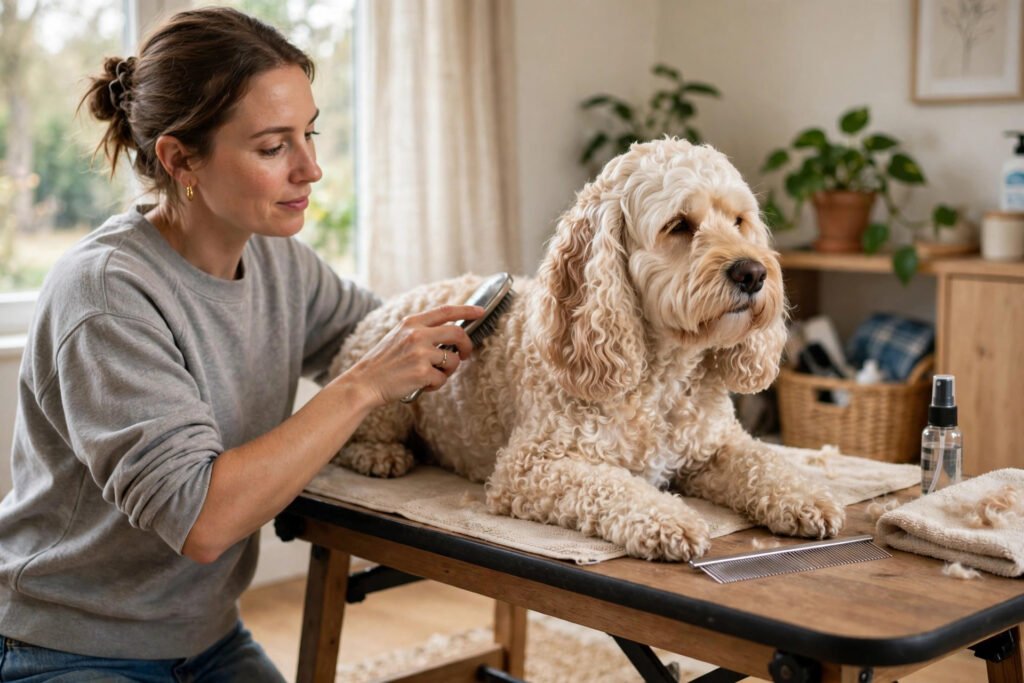
Grooming is the biggest and least optional line. The coat grows continuously and mats if left alone, so the routine is brushing several times a week at home plus a professional groom every six to eight weeks. The professional visit is the expensive part — and the part owners most often try to skip, which is how a routine groom turns into a dematting session or a shave-down, both costlier and stressful for the dog. Between visits you will use shampoo, a brush and comb, ear cleaner and nail clippers: a small cost spread across months. Our Cockapoo grooming cost guide breaks this line down in detail.
Vet Care and Preventives
Routine vet care is a small monthly average with occasional spikes: the annual exam, booster vaccines, flea, tick and heartworm prevention, and dental care, spread across the year. Skipping prevention is the classic false economy, because the conditions it prevents cost far more to treat. Cockapoos also carry breed-specific risks: ear infections are the most common, thanks to long spaniel ears plus poodle ear hair, and dental disease builds up in small breeds. Our Cockapoo vet visit schedule shows what the vet expects to see, and when.
Insurance
Pet insurance is the line owners argue about most, and the honest answer is that it is a judgment call, not a must. A typical accident-and-illness policy converts a sudden large vet bill into a monthly premium plus a deductible — worth it if a surprise would break your budget, less necessary if you keep a disciplined emergency fund instead. Premiums depend on age, location and level of cover, and are lowest if you start while the puppy is young and healthy, before anything counts as a pre-existing condition.
Treats and Toys
Treats and toys are the smallest line, and the easiest to let drift. Training treats, chews and the occasional toy replacement add up quietly, especially in the puppy year. The rule is simple: buy small. Small treats go further, last longer in training and add fewer calories — and keep treats to a small share of daily food, or the treats line shows up in the vet line as weight gain. Our guide to the best treats for Cockapoo puppies lists gentle options that work for training without upsetting sensitive stomachs.
Training
Training is a front-loaded cost that fades into a small ongoing line. The puppy year usually means one group class — money well spent, because a Cockapoo that learns recall, loose-lead walking and calm greetings early costs less in every other line later: it is easier to exercise, groom and take to the vet. After the first class, the ongoing cost is mostly treats and your time, unless you want one-to-one help for a specific problem such as separation anxiety, which costs more per session but solves a problem a group class cannot.
DIY vs Professional Grooming: The Monthly Decision
Grooming is the one line where you genuinely control the monthly number: every professional visit you replace with home care is money saved — as long as the home care is actually done.
Professional grooming means a full groom every six to eight weeks: bath, clip, tidy, nails and ears, done by someone who does it all day. It is the most expensive way to keep the coat healthy, and also the most reliable: a professional spots matting early, handles a wriggly dog safely, and returns a coat that stays manageable until the next visit.
DIY grooming means brushing several times a week, bathing, trimming the face and paws, and clipping nails at home. The cash cost is far lower — a brush, shampoo, clippers and a comb, bought once and used for months — but the time cost is real. A Cockapoo brushed properly at home mats less, so the professional visits you do book are quicker and cheaper.
The smart middle ground is a mix: brush and bathe at home between visits, do small tidy-up trims on the face and paws, and keep the professional groom on its six-to-eight-week rhythm. Owners who go fully DIY usually find the coat wins eventually, when the puppy coat changes to adult coat and matting gets dramatically worse. Owners who go fully professional pay the most, but get the most predictable coat.
Never skip grooming to save money. A skipped groom does not save the cost of a groom; it converts it into a dematting or shave-down bill, a stressed dog, and a coat that takes months to grow back. If the budget is tight, stretch the interval by a week and brush more — but do not cancel the appointment outright.
 CockapooDaily
What Changes Your Monthly Number
Four factors move the monthly cost most. Size: a standard eats more, takes longer to groom and needs larger doses than a toy — a small monthly difference that compounds across fourteen-plus years. Coat: a thick, tight curly coat mats faster and takes longer to groom than a loose wavy coat, and the adult coat that comes in around the first year is denser and harder to maintain than the puppy coat. Health: a healthy Cockapoo costs the baseline; one with recurring ear infections, allergies, a sensitive stomach or a knee problem costs more in vet visits, prescription food and medication — no budget can predict this, which is why the emergency fund matters more than the exact monthly figure. Location: everything costs more in a high-cost city than in a small town, and two owners with identical dogs can have meaningfully different numbers purely because of where they live.
First Year vs Ongoing Costs
The first year is the most expensive year, and it is not close. Fur Forecast puts one-time first-year setup at roughly $775, on top of the roughly $126 a month in recurring costs — and that setup figure does not include the puppy itself. Year one brings the crate, bed, bowls, leash, harness and gates; the vaccine series and first vet exams; spay or neuter; the first training class; and the grooming kit.
After the first year, the budget settles into the ongoing pattern: food, grooming, routine vet care and prevention, insurance if you carry it, and treats and toys. The monthly number gets steadier — which is exactly when owners stop budgeting, and exactly when the surprise bills start. A senior costs more again as vet visits get more frequent and dental and joint care join the routine, but that rise is gradual.
Money-Saving Tips That Do Not Cut Corners on Health
These tips cut the bill, not the care.
Learn to brush properly. Brushing several times a week is free, and the single best money-saver in this article: a well-brushed coat means quicker, cheaper professional grooms and no dematting bills. Buy one good slicker brush and a comb, and brush while the dog is relaxed.
Buy food in the right size bag. A bag that lasts too long goes stale; a bag that is too small costs more per pound. For one Cockapoo, a mid-size bag of a quality small-breed formula is usually the sweet spot. Measure meals with a cup — overfeeding wastes food and creates a weight problem that costs vet money later.
Keep prevention current. Flea, tick and heartworm prevention feels like a cost until the month you skip it and pay for the treatment instead. Prevention is the cheapest line in the budget and the one that prevents the most expensive lines.
Decide insurance or an emergency fund — and actually do one of them. The expensive mistake is not choosing the wrong one; it is choosing neither and hoping. A maintained emergency fund is as legitimate as a policy, but only if the money is really set aside and really untouched.
Do not economize on food or prevention. These are the two cheapest lines in the budget and the two that keep the expensive lines away — a cheap food that upsets a sensitive stomach costs more in vet visits than the premium bag ever did.
Frequently asked questions
How much does a Cockapoo cost per month?
About $126 a month in recurring costs, per Fur Forecast’s 2026 model, or $100–$400+ a month on Hepper’s wider 2026 range. The first year costs more, with roughly $775 of one-time setup on top. Grooming is the biggest line, then food and routine vet care.
Is a Cockapoo expensive to maintain?
More expensive than a short-haired small breed, mostly because of grooming. The coat needs brushing several times a week and a professional groom every six to eight weeks, for life. Food and routine vet care are ordinary small-dog costs; the grooming subscription is what makes the Cockapoo budget different.
What is the most expensive part of owning a Cockapoo monthly?
Grooming. A full professional groom every six to eight weeks is the largest recurring line, and it never stops — the coat grows continuously. Food is second, routine vet care and prevention third. Skipping grooms does not save money; it turns a routine groom into a dematting or shave-down bill.
Does a toy Cockapoo cost less per month than a standard?
Yes, generally. A toy eats less, grooms quicker and needs smaller doses of preventives than a standard, so it tends toward the lower end of the range while a standard tends toward the higher end. Training costs about the same at every size, and a toy with a thick curly coat and premium food can still cost more than a standard on a lean routine.
How much does a Cockapoo cost in the first year vs later years?
The first year is the most expensive: roughly $775 of one-time setup on top of the monthly costs, covering the crate and supplies, the vaccine series, spay or neuter and the first training class — and that is before the puppy itself. After that the budget settles into the steady monthly pattern, then rises gradually in the senior years as vet care increases.
Conclusion
A Cockapoo costs about $126 a month in recurring expenses, or $100–$400+ a month across the full range of sizes, coats and choices — with roughly $775 of one-time setup in the first year. That is the honest number, affordable for most households that go in with their eyes open. The budget works when grooming stays on its six-to-eight-week rhythm, prevention stays current, and the surprise vet bill has a policy or an emergency fund waiting for it. Get those three things right and the monthly cost is just a line in the household budget, not a worry. If you are still deciding, our guide to how much a Cockapoo costs to buy covers the purchase price and first-year total that come before the monthly routine starts.
Leave a Reply