
Your Cockapoo’s honking cough could be kennel cough. Learn the signs, how long it lasts, home care that helps, vet red flags and Bordetella prevention.
Quick answer: Kennel cough is a highly contagious respiratory infection, usually caused by the bacterium Bordetella bronchiseptica together with viruses such as parainfluenza. The classic sign is a dry, honking cough that sounds like a goose. Most healthy adults recover in 1 to 3 weeks with rest, but puppies, unvaccinated dogs and seniors need a vet sooner — pneumonia is the risk.
You bring your Cockapoo home from daycare, boarding or the groomer, and a few days later the coughing starts: loud, dry and harsh, a honking sound as if something is stuck in the throat, often ending with a gag. It sounds alarming. But in most healthy adult Cockapoos, kennel cough is the dog equivalent of a bad cold: miserable for a week or two, then gone.
The same cough can mean different things in a puppy, a senior, or a dog with a heart condition, and a Cockapoo’s social life makes it easy to catch and easy to misread.
What Is Kennel Cough?
Kennel cough is the common name for canine infectious respiratory disease complex (CIRDC), also called infectious tracheobronchitis — an inflammation of the upper airways, mainly the trachea and bronchi. Despite the name, it is not one disease caused by one germ, but a group of infections working together.
The best-known culprit is the bacterium Bordetella bronchiseptica — hence the nickname “Bordetella”. It usually does not act alone: contributing viruses include canine parainfluenza, adenovirus type 2, influenza, respiratory coronavirus and distemper virus. A dog can carry two or more at once — one reason the Bordetella vaccine alone cannot prevent every case.
It is not the same as reverse sneezing, a short snorting spasm that clears on its own in seconds. Kennel cough is a real cough — forceful, repeated, lasting days to weeks. Cockapoos are not more likely than other breeds to catch it; what matters is exposure, because Cockapoo owners use daycare, boarding, grooming and dog parks more than average.
How a Cockapoo Catches It
Kennel cough spreads when a dog inhales bacteria or virus particles. An infected dog coughs, sneezes or breathes out germs, and a nearby dog breathes them in. It also spreads through shared bowls, toys and bedding, and through the air in poorly ventilated spaces.
Doggy daycare. The most common exposure in the real Cockapoo cases owners report. Dogs play in close contact indoors for hours; one coughing dog can expose a whole room.
Boarding kennels and shelters. Crowded, stressful and often poorly ventilated — the conditions the disease is named for.
The groomer. Short visits, but dogs wait near other dogs and grooming tools are shared.
Dog parks and training classes. Outdoor air helps, but nose-to-nose greetings and shared water bowls still spread germs.
Symptoms usually appear 2 to 10 days after exposure, most often in 5 to 10 days. That delay matters: your Cockapoo can pick up the infection on a Saturday at daycare and look fine until the following weekend. A dog can also be contagious before it starts coughing. Dogs are usually contagious for about 2 to 3 weeks, so a coughing Cockapoo should stay away from other dogs until the cough has been gone for at least a week.
Symptoms: What It Sounds and Looks Like
The hallmark symptom is a sudden, frequent, dry cough that sounds like a goose honking — as though the dog has something stuck in its throat. The cough comes in fits and often ends with a gag, a retch, or a small amount of white foam. That foam is not vomit, and it does not mean the dog is choking.
The cough usually gets worse with excitement, exercise, or pressure on the neck from a collar. It is often worse at night, when the dog is lying down.
Other symptoms may appear alongside the cough: sneezing or a runny nose, clear eye discharge, a mild fever, less energy, or a reduced appetite. Some dogs swallow often because their throat is sore.
In a mild case, that is all: a dog that coughs a lot but is otherwise bright, eating and drinking normally. In a more serious case, the cough turns wet, the dog develops thick yellow or green discharge, stops eating, runs a fever, or struggles to breathe — see the red flags below.
Most mild cases clear up within 1 to 3 weeks, many improving within the first week. In puppies, seniors and dogs with other health problems, recovery can take up to 6 weeks.
The Honking-Cough Decoder
A honking sound does not automatically mean kennel cough. Use this table to narrow it down, then confirm with your vet.
| Condition | Sound | When it happens | Other signs | What to do |
|---|---|---|---|---|
| Kennel cough | Dry goose-honk cough, often ending in a gag | In fits; often starts 5–10 days after daycare or boarding | Runny nose, sneezing, mild fever | Rest, isolate from other dogs; vet if red flags appear |
| Reverse sneezing | Rapid inward snorting, like a pig — a nasal sound | Episodes lasting seconds to a minute | No fever, no discharge, dog normal between episodes | Usually harmless; see our guide to Cockapoo reverse sneezing |
| Heart cough | Soft, moist cough, worse at night or lying down | Worsens over weeks; common in older dogs | Tiredness on walks, swollen belly, loss of appetite | Vet promptly — heart disease needs diagnosis, not home care. |
| Collapsing trachea | Dry, honking cough triggered by excitement or pulling on the leash | Chronic and recurring; more common in small, older dogs | Gagging, wheezing, difficulty breathing | Vet assessment; use a harness, keep weight down |
The most useful question is: when did it start, and what happened 5 to 10 days before? A cough that began a few days after daycare or boarding points strongly to kennel cough. A cough that has been coming and going for months, or worsening week by week in an older dog, needs a vet’s examination — heart disease and trachea problems cannot be diagnosed from sound alone.
Reverse sneezing is the one owners confuse with kennel cough most often. The difference is direction: a reverse sneeze pulls air in through the nose in rapid snorts, while a kennel cough pushes air out of the chest. Reverse sneezing lasts seconds and the dog is fine right after; kennel cough lasts days and the dog is unwell. Not sure which you are hearing? Record a short video and show it to your vet.
 CockapooDaily
Home Care
There is no single drug that cures kennel cough. Home care is about rest and comfort while the immune system does its work. Do not give human cough or cold medicine without your vet’s advice — many human products are unsafe for dogs.
Rest, properly. Limit exercise and excitement for at least a week, ideally until the cough is gone. Short, calm lead walks for toilet breaks only — no dog park, no daycare, no rough play. Our guide to how much exercise a Cockapoo needs gives the normal routine; during kennel cough, cut it back sharply and build it back up gradually once the cough has stopped.
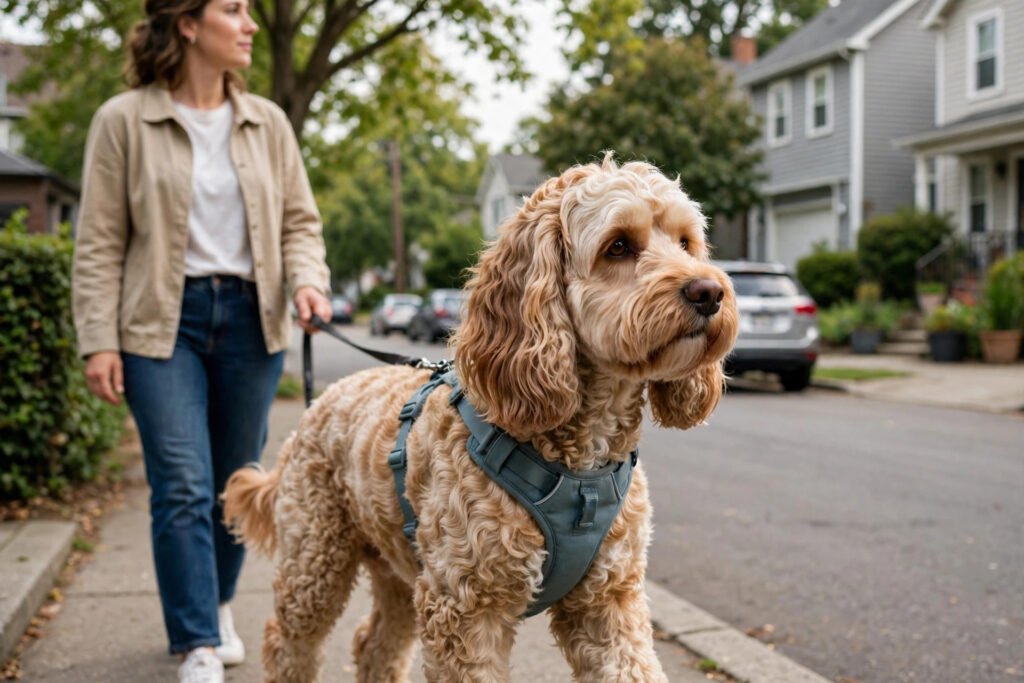
Use a harness, not a collar. A collar presses on the trachea and makes the cough worse. Switch to a harness and keep the lead loose.
Keep the air clean and moist. Avoid smoke, scented candles, air fresheners, dust and strong cleaning products around a coughing dog. A humidifier, or 10 to 15 minutes in a steamy bathroom a few times a day (hot shower running, door closed, dog on the floor), can soothe irritated airways.
Keep food and water easy. Offer fresh water at all times, and soften dry kibble with warm water if a sore throat makes it uncomfortable. If your Cockapoo stops drinking, that is a vet visit, not a home-care problem.
Isolate from other dogs. Keep your Cockapoo away from other dogs until the cough has been gone for at least a week, and tell your daycare or groomer.
Antibiotics and cough suppressants. Your vet may prescribe antibiotics, usually doxycycline, for a bacterial infection, fever, thick discharge, lethargy or poor appetite. Antibiotics do not help a purely viral case, so vets often watch a mild, bright, eating dog for up to 10 days first. A cough suppressant may be prescribed for a severe, dry cough, but only on your vet’s advice. Never start either on your own.
When to See the Vet: Red Flags
Most healthy adults get through kennel cough with rest alone. But some symptoms mean the illness has reached the lungs. Call your vet the same day if you see any of these:
- A puppy under 6 months old is coughing — puppies can go downhill fast.
- An unvaccinated dog is coughing. Without core vaccines and Bordetella, the risk of serious infection is higher.
- A senior Cockapoo, or a dog with a known health problem such as heart disease, is coughing — older dogs recover more slowly and are more likely to develop pneumonia.
- The cough lasts more than 10 days without improving, or is getting worse.
- Thick yellow or green nasal discharge, especially with a fever.
- Loss of appetite or refusing water — a dog that will not drink needs a vet the same day.
- Lethargy or weakness. A tired dog is one thing; a dog that will not get up is another.
- Rapid or labored breathing, wheezing, or blue or pale gums — go to the vet immediately.
- Vomiting or coughing up blood.
- The cough turns wet and productive, with yellow or green mucus — a possible secondary infection or pneumonia.
If you are unsure, call the vet — a vet can usually tell whether the dog needs to be seen today. Our Cockapoo vet visit schedule shows what happens at each routine age, but a coughing dog should not wait for its next scheduled visit.
The main complication is pneumonia — when the infection reaches the lungs. Warning signs are a wet cough, fever, loss of appetite, lethargy and fast or labored breathing. Pneumonia needs vet-directed treatment, sometimes hospitalization. It is uncommon in healthy adults, but it is why puppies, seniors and unvaccinated dogs should be seen early.
Prevention: The Bordetella Vaccine and Everyday Habits
Kennel cough cannot be prevented completely — too many germs cause it, and no vaccine covers them all. But the risk can be cut sharply, and the illness made milder.
The Bordetella vaccine. This is the single most useful step. It targets Bordetella bronchiseptica, the most common cause, and reduces the severity of the illness even when it does not prevent infection entirely. The vaccine comes as an injection, a nasal spray, or an oral dose, boosted every 6 to 12 months. It is not always part of the core puppy series, so ask your vet specifically whether your Cockapoo has had it. Our Cockapoo puppy vaccination schedule shows where Bordetella fits in.
Many daycares, kennels and groomers require proof of Bordetella vaccination. Keep the record handy and book the booster in good time — the nasal spray needs a few days to take effect.
Avoid sick dogs. If a dog at the park is coughing, keep your Cockapoo away. If your daycare has a case going around, keep your dog home for a week or two. If your own dog is coughing, stay home.
Choose well-ventilated, clean facilities. A daycare with good airflow, clean surfaces and a policy of sending coughing dogs home is safer than a crowded, stuffy one. Ask whether they require Bordetella vaccination.
Keep the immune system strong. A healthy weight, good diet, regular exercise and routine vet care help a dog fight off respiratory infections. Puppies need their full vaccine series before mixing freely with other dogs.
Clean shared items. Wash bowls, toys and bedding regularly. Bleach diluted 1 part to 32 parts water kills Bordetella on hard surfaces.
Frequently asked questions
How long does kennel cough last in a Cockapoo?
Most mild cases last 1 to 3 weeks, improving within the first week, and the cough usually eases gradually rather than stopping overnight. Puppies, seniors and dogs with other health problems can take up to 6 weeks. If it has not improved after 10 days, call your vet.
Is kennel cough contagious to other dogs?
Yes, very — through the air when an infected dog coughs or sneezes, and through shared bowls, toys and surfaces. Dogs are usually contagious for about 2 to 3 weeks. Keep a coughing Cockapoo away from other dogs until the cough has been gone for at least a week.
Can a vaccinated Cockapoo still get kennel cough?
Yes. The Bordetella vaccine reduces severity but does not guarantee prevention, because kennel cough can be caused by several different bacteria and viruses, and the vaccine only covers Bordetella. A vaccinated dog usually gets a milder, shorter illness.
What is the difference between kennel cough and reverse sneezing?
Kennel cough is a dry, honking cough from the chest that comes in fits, lasts days to weeks, and is often followed by gagging or white foam. Reverse sneezing is a rapid inward snort through the nose, like a pig, lasting seconds to a minute and leaving the dog completely normal afterwards. Reverse sneezing is usually harmless; kennel cough is an infection that needs rest and isolation.
When should I take my Cockapoo to the vet for a cough?
See a vet the same day for a puppy under 6 months, an unvaccinated dog, a senior, or a dog with a known health problem; a cough lasting more than 10 days without improving; or thick discharge, fever, loss of appetite, refusal to drink or lethargy. Go immediately for rapid or labored breathing, wheezing, blue or pale gums, vomiting or blood in the cough.
Conclusion
Kennel cough sounds worse than it usually is. A healthy adult Cockapoo that picks it up at daycare or the groomer will most likely cough for a week or two, rest at home, and recover fully. The owner’s job: keep the dog calm and rested, switch to a harness, keep the air clean and moist, keep other dogs away, and watch for the red flags.
Puppies, seniors and unvaccinated dogs need extra care. Keep the Bordetella vaccine up to date, avoid obviously sick dogs, and choose facilities that take respiratory illness seriously. Do that, and the next honking cough will be a short interruption rather than a scare.
Leave a Reply