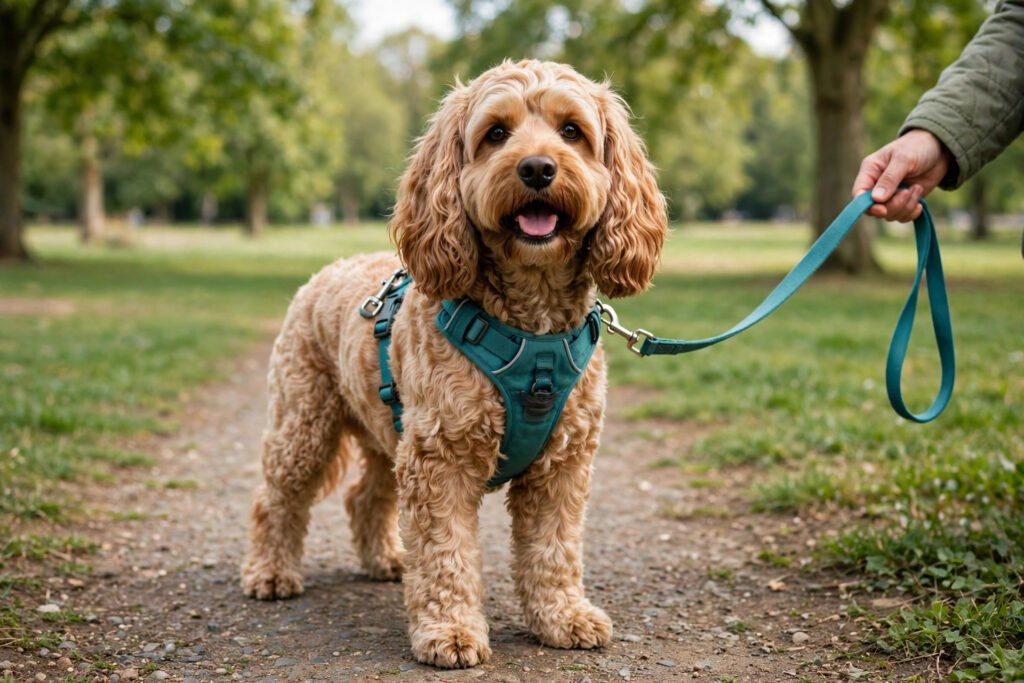
Find the best harness for your Cockapoo — no-pull, step-in and Y-front picks compared, with chest measuring and sizing by toy, miniature and standard.
Quick answer: The best harness for a Cockapoo is a dual-clip no-pull harness with a Y-front chest plate, such as the rabbitgoo No Pull, sized by chest measurement, not weight. Most take a Small or Medium, with a chest of roughly 15 to 26 inches. Measure behind the front legs and pick the size your number falls in the middle of.
A Cockapoo on a collar is a dog pulling on its own throat. This breed is small, strong for its size, and famously excitable — it spots a squirrel or another dog, and it lunges. A collar concentrates all that force on the neck; a harness spreads it across the chest and shoulders.
The problem is fit: three sizes — toy, miniature and standard — deep chests, fluffy coats, wide variation. A harness that fits the chart but not your dog will twist, rub raw spots under the front legs, or slip off. Every pick below was chosen for a different job: stopping pulling, easy on-and-off, all-day comfort, or a hard-to-fit shape.
No-Pull vs Step-In vs Y-Front: Which Type Fits Your Cockapoo?
Most harnesses combine two of these. No-pull (front-clip) means the leash attaches to a ring on the chest instead of the back. When your Cockapoo pulls, the front clip turns its body sideways instead of letting it drive forward with its shoulders. It gives you steering while you train — it does not train the dog by itself. Buy this type first if pulling is the problem.
Step-in. The dog steps its front paws into two loops and you clip it closed on the back. Nothing goes over the head — ideal for Cockapoos that hate things pulled over their ears. Usually soft, light vests, and the easiest type for a squirming puppy.
Y-front. The chest strap forms a Y shape between the front legs instead of a straight bar across the chest, leaving the shoulders free to move — important for a breed that runs, jumps and twists. A straight-front harness can restrict the shoulder and change how your dog moves.
Dual-clip. Many of the best harnesses have both a front ring and a back ring. Train on the front clip, switch to the back clip once walks calm down.
How to Measure Your Cockapoo’s Chest
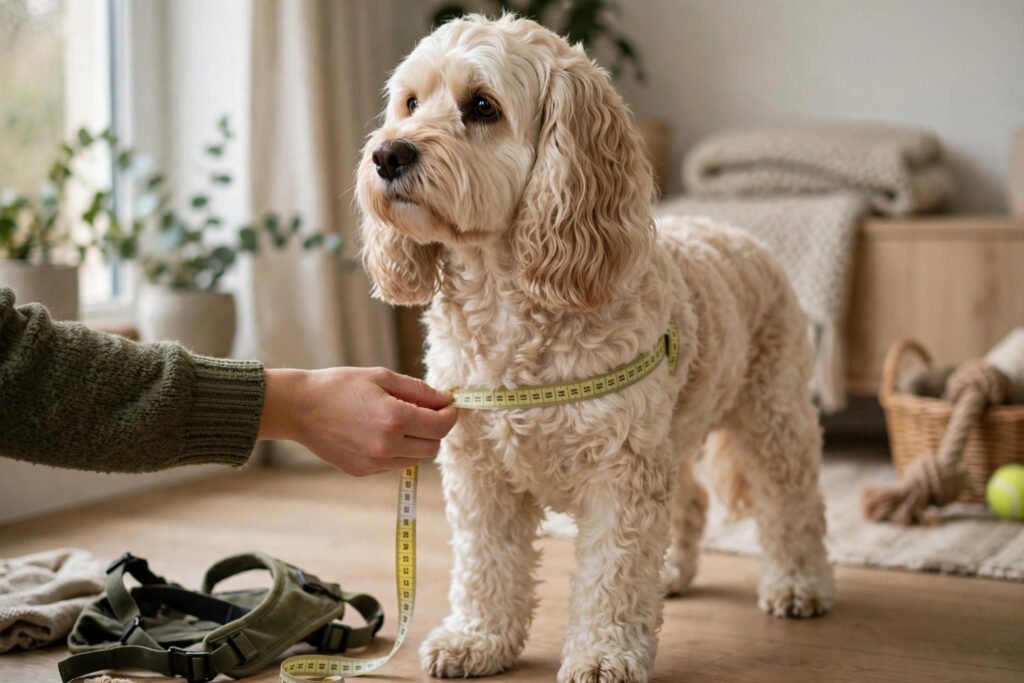
Do not order by weight or breed size — two Cockapoos of the same weight can have chests several inches apart, and a fluffy coat hides the difference. Measure your own dog with a soft tape measure, or string and a ruler.
Measure around the widest part of the chest, just behind the front legs, where the harness strap will sit. Lay the tape over the coat the way the harness will sit and keep it level; you should be able to slide two fingers flat between the tape and the dog. Also measure the neck at the base — some harnesses size by neck.
Pick the size whose range your number sits in the middle of. If its chest is at the top of one size and the bottom of the next, take the larger — a roomy harness can be tightened, a small one cannot be stretched. Puppies grow fast: measure monthly until age one and expect two or three harnesses in the first year. If your Cockapoo was recently clipped short, measure again after the next groom. Our Cockapoo leash training guide covers the training side of loose-leash walking once the harness fits.
 CockapooDaily
The 5 Best Harnesses for Cockapoos at a Glance
As an Amazon Associate I earn from qualifying purchases.
| Harness | Best for | Type | Chest range (size to buy) |
|---|---|---|---|
| rabbitgoo No Pull | Best overall, stopping pulling | Dual-clip no-pull, Y-front | S 13–20″, M 16–25″ |
| PetSafe Easy Walk | Best trainer-recommended no-pull | Front-clip, martingale loop | S/M 15–20″ girth |
| Blue-9 Balance | Best for hard-to-fit dogs | Y-front, 6-point adjustment | S 16–21″, M 21–32″ ribcage |
| Puppia Soft Harness | Best soft everyday harness | Over-the-head, mesh | S neck 9.5″, M neck 12″ |
| Voyager Step-in Air | Best step-in, easiest on-off | Step-in vest, mesh | S chest 14.5–16″, M 16–18″ |
The Picks in Detail
1. Best Overall: rabbitgoo No Pull Dog Harness with 2 Leash Clips
rabbitgoo No Pull Dog Harness on Amazon
The default recommendation for a reason: dual-clip, padded chest plate, four adjustment straps, top handle and reflective trim, at a far lower price than premium brands. Clip the leash to the front ring while your Cockapoo is still learning not to pull, then move to the back ring once walks calm down. Four straps adjust neck and chest separately — exactly what a deep-chested, fluffy Cockapoo needs.
Most Cockapoos take a Small (chest 13–20 inches) or a Medium (16–25 inches): toy usually a Small, miniature a Small or Medium, standard usually a Medium.
Watch out for: the buckles are plastic and the maker publishes no load rating — not the pick for a strong, reactive or escape-prone dog. Check under the front legs after the first week for rubbing.
2. Best Trainer-Recommended No-Pull: PetSafe Easy Walk Harness
PetSafe Easy Walk Harness on Amazon
The Easy Walk is the harness most trainers reach for, and the one most often recommended by vets for dogs that pull. It uses a martingale loop across the chest: when your Cockapoo pulls, the loop tightens gently and steers the dog back toward you, without any pressure on the throat. No padding, no back clip — a pure training tool.
For Cockapoos, the Small/Medium fits most adults; the Medium fits larger standards. Follow the included fitting guide closely — the Easy Walk only works when the chest strap sits high and snug behind the front legs. Used correctly, it is the fastest way to take the pulling out of a walk; our Cockapoo leash training guide covers the training itself.
Watch out for: the chest strap can slide down and chafe the armpits if it is fitted too loosely. Fit it snug and check it every walk for the first week. Do not use it as an all-day harness.
3. Best for Hard-to-Fit Dogs: Blue-9 Balance Harness
Blue-9 Balance Harness on Amazon
If every harness you have tried twists, gaps or slips, try this one. The Balance has six points of adjustment — more than any other pick here — and a buckle neck, so nothing goes over your Cockapoo’s head. The Y-front leaves shoulders free, and the harness is light enough that most dogs forget it.
Most Cockapoos take a Small (ribcage 16–21 inches) or a Medium (21–32 inches): Small fits toy and smaller miniatures, Medium fits larger miniatures and standards.
Watch out for: there is almost no padding, so it can rub on long walks on a thin-coated or freshly clipped Cockapoo. No reflective trim and no handle, so it is less suited to night walks. It costs more, but it is the one to buy when fit is the problem.
4. Best Soft Everyday Harness: Puppia Soft Harness
The Puppia is the softest harness on this list and the best choice for a Cockapoo that only needs a comfortable everyday harness — a calm walker, a puppy, or a senior. Triple-layered breathable mesh goes on over the head and spreads pressure evenly across the chest so nothing digs in.
Sizing is by neck, not chest, so measure the neck carefully: a Small fits a neck of about 9.5 inches, a Medium about 12 inches. Most adults take a Medium, toy types a Small. The chest belt fine-tunes the fit, but the neck size decides it.
Watch out for: it has no front clip, so it will not help with pulling. It is also an over-the-head design, so if your Cockapoo hates things going over its ears, pick a step-in or buckle-neck harness instead. Soft mesh can be damaged by a chewer — do not leave it on unsupervised.
5. Best Step-In: Best Pet Supplies Voyager Step-in Air Harness
Voyager Step-in Air Harness on Amazon
The Voyager is the easiest harness on this list to put on. Your Cockapoo steps its front paws in, you fasten the hook-and-loop closure and the buckle, and you are done — no head, no wrestling, no straps to thread. A breathable air-mesh vest with three layers of security (hook-and-loop, buckle, double D-rings) and reflective bands.
Most Cockapoos take a Small (chest 14.5–16 inches) or a Medium (16–18 inches). Toy types take a Small; miniature and standard types need a Medium. Check the chest against the size chart rather than guessing from weight — the sizes run small, so size up at the top of a range.
Watch out for: the hook-and-loop fastener collects fur and loses grip if not cleaned — brush it out regularly. It is a light vest, not a training harness: no front clip, so it will not stop pulling on its own.
Harness Sizing by Cockapoo Type
Use your dog’s chest measurement first — this table is only a starting point.
| Cockapoo type | Typical adult weight | Typical chest | Usual harness size |
|---|---|---|---|
| Toy | 6–12 pounds | 13–17 inches | Small |
| Miniature | 13–18 pounds | 16–21 inches | Small or Medium |
| Standard | 19–24 pounds and up | 20–26 inches | Medium |
These are starting points, not rules — a stocky miniature can out-measure a lean standard. Measure every time, and re-measure after a groom. Our guide to how big Cockapoos get covers growth and adult size, and our exercise guide explains how much walking that size needs each day.
Getting a Harness-Hating Cockapoo Used to It
Some Cockapoos freeze, flop, or run when the harness comes out. That is normal — go slowly.
First, let the harness exist: put it on the floor near your dog’s bed for a day or two, with a treat on top. Then treat for every step — nose touch, one paw in, clip on, straight off. Keep first sessions under a minute.
Next, wear it indoors for five minutes, with treats and play, for a few days before the first walk. Do not chase your dog with it — if your Cockapoo runs, stop and try again later with a treat lure. Chasing teaches the dog that the harness is something to escape.
Finally, check for pain, not stubbornness. If your dog suddenly hates a harness it accepted, check for rubbing under the front legs or a strap that is too tight — yelping or nipping usually means it hurts.
A Cockapoo that pulls, jumps and spins is often just under-exercised and over-excited — see our guides to when Cockapoos calm down and how to stop a Cockapoo jumping up.
What to Avoid
Buying by weight or breed label alone. Weight does not measure a chest. Two Cockapoos of the same weight can need different sizes, and the “Cockapoo” size on a box is a guess. Measure every time.
A harness that is too loose. A loose harness twists, rubs and lets a determined Cockapoo back out of it. If you can fit more than two fingers under the straps, tighten it; if it is already at its tightest and still loose, go a size down.
Choke chains, prong collars and slip leads as a first step. A harness and training fix pulling without pain — start with equipment that does not hurt your dog.
Frequently asked questions
What size harness does a Cockapoo need?
Most Cockapoos need a Small or Medium, decided by chest measurement — not weight. Measure behind the front legs: toy 13–17 inches, miniature 16–21, standard 20–26. Pick the size whose range your number falls in the middle of; size up at the top.
Is a harness or a collar better for a Cockapoo?
A harness is better for walks. Cockapoos pull, and a collar puts all that force on the neck; a harness spreads it across the chest and shoulders, gives steering with a front clip, and is harder to slip out of. Keep a collar for ID tags; use the harness for the leash.
What is the best no-pull harness for a Cockapoo?
For most Cockapoos, the rabbitgoo No Pull: dual clips, padded Y-front plate, four adjustment straps, low price. For severe pulling, the PetSafe Easy Walk is the trainer-recommended option. Neither trains the dog alone — pair either with loose-leash training.
Can a Cockapoo wear a harness all day?
No. A harness is walking equipment, not clothing: worn all day it traps moisture, mats the coat and rubs sore spots under the front legs. Put it on for walks, take it off at home; a lightweight collar with ID tags is the all-day choice.
How do I stop my Cockapoo pulling on the harness?
Use the front clip, keep the leash short, and stop the moment it goes tight — move forward only when it slackens. Reward walking beside you and change direction when your dog surges ahead. Our Cockapoo leash training guide covers the full method.
Conclusion
The best harness for a Cockapoo fits your dog’s actual chest, not the breed on the box. Measure behind the front legs, pick a dual-clip no-pull harness with a Y-front — the rabbitgoo No Pull is the first buy — and switch to the back clip once walks calm down. Hard to fit? The Blue-9 Balance is worth the extra money. Hates things over its head? The Voyager step-in solves that in seconds.
Leave a Reply