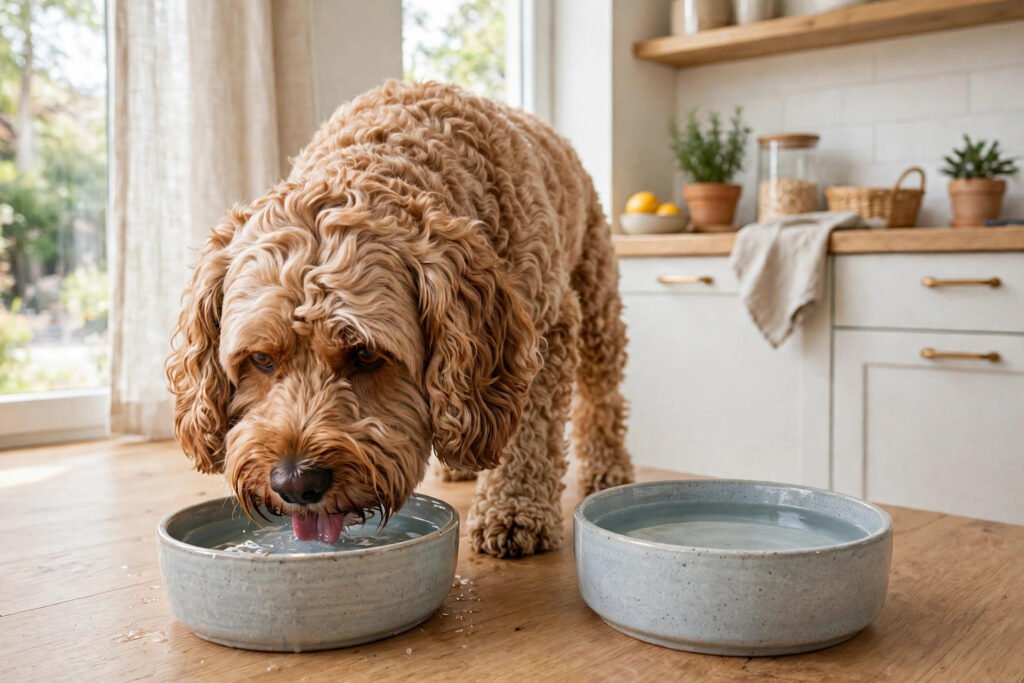
Is your Cockapoo drinking more, peeing more and losing weight? Learn the four early signs of diabetes, how vets diagnose it, and daily insulin care.
Quick answer: Diabetes in Cockapoos shows up as four signs: drinking more, peeing more, eating more, and losing weight. Your vet confirms it with a fasting blood glucose test, a urinalysis, and often a fructosamine test. After diagnosis, most diabetic Cockapoos live well on twice-daily insulin with meals at set times. Watch the eyes: most diabetic dogs develop cataracts within a year.
Your Cockapoo empties its water bowl constantly, asks to go out at night, and begs for food, yet its ribs are suddenly easier to feel. That is the classic pattern of diabetes, a common hormone disorder in middle-aged and older dogs.
The good news: diabetes is manageable. It does not go away, but with insulin, a steady routine, and regular vet check-ups, most diabetic Cockapoos live comfortable lives for years. The hard part is the first few weeks of injections and dose adjustments.
What Is Diabetes in Dogs?
Diabetes mellitus means the body cannot control its blood sugar (glucose). Glucose fuels every cell, and insulin, made by the pancreas, is the key that lets glucose move from the blood into the cells.
In dogs, diabetes almost always develops because the pancreas stops making enough insulin. Glucose builds up in the blood, the cells go hungry, and excess sugar spills into the urine, dragging water with it — which is why a diabetic dog drinks and pees so much, and loses weight even while eating more. The pancreas itself has usually failed, so insulin injections, not tablets, are the standard treatment.
Why Cockapoos? Who Is Most at Risk?
Any dog can develop diabetes, but Cockapoos carry risk from both sides of the family: Poodles are one of the breeds vet sources list as higher-risk, and Cocker Spaniels bring their own hormone and pancreas problems.
Diabetes most commonly appears in middle-aged and older dogs, females more often than males, and overweight dogs face a higher risk. A Cockapoo that has had pancreatitis is also at higher risk, because inflammation can damage the insulin-making cells. Our guide to Cockapoo pancreatitis explains that connection.
The clearest known trigger is pancreatitis. Diabetes is not caused by feeding your dog sugar.
The Four Early Signs
Diabetes rarely announces itself with one dramatic symptom. It creeps in as a pattern.
1. Drinking a lot more water
This is usually the first sign owners notice: your Cockapoo empties its water bowl and asks for more, and you may refill the bowl two or three times as often as before. Excess sugar pulls water into the urine, so the dog gets thirsty replacing the fluid it loses.
2. Peeing a lot more
More water in means more urine out. Your Cockapoo may ask to go outside far more often, produce much larger puddles, or start having accidents in the house, including overnight. Do not mistake this for a housetraining problem: a previously reliable adult that suddenly cannot hold its bladder needs a vet check.
3. Eating more — but losing weight
This confuses owners most. A diabetic Cockapoo is often hungrier than usual, yet loses weight anyway, because without insulin, food energy cannot reach the cells, so the body breaks down fat and muscle for fuel instead. If the ribs have become easy to feel, or the waist has narrowed, tell your vet.
4. Losing weight and slowing down
Weight loss is often gradual at first, then speeds up. Many diabetic dogs also become less energetic, sleeping more, less keen on walks, slower to get up, and the coat may look dull. Any one of these signs alone could mean many things. All four together, in a middle-aged or older Cockapoo, point strongly toward diabetes.
Other Signs Owners Often Miss
Two more clues: repeated urinary tract infections, since sugar in the urine feeds bacteria, and cloudy eyes, since cataracts can appear within weeks. If you notice one or two of the classic signs, do not wait — diabetes does not resolve on its own.
How the Vet Confirms It
Diagnosing diabetes is straightforward, and your vet will have an answer the same day. There is no home test: this needs a vet visit, a blood sample, and a urine sample.
Fasting blood glucose. The first step is measuring blood sugar after a period without food. One high reading is not enough on its own, because stress, including a vet visit, can push blood sugar up temporarily, so the vet reads it together with the urine result and the signs you have seen at home.
Urinalysis. A urine test is essential. In a healthy dog there should be no glucose in the urine at all — the kidneys reabsorb all of it. When blood sugar stays high, glucose spills into the urine, and finding it there alongside persistently high blood sugar, in a dog with the classic signs, confirms diabetes. It also checks for ketones, a warning sign of ketoacidosis, and for a urinary tract infection.
Fructosamine. Many vets also run a fructosamine test, which reflects average blood sugar over the previous one to three weeks. It is not affected by vet-visit stress or by whether the dog just ate, so it helps confirm the diagnosis, and later, how well the insulin is working.
Other tests. Your vet will usually run a full blood panel too, checking the kidneys and liver and screening for Cushing’s disease, the main lookalike. For check-up frequency, see our Cockapoo vet visit schedule.
Daily Life After Diagnosis: Insulin, Meals and Routine
A diagnosis changes your daily routine, but it does not end your Cockapoo’s normal life. Most diabetic dogs settle into a rhythm within a few weeks, and the whole system rests on one principle: consistency — same food, same amount, same times, same insulin, same exercise, every day.
Insulin injections, twice a day
Almost every diabetic dog needs insulin injections for life, usually twice a day, about 12 hours apart. The injections go under the skin, and most owners learn within a day or two: it is a small needle, the dog barely notices, and your vet will show you how. Never skip a dose, never double a dose, and never change the dose yourself. If you are unsure whether you gave the injection, call your vet rather than guessing — insulin given to a dog that has not eaten, or a second dose by mistake, can drop blood sugar dangerously low.
Meals at the same time as insulin
Insulin is given with food, and the meal is part of the treatment. Feed at the same times every day, usually twice a day alongside the injections, and keep the amount and type of food the same. Your vet may recommend a food higher in fiber and complex carbohydrates, which releases glucose more slowly. Avoid table scraps and fatty treats, and keep treats small and consistent. For portion sizes, see our guide to how much to feed your Cockapoo, and ask your vet to confirm the right amount for a diabetic dog.
Consistent, moderate exercise
Exercise helps the body use glucose, but the key word is consistent: a diabetic Cockapoo should get about the same amount of activity every day, since a sudden long hike or a day of no exercise can swing blood sugar up or down. Regular walks at the same times, at a moderate pace, are ideal. Avoid intense activity right after an injection, when blood sugar is lowest, and never exercise a dog that seems wobbly or weak.
Monitoring and vet check-ups
In the first weeks, your vet will want to see your Cockapoo regularly to find the right insulin dose, using a blood glucose curve, measuring blood sugar every couple of hours over a day, or fructosamine tests every few weeks. Once the dose is settled, expect check-ups every few months. Keep a simple log at home: water intake, appetite, energy, any vomiting, and the times of meals and injections. That log is the most useful thing you can bring to a vet visit.
Low blood sugar: know the signs
Too much insulin, a missed meal, or unusual exercise can drop blood sugar too low. The signs come on fast: weakness, wobbliness, confusion, trembling, or a glazed look; in severe cases the dog may have a seizure or collapse. This is an emergency: rub honey or corn syrup onto the gums if your vet has told you to, and get to the vet immediately. Ask your vet, at the diagnosis visit, exactly what to do for a low — do not wait until it happens.
 CockapooDaily
The Cataract Watch
The complication every diabetic Cockapoo owner should know about is cataracts. Excess sugar in the lens is converted into sorbitol, which draws water in, causing the lens to swell and turn cloudy. Diabetic cataracts can appear very fast, sometimes seeming to develop overnight, and they can blind a dog within weeks.
Cornell University College of Veterinary Medicine states that about 75–80% of diabetic dogs will develop cataracts within the first year of diagnosis, regardless of how well-controlled the diabetes is — so watch the eyes from day one.
Check your Cockapoo’s eyes in good light once a week for a milky, cloudy, or bluish-white haze in the center of the eye. That is different from the slight blue-grey haze of normal aging, which develops gradually and usually does not blind the dog. If you see cloudiness, call your vet promptly and ask for a referral to a veterinary ophthalmologist: cataract surgery is the only treatment that restores vision, and it works best before the cataract is fully mature. Our guide to Cockapoo eye problems covers cataracts in more detail. A blind Cockapoo can still live a full life, but the goal is to catch cataracts early and keep surgery an option.
Diabetic Ketoacidosis: The Red Flags
The most dangerous complication of diabetes is diabetic ketoacidosis, often called DKA. Unable to use glucose at all, the body breaks down fat at a furious rate and produces acidic waste products called ketones. The blood becomes acidic, the dog becomes dehydrated, and without hospital treatment the condition is fatal, as PetMD notes.
DKA can be the first sign of diabetes in a dog never diagnosed, or it can strike a known diabetic dog whose insulin was missed or who developed an infection or pancreatitis. Either way, it is an emergency — not a “wait until morning” situation.
Call your vet or an emergency clinic immediately if your Cockapoo shows any of these:
- Vomiting, especially repeated vomiting — the single most common warning sign
- Refusing food or water — a diabetic dog that will not eat is an emergency
- Extreme tiredness, weakness, or collapse
- Rapid, deep breathing — the body trying to correct the acid build-up
- Sweet or chemical-smelling breath — the smell of ketones
- Dehydration — dry, tacky gums, sunken eyes, skin that stays tented when pinched
A diabetic dog with vomiting and diarrhea needs a vet, not home care. Our guide to Cockapoo diarrhea and upset stomach covers home care for ordinary stomach upsets, but vomiting in a diabetic dog may be the start of ketoacidosis. DKA treatment means several days in the hospital on intravenous fluids, electrolyte correction, and short-acting insulin. Most dogs that reach the hospital in time do recover — but act the moment you see the signs.
What NOT to Do
- Do not try to treat diabetes with diet alone — no food, supplement, or herbal remedy replaces insulin.
- Do not skip insulin because your dog “seems fine” — dogs can look well while blood sugar is dangerously high.
- Do not change the dose yourself — if the numbers seem off, call your vet.
- Do not feed sugary treats or table scraps — fatty foods can trigger pancreatitis, which makes diabetes harder to control.
- Do not use another dog’s insulin, or human diabetes tablets — dosing is specific to the individual dog.
- Do not ignore vomiting in a diabetic dog — a dog that vomits or stops eating needs the vet the same day.
Frequently asked questions
How long can a Cockapoo live with diabetes?
With consistent insulin treatment, a steady routine, and regular vet check-ups, most diabetic dogs live for years after diagnosis and reach a near-normal lifespan. The dogs that do worst are diagnosed late, after ketoacidosis has set in, or whose owners struggle to keep the routine. Early diagnosis and consistency matter most.
Can diabetes in Cockapoos be cured?
No. Once the pancreas has stopped making enough insulin, it does not recover, and diabetes in dogs is a lifelong condition. A rare, temporary form linked to the heat cycle in unspayed females can resolve after spaying, but for most dogs the treatment is insulin for life. Most owners find the routine becomes second nature within a few weeks.
Is diabetes in Cockapoos genetic?
Partly. Diabetes runs in some families and some breeds — Poodles are one of the breeds vet sources list as higher-risk, which matters for a Cockapoo. But genetics is not the whole story: age, weight, pancreatitis, Cushing’s disease, and long-term steroid use all play a part.
How much does it cost to treat a diabetic Cockapoo?
It varies, so ask your own vet for a local estimate. The ongoing costs are insulin and syringes, regular blood tests such as fructosamine, glucose curves when the dose needs adjusting, and more frequent vet visits, plus treating complications like cataracts if surgery is chosen. Ask for a realistic monthly figure at the diagnosis visit.
My Cockapoo drinks a lot of water. Does that mean it has diabetes?
Not necessarily, but it is the single most common early sign, and it is always worth checking. Drinking more can also mean kidney disease, Cushing’s disease, a urinary tract infection, or simply hot weather and more exercise. The difference with diabetes is the pattern: drinking more plus peeing more plus eating more plus losing weight. If you see two or more together, book a vet visit and ask about a diabetes check.
Conclusion
Diabetes in Cockapoos is serious, but it is also one of the most manageable long-term conditions. The four early signs — drinking more, peeing more, eating more, and losing weight — are easy to spot once you know them, and the earlier you act, the easier the road is. Your vet can confirm the diagnosis in a single visit with a fasting blood glucose test, a urinalysis, and a fructosamine test. After that, life settles into a routine: insulin twice a day with meals, the same food at the same times, steady exercise, and regular check-ups. Watch the eyes for cataracts, and treat vomiting or refusal to eat as an emergency. Most diabetic Cockapoos live well for years, and the owners who do best keep the routine steady and call the vet early.
Leave a Reply