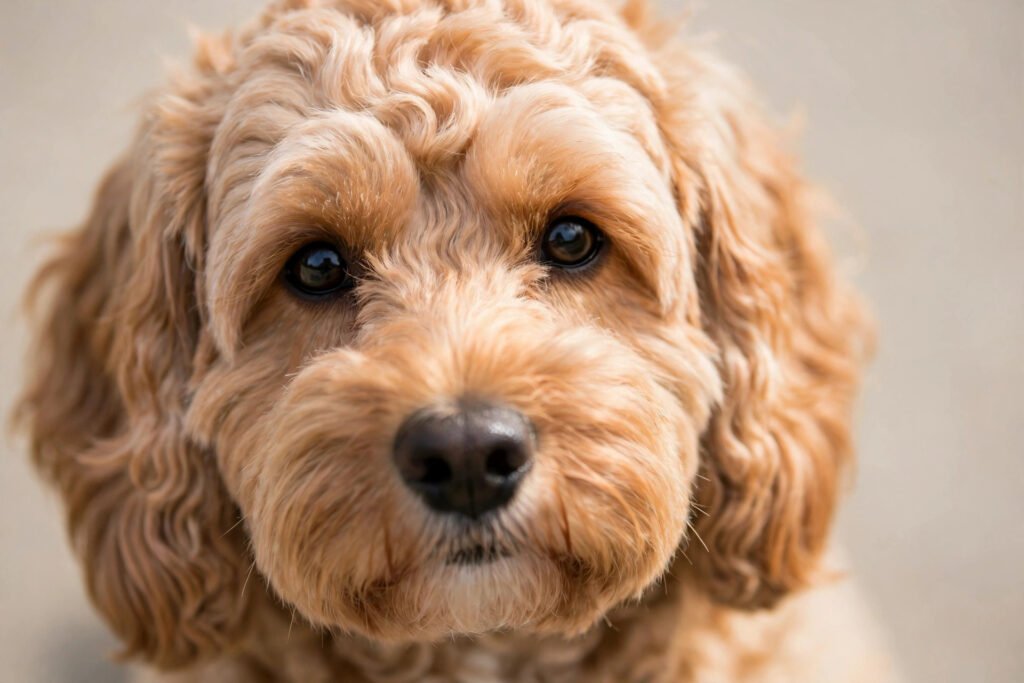
Cockapoo eye problems explained: PRA, cataracts, glaucoma, cherry eye, entropion and ulcers — plus a discharge decoder and the red flags to watch for.
Quick answer: Cockapoos can inherit eye problems from both parent breeds, most often PRA, hereditary cataracts, glaucoma, cherry eye, entropion, and corneal ulcers. Clear, watery discharge is often minor, but thick yellow or green discharge, squinting, or cloudiness needs a vet visit, and a painful or suddenly blind eye is an emergency. Ask breeders for prcd-PRA DNA results on both parents.
Eye problems are one of the quieter Cockapoo health risks — easy to miss until they are serious, and easy to confuse with something harmless. A little morning gunk in the corner of the eye is normal. A cloudy lens, a red cherry-like lump, or an eye that suddenly will not open is not. The difference matters, because some eye conditions are painless and slow, while one of them — glaucoma — can take vision in hours.
This guide walks through each condition Cockapoos actually face, what it looks like at home, and how to read eye discharge: what to wipe and watch, what to book, and what to treat as an emergency. It is general information only, not veterinary advice, and it does not diagnose your dog. If you are worried about an eye, the safe move is always a vet visit — eyes deteriorate fast.
Why Cockapoos Are Prone to Eye Problems
Cockapoos inherit eye risk from both sides of the family. Cocker Spaniels carry elevated risk for cataracts, glaucoma, cherry eye, and progressive retinal atrophy (PRA). Poodles independently carry PRA risk and a cataract predisposition. When both parent breeds bring the same vulnerabilities, the offspring inherits a compounded risk — not a guarantee of disease, but a higher chance than either parent alone would suggest.
That does not mean every Cockapoo will develop an eye problem — many never do. It means eye checks belong on your routine vet-visit list, and breeder health testing matters for eyes more than for almost any other body system, because the main inherited eye diseases can be screened for before breeding.
Age matters too: cherry eye shows up in young dogs, PRA and hereditary cataracts in middle age or later, and corneal ulcers at any age. For the wider health picture, our common Cockapoo health problems guide covers the full list — this article goes deep on eyes only.
The Conditions at a Glance
Each condition gets its own section below.
| Condition | What it is | First signs owners notice | Urgency |
|---|---|---|---|
| PRA (progressive retinal atrophy) | Inherited degeneration of the retina | Night blindness, bumping into things in dim light, dilated pupils | Vet visit; not an emergency, but needs diagnosis |
| Hereditary cataracts | Clouding of the eye’s lens | Cloudy, white, or blue-gray film over the eye | Vet visit; surgery is a specialist decision |
| Glaucoma | Raised pressure inside the eye | Pain, squinting, redness, cloudy or bulging eye, sudden blindness | Emergency — same day, hours matter |
| Cherry eye | Prolapsed gland of the third eyelid | Red, cherry-like lump in the inner corner | Vet visit within days |
| Entropion | Eyelid rolls inward, lashes rub the eye | Watery eyes, squinting, pawing at the eye | Vet visit; surgery often needed |
| Corneal ulcer | Scratch or sore on the eye surface | Squinting, tearing, pawing, cloudy spot | Vet visit promptly; can worsen fast |
| Conjunctivitis | Inflammation of the eye lining | Redness, swelling, yellow/green discharge | Vet visit, usually within a day or two |
| Dry eye (KCS) | Not enough tear production | Thick, sticky discharge, dull eye, redness | Vet visit; long-term care needed |
PRA: The Inherited Disease to Ask About Before You Buy
Progressive retinal atrophy, or PRA, is the eye condition Cockapoo buyers should know by name before they ever meet a puppy. It is a group of inherited diseases in which the retina — the light-sensitive layer at the back of the eye — slowly degenerates. Vision fades gradually, starting with night vision, and the dog eventually goes blind. There is no cure.
The early signs are subtle, which is why PRA is so often caught late. A dog that hesitates at the top of dark stairs, bumps into furniture in a dim room, or seems nervous in low light may be losing night vision. Later, the pupils look large and dilated, and the dog starts bumping into things in daylight too. PRA is not painful, and most affected dogs adapt remarkably well to blindness — they map the house by memory and smell, and they can still live a full, happy life. But it is a life-changing diagnosis, and it is largely preventable through breeder testing.
The prevention is a DNA test. The most common form of PRA in Cockapoos is prcd-PRA, and a DNA test can tell whether a parent dog is clear, a carrier, or affected. A puppy can only develop prcd-PRA if it inherits the variant from both parents, so breeding a clear dog to a carrier, or two clear dogs, prevents affected puppies. Before you buy, ask the breeder for the prcd-PRA DNA results for both parents, in writing. “The parents were vet-checked” is not the same thing — a vet check cannot see a PRA gene. If your Cockapoo’s breeding background is unknown, ask your vet about an eye exam by age 3 or 4.
Hereditary Cataracts: The Cloudy Lens
A cataract is a clouding of the lens, the clear structure inside the eye that focuses light. In Cockapoos, cataracts can be hereditary, or they can develop with age, after an eye injury, or alongside another eye disease. Hereditary cataracts can appear in young dogs, not just seniors, which is why a cloudy eye in a two-year-old deserves the same attention as one in a ten-year-old.
What you will see is a white, gray, or blue-gray film spreading across the eye. In early stages it may be a small cloudy patch; later it can cover the whole lens, and the dog’s vision fades with it. A blue-gray haze in an older dog’s eyes is sometimes just nuclear sclerosis, a normal age-related lens change that barely affects vision — only a vet exam can tell the two apart, so do not diagnose cloudiness from a photo.
Cataracts are not usually painful, but they can lead to glaucoma if the swollen lens blocks fluid drainage. Your vet will monitor it, and if it significantly affects vision, a veterinary ophthalmologist can surgically remove the lens.
Glaucoma: The Emergency
Glaucoma is the eye condition every Cockapoo owner should be able to recognize, because it is the one where hours matter. It is raised pressure inside the eye, caused when the fluid that normally drains out cannot escape. The pressure rises, the eye becomes painful, and the optic nerve is damaged. In acute glaucoma, vision can be lost in hours, and the damage is often permanent.
Learn these signs, because they are your trigger to call the vet immediately — not tomorrow, not after work:
- A suddenly painful eye: squinting, holding the eye shut, pawing at the face, or flinching at touch
- Redness in the white of the eye, or a cloudy, blue-gray look to the surface
- The eye looking larger, bulging, or harder than the other one
- Sudden blindness in one eye: bumping into things on one side
- Lethargy, loss of appetite, or vomiting alongside eye signs
Glaucoma can also follow another eye problem, including an untreated cataract. If you see these signs, call your vet or an emergency vet clinic right away and say the word “glaucoma”. Do not put any drops in the eye unless a vet tells you to. This is the single most urgent condition in this guide.
Cherry Eye: The Red Lump in the Corner
Cherry eye is the nickname for a prolapsed gland of the third eyelid — the pink, cherry-like lump that appears in the inner corner of the eye, usually in a young dog. The gland normally sits tucked under the third eyelid and helps produce tears. When the tissue holding it weakens, it pops out, red and swollen.
It looks alarming, and it is uncomfortable, but it is not usually an emergency. What it does need is a vet visit within days. The exposed gland can become irritated, it can reduce tear production over time, and it can be damaged if the dog paws at it. The usual treatment is surgery to tuck the gland back into place — not to remove it, because removing it can cause dry eye later in life.
Cherry eye can affect one eye or both, and it sometimes appears in the second eye after the first is fixed. If you see the lump, keep the dog from pawing at it, do not try to push it back yourself, and book the vet.
Entropion: When the Eyelid Rolls In
Entropion is a condition in which the eyelid rolls inward, so the eyelashes rub against the surface of the eye with every blink. It is painful, it irritates the cornea, and if left untreated it can cause corneal ulcers and scarring.
The signs are easy to mistake for something minor, which is why entropion is often caught late. Watch for a dog that squints a lot, tears constantly, paws at its eye, or has a red, irritated-looking eye that does not clear up. Watery eyes with squinting are worth a vet look, not just a wipe.
Entropion is usually corrected with surgery to tighten the eyelid. In puppies, a vet may first try a temporary tacking stitch, because a puppy’s face is still growing. The sooner it is fixed, the less damage the lashes do to the cornea.
Corneal Ulcers: A Scratch That Can Turn Serious
The cornea is the clear surface at the front of the eye, and a corneal ulcer is a sore or scratch on it — from a grass seed, a twig on a walk, a rough play session, or the rubbing of an entropion eyelid. Cockapoos, with their busy, nose-first lifestyle, are good candidates for them.
A dog with a corneal ulcer usually squints, tears heavily, paws at the eye, and may hold the eye partly shut. You may see a cloudy or dull spot on the clear surface. The danger is that an ulcer can deepen quickly, and a deep ulcer can threaten the whole eye. That is why a squinting, painful eye is always a same-day vet call. The vet will usually stain the eye with a fluorescent dye, which shows up the ulcer under a blue light and tells the vet how deep it is.
Do not use leftover eye drops, human eye drops, or anything from the medicine cabinet. Some drops that are safe for a simple irritation can make an ulcer worse. Keep the dog from rubbing the eye and call the vet.
Conjunctivitis and Dry Eye: The Common Irritations
Not every eye problem is inherited or dramatic. The two most common everyday eye conditions in Cockapoos are conjunctivitis and dry eye, and both are the usual cause of the discharge owners actually see.
Conjunctivitis is inflammation of the pink lining around the eye — the dog version of pink eye. It can be caused by infection, allergy, or irritation, and it shows up as redness, swelling, and yellow or green discharge. It needs a vet visit, usually within a day or two, because the cause determines the treatment — and because what looks like conjunctivitis can sometimes be the first sign of something deeper, like an ulcer.
Dry eye, known as keratoconjunctivitis sicca (KCS), is the opposite problem: the eye does not make enough tears. The discharge becomes thick, sticky, and gray or white, and the eye looks dull. Dry eye needs long-term veterinary care, and it is diagnosed with a simple tear test — a small strip of paper held inside the lower lid for a minute. If your Cockapoo has persistent thick, sticky discharge, ask your vet about a tear test rather than just cleaning more often.
The Discharge Decoder: What the Color and Texture Mean
Eye discharge is the symptom Cockapoo owners search for most, and it is the question the internet answers worst — the discharge query is dominated by one-off Q&A threads, not a proper guide. This table is that guide, not a diagnosis: more than one problem can overlap, and only a vet exam can confirm the cause. Two rules cut through it: color is the fastest clue (clear is usually minor, yellow or green usually means infection, thick gray-white usually means dry eye), and discharge plus squinting, redness, or cloudiness is a vet visit the same day, whatever the color.
| Discharge | What it often means | What to do |
|---|---|---|
| Small amount of clear, watery tears | Irritation, wind, dust, mild allergy, or normal tearing | Wipe gently and watch; vet if it persists |
| Clear crust or reddish-brown gunk in the morning | Normal overnight buildup, often with tear staining | Clean as below; cosmetic unless the eye looks sore |
| Thick yellow or green, pus-like | Bacterial infection or conjunctivitis | Vet visit, usually within a day or two |
| Thick white or gray, sticky and stringy | Dry eye (KCS) or blocked tear ducts | Vet exam and a tear test; needs long-term care |
| Watery overflow with constant wetness | Blocked tear duct, eyelid problem, or glaucoma | Vet visit; glaucoma must be ruled out |
| Bloody discharge, or discharge after trauma | Injury, ulcer, or a serious eye problem | Same-day vet visit |
| Any discharge plus squinting, redness, cloudiness, or pawing | The eye is painful or the surface is damaged | Same-day vet visit |
How to Clean Your Cockapoo’s Eyes at Home
For normal, minor discharge — a little clear tearing or morning crust — home cleaning is fine. Use lukewarm water or sterile saline and a clean, soft cloth, one cloth per eye, wiping from the inner corner outward. Never use soap, human eye drops, or leftover drops unless your vet tells you to. Brown or red fur around the eyes is tear staining — a cosmetic issue, not an eye disease. Our Cockapoo tear stains guide covers it in detail. Stop cleaning and call the vet if the discharge changes color, increases, or comes with any red-flag sign below.
Prevention: What Actually Reduces the Risk
You cannot prevent every eye problem, but most of the work happens before you ever bring a puppy home:
- Buy from a breeder who tests. Ask for prcd-PRA DNA results on both parents, plus a current eye exam (CAER) on both parents. Get both in writing. This is the single highest-value eye question you can ask a breeder.
- Keep up routine vet exams. An annual exam catches early cataracts, early PRA signs, and eyelid problems before they become emergencies. Mention any eye change, however small, at the visit.
- Do not ignore a one-eye problem. Most eye conditions start in one eye. A problem in one eye is a vet visit, because a one-sided problem is more likely to be an ulcer, an injury, or glaucoma than a simple irritation.
Ear problems often travel with eye problems in this breed — the same allergies that irritate eyes can inflame ears — so if eye trouble comes with head-shaking, read our Cockapoo ear infections guide and how to clean Cockapoo ears.
Red Flags: Call the Vet Today
Most eye discharge is minor, but these signs mean same-day veterinary attention — the first three mean emergency care:
- A painful eye: squinting, holding the eye shut, pawing at the face, or flinching at touch
- A cloudy, blue, or bulging eye, or one that suddenly looks larger than the other
- Sudden blindness in one or both eyes, or bumping into things on one side
- Thick yellow or green discharge, especially in one eye only
- Discharge after any trauma: a scratch, a knock, a grass seed, or a fight
- A red lump in the corner of the eye that is growing or bleeding
- Any eye problem in a puppy under 12 weeks, or discharge that has lasted more than a day or two
If you are ever unsure whether an eye sign is urgent, call your vet and describe it — with eyes, early is everything.
Frequently Asked Questions
Why does my Cockapoo have goopy eyes?
The most common causes are mild irritation, allergies, or a blocked tear duct, which produce clear or slightly crusty discharge. Thick yellow or green usually means infection, and thick gray, sticky discharge usually means dry eye. If it keeps coming back, or comes with squinting, it needs a vet visit rather than more cleaning.
Is a little eye discharge normal in Cockapoos?
Yes, in small amounts. A little clear tearing or crust in the inner corners in the morning is normal, especially after a windy or dusty walk. What is not normal is a change: more discharge than usual, a color change to yellow or green, or discharge with squinting or cloudiness.
Can Cockapoos go blind from PRA?
Yes, eventually. PRA is progressive, with no treatment, and affected dogs lose vision over months or years, starting with night vision. It is not painful, and most dogs adapt well to blindness. The way to avoid it is breeder DNA testing for prcd-PRA on both parents before breeding.
Is cherry eye an emergency?
Usually not, but it needs a vet visit within days. The exposed gland can become irritated and reduce tear production, and the dog may paw at it. Surgery to tuck the gland back is the usual treatment. Do not try to push it back yourself.
When should I worry about a cloudy eye?
Any new cloudiness deserves a vet visit, because the causes range from a normal age-related lens change to cataracts to glaucoma — and only an exam can tell them apart. A cloudy eye that is also painful, red, or suddenly blind is an emergency.
Conclusion
Cockapoo eyes deserve more attention than they usually get, because the breed inherits real risk from both parent breeds — and because the difference between a minor irritation and a sight-threatening emergency can be as small as a color change in discharge or a single squint. The plan is short: buy from a breeder who DNA-tests for prcd-PRA and eye-exams both parents, keep up annual vet exams, learn the discharge decoder, and treat any painful, cloudy, or suddenly blind eye as an emergency.
Start tonight: look at your Cockapoo’s eyes in good light. Clear, white, and comfortable with only a little morning crust? Keep the routine going. Yellow or green discharge, a cloudy patch, a red lump, or a new squint? Call your vet tomorrow at the latest — and if the eye is painful or the dog suddenly cannot see, call now.
This article is general information only and is not veterinary advice. Eye conditions should be diagnosed and treated by your Cockapoo’s veterinarian, and any painful, cloudy, or suddenly blind eye needs same-day veterinary care.


Leave a Reply