
Cockapoo summer safety: heatstroke signs and first aid, the 85°F rule, hot-pavement paw checks, water safety, summer trims, and cooling tips that work.
Quick answer: Cockapoos overheat faster than many breeds because of their dense, curly coat and high energy. Above 85°F, cut exercise short, walk only early morning or late evening, and never leave your dog in a car. Heavy panting, drooling, red gums, and wobbliness are heatstroke signs — an emergency that needs a vet immediately.
Summer is the best season to own a Cockapoo — long evenings, lakes, trails, backyard games — and also the riskiest. Cockapoos do not sweat the way we do: they cool themselves almost entirely by panting and through the pads of their paws, and their thick, curly coat traps heat when it is matted or overlong. Add a dog that never wants to stop playing, and you have a breed that will happily run itself into heatstroke. This guide covers the real risks, in order of danger, and exactly what to do about each one.
Why Cockapoos overheat faster than you think
A Cockapoo’s coat is built for insulation, not for shedding heat. The dense curls inherited from the Poodle side, layered over the Cocker Spaniel’s coat, trap a layer of warm air against the skin. That is useful in winter and a liability in July. A matted coat is worse: mats block airflow entirely and can hide hot spots and skin irritation underneath.
Some Cockapoos also inherit a slightly shorter muzzle, which means less efficient panting — and panting is the main cooling system. Add high energy and a strong desire to please, and many Cockapoos will keep fetching long after they should have stopped. Your dog will not self-regulate reliably in the heat — you have to do it for them.
Age and health matter too. Puppies under six months, seniors, overweight Cockapoos, and any dog with a heart or breathing condition overheat faster and recover more slowly. If your dog falls into one of those groups, treat every hot day as a high-risk day.
The 85°F rule: when to change the plan
There is no single magic temperature, because humidity matters as much as heat — a humid 85°F day is harder on a dog than a dry 90°F one. But 85°F is a useful line in the sand for Cockapoos: above it, change the plan.
| Temperature | What to do |
|---|---|
| Below 75°F | Normal walks and play, with water available. |
| 75–85°F | Shorten exercise, stick to shade, carry water, watch for heavy panting. |
| Above 85°F | Walk only early morning or after sunset. No midday walks, no fetch, no long hikes. |
| Above 90°F, or high humidity | Keep it indoors: air conditioning, puzzle toys, and short potty breaks only. |
The hottest part of the day in most of the US is 10 AM to 4 PM. Move walks to before 9 AM or after 7 PM in summer, and choose shaded routes — tree-lined streets, wooded trails, parks with cover — over open sun. Cut exercise sessions in half on hot days, and always carry water. A collapsible bowl and a bottle of cool water weigh nothing and can prevent an emergency.
If you want the full exercise picture across the year, our exercise guide covers how much activity a Cockapoo needs by age — the summer rule is to do less of it, earlier in the day.
Heatstroke: the signs and what to do in the first minutes
Heatstroke is the most dangerous summer risk, and it can kill. A dog’s normal body temperature is about 101–102.5°F. At 104°F they are in the danger zone; at 106°F, organ damage begins, and it can be fatal within minutes.
Learn the signs in order, because early signs are easy to miss:
- Early: heavy panting that does not slow down with rest, drooling, a dry or sticky mouth, restlessness, and a faster heartbeat.
- Getting worse: very red or pale gums and tongue, lethargy, wobbliness or lack of coordination, vomiting or diarrhea.
- Emergency: collapse, seizures, loss of consciousness, or a body temperature above 104°F.
If you see early signs, act at once. Move your dog into shade or air conditioning, offer small amounts of cool water (do not force it), and wet their belly, paws, and ears with cool — not ice-cold — water. A fan helps. Do not use ice or ice water: cooling too fast causes shivering, which generates heat, and can send the body into shock.
Then get to a vet immediately, even if your dog seems to be improving. Heatstroke can cause delayed organ damage that is not visible from the outside, and a vet can check blood work, give IV fluids, and monitor for complications. Call ahead on the way so the clinic is ready. Heatstroke is always a veterinary emergency — home cooling is first aid, not treatment.
Hot pavement and burned paws
Asphalt in full sun can reach 140–150°F on a 90°F day, and a dog’s paw pads burn at around 125°F. Burns happen fast — a minute on scorching pavement is enough to blister a pad.
Use the 5-second rule: press the back of your hand flat on the pavement for five seconds. If you cannot hold it there comfortably, it is too hot for your Cockapoo. Walk on grass, shaded paths, or dirt trails instead, and if you must cross pavement, do it quickly. Dog booties help on hot surfaces and also protect against sharp gravel and salt, though many Cockapoos need a few days to get used to them — introduce them indoors first, with treats.
Check paws after every summer walk. Look for redness, blisters, peeling pads, limping, or your dog licking its paws obsessively. Minor pad burns need rest, clean cool water, and a vet check if the skin is broken — do not apply creams or bandages without veterinary advice. Burned pads can take weeks to heal, and a dog that will not walk is a dog in pain.
Never leave your Cockapoo in a car
This is the rule with no exceptions, and it is the one people get wrong most often. A parked car’s interior can reach 120°F in 20 minutes on a 90°F day, even with the windows cracked — cracking a window barely slows the rise. At 100°F outside, the inside can pass 140°F. A dog left in those conditions can suffer heatstroke in minutes, and dogs die this way every summer in the US.
Do not leave your Cockapoo in the car “just for a minute,” and do not rely on the air conditioning staying on. In many US states it is illegal to leave a dog in a hot car, and bystanders may legally break in to rescue one. Plan stops around your dog: drive-throughs, pet-friendly stores, or one person staying with the dog in a running, air-conditioned car. Our traveling with a Cockapoo guide has the full road-trip checklist.
Water safety: swimming, lakes, and blue-green algae
Most Cockapoos love water — the Spaniel side often does — and swimming is one of the best ways to exercise a dog in summer without overheating. But water has its own risks, and the most dangerous one is invisible.
Blue-green algae (cyanobacteria) blooms in warm, slow-moving fresh water — lakes, ponds, and reservoirs — typically from mid-summer into fall. It often looks like green scum, pea soup, or spilled paint on the water’s surface, but it can also be present without any visible sign. It produces toxins that can kill a dog within an hour of exposure, and there is no antidote. Never let your Cockapoo swim in or drink from water with visible scum, a green tint, or a foul smell, and check your state’s environmental agency or local park warnings before visiting a lake. If your dog swims in a lake and then starts vomiting, drooling, staggering, or having seizures, get to an emergency vet immediately and tell them about the algae exposure.
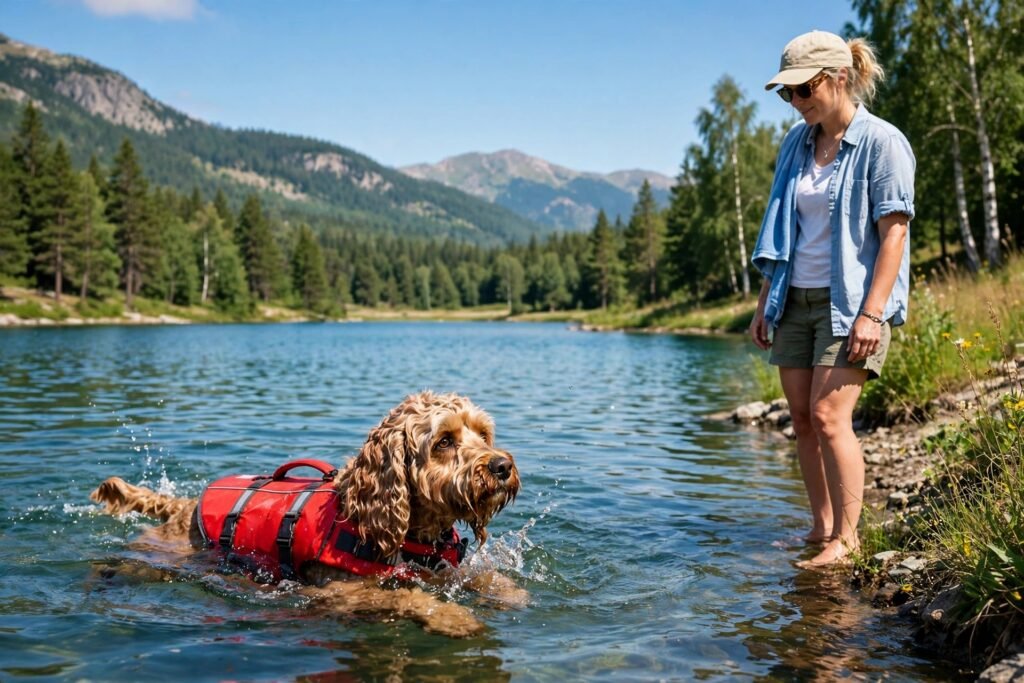
For general swimming: never let a Cockapoo swim unsupervised, even a confident swimmer; use a dog life jacket in open water or strong currents; show your dog how to get out — the ramp, steps, or shallow edge — before letting them swim; and rinse them with fresh water afterward. In pools, teach your dog where the steps are and never leave them alone in the pool area. Our swimming guide covers how to introduce a Cockapoo to water safely.
 CockapooDaily
The post-swim ear routine
This is the step most owners skip, and it is the one that causes the most summer vet visits. Cockapoos have long, floppy ears that trap moisture, and a damp, warm ear canal is the perfect place for yeast and bacteria to grow. A swim followed by a long car ride home with wet ears is a classic recipe for an ear infection.
After every swim or bath, dry the ears: lift the ear flap, gently wipe the visible outer ear with a clean towel or cotton ball, and let air circulate. Do not push anything deep into the ear canal. A vet-approved ear-drying solution, used as directed, helps evaporate trapped moisture — ask your vet to recommend one. Watch over the next few days for head shaking, scratching, a yeasty smell, redness, or discharge: those mean an infection is starting, and early treatment is far easier than a deep one. Our ear infection guide covers the signs and treatment in detail.
Summer coat: trim, do not shave
A shorter summer trim helps a Cockapoo stay cool and makes mats far less likely — most owners find a trim to about 1–1.5 inches works well, with the ears and feathering kept tidy. But do not shave the coat down to the skin. The coat protects against sunburn, and a shaved dog can burn just like a person. A groomer can advise on the right length for your dog’s coat type, and summer is a good time to book more frequent grooming — every 6–8 weeks, with brushing several times a week in between, especially after swimming, when wet curls mat fastest.
Sunburn is a real risk for light-colored Cockapoos and for any dog with a pink nose, pale skin on the belly, or thin fur on the ears. If your dog spends time in strong sun, use a dog-safe sunscreen (never human sunscreen, which can contain zinc oxide or other ingredients toxic to dogs) on the nose, ear tips, and belly, and reapply after swimming. A shady spot and a UV-blocking vest are better than sunscreen alone.
Keeping cool at home and on the go
Cooling at home is mostly about giving your dog choices. Keep fresh, cool water in more than one place — and check it twice a day in summer, because bowls in the sun heat up fast. Make sure there is always a shaded or air-conditioned spot to lie in, and a cool floor (tile or concrete) rather than carpet. A cooling mat, a damp towel, or a shallow paddling pool in the shade all help, and frozen treats — a Kong stuffed with frozen peanut butter or plain yogurt — keep a bored Cockapoo busy indoors on days too hot to go out.
On the go, pack a small summer kit: a water bottle and collapsible bowl, a towel, a cooling vest or bandana if your dog tolerates one, and booties if you will be on pavement. In a car, use a sunshade on the windows and never let the air conditioning blast directly onto a wet dog after swimming — dry them first, or the chill can be a shock.
Summer parasites: fleas, ticks, and mosquitoes
Warm weather is parasite season. Fleas thrive in heat and humidity, ticks are most active from spring through fall, and mosquitoes carry heartworm, which is a serious risk across much of the US. Summer is not the time to let prevention lapse: keep flea and tick treatment current, check for ticks after every walk in grass or woods (ears, armpits, groin, and between the toes are the hiding spots), and talk to your vet about year-round heartworm prevention if you are not already using it. Our fleas and ticks guide covers identification, removal, and prevention in detail.
Also watch for grass seeds and burrs, worst in late summer. They lodge between toes and in ears, and a grass seed in an ear canal is a painful vet emergency. A quick check of paws and ears after every walk takes a minute.
Frequently asked questions
What temperature is too hot for a Cockapoo?
Above 85°F, cut exercise short and walk only in the early morning or late evening. Above 90°F, or on very humid days, keep activity indoors with air conditioning and short potty breaks only. Humidity matters as much as temperature — a humid 85°F day is harder on a dog than a dry 90°F one.
Can Cockapoos get heatstroke?
Yes — they are at moderate risk, more than many breeds, because of their dense curly coat, high energy, and sometimes shorter muzzle. Heavy panting that does not ease with rest, drooling, red gums, wobbliness, vomiting, or collapse are heatstroke signs. Cool the dog with cool water on the belly and paws and get to a vet immediately.
Can I leave my Cockapoo in the car with the windows down?
No. A parked car can reach 120°F in 20 minutes on a 90°F day, and cracked windows barely slow the rise. Dogs can suffer heatstroke in minutes. Never leave a dog in a parked car in warm weather, even briefly.
Is it safe for my Cockapoo to swim in a lake?
Only if the water is clear of blue-green algae. Never let your dog swim in water with green scum, a pea-soup look, or a foul smell, and check local water warnings first. Always supervise swimming, rinse off afterward, and dry the ears thoroughly to prevent infection.
Should I shave my Cockapoo for summer?
No — trim, do not shave. A summer trim to about 1–1.5 inches keeps the coat manageable and helps with cooling, but shaving to the skin removes sun protection and can cause sunburn. Keep brushing several times a week, especially after swimming.
Conclusion
Summer with a Cockapoo is mostly common sense applied consistently: walk early, carry water, check the pavement, never use the car as a waiting room, keep the coat trimmed but not shaved, and dry the ears after every swim. The one thing to take seriously above all is heatstroke — learn the signs now, before you need them, because the first minutes decide the outcome. Do that, and the long summer evenings are exactly what they should be: the best part of the year, for both of you.
Leave a Reply