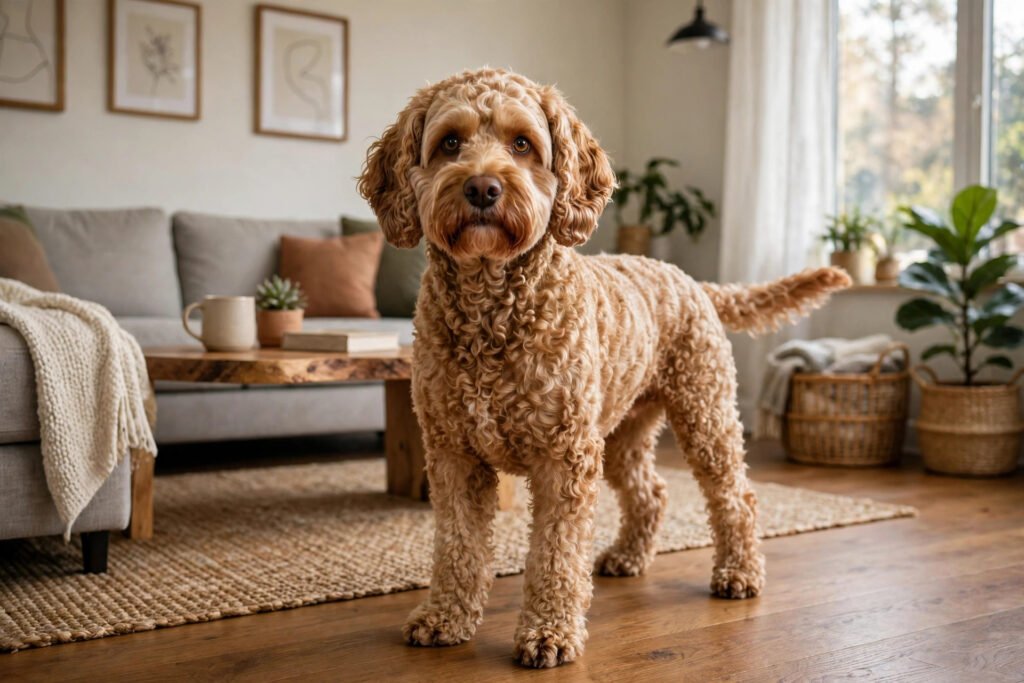
Why is your Cockapoo growling? Decode play, warning, fear, and pain growls by sound and body language, and learn what to do in the moment.
Quick answer: Most Cockapoo growling is communication, not aggression: play growls are short and high-pitched with a loose, bouncy body, while warning, fear, and pain growls are low and long with a stiff or crouched body. Never punish a growl — it is your dog’s warning before a snap or bite. Step back, give space, and work out the trigger.
Hearing your Cockapoo growl for the first time is unsettling, especially when it is aimed at you or at a child. The instinct is to tell the dog off and make it stop. That instinct is exactly backwards: a growl is your dog talking to you, and if you take that warning away, you get a dog that skips the warning next time.
This guide decodes the growl by type, so you can tell in seconds whether your Cockapoo is playing, frightened, hurting, or telling someone to back off.
One scope line before we start: growling over food, a bone, a toy, or a favorite spot is resource guarding, and it has its own full guide. If that is what your Cockapoo is doing, read our Cockapoo resource guarding article instead — this article covers every other kind of growling and does not repeat that content.
What a Growl Actually Is
A growl is a distance-increasing signal: your dog is asking for more space, more time, or for something to stop. The Cockapoo Owners Club UK, drawing on trainer Anne Rogers, puts it on a scale from 0 to 10, where 0 is a warm, happy, relaxed dog and 10 is a bite. A growl sits at about 6 — which means there were 5 or 6 earlier, quieter signals you probably missed.
 CockapooDaily
Growling is normal dog communication. All dogs growl, and Cockapoos are no exception. It does not mean your dog is aggressive, dominant, or “bad.” It means something in that moment is making your dog uncomfortable, frightened, frustrated, excited, or sore.
The sound alone will not tell you which one it is. A growl is a growl, as Cockapoo HQ puts it — the same sound can mean different things, and the difference lives in the body around it. That is why this article is built around the decoder table below.
The Growl Decoder: Every Type at a Glance
Read the whole row, not just the sound column. The body is what separates a play growl from a warning.
| Growl type | Sound | Body language | What it means | What to do |
|---|---|---|---|---|
| Play | Short, high-pitched, breathy | Loose, wiggly, play bows, bouncy | “This is fun” | Let play continue |
| Warning | Low, long, steady | Stiff body, hard stare, weight forward | “Back off” | Stop and give space at once |
| Fear or anxiety | Low, rumbling | Crouched, tail tucked, ears flat, trying to escape | “I am scared” | Increase distance; never drag the dog closer |
| Pain | Sharp, sudden, often with a yelp | Flinching when touched, tense, hiding | “That hurts” | Stop touching and call your vet |
| Frustration | Rising, mixed with barking | Pulling, lunging, fixated | “I cannot get to it” | Remove the dog calmly |
| Territorial | Low grumble, rising in pitch | At the window or door, hackles up | “This is my space” | Redirect calmly indoors |
Remember this: loose body means play, stiff body means take it seriously.
1. Play Growls: The One to Enjoy
Play growls are the most common growls a Cockapoo owner hears, and the least worrying. They show up during tug-of-war, wrestling, chase games, and roughhousing. They sound dramatic, but the body gives them away: wiggly movements, play bows (front end down, rear end up), taking turns, and frequent pauses.
A play growl is usually high-pitched and short, often broken into pulses rather than one long rumble. The mouth is open and relaxed, the tail wags in wide sweeps, and the dog keeps coming back for more.
Do not scold a play growl, and do not stop a game just because it sounds fierce. The one thing to watch is arousal: if play gets faster, louder, and stiffer, and the pauses disappear, end the game calmly for a minute and then resume. Puppies are the worst for this, and teething can make them mouthier and noisier still. Our guide to how to stop Cockapoo puppy biting covers the same over-arousal problem from the biting side. The line between play and a real warning is the body: stiffness, a hard stare, freezing, or one dog repeatedly trying to escape means it is no longer play — step in and separate them calmly.
2. Warning Growls: The Polite “Back Off”
A warning growl is the growl most owners picture when they search this question. It is low-pitched and long, the body tenses, the face hardens, and the dog may show its teeth. It happens when someone is doing something your Cockapoo does not like, and the dog has decided that the earlier, quieter signals did not work.
Common triggers include reaching over the dog’s head, hugging the dog, crowding it in a corner, or a stranger leaning in to stroke it. Cockapoos are friendly dogs, but they are also, as OodleLife notes, more territorial than their cute looks suggest.
A warning growl is not a failure. It is the dog choosing to warn instead of bite. Treat it as information, not defiance: stop what you are doing, give the dog space, and note where the boundary is.
What a warning growl is not: it is not dominance. The idea that a growling dog is trying to be the boss of the house is outdated, and Cockapoo HQ’s FAQ answers it directly — dogs do not think in those terms. Staring the dog down, pinning it, or “showing it who is boss” is the fastest way to turn a warning into a bite.
3. Fear and Anxiety Growls: The Dog That Wants Out
A fear growl sounds a lot like a warning growl, but the body language is almost the opposite. A fearful Cockapoo does not lean forward. It bunches up, sinks lower, tucks its tail, flattens its ears, and tries to get away. It may hide under furniture, shake, lick its lips, or yawn (a stress sign, not tiredness).
The triggers are often small things: a bag of trash on the sidewalk, a stranger reaching out a hand, a loud noise, or another dog barking down the street.
Two mistakes make fear growling worse. The first is dragging the dog closer to whatever is scaring it. Never do this — a frightened dog that cannot escape has no options left except to escalate. The second is comforting the dog in a way that traps it: holding it still or blocking its escape route. Comfort is fine; restraint is not. Let the dog move away and choose the distance it needs.
Fear growling that shows up often is usually a socialization gap, and it is worth working on early. Our Cockapoo separation anxiety guide covers one common form of anxiety in detail, and the same slow approach applies here: small exposures, at a distance the dog can cope with, paired with treats, never forced.
4. Pain Growls: The One That Needs a Vet
A pain growl is different from the others: it usually comes on suddenly, in a dog that was fine a moment ago. Your normally sweet Cockapoo growls when you touch a particular spot or pick it up a certain way. It may flinch, yelp, or move away — and the growl gets louder if you touch the same place again.
Dogs are good at hiding pain. A pain growl may be the first sign you get that something is wrong, from a sore paw to a pulled muscle or a joint problem. Cockapoo HQ puts it plainly: a dog with an injury you cannot see may growl when you go near it because it knows you are about to touch it. If the growling is new, happens when you touch one specific area, or comes with limping, hiding, or a change in appetite, stop handling the dog and call your vet.
This is also the growl to take seriously in an older dog. A Cockapoo that has never growled and suddenly starts growling when lifted or stroked is very likely hurting somewhere — joints are a common culprit as dogs age, and our guide to Cockapoo joint problems covers the signs to watch for. Do not keep touching the sore spot to “check.” The vet visit is the check.
5. Frustration and Territorial Growls
Frustration growling is the release valve for a dog that wants something it cannot reach. The classic version is leash frustration: your Cockapoo sees another dog across the street, pulls hard toward them, barks, whines, and growls — and behaves completely differently off the leash. You will also see it behind a fence or a baby gate, or when a toy rolls under the sofa.
The fix is to stop the frustration from building. Cross the street before your dog locks onto the other dog, or turn around and walk the other way. Increase the distance until your dog can notice the trigger without losing control, then reward calm behavior at that distance. Marching the dog straight through the trigger while it is already over the threshold just rehearses the growling.
Territorial growling is related but different: the dog is guarding the house, the yard, or the family. It starts as a low grumble at the window or the front door and rises in pitch if the person outside keeps coming closer. Most Cockapoos warm up to visitors quickly once they are inside. The problem is only when the growling is constant and aimed at every passer-by — then the dog spends its whole day on alert. Do not leave the dog staring out of the front window all day rehearsing the behavior: close the curtains, use a baby gate to keep the dog out of the hallway, and teach a “go to your bed” cue for the doorbell.
6. Growling When Moved, Picked Up, Petted, or Woken Up
Some of the most confusing growls happen at home, in ordinary moments — and they have their own logic.
Moved off the sofa or bed. Your Cockapoo is comfortable and does not want to move — not stubbornness, not dominance. Lure the dog off with a treat, teach an “off” cue when the dog is calm, or use a baby gate to keep the dog off the furniture. Never drag the dog off by its collar while it is growling.
Picked up. Not all dogs like being picked up. A growl when lifted can mean discomfort, fear, or pain — especially if the dog is picked up under the front legs. If your Cockapoo growls when picked up, stop doing it unless you have to; when you must, lift with one hand under the chest and one under the hindquarters.
Petted. A dog can growl during petting for three reasons: overstimulation, a sore spot, or simply having had enough. The last one confuses owners most — the dog leans in, you keep stroking, and then it growls. Learn the signs that the session is ending: the body goes still, the mouth closes, the dog turns away or licks its lips. Stop there, while the dog is still happy.
Woken up. A dog woken suddenly from a deep sleep can growl or snap before it is fully awake — sometimes called sleep startle. Never wake a sleeping Cockapoo by touching it or leaning over it; call its name from a few steps away. This matters most with children, who are the most likely to flop down next to a sleeping dog.
The Signs Before the Growl: The Ladder You Are Missing
The growl is not the first warning. It is roughly the middle of a ladder of signals, and every step before it is quieter and easier to miss. Catching the dog at step 2 means you never reach step 6.
- Yawning. A big yawn in a situation that is not sleepy is a stress sign.
- Mouth closes. A happy, relaxed dog has a slack jaw and a slightly open mouth. If the mouth closes, the dog is starting to feel tense.
- Turning away. The dog turns its head or body away, trying to reclaim personal space.
- Lip licking. Quick tongue flicks over the nose, with no food around, mean discomfort.
- Freezing. The dog goes suddenly still. This is the step after the growl, and the most dangerous one to miss — a freeze means the next step may be a snap, and it can happen in a split second.
If you see the early signs, act on them: give the dog space, stop what you are doing, and let the dog move away. Every time you respect an early signal, you teach your dog that the quiet signals work.
What to Do in the Moment: The 5-Step Response
Whatever kind of growl it is, the in-the-moment response is the same. Memorize it, because you will need it when you are startled and not thinking clearly.
- Stop. Freeze what you are doing. Take your hand away. Stop moving toward the dog. Do not lean over it.
- Give space. Step back calmly, turn slightly sideways, and avoid direct eye contact. Let the dog move away if it wants to.
- Stay calm and quiet. Do not shout, do not scold, and do not make sudden movements.
- Work out the trigger. Once everyone is safe, ask what just happened. What were you doing? Who was near? Write it down if the growling keeps happening — a pattern usually appears within a week.
- Change the setup, not the dog. Move the dog’s bed to a quieter spot. Keep children from hugging the dog. Give the dog an escape route from the room. Most growling problems are setup problems.
What never to do in the moment: do not grab the dog’s collar, do not corner it, do not try to “correct” the growl, and do not punish the dog after the fact.
Never Punish the Growl: The Rule That Protects Everyone
This is the single most important rule in this article, and every source on the subject agrees on it — OodleLife, Cockapoo HQ, the Owners Club, and the general dog-behavior guides all say the same thing: never punish a growl.
Here is why. A growl is a warning, and a warning is a gift. If you punish the growl — shouting, scolding, tapping the muzzle, or any other correction — the dog does not stop being uncomfortable. It stops telling you. The next time the trigger appears, the dog skips the growl and goes straight to a snap or a bite. Trainers call this “taking the warning out of the dog,” and it is how friendly family dogs end up biting a child with no warning at all.
Keep the growl. Give the growling dog what it wants — distance — and then fix the situation that caused it. The growl is not the problem; the situation that caused it is. This rule holds even when the growl is aimed at a child, and even when it feels embarrassing in front of guests.
Growling at Children: The Safety Section
Growling at children is the scariest version of this problem, and the one where the stakes are highest — so it gets its own section, and its own rules.
First, understand why it happens. Children are the hardest people for a dog to read: they move fast, they are noisy, they lean over dogs, they hug and grab, and they do it all at the dog’s eye level. From the dog’s point of view, a child hugging it is not affection — it is being trapped. The growl is the dog saying “I need space,” and the child is the person least likely to hear it.
Many dog bites on children happen because the early signals were missed, the growl was punished or ignored, and the dog eventually ran out of options. The dog always gets blamed for the bite. The adults are the ones who could have prevented it.
The rules are simple and non-negotiable:
- Never leave a dog and a child unsupervised together. Not for a minute, not because “he has never done anything before.”
- Teach children what a growl means. A growl means “back off, I am really unhappy about this.” Teach them to stop, stand still, and walk away calmly — and to tell an adult. Teach them never to hug a dog around the neck, never to lean over a sleeping dog, and never to take a toy from a dog’s mouth.
- Give the dog an escape route and a safe place. The dog needs somewhere it can go that children are not allowed to follow — a crate with the door open, a bed in a quiet room, a spot behind a baby gate.
- Do not punish the growl at a child. A dog punished for growling at a child may bite a child without warning next time.
- If the growling at children keeps happening, get help now. A certified professional dog trainer or a veterinary behaviorist — not a neighbor, not a video — should assess the dog and the household. In the meantime, the dog and the children are separated unless an adult is actively supervising.
For the wider picture on children and Cockapoos, read our guide on are Cockapoos good with children.
Growling at Strangers and Other Dogs
Growling at strangers is usually fear, territorial behavior, or a mix of the two. Tell visitors to ignore the dog when they arrive: no eye contact, no reaching out, no leaning over. Let the dog approach in its own time, and let the visitor drop a treat on the floor rather than hand-feeding it.
Growling at other dogs is similar, with leash frustration as the most common cause on walks. Off the leash, a brief growl during a greeting is often normal — what matters is whether the dogs can disengage. If every greeting ends in a growl, shorten them: three seconds of sniffing, then call your dog away with a treat.
If the growling at strangers or other dogs is getting worse, or it started suddenly in a dog that used to be friendly, that is a vet visit first — pain can make a friendly dog growl at the world — and a certified trainer or behaviorist second.
The Longer Fix: Teaching Your Cockapoo to Cope
Stopping the growl is not the goal. The goal is a dog that does not need to growl so often — because it feels safer and the triggers are managed.
- Find the pattern. Keep a simple log for two weeks: date, time, what happened just before the growl, who was there, and what the dog did. Most owners find the pattern in a few days — it is almost always the same 2 or 3 triggers.
- Manage the triggers. If the dog growls when woken, stop waking it by touch. If it growls at the window, block the view. If it growls when hugged, teach the family not to hug it. Management is not giving in — it is removing the situations that force the dog to warn you.
- Desensitize slowly. For fear-based growling, work at a distance where the dog notices the trigger but does not growl, and pair the trigger with something good. Move closer only when the dog is relaxed at the current distance. This is slow work, measured in weeks.
- Reward calm behavior. Catch your dog being calm around a trigger and reward it.
- Get professional help when you need it. If the growling is frequent, escalating, or aimed at children, talk to your vet first to rule out pain, then to a certified professional dog trainer or a veterinary behaviorist.
Two things that do not fix growling: spaying or neutering, and dominance-based training. Cockapoo HQ’s FAQ answers the first directly — there is no evidence that spaying or neutering stops a dog from growling, because growling is communication, not a hormone problem. Dominance-based methods — alpha rolls, staring the dog down, physical corrections — suppress the warning without removing the cause.
When to Worry: The Vet and Behaviorist Checklist
Most growling is normal communication and needs management, not medical care. Get professional help promptly if any of these apply:
- The growling started suddenly in a dog that never growled before
- The growl happens when you touch one specific part of the body
- The growling is getting more frequent, louder, or more intense over weeks
- The dog has snapped, lunged, or bitten, or the growl is now followed by a freeze with no warning
- The growling is aimed at children and it keeps happening
- The dog’s behavior has changed in other ways too — hiding, not eating, or seeming withdrawn
- You feel afraid of your own dog
The first step is your vet, to rule out pain or illness. The second is a certified professional dog trainer or a veterinary behaviorist — ask your vet for a referral, or look for a trainer certified by the Certification Council for Professional Dog Trainers (CCPDT). Avoid any trainer who promises a quick fix or whose first suggestion is to punish the growl.
Frequently Asked Questions
Is it normal for a Cockapoo to growl?
Yes. Growling is normal dog communication, and all dogs growl, including Cockapoos. Most growls are play growls or warnings that the dog is uncomfortable, frightened, or in pain. A growl only becomes a problem when it is frequent, escalating, or aimed at children.
Should I punish my Cockapoo for growling?
No. Never punish a growl. Punishing the growl teaches your dog to stop warning you, and a dog that stops warning goes straight to a snap or a bite next time. Every source on this subject gives the same advice: keep the growl, give the dog space, and fix the situation that caused it.
Why does my Cockapoo growl at me when I pet him?
Usually one of three reasons: you touched a sore spot, the dog is overstimulated, or the dog has simply had enough. Watch for the session ending — the body goes still, the mouth closes, the dog turns away — and stop while the dog is still happy. If the growl happens when you touch one particular spot, see your vet.
Why does my Cockapoo growl when I try to move him off the sofa or bed?
Because he is comfortable and does not want to move. Lure him off with a treat, teach an “off” cue during calm training sessions, or use a baby gate to keep him off the furniture. Never drag a growling dog off the sofa.
Will spaying or neutering stop my Cockapoo from growling?
No. There is no evidence that spaying or neutering stops a dog from growling, because growling is communication, not a hormone problem. If your Cockapoo is growling often, work out the trigger and address that instead.
Conclusion
A growl is not your Cockapoo being bad. It is your Cockapoo talking. Play growls mean fun and need nothing from you. Warning, fear, and pain growls mean something is wrong in that moment, and the fix is space first, then working out the trigger, then changing the setup so the trigger happens less often. The one rule that never changes: never punish the growl, because the growl is the warning that keeps everyone safe.
Next step: start the two-week log. Write down every growl — what happened just before it, who was there, and what the dog’s body looked like. By the end of the second week you will know your dog’s triggers, and whether this is a management problem you can fix at home or a job for your vet and a certified trainer. If the growling involves children, or if it is getting worse, skip the waiting and get professional help now.
Leave a Reply