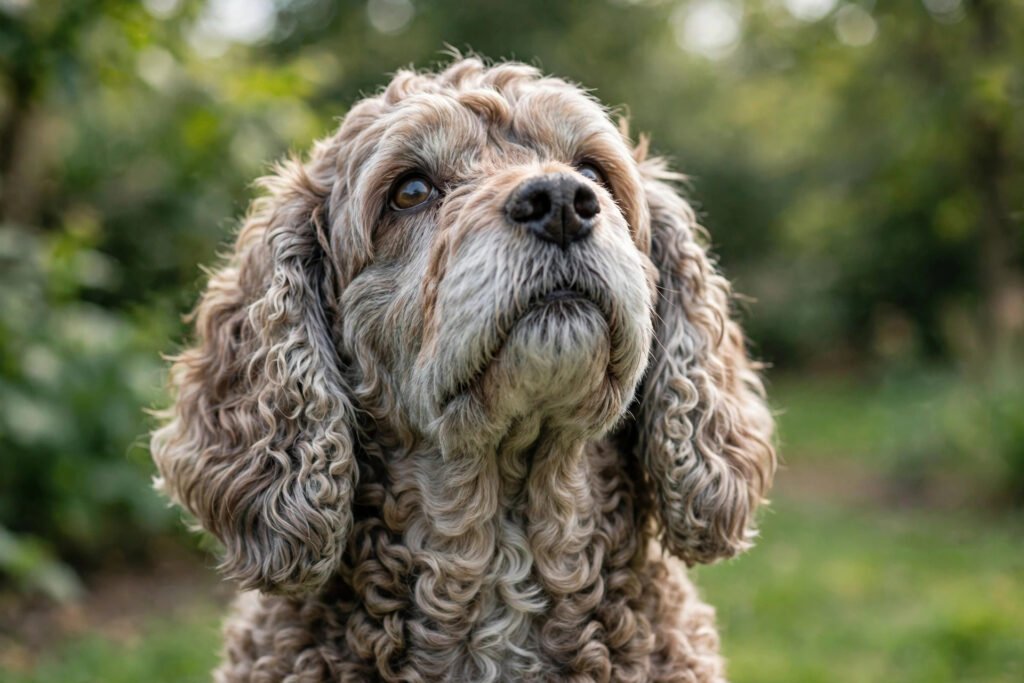
Your cockapoo is slowing down? Learn the senior vet schedule, mobility plan, home tweaks, and dementia warning signs for comfortable older years.
Quick answer: A cockapoo enters its senior years around age 8 to 10 — earlier for larger types, later for tiny toys. From age 8, switch to vet exams every six months with yearly bloodwork, swap long runs for shorter walks, add ramps and non-slip rugs, and watch for nighttime restlessness. Good senior care pushes most cockapoos toward 12 to 15 years.
Your cockapoo’s muzzle is going gray, the sprint to the door has become a trot, and it takes a beat longer to get up off the floor. None of that is an emergency — but all of it is a signal. The senior years are the longest chapter of a cockapoo’s life, often five or more years, and the care shifts you make now decide whether those years are comfortable or a slow decline. This guide covers exactly what to change, and when.
When Does a Cockapoo Become a Senior?
There is no single birthday, and sources disagree — which is worth knowing rather than hiding. The American Animal Hospital Association (AAHA) defines “senior” as roughly the last quarter of a dog’s expected lifespan, which for small breeds lands around 11 to 12 years. Breed guides for cockapoos tend to start earlier: most put the senior shift at 8 to 10 years, with one well-known lifespan guide calling 8 the start of the “older” stage and 12 the start of “truly senior.”
The honest way to use those numbers: start senior-style care at 8, and expect the deeper geriatric stage around 12. Size moves the timing, because smaller cockapoos age more slowly than larger ones.
Senior timing by size
| Cockapoo size | Adult weight | Typical lifespan | Senior care starts |
|---|---|---|---|
| Toy | Under 12 lbs | 14–18 years | Around 9–10 years |
| Miniature | 12–18 lbs | 13–16 years | Around 8–9 years |
| Maxi (standard Poodle parent) | 19 lbs and up | 12–15 years | Around 8 years |
If you are unsure which size class your dog falls into, our guide to how big cockapoos get breaks down each tier by height and weight. And for the full lifespan picture, see how long cockapoos live.
Do not wait for an obvious problem to start. Dogs are hardwired to hide illness, and an organ can lose a large share of its function before a dog ever looks sick. The whole point of senior care is catching change early, while it is still cheap and treatable.
The Senior Vet Schedule: Twice a Year, Every Year
This is the single highest-impact change. AAHA recommends that healthy senior dogs be examined at least twice a year, with screening bloodwork every 6 to 12 months. A year is a long time inside an aging body — six months for a 12-year-old dog is roughly two human years — and two visits a year give your vet two weights, two sets of lab numbers, and two chances to spot a trend while it is still small.
What a senior screening typically includes
| Test | What it screens for | How often (senior dogs) |
|---|---|---|
| Complete blood count (CBC) | Anemia, infection, some cancers | Every 6–12 months |
| Chemistry panel | Kidney, liver, pancreas, diabetes | Every 6–12 months |
| Urinalysis | Kidney function, diabetes, infection | Every 6–12 months |
| Thyroid test | Hypothyroidism (common in the parent breeds) | Annually |
| Blood pressure | Hypertension | Annually |
| Heartworm test | Heartworm disease | Annually |
| Dental check | Periodontal disease, tooth pain | Every visit |
A result inside the normal range can still be a warning: kidney values creeping from the low end to the high end across three years read as “normal” every single time, but the direction is the whole story. That trend-spotting is exactly what twice-yearly testing buys you.
Ask your vet to also listen for a heart murmur at every visit. Older small-breed dogs commonly develop mitral valve disease, and a murmur found on a routine exam is usually the first sign — long before coughing or tiring easily shows up at home. The same visit should cover eyes (cataracts and progressive retinal atrophy run in both parent breeds), ears (those floppy, hairy ears trap moisture and infection), and weight.
A note on cost: one published US estimate puts total annual care for a senior cockapoo at roughly $2,000–$3,500, driven by twice-yearly exams, bloodwork, dental care, and medications, with grooming on top. Prices vary a lot by region and by clinic, so ask your own vet for a senior wellness plan price — many clinics bundle the twice-yearly exams and labs at a discount. If cost ever forces a choice, prioritize the exam and bloodwork over supplements; diagnostics first, extras second.
The Mobility Plan: Joints, Stairs, Ramps, and Exercise
Arthritis is the most common reason a senior cockapoo slows down, and it is also one of the most treatable. Patellar luxation (a slipping kneecap) is common in small dogs, and hip dysplasia can come down from either parent breed. The early signs are subtle: stiffness for a few minutes after waking, hesitating at the stairs, reluctance to jump onto the couch, or a shorter stride on walks.
Step 1: Adjust exercise, don’t stop it
Stopping exercise makes arthritis worse, because muscle is what supports the joints. The adjustment is in type and length, not in whether you go out:
- Swap one long walk for two or three short ones. Most senior cockapoos do best on one or two shorter walks plus potty breaks, rather than a single long outing.
- Keep it low-impact. Flat, soft surfaces beat hills and stairs. Gentle swimming is excellent for arthritic dogs if your cockapoo likes water and your vet agrees.
- Drop the jumping sports. Retire high-impact fetch, agility jumps, and repeated stair runs. A leisurely game of fetch on grass is fine; launching off the couch is not.
- Watch the day after, not just the day of. If your dog is stiffer than usual the morning after a walk, that outing was too long. Shorten the next one.
Step 2: Remove the jumps from daily life
Every jump onto a bed, couch, or car is a small impact on aging knees and hips, repeated dozens of times a week. Fix it once and the benefit compounds:
- Ramps or pet steps at the bed, the couch, and the car. Train with treats so the ramp becomes the default route, not an obstacle to walk around.
- Lift the dog in and out of the car if it will not use a ramp. A 15-pound dog is easy to lift; a torn cruciate ligament is not easy to fix.
- Block the staircase with a baby gate if your dog still charges up and down, and carry or guide it on stairs when needed.
Step 3: Talk to your vet about pain management
Do not guess with human painkillers — several are dangerous for dogs. What your vet can offer depends on the diagnosis, but the usual toolkit includes prescription anti-inflammatory medication, joint supplements such as glucosamine and chondroitin, omega-3 fatty acids (fish oil, which has solid evidence for reducing joint inflammation), weight loss, and physical therapy or laser therapy. Supplements can interact with medications and mask problems, so run any addition past your vet first rather than stacking products from a pet store shelf.
Home Adaptations Checklist
Most senior-proofing costs little and takes an afternoon. Work through this list once, then revisit it every six months as your dog ages:
- Non-slip rugs or runners on hardwood, tile, and laminate — the single best fall-prevention move for a stiff senior dog. Pay special attention to the path from bed to water bowl to door.
- An orthopedic bed with supportive foam, placed in a warm, draft-free spot. Senior dogs sleep more, and thin bedding on a hard floor turns into joint pain.
- Raised food and water bowls so an arthritic neck and shoulders do not have to strain downward.
- Night-lights along hallways and near the door. Aging eyes cope badly with darkness, and a lit path prevents the nighttime bumping and confusion that owners mistake for dementia.
- A ramp or steps at every piece of furniture your dog uses daily.
- Pee pads or a dog door near the sleeping area for nights when the bladder cannot wait until morning. This is management, not failure — see the cognitive section below before assuming accidents mean a training problem.
- Keep food, water, bed, and door in the same places. A senior dog, especially one with early cognitive decline, leans heavily on routine and a stable layout to stay oriented.
- Grooming help. A stiff senior may not tolerate long grooming sessions. Shorter, more frequent brushing prevents the painful matting this coat is prone to, and keeps ears checked weekly.
Feeding a Senior Cockapoo: Weight Is the Lever
A landmark lifetime study in Labrador Retrievers found that dogs kept lean lived a median of nearly two years longer than their overweight littermates. The mechanism applies across breeds, and for a cockapoo it matters twice over: extra weight worsens both arthritis and heart strain.
- Switch to a senior formula when your vet advises, usually around age 8. Senior diets typically trim calories as activity drops and often add joint support.
- Measure meals, never free-feed. Weigh the food, keep treats under roughly 10% of daily calories, and weigh your dog monthly so drift gets caught early.
- Do not default to low protein. Older dogs need enough quality protein to protect muscle — muscle is what keeps arthritic joints working. If a well-meaning friend suggests cutting protein “because he’s old,” check with your vet first.
- Transition food gradually over about a week to avoid the digestive upset this breed can be prone to.
- Watch the other direction too. Weight loss in a senior is not automatically good. If a dog that was never fat starts feeling bonier, that can signal dental pain, kidney disease, thyroid problems, or another condition — mention it at the next visit, or sooner if it is rapid.
Cognitive Dysfunction: The Signs Most Owners Miss
Canine cognitive dysfunction (CCD), often called dog dementia, usually starts around age 9 and worsens slowly. It is frequently dismissed as “just old age,” which is a shame, because early intervention — routine, enrichment, diet, and sometimes medication — can genuinely improve quality of life. There is no single test for it; diagnosis means ruling out look-alikes first, which is another reason the twice-yearly vet visit matters.
Vets screen for it with the DISHAA checklist. Run through it at home and bring your notes to the appointment:
The DISHAA checklist
- D — Disorientation. Gets stuck in corners or behind furniture, stares at walls, goes to the hinge side of the door, seems lost in familiar rooms or the yard.
- I — Interaction changes. Less interest in greeting, petting, or play — or the opposite, new clinginess and shadowing you anxiously. Sometimes out-of-character irritability.
- S — Sleep-wake changes. Sleeps through the day, then paces, pants, or vocalizes at night. This evening worsening has a name: sundowning. A dog that is calm all day but restless, trembling, or “lost” as night approaches is showing the classic pattern.
- H — House-soiling. Accidents indoors from a reliably house-trained dog, sometimes right after coming inside, or forgetting to signal to go out.
- A — Activity changes. Less interest in walks, toys, and food — or repetitive behaviors that go nowhere, like pacing the same route or circling.
- A — Anxiety. New separation distress, fear of sounds or places that never mattered, a general unsettledness that is hard to soothe.
One sign on its own is rarely dementia. A pattern of two or three, getting worse over weeks and months, is the signal to act. And remember the look-alikes: arthritis pain causes nighttime pacing, vision loss causes bumping into things, hearing loss causes not responding to cues, and urinary tract infections cause accidents. Your vet will want to rule those out before settling on a cognitive diagnosis — so do not self-diagnose from a checklist alone.
What helps at home: keep the daily routine rigidly consistent, keep the layout unchanged, add short enrichment sessions (snuffle mats, puzzle feeders, gentle training games) during the day to tire the brain, and give a calm, lit, familiar sleeping spot at night. Mental stimulation is not optional for a senior cockapoo — these are bright dogs, and a bored aging brain declines faster.
The Rest of the Senior Watch List
- Teeth. Periodontal disease is one of the most common diseases in dogs, and bacteria from diseased gums strain the heart, liver, and kidneys. Bad breath, dropping food, or reluctance to chew are dental signs, not quirks. A professional cleaning under anesthesia when your vet advises is maintenance, not an optional extra.
- Eyes. Cloudiness, bumping into furniture, or hesitation in dim light deserves an eye exam.
- Ears. Weekly checks and drying after baths or swimming prevent the chronic infections that cause pain and, eventually, hearing loss.
- Lumps. Older dogs grow lumps. Most are benign fatty tumors, but any new, fast-growing, or ulcerated lump should be checked rather than assumed harmless.
- Separation anxiety. Senior cockapoos often become more attached and more reliant on routine. Calm departures and gradual alone-time practice protect a dog whose stress levels are already rising with age.
 CockapooDaily
A Sample Senior Day
Routine is medicine for an aging cockapoo. A realistic day: morning potty and a short gentle walk; measured breakfast; a mid-morning puzzle feeder or training game; a nap in the orthopedic bed; a second short afternoon walk; dinner at the same time; a calm evening; a final potty break with a night-light on. Two short outings beat one long one, and the same schedule every day beats a varied one.
Frequently Asked Questions
What health problems are most common in senior Cockapoos? Arthritis and stiff joints, dental disease, cataracts and progressive retinal atrophy (PRA), heart murmurs including mitral valve disease, ear infections, and kidney and thyroid changes picked up on bloodwork. None of these is a reason to panic — all of them are reasons for the twice-yearly vet visits in this guide.
Should I switch my senior Cockapoo to senior dog food? Usually yes, but on your vet’s advice and never abruptly: a senior formula with joint support (omega-3s, glucosamine) suits a dog that moves less, and weight is the lever — extra weight makes arthritis and heart disease worse. Switch over 7–10 days, mixing the old food out gradually.
How do I help my senior Cockapoo with stairs and jumping? Take the jumps out of daily life: a ramp or pet steps for the sofa, bed, and car; non-slip rugs or runners on wooden floors; a lift into the car instead of a jump; and a baby gate on steep stairs. The goal is the same exercise with no impact landings.
Is 10 old for a Cockapoo? No — 10 is a senior but usually far from the end. With a 12–15 year average and many reaching 16 or 17, a healthy 10-year-old often has several good years ahead. Ten is the age to shift into senior care (twice-yearly vet visits, bloodwork, closer dental monitoring), not the age to slow down for its own sake.
When should I worry about my senior Cockapoo drinking more water? Increased thirst and urination can signal kidney disease, diabetes, or Cushing’s disease — all common in older dogs. Book a vet check rather than restricting water: the vet runs bloodwork and a urine test, and cutting water back only makes dehydration and kidney strain worse.
At what age is a cockapoo considered a senior?
Most breed guides start senior care around 8 to 10 years, with larger maxi cockapoos on the earlier end and tiny toy cockapoos on the later end. Veterinary guidance frames “senior” as the last quarter of expected lifespan, which for a dog expected to live 14 to 16 years lands around 11 to 12. Start the twice-yearly vet schedule at 8 regardless — it is better to start early than to discover a problem a year late.
How much exercise does a senior cockapoo need?
One or two short, gentle walks a day plus potty breaks is the usual pattern, with mental stimulation (puzzle feeders, scent games, gentle fetch) filling the gap that long walks used to fill. Let stiffness the morning after be your guide: if it is worse, shorten the walks. Never cut exercise out entirely — muscle supports arthritic joints.
How often should a senior cockapoo see the vet?
Twice a year for a healthy senior, per AAHA guidance, with bloodwork (complete blood count, chemistry panel, urinalysis) every 6 to 12 months. Dogs with a known condition such as kidney disease or a heart murmur may need rechecks more often — your vet will tailor the schedule.
What are the first signs of dementia in a cockapoo?
The earliest signs are usually disorientation (getting stuck behind furniture, staring at walls), sleep changes (sleeping all day, restless at night — sundowning), and subtle interaction changes (less greeting, new clinginess). A pattern of two or three DISHAA signs worsening over weeks is the trigger for a vet visit, not any single odd moment.
Is it normal for a senior cockapoo to sleep all day?
Senior dogs do sleep more — 16 to 18 hours is not unusual for an older dog. What is not normal is a sudden change: sleeping far more than usual within a few weeks, or sleeping all day and then pacing all night. A sharp change in either direction is worth a vet call, because pain, cognitive decline, and thyroid or kidney problems can all hide behind “he’s just old.”
Conclusion
Senior cockapoo care is not a dramatic overhaul. It is five habits, started around age 8: vet visits every six months with regular bloodwork, shorter and gentler exercise that never stops, ramps and rugs instead of jumps and slippery floors, a lean body on measured meals, and a sharp eye for the DISHAA signs of cognitive change. Your cockapoo gave you its energetic years; these are the years where steady, unglamorous care pays it back. Book the senior screening visit this week — and if your dog is already past 8 and has never had senior bloodwork, it is not too late to start.


Leave a Reply