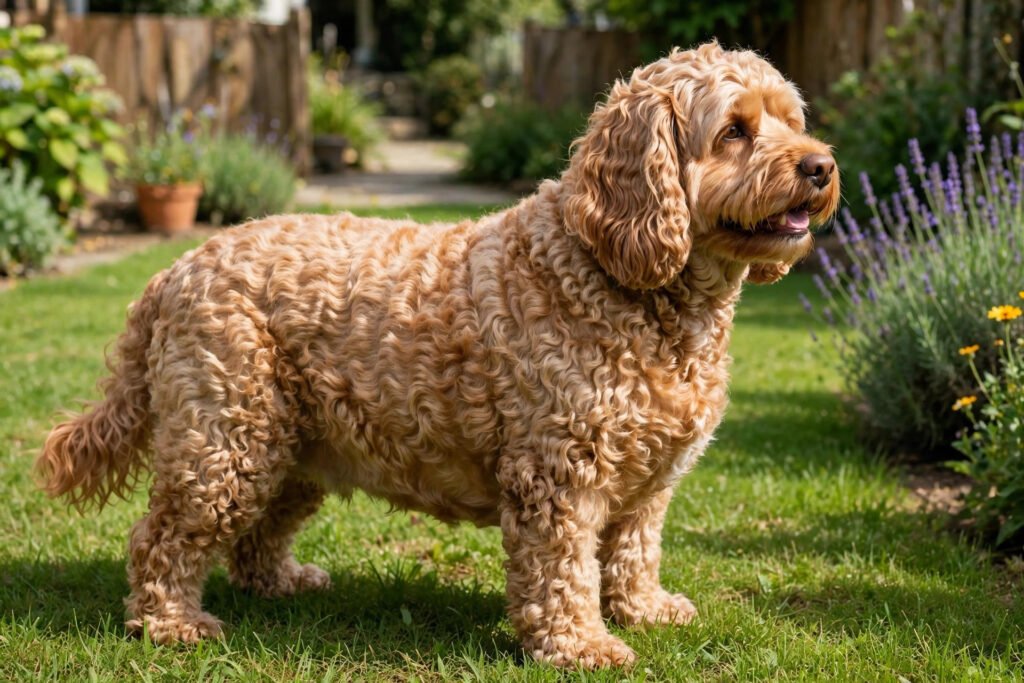
Is your Cockapoo overweight? Learn the at-home body-condition check, healthy weight by size, and a safe slimming plan that works — without starving your dog.
Quick answer: Your Cockapoo is overweight if you cannot easily feel its ribs under a thin fat layer, its waist has vanished from above, or its belly hangs level with its ribs from the side. Vets score this on a 9-point scale: 4–5 is ideal, 6–7 overweight, 8–9 obese. Healthy weight is Toy 6–12 lbs, Miniature 13–18 lbs, Standard 19–30+ lbs.
You run your hand along your Cockapoo’s side and the ribs that used to be easy to find have gone soft. Or the vet said “a few pounds over.” It matters — and it is one of the most fixable health problems a Cockapoo can have.
PetMD flags obesity as a Cockapoo breed issue: extra weight can shorten life and raise the risk of diabetes, heart and joint problems. The Cocker side of the family is one of the breeds most prone to weight gain, and Cockapoos inherit the appetite. Add a generous owner and a coat that hides the body’s shape, and weight creeps on.
The scale alone will not tell you, because healthy Cockapoos come in three sizes and a heavy-boned Miniature can weigh the same as a fat Toy. What tells you is your hands and your eyes: the body-condition score. Vets judge weight by body condition, not the scale. This guide shows you the 3-minute check, the healthy weight for your dog’s size, why Cockapoos gain, and a safe plan.
The 3-Minute Body-Condition Check at Home
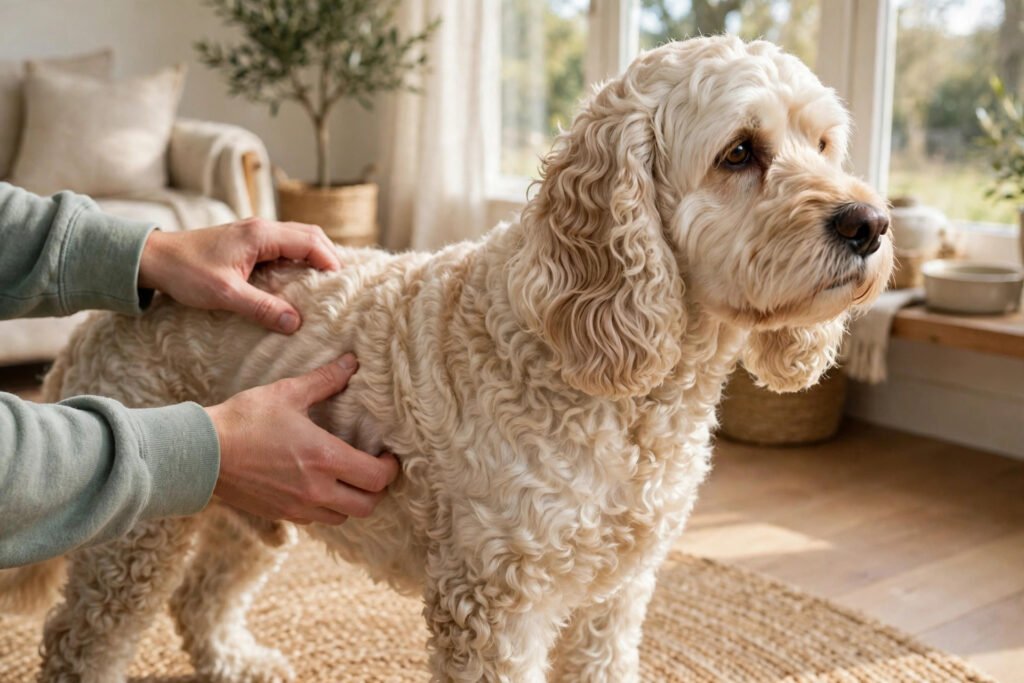
Do all three together, with your dog standing square on a hard floor. One check alone can mislead; all three together rarely lie.
1. Feel the ribs. Place your hands flat on either side of your dog’s chest and press gently, about as firmly as you would press the back of your own hand. You should feel each rib easily under a thin fat layer. If you must press hard to find them, your dog is carrying too much fat. Ribs visible from across the room mean too thin.
2. Look for a waist from above. Stand over your dog and look straight down. Behind the ribs, the body should narrow into a waist before widening at the hips — an hourglass, not a straight line. If it runs straight from ribs to hips, the waist is gone and the dog is overweight. Part the coat if fur hides the outline, or check when the dog is wet.
3. Check the tuck from the side. Look at your dog in profile, at floor level. Behind the ribcage, the belly should tuck upward toward the back legs. Level with the ribcage means overweight; lower than it means obesity. Owners miss this check most, because from above a dog can still look roughly right while the side view tells the truth.
All three clean — ribs easy to feel, waist visible, tuck clear — means a healthy weight whatever the scale says. If two or three fail, your dog needs a plan.
 CockapooDaily
The 9-Point Scale: What Your Score Means
Vets score body condition on a 9-point scale, 1 emaciated and 9 severely obese. The ideal range is 4–5.
| Score | What you feel and see | What it means |
|---|---|---|
| 1–3 | Ribs, spine and hip bones visible from across the room. | Underweight. Needs a vet check first. |
| 4–5 | Ribs easy to feel but not visible. Waist and tuck visible. | Ideal. Keep doing what you are doing. |
| 6–7 | Ribs hard to feel under thick fat. Waist barely visible. | Overweight — roughly 10–20% above ideal weight. |
| 8–9 | Ribs cannot be felt at all. No waist. Belly hangs. | Obese. Get a vet-supervised plan first. |
Each point above 5 is roughly 10% extra body weight: 6 means about 10% over ideal, 7 about 20% over. A dog scoring 7 must lose a fifth of its weight.
Two notes. Puppies are scored differently — a growing puppy should be lean but not bony, and steady growth matters more than condition, so never diet a puppy without your vet. If the checks disagree, trust your hands over your eyes and ask your vet to score your dog.
Healthy Weight by Size Type
Healthy weight depends on your Cockapoo’s size type. The ranges below come from our own size and growth chart, which reconciles the conflicting online charts against the two parent breeds’ actual standards. There is no official standard for a crossbreed, so these are the ranges most well-bred dogs actually land in.
| Size type | Height at shoulder | Adult weight |
|---|---|---|
| Toy | Up to 10″ | 6–12 lbs |
| Miniature | 11–14″ | 13–18 lbs |
| Standard | 15″+ | 19–30+ lbs |
Outliers exist: a Standard from a very large line can push 35–40 lbs and still be lean; an occasional Miniature stops at 11 lbs. Other sources differ — PetMD gives 15–22 lbs generally, vet Q&A answers cite 12–24 lbs — so the score matters more than any chart: the chart gives the neighborhood, the score tells you if your dog is in shape inside it.
The most common surprise is the Miniature. Owners are told their puppy will be 14 lbs, because charts copy the Miniature Poodle’s numbers — but a puppy with a 25-lb Cocker parent lands heavier by simple arithmetic. If your “Miniature” weighs 21 lbs, ask first whether the ribs are easy to feel: a 17-lb Miniature carrying 4 lbs of fat weighs 21 lbs. The dog is not oversized, it is overweight — the fix is food, not a new label.
Why Cockapoos Gain Weight
Weight gain is rarely one cause — usually three or four small ones stacking up, and Cockapoos are set up for all of them.
Table scraps. The one PetMD names first, and the biggest single cause. A bite of dinner nightly, the crust of the children’s toast, whatever falls on the floor — easily 100 extra calories a day on a dog whose whole need may be only 300–400 calories. Nobody measures scraps, and everyone thinks someone else gives them.
Treats nobody counts. Training treats, good-behavior treats, a biscuit because the dog looked at you — a medium biscuit can hold 30–50 calories, over 10% of a small dog’s daily allowance. Our treat guide covers small, soft treats; the weight rule is simpler — treats count as food, and uncounted treats are extra.
Too little exercise. A dog that gets a garden and a short walk is not burning what its food provides, and the gap widens in winter. Our exercise guide gives the right daily amounts by age — but exercise alone rarely fixes weight gain. Diet does most of the work; exercise protects muscle while it does.
Neutering, age and free-feeding. Neutered dogs typically need fewer calories, yet many owners keep feeding the same amount after the operation. Older dogs slow down too: less play, shorter walks, the same bowl. A bowl that is always full, or a scoop that is really a mug, adds calories nobody notices.
The Safe Slimming Plan: 6 Steps
Do not crash-diet your dog. A safe plan is slow, measured and boring — and that is why it works. Extra weight is not cosmetic: PetMD notes obesity can shorten lifespan and raise the risk of high blood pressure, heart disease, kidney disease and diabetes, and it loads the joints. Weight is one of the few health risks an owner can fully control.
Step 1: Start with the vet. Get a check-up before you cut a single calorie. Your vet confirms the score, sets a target weight, and rules out medical causes — most important for dogs scoring 8–9, fast gainers, and dogs over 7. Ask for a daily calorie target based on ideal weight, not current weight.
Step 2: Set the target and the timeline. The safe pace is 1–2% of body weight per week (Cornell). For a 20-lb Cockapoo 4 lbs over, that is 0.2–0.4 lbs a week — 10 to 20 weeks to the goal. A dog 10% over needs 5 to 10 weeks; 20% over needs two to four months or more. Slower is fine; faster than 2% a week can cost muscle.
Step 3: Measure every meal. Stop free-feeding and scooping by eye. Weigh food on a kitchen scale, or use a measuring cup, and feed the amount in our feeding chart for your dog’s target weight — not its current weight. If your vet recommends a therapeutic weight-loss diet, use it.
Step 4: Cap treats at 10% of daily calories. This is the WSAVA guideline, and the step most plans fail on. Count treats, do not estimate them: set aside part of the daily food and use kibble as treats — the same rewards, no extra calories. Swap biscuits for green beans, cucumber or blueberries, and tell everyone in the house the rule. Table scraps stop entirely too. If the family cannot resist, put a tub of the dog’s kibble on the counter and let everyone give from that.
Step 5: Add sniff walks, not harder exercise. Add movement gradually — longer walks, more sniffing, gentle play. Sniff walks suit an overweight dog: sniffing works the brain and burns energy without pounding the joints. Do not suddenly double exercise or run with an overweight dog; build up slowly and watch for stiffness.
Step 6: Weigh every few weeks — and write it down. Weigh your dog every two to four weeks on the same scale, at the same time of day, and record the number. Bathroom scales work if you weigh yourself holding the dog and subtract your own weight; most clinics allow a free weigh-in. If the weight stalls for four weeks, cut 5–10% of calories or add activity and recheck in two weeks. If it still stalls, go back to the vet.
What NOT to Do
Do not skip meals or halve the food overnight. A sudden large cut leaves the dog hungry, nutrient-short and miserable, and hungry dogs raid bins and steal food. Cut gradually, only to the level your vet agreed.
Do not feed a human diet. Low-fat human food or “just chicken and rice” is not a balanced dog diet: a dog on one can lose muscle and develop deficiencies while the scale moves the right way.
Do not punish begging. Begging is a habit the household trained, and scolding a hungry dog only teaches it that food is stressful. Remove the opportunity: no food from the table, no treats from pockets, and a chew or sniff game at mealtimes.
Do not rely on exercise alone. Diet does most of weight-loss work; exercise alone rarely produces significant results. And do not compare your dog to the neighbor’s — a lean 24-lb Standard and a fat 18-lb Miniature can both be “18 to 24 lbs.” Compare your dog to its own score.
When Weight Gain Is Medical
Most overweight Cockapoos are overweight because of food. A few are not — and no diet fixes that.
See your vet promptly — before starting a diet — if the weight gain came on fast, if your dog is drinking and peeing much more than usual, if its belly is swollen and pot-bellied while its legs look thin, if its coat is thinning, if it pants constantly, or if it is losing weight everywhere except the belly.
Two conditions sit at the top of that list. Cushing’s disease (too much cortisol) causes a pot belly, more thirst and urination, a bigger appetite, hair loss, thin skin and panting — often missed because each sign arrives slowly and looks like aging. Hypothyroidism (an underactive thyroid) causes slow weight gain, lethargy, hair thinning, dry skin and feeling the cold; it is confirmed with a blood test and treated with a daily tablet for life. Certain medications, and fluid retention from liver or kidney disease, can also mimic weight gain.
For the full picture — the signs owners miss, how the vet confirms it, and daily life on medication — see our Cockapoo Cushing’s disease guide.
If your dog is on a proper plan and the weight will not move for four weeks or more, ask the vet about these conditions.
Frequently asked questions
How do I know if my Cockapoo is overweight without a scale?
Feel the ribs, look for a waist from above, and check the belly tuck from the side. Ribs hard to find under fat, no waist, or a belly level with the ribcage means overweight. The score answers the question better than any number.
What is a healthy weight for a Cockapoo?
It depends on size type: Toy 6–12 lbs, Miniature 13–18 lbs, Standard 19–30+ lbs. Ranges are a guide, not a verdict — a lean dog at the top of its range is healthier than a fat dog at the bottom. Aim for 4–5 out of 9: ribs easy to feel, waist visible, belly tucked.
How fast should my Cockapoo lose weight?
About 1–2% of body weight per week. For a 20-lb Cockapoo 4 lbs over, that is 0.2–0.4 lbs a week, or 10 to 20 weeks to the goal. Faster loss can cost muscle. If the weight stalls for four weeks, cut calories by 5–10% or add activity — and if it still will not move, ask your vet about medical causes.
How many treats can my Cockapoo have on a diet?
No more than 10% of daily calories. Set aside part of the daily food and use kibble as treats, and swap biscuits for green beans, cucumber or blueberries. One medium biscuit can be over 10% of a small dog’s whole daily allowance.
Is my Cockapoo overweight because of its thyroid?
Possibly, but food is the more common cause. Hypothyroidism causes slow weight gain with lethargy, hair thinning and feeling the cold, confirmed with a blood test. If your dog gains despite measured food, or gains fast with more thirst, a pot belly or constant panting, see your vet first — Cushing’s and thyroid problems need treatment, not just fewer calories.
Conclusion
Your Cockapoo is overweight if the ribs are hard to feel, the waist has gone, or the belly hangs level with the ribs — 6–7, or 8–9 if the ribs cannot be felt at all. Healthy adult weight runs 6–12 lbs for a Toy, 13–18 lbs for a Miniature and 19–30+ lbs for a Standard — but the score matters more than the chart. The cause is usually ordinary: table scraps, uncounted treats, too little movement. The fix is ordinary too: a vet check first, measured food for the target weight, treats capped at 10%, scraps stopped, sniff walks added, and a weigh-in every few weeks at 1–2% a week. Keep the habits after the goal and re-weigh monthly. If the weight will not move, or the gain came with thirst, a pot belly or hair loss, that is a vet conversation, not a diet problem.
Leave a Reply