
Cockapoo meningitis (SRMA) explained: the neck-pain and fever signs owners see, how vets diagnose it, steroid treatment, relapse risk, and prognosis.
Quick answer: SRMA is an immune-mediated inflammation of the membranes around a Cockapoo’s brain and spinal cord, usually striking dogs under 2, most often between 6 and 18 months. The classic signs are a stiff, painful neck, fever, and yelping when touched. Steroids bring most dogs into remission, but about 1 in 5 relapse — so follow your vet’s taper exactly.
A Cockapoo puppy that was bouncing yesterday and today will not lift its head, yelps when you touch its neck, and is burning up with fever is every owner’s nightmare — and it is exactly how steroid-responsive meningitis-arteritis, or SRMA, usually arrives. It comes on fast, it looks terrifying, and the name alone sounds like a sentence. The good news, and the reason this guide exists, is that SRMA is one of the most treatable serious conditions a young Cockapoo can get, and most dogs recover well.
A note before anything else, and it runs through the whole article: this is general information only, not a medical directive. It will not tell you what treatment your dog needs. Only your vet — ideally a veterinary neurologist, if your vet refers you — can diagnose SRMA and plan treatment. If your dog shows the signs in this guide, the right move is a vet visit the same day, not a wait-and-see.
What SRMA Actually Is
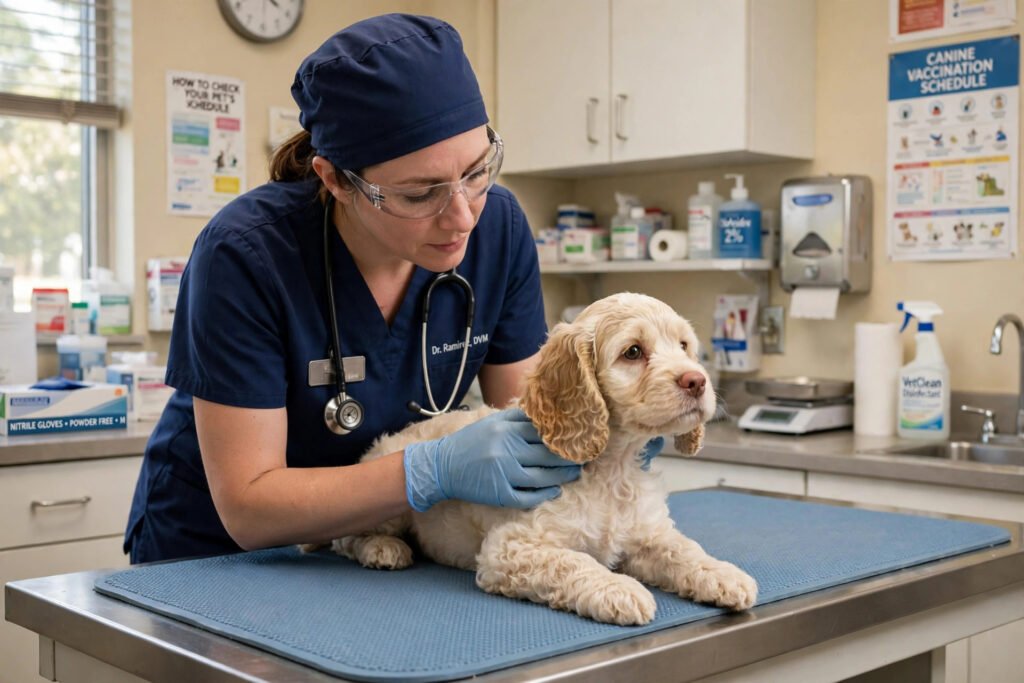
SRMA stands for steroid-responsive meningitis-arteritis. Break that down and it is less mysterious than it sounds. The meninges are the thin protective membranes that wrap the brain and spinal cord. Meningitis is inflammation of those membranes. Arteritis is inflammation of the blood vessels running through them. And “steroid-responsive” is the hopeful part: the inflammation answers to steroid treatment.
 CockapooDaily
The key word is immune-mediated. In SRMA, the dog’s own immune system attacks the meninges for reasons nobody fully understands — no infection has been found to cause it. That matters for three reasons owners should know. First, SRMA is not contagious: your other dogs, your children, and you cannot catch it. Second, it is not the same as human meningitis, and there is no vaccine that prevents it. Third, because the immune system is the problem, the treatment is to calm the immune system down — which is what steroids do.
VCA Animal Hospitals describes SRMA as the most common type of meningitis seen in dogs, and the form with the best prognosis. That is the frame to hold onto through the rest of this guide: serious, frightening, but very treatable.
Why Cockapoos? The Breed Connection
Here is the fact that makes this article necessary. A published veterinary study in Frontiers in Veterinary Science (2023) looked at 85 dogs diagnosed with SRMA at two referral hospitals — and the Cockapoo was the most common breed in the whole sample, with 15 of the 85 dogs. Whippets and Beagles were next. Cockapoos are not the only breed affected — Beagles, Bernese Mountain Dogs, Boxers, and Border Collies are all overrepresented too — but in this study, Cockapoos led the list.
The same study found that SRMA was diagnosed significantly more often in dogs under 12 months old, and the typical age across the veterinary literature is 6 to 18 months, with a median of about 10 months. That age window is the pattern to remember: SRMA is overwhelmingly a disease of puppies and young dogs, not seniors. A Cockapoo that falls ill at 16 weeks, as one owner shared publicly in September 2026, is on the young end of that range but squarely inside it.
Nobody knows exactly why Cockapoos are affected more often. The honest answer is that the breed mix — Cocker Spaniel and Poodle — may carry some inherited tendency toward immune overreaction, but no gene test exists and no breeder can screen for it. What that means in practice is simple: if you own a young Cockapoo, SRMA belongs on your mental list of things to recognize early, the same way ear infections and upset stomachs do. And if you are still choosing a breeder, it belongs on your list of health questions — our guide to questions to ask a Cockapoo breeder covers the health history worth asking about, even though no breeder can guarantee against SRMA.
The Signs Owners Actually See
SRMA rarely announces itself politely. Most owners describe a dog that was fine, then suddenly was not. The signs below are the ones vets and owners report most often, roughly in the order owners tend to notice them:
- A stiff, painful neck. The signature sign. The dog holds its head low, moves its whole body instead of turning its neck, and may cry out when you touch its neck or try to lift its chin. Vets describe the worst pain as coming when the chin is pushed toward the chest.
- Yelping when touched or picked up. A dog that normally loves being scooped up may scream, flinch, or snap when handled. This is pain, not bad behavior — do not scold it.
- Fever. High fevers are common, and they can run very high. A dog that feels hot to the touch, is panting, and has dry, warm ears and nose is running a fever.
- Reluctance to move. A stiff, hunched walk, a dog that will not go up or down stairs, will not jump onto the couch, or simply lies down and refuses to get up. Some dogs walk as if their whole body is sore.
- Lethargy and loss of appetite. The dog is flat, uninterested in food or play, and sleeps far more than usual. A Cockapoo that turns down a treat is a dog telling you something is wrong.
- A hunched back. Some dogs arch their back and tuck their tail, a posture that reads as misery.
One cruel feature of SRMA is that the signs wax and wane. A dog can seem better for a day or two, then worse again — and painkillers or antibiotics from an earlier vet visit can briefly mask the symptoms, which is why diagnosis sometimes takes more than one visit. If your young Cockapoo has a painful neck and a fever that keep coming back, that pattern itself is a clue worth telling your vet about.
There are two forms of the disease. The acute form — by far the more common — is the sudden neck pain and fever described above. The chronic form is slower and more drawn out, sometimes with additional neurological signs such as weakness or wobbliness, and it is harder to treat. Most Cockapoos with SRMA have the acute form, and that is the form this guide is mainly about.
When to See the Vet — Today, Not Next Week
A stiff neck plus a fever in a young Cockapoo is a same-day vet visit. Do not wait to see if it passes, and do not try to manage it at home with leftover painkillers — some human painkillers are dangerous for dogs, and masking the pain can delay the diagnosis.
Call your vet immediately, or go to an emergency vet, if you see any of these:
- Your Cockapoo will not move its neck, yelps when touched, or cannot lift its head
- A fever with lethargy and refusal to eat that lasts more than a few hours
- The signs keep coming back after seeming to improve
- Weakness in the legs, wobbliness, stumbling, or any seizure
- Your dog seems suddenly worse — collapsed, unresponsive, or in obvious severe pain
At the appointment, tell the vet the whole story: when the signs started, whether they have come and gone, what the dog’s temperature has felt like, and whether any medication was already given. That timeline is genuinely useful diagnostically, because SRMA’s on-and-off pattern is part of how vets recognize it.
How Vets Diagnose SRMA
There is no single blood test that says “SRMA.” Diagnosis is a process of elimination plus one decisive test, and it usually goes in this order:
1. Examination and bloodwork. Your vet will check the neck carefully — the pain on flexing the neck is often unmistakable — and run baseline blood tests (a complete blood count, a biochemistry panel, and a urinalysis). These rule out other causes and check the dog’s overall health. One blood marker vets watch is C-reactive protein (CRP), a measure of inflammation in the body: in the Frontiers study, CRP was raised in essentially every SRMA dog tested, and it falls as treatment works, so vets use it to track progress as well as to support the diagnosis.
2. Imaging. X-rays of the neck are often taken first, mainly to rule out other problems such as a slipped disc or a bone infection. If the diagnosis is still unclear, your vet may recommend an MRI or CT scan of the brain and neck, usually done by a veterinary neurologist under general anesthetic.
3. The spinal tap. The decisive test is analysis of the cerebrospinal fluid (CSF) — the fluid that bathes the brain and spinal cord. Under general anesthetic, a small amount of fluid is collected with a needle placed between the vertebrae in the neck or lower back. In SRMA, the fluid shows a large number of white blood cells (mostly neutrophils) and raised protein, with no organisms visible — the signature of an immune-driven inflammation rather than an infection. Because a spinal tap carries some risk, an MRI or CT is often done first.
Your vet may refer you to a veterinary neurologist for the imaging and spinal tap. That referral is normal, not a sign that things are hopeless — neurologists do these procedures every day, and a confirmed diagnosis means the treatment plan can start with confidence instead of guesswork.
Treatment: Steroids and the Long Taper
The treatment for SRMA is, as the name promises, steroids — usually prednisone or prednisolone, given at immune-suppressing levels. The response is often dramatic: many dogs improve markedly within 2 to 3 days of starting treatment, and most are in remission within about 2 weeks, according to veterinary neurology guidance. That fast improvement is itself part of the confirmation — a dog that bounces back on steroids almost certainly had SRMA.
But the fast improvement is also the trap. The treatment does not stop when the dog looks better. Steroids are tapered down very slowly over months — typically 5 to 7 months of treatment in total, and sometimes a year or more, according to VCA — with regular rechecks, examinations, and CRP blood tests along the way to confirm the inflammation is truly gone before each dose reduction.
The single most important rule of SRMA treatment: never stop the steroids suddenly, and never speed up the taper yourself. Stopping abruptly is dangerous, and reducing the dose too fast is the most common reason the disease comes back. If the dose feels too high, or the side effects worry you, call your vet and ask — do not adjust it on your own.
Steroids at these levels have real side effects, and your vet should warn you about them before you start:
- Increased thirst and urination. Your dog will drink far more and need to go out far more often — including at night. Plan for extra toilet breaks.
- Increased appetite and weight gain. A dog on steroids can become ravenous. Measure food carefully and ask your vet about the right amount, because weight gain on top of a healing neck is the last thing you want.
- Panting, restlessness, and lethargy. Some dogs pant more or seem flat; both are known steroid effects.
- A higher risk of infection. Steroids suppress the immune system, which is the point of the treatment — but it also means your dog is more vulnerable to other infections while on them. Tell your vet promptly about any new illness.
A small number of dogs do not respond fully to steroids alone, or relapse repeatedly. In those cases vets may add a second immune-suppressing drug. That decision belongs to your vet or neurologist — this guide names no drug and gives no dose, because the choice depends on your individual dog.
During treatment, life gets quieter. No rough play, no jumping on and off furniture, no long walks while the neck is healing. Short, calm toilet trips on the lead, a comfortable bed, and patience. Your Cockapoo will hate the boredom — and that is a sign the treatment is working.
Relapse: What It Looks Like and What Happens Next
Relapse is the part of SRMA that owners fear most, and it deserves an honest section rather than a footnote. Roughly 1 in 5 dogs with SRMA relapse — about 20%, according to veterinary neurology guidance — and one US veterinary neurology handout puts the range at 16 to 34%. Relapse most often happens during the steroid taper, when the dose drops too low too fast, or after treatment has finished.
A relapse usually looks like the original illness returning: the stiff neck, the fever, the reluctance to move. If you have seen it once, you will recognize it — and that recognition is valuable, because relapses usually respond to treatment again. The usual response is to go back up to a higher steroid dose and taper more slowly the second time.
The experience of one Cockapoo owner, shared publicly on Instagram in September 2026, shows what the hard end of this looks like: her Cockapoo, Autumn, fell ill at 16 weeks old with a CRP level of 122.9 — against a normal level under 10 — and after 21 months on steroids had been through three failed taper attempts, each ending in relapse, with lifelong low-dose medication under discussion. That is an unusually difficult course, not the typical one. Most dogs do not go through that. But her story is the reason this guide is blunt about the taper: the months of slow dose reduction are not a formality, and a relapse is not a failure — it is a known part of the disease that your vet knows how to handle.
If your dog relapses, tell your vet straight away, keep a simple diary of the signs and the dose your dog is on, and ask what the new taper plan will be. The diary matters: it turns a worried phone call into a clear picture your vet can act on.
Prognosis and Life After SRMA
The overall outlook for SRMA is good — VCA calls it the best prognosis of any form of meningitis in dogs. One US veterinary neurology handout reports that about 98% of dogs go into remission with treatment and about half are completely cured. A standard veterinary textbook puts the figure at 60 to 80% of dogs with acute signs recovering with treatment and never relapsing. The numbers vary between sources because the studies are small and the follow-up periods differ, but they all point the same way: most dogs get better, and most stay better.
Dogs that finish treatment successfully generally go on to live a normal length and quality of life. There are no lasting restrictions once the vet confirms the disease is gone, and most dogs return to their usual activity — walks, play, training — gradually, on the vet’s say-so. Some dogs do need lifelong low-dose medication, and that is a manageable outcome, not a catastrophe: a daily tablet and periodic check-ups.
One thing there is no answer for is prevention. Because no cause has been found and no gene test exists, there is nothing an owner can do to stop SRMA happening. The useful thing is recognition: knowing the signs, and acting the same day, is the closest thing to prevention that exists — because dogs treated early do best.
SRMA or Something Else? The Look-Alikes
Neck pain and a reluctance to move are not unique to SRMA, and vets spend real effort ruling out the alternatives. This table shows the main look-alikes and how they differ — it is a guide to the conversation with your vet, not a home-diagnosis tool.
| Condition | How it looks similar | What sets it apart |
|---|---|---|
| Slipped disc (IVDD) | Yelping, stiff neck or back, reluctance to jump or climb stairs | Usually no fever; pain is often in one spot; MRI shows the disc problem |
| Ear infection | Head tilt, head shaking, pain when the head is touched | Discharge or smell from the ear, itching at the ear; no fever in most cases |
| Neck or back injury | Sudden pain, reluctance to move, yelping when handled | A clear incident (a fall, a jump, rough play); no fever; improves steadily with rest |
| Immune-mediated joint disease (IMPA) | Fever, lethargy, pain, reluctance to move | Pain is in the joints, often several at once, with swollen joints; can occur alongside SRMA |
| Bacterial meningitis | Fever, neck pain, lethargy | Organisms visible in the spinal fluid; treated with antibiotics, not steroids alone |
Two of these are worth a closer look. A slipped disc is the closest look-alike, and it is the reason imaging matters — our guide to Cockapoo joint problems covers the joint and mobility issues that can confuse the picture. And ear infections are so common in Cockapoos that they are often the first thing owners suspect when a dog flinches at head-touching — if the ear looks or smells off, read our guide to Cockapoo ear infections before assuming the worst. Finally, a dog that is off its food and vomiting alongside the other signs may simply be feeling generally unwell rather than having a separate stomach problem; our guide to Cockapoo vomiting and upset stomach covers what to do first while you wait for the vet.
Living With a Dog on Steroids: The Practical Stuff
Months of steroids and restricted activity are hard on an owner as well as a dog. A few practical points that owners who have been through it wish they had known at the start:
- Toilet breaks multiply. A dog drinking twice as much needs to go out twice as often, including in the middle of the night. Set an alarm rather than waiting for an accident — a dog that cannot hold it is not being naughty.
- Food needs measuring, not guessing. The steroid appetite is real and relentless. Weigh the food, keep treats small, and ask your vet to set the daily amount. Weight gained during treatment is hard to shift afterwards.
- Keep a simple log. Date, dose, appetite, thirst, energy, and any sign of neck pain. It takes a minute a day, and it is the single most useful thing you can bring to a recheck — or to a relapse phone call.
- Rest is treatment, not punishment. A Cockapoo that feels better on day three will want to bounce. Do not let it. Short lead walks for toileting only, no stairs if you can avoid them, no jumping, and calm indoor games instead of wrestling.
- Budget for the long haul. SRMA treatment is not one vet visit: it is months of rechecks, blood tests, and medication, and possibly a neurology referral and MRI. If your dog is insured, check what is covered early. Our overview of Cockapoo common health problems puts SRMA in context with the other conditions worth budgeting for.
What to Ask Your Vet
Take this list to the appointment — it turns a frightening diagnosis into a plan:
- Is a spinal tap needed to confirm SRMA, or is a presumptive diagnosis enough to start treatment?
- Should we be referred to a veterinary neurologist, and how quickly?
- How long do you expect treatment to last for this dog, and what does the taper schedule look like?
- How will we know the inflammation is gone — CRP blood tests, repeat spinal tap, or both?
- What side effects should I expect from the steroids, and when should I call you about them?
- What should I do if the signs come back during the taper?
- What activity is safe while my dog is on treatment — walks, stairs, play?
- What will the total cost look like, including referral, imaging, and months of rechecks?
If your vet’s answers differ from something you read online — including this article — trust your vet. They have examined your dog, and SRMA treatment is always tailored to the individual.
Frequently Asked Questions
Can a Cockapoo get meningitis?
Yes. A published 2023 veterinary study of 85 dogs with SRMA found the Cockapoo was the most common breed in its sample, with 15 of the 85 dogs. SRMA — steroid-responsive meningitis-arteritis — is an immune-mediated inflammation of the membranes around the brain and spinal cord, and it most often affects dogs under 2 years old, typically between 6 and 18 months.
Is SRMA in dogs contagious?
No. SRMA is not caused by an infection — it is the dog’s own immune system attacking the meninges — so it cannot spread to other dogs, to other pets, or to people. It is also not the same as human meningitis, and there is no vaccine that prevents it.
What are the first signs of meningitis in a Cockapoo?
The classic first signs are a stiff, painful neck — the dog holds its head low and yelps when its neck is touched — plus a fever, lethargy, loss of appetite, and a reluctance to move or jump. A hunched walk and a dog that suddenly refuses stairs are also common. If you see a painful neck with a fever in a young Cockapoo, see the vet the same day.
How long does SRMA treatment take?
Steroid treatment typically lasts 5 to 7 months, sometimes a year or more, with the dose tapered down very slowly and regular rechecks and CRP blood tests along the way. Most dogs improve within 2 to 3 days of starting steroids and reach remission within about 2 weeks — but the treatment continues long after the dog looks better, because stopping too fast is the most common cause of relapse.
Can a dog recover fully from SRMA?
Most dogs can. About 98% go into remission with treatment, according to a US veterinary neurology handout, and about half are completely cured, with a standard veterinary textbook putting the never-relapse figure at 60 to 80%. Roughly 1 in 5 dogs relapse, usually during the taper, but relapses usually respond to treatment again. Dogs that finish treatment generally live a normal life.
Conclusion
SRMA is a frightening diagnosis with a reassuring track record: a young Cockapoo’s immune system attacks the membranes around its brain and spinal cord, producing a stiff, painful neck, a fever, and a dog that will not move — and steroid treatment, tapered slowly over months, brings most dogs into remission. The breed connection is real — in one published study, Cockapoos were the most common breed affected — which is why knowing the signs matters more for this breed than for most.
Next steps: if your Cockapoo shows a painful neck with a fever, see the vet the same day and mention SRMA by name. If your dog is already on treatment, follow the taper exactly, keep a daily log, and call your vet at the first sign of relapse rather than waiting. And if you are still learning what to watch for in a young Cockapoo, our overview of Cockapoo common health problems is the place to start.
This article is general information only and is not veterinary advice. SRMA is a serious medical condition — diagnosis and treatment decisions must be made with your Cockapoo’s veterinarian, or a veterinary neurologist.


Leave a Reply