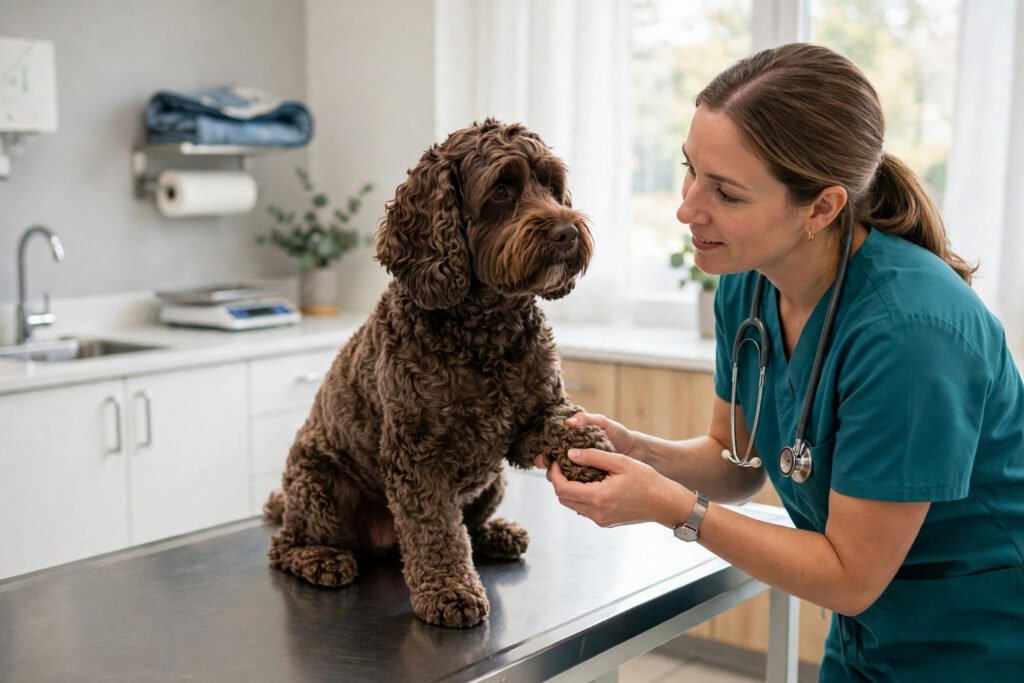
Fishy smell or scooting? Your Cockapoo’s anal glands may be full. Learn the signs of impaction and infection, when to see the vet, and how firm stools help.
Quick answer: Dogs have two anal glands, one on each side of the anus, that normally empty when they poop. When they do not empty, they fill up and cause a fishy smell, scooting, and licking under the tail. Firm stools keep them empty; soft stools and low fibre make blockages more likely. A swollen, painful lump needs a vet that day.
If your Cockapoo smells like a fish market and keeps dragging its bottom across the rug, you have probably met its anal glands — and you are not alone. It is one of the most common, least glamorous problems in the breed, and one of the most misunderstood. Owners either ignore it for months or panic at the first whiff, and neither response is quite right.
This guide starts where owners actually start: the smell and the scooting. It explains what the glands are, how to tell a full gland from an infected one, what keeps them empty naturally, who should express them and who should not, and the red flags that mean “vet today.” It is general information, not veterinary advice — your vet makes the call for your dog.
What Are Anal Glands? (And Yes, There Are Two)
Anal glands — vets often call them anal sacs — are two small pouches just inside the anus, one on each side, at roughly the four o’clock and eight o’clock positions. Each one holds a strong-smelling, oily fluid that works as a scent marker: a little is squeezed out onto the stool every time your dog poops, which is why dogs sniff each other’s rear ends so intently. A frightened dog sometimes releases a sudden burst of the same fluid, which is why a scared Cockapoo can suddenly smell fishy for no obvious reason.
One point worth stating plainly, because at least one Cockapoo site gets it wrong: dogs have two anal glands, not one. If a guide tells you your Cockapoo has a single gland, that guide is wrong on the most basic fact of the topic, and you should not trust its advice on the rest.
In a healthy dog the system looks after itself. Firm stool presses on the glands as it passes, squeezing a little fluid out each time, and the glands refill slowly. Problems start when the stool is too soft to press properly, when the ducts narrow, or when the fluid thickens — then the glands fill up, and everything in this article follows from that.
Why Cockapoos Are Prone to Anal Gland Problems
Cockapoos are not the worst breed for anal gland trouble, but they sit well above average. A large UK veterinary study of more than 104,000 dogs found that anal sac disorders affect around 4.4% of dogs every year, and Cockapoos carried about 2.6 times the risk of crossbreeds generally. Small dogs were affected most: dogs under 10 kg had more than twice the odds of the largest dogs.
Nobody can point to a single reason Cockapoos are prone, but the pieces fit together. They are a small breed, and small breeds get this more. Many have soft stools — from food sensitivities, scavenging, or a sensitive stomach — and soft stools do not press the glands empty. And they are a breed where allergies are common, which brings us back to soft stools and irritated skin around the rear end. None of this means your Cockapoo is doomed to gland problems; it means the topic is worth knowing about before the first fishy smell, not after the third.
If your Cockapoo’s stomach is unsettled for other reasons, see our guide to Cockapoo vomiting and upset stomach for the first-24-hours plan, and our Cockapoo food allergies guide if soft stools keep coming back — the two problems overlap more often than owners realise.
Signs of Anal Gland Problems
The signs cluster in a few places: the smell, the rear end, and your dog’s behaviour. Watch for these:
- The smell: a strong, fishy odour around your dog’s rear end, on their bed, or on furniture where they have been sitting. It is distinctive once you have smelled it — oily, fishy, and hard to wash out.
- Scooting: dragging the bottom along the floor or carpet, usually in short bursts. This is your dog trying to relieve pressure in the glands.
- Licking and biting: licking under the tail, at the tail base, or chewing at the rear end. Some dogs do this obsessively enough to irritate the skin raw.
- Discomfort sitting: shifting, yelping when sitting down, or avoiding sitting at all. Some dogs chase their tail or suddenly spin around.
- Leakage: brownish or oily spots on bedding, furniture, or your lap — fluid escaping from over-full glands.
- Swelling or redness: a visible lump or puffiness beside the anus, on one side or both.
One caution: scooting is a symptom, not a diagnosis. Worms can also cause scooting — tapeworm segments look like grains of rice around the rear end — as can itchy skin or irritation after grooming. If your dog is scooting and you are not sure why, our Cockapoo worms and deworming guide covers the worm signs to check first, and your vet can tell the two apart in a minute.
Impaction vs Infection vs Abscess: Know Which One It Is
Owners and even some guides use “blocked glands” as one catch-all, but the three stages need different responses. This table is the distinction competitors blur.
| Stage | What is happening | What you see | What to do |
|---|---|---|---|
| Full or impacted glands | Fluid builds up because the glands are not emptying; no infection yet | Fishy smell, scooting, licking, mild discomfort | Vet or groomer expression; fix the cause (stools, fibre) |
| Infected glands (sacculitis) | Bacteria grow in the trapped fluid; the glands become inflamed | Stronger smell, redness, swelling, pain when touched, sometimes fever or lethargy | Vet — expression plus antibiotics; do not wait |
| Abscess | Infection breaks through the skin, usually beside the anus | A hot, painful, swollen lump; red or purple skin; discharge or bleeding; your dog may be clearly unwell | Vet the same day — this is urgent, and it may need draining |
The progression matters because time is the difference between the first row and the third. An impacted gland expressed promptly is a five-minute job. The same gland left for weeks can become an abscess that needs draining, antibiotics, and sometimes surgery. If you are ever unsure which stage you are looking at, treat it as the worse one and call the vet.
Firm Stools and Fibre: The Prevention Owners Can Control
The single most useful fact in this article is also the simplest: firm stools empty the glands. Every prevention step below is really a way of getting firmer, bulkier stools.
- Feed a consistent, good-quality diet. Sudden food changes and rich treats soften stools. If your dog’s stools are often soft, look at the food before you look at the glands — our Cockapoo feeding chart covers amounts by age and size, and overfeeding is a common cause of loose stools.
- Add fibre, with your vet’s agreement. A little extra fibre bulks the stool and gives it more press against the glands. Plain canned pumpkin (not pie filling), psyllium husk, or a vet-recommended fibre supplement are the usual options — ask your vet which suits your dog and how much, because too much fibre causes its own problems.
- Keep your dog at a healthy weight. Overweight dogs get anal gland problems more often, partly because fat around the glands changes the pressure, and partly because overweight dogs tend to be less active.
- Keep exercise regular. Activity keeps the gut moving normally, and normal gut movement means normal stools. It is not a cure on its own, but a dog that barely moves is a dog whose digestion is sluggish.
- Treat the allergy if there is one. If soft stools, itchy skin, and gland trouble keep arriving together, the root cause may be a food allergy rather than the glands themselves. Our guide to Cockapoo food allergies explains the symptoms and the elimination-diet approach your vet may suggest.
One thing fibre and firm stools cannot do: fix glands that are already infected or abscessed. Prevention works before the problem, not during it.
Groomer vs Vet Expression — and When NOT to Do It at Home
Expression means manually emptying the glands by squeezing them, and someone has to do it when they will not empty on their own. The question is who.
A groomer can express glands as part of a groom, and many do it routinely. This is fine for a healthy dog whose glands are simply full — no pain, no swelling, no smell beyond the usual. But a groomer is not a vet: if the glands are painful, swollen, or discharging anything unusual, a groomer should stop and send you to the vet, not push through.
A vet is the right choice whenever anything is abnormal — pain, swelling, redness, discharge, fever, a lump, or glands that fill up again within days. A vet can also feel whether the glands are infected, check the fluid, prescribe antibiotics, and, if the problem keeps recurring, discuss longer-term options.
At home: usually, do not. Many guides — including some Cockapoo ones — give step-by-step instructions for expressing glands at home, complete with glove advice. Here is the honest version: it is messy, it smells terrible, it is easy to do wrong, and done wrong it can rupture a gland or push infection deeper. It is also painful for a dog whose glands are already sore, and a dog in pain bites. Leave it to someone trained unless your own vet has shown you how, on your own dog, in person. If your vet does teach you, follow their instructions exactly — not a blog post’s.
How often expression is needed varies enormously. Some dogs never need it. Some need it every few months. If your dog needs it every few weeks, that is not a routine — that is a sign the underlying cause has not been found, and your vet should be looking for it.
Red Flags: Call the Vet Today
Most anal gland cases are routine, but these signs mean same-day veterinary attention:
- A hot, swollen, painful lump beside the anus, or skin that looks red, purple, or broken
- Discharge, pus, or bleeding from near the anus
- Your dog is lethargic, off food, or running a fever alongside gland symptoms
- Scooting or licking that has become constant, or your dog is crying when it poops
- Glands that refill within days of being expressed, or that your groomer cannot empty
- Any gland problem in a puppy under 6 months, or in a dog that is already ill
If you are ever unsure whether a sign is urgent, call your vet and describe it — that phone call is free, and it is what the clinic is there for.
Frequently Asked Questions
Why does my Cockapoo smell fishy?
A fishy smell in a Cockapoo most often comes from full or impacted anal glands — two small sacs beside the anus that release a strong-smelling fluid. The smell appears when the glands do not empty properly during bowel movements and the fluid leaks out. If the smell comes with scooting or licking under the tail, the glands are the likeliest cause, and a vet or groomer can check them in a minute.
How often should a Cockapoo’s anal glands be expressed?
There is no fixed schedule — it depends on the dog. Many Cockapoos never need expression at all, because firm stools empty the glands naturally. Some need it every few months. If your dog needs expression every few weeks, that is a sign the underlying cause (usually soft stools or low fibre) has not been fixed, and your vet should investigate rather than just keep expressing.
Can I express my Cockapoo’s anal glands at home?
It is possible, but most owners should not. Done wrong, expression can rupture a gland, push infection deeper, or badly hurt a dog whose glands are already sore. Leave it to your vet or groomer unless your own vet has shown you how on your dog, in person. If the glands are painful, swollen, or discharging, do not attempt it at all — see the vet.
Does scooting always mean anal gland problems?
No. Scooting is a symptom, not a diagnosis. Full anal glands are the most common cause, but worms (especially tapeworm), itchy skin, irritation after grooming, or a foreign body can all cause scooting. If scooting continues after the glands have been checked and emptied, ask your vet to check for worms and skin irritation next.
Can anal gland problems be prevented?
Often, yes — at least the mild, recurring kind. Firm, bulky stools are the main defence, because they press the glands empty with every bowel movement. A consistent diet, the right amount of fibre, a healthy weight, and regular exercise all help. Some dogs still get problems despite all of that, because of their anatomy, and those dogs need a vet’s plan rather than more home fixes.
Conclusion
Anal gland trouble in Cockapoos is common, smelly, and usually fixable — but it rewards early action and punishes waiting. Learn the signs: the fishy smell, the scooting, the licking under the tail. Keep stools firm with a steady diet and enough fibre. Let your vet or groomer do the expressing, and do not try it at home on a sore dog. And treat a hot, swollen lump beside the anus as what it is — a same-day vet visit, not a next-week one.
Most dogs with gland trouble go on to live perfectly normal lives once the cause is found and the routine is set. The goal is not a dog that never has a gland issue; it is a dog whose issue gets noticed in days, not months.
For the wider picture of your Cockapoo’s health — including the other conditions that bring owners to the vet most often — see our common Cockapoo health problems guide.
This article is general information only and is not veterinary advice. Anal gland problems, expression, and treatment should be decided by your Cockapoo’s veterinarian.


Leave a Reply