
Cockapoo pregnancy explained: signs week by week, vet confirmation, feeding in the last three weeks, whelping-box setup, key labour stages and red flags.
Quick answer: A Cockapoo pregnancy lasts about 63 days. Signs build slowly: appetite changes and enlarged nipples around week four, a rounding belly from week six, and nesting near the end. Confirm it with a vet ultrasound from about day 25, switch to puppy food for the last three weeks, and set up the whelping box two weeks early.
A pregnant Cockapoo rarely announces herself. For the first three weeks there is usually nothing to see at all — she eats, plays and sleeps exactly as before. Then small changes creep in: a skipped meal, fuller nipples, a slowly rounding belly.
This guide covers the whole nine weeks: gestation, signs by week, vet confirmation, feeding, the whelping box, normal labour, litter size, and red flags. If you are still deciding whether to breed at all, read our honest should I breed my Cockapoo guide first.
How Long Is a Cockapoo Pregnant?
A Cockapoo pregnancy lasts about 63 days from ovulation, with a normal range of 58 to 68 days. Counted from the mating day, it can look like 58 to 72 days, because ovulation can happen a few days after mating, so a mating-day due date is only an estimate.
That range matters in both directions. A Cockapoo that whelps on day 59 is not necessarily early, and one that reaches day 66 is not necessarily overdue. Your vet can date it far more accurately, using ultrasound early and X-ray late. Write down the mating dates and give them to your vet at the first check.
Toy, miniature and standard Cockapoos all carry for roughly the same nine weeks; what differs is litter size. Our Cockapoo heat cycle guide explains the season that leads to mating.
Signs of Pregnancy Week by Week
Most Cockapoos show almost nothing for the first three weeks; after that the signs arrive in a fairly reliable order. Use the timeline as a guide, not a checklist.
Weeks 1–3 (days 1–21): Almost Nothing to See
Fertilization happens, the embryos travel to the uterus and implant around day 16 to 18 — and from the outside, nothing changes. Some owners notice a slightly clingier or quieter dog in week three, and a few see a brief dip in appetite or mild nausea. Most see nothing at all. Keep her routine normal and give no new medications unless your vet says so.
Weeks 4–5 (days 22–35): The First Real Signs
This is when pregnancy starts to show. Her nipples enlarge, darken and become more prominent — usually the first sign owners spot, around day 25 to 30. Appetite often rises after an early dip, and she may seem more tired or affectionate than usual. A little clear, odourless discharge around week four is normal; anything coloured or smelly means calling the vet. Inside, hearts, whiskers, toes and nails form, and her weight starts to climb.
Weeks 6–7 (days 36–49): The Belly Rounds Out
Now it becomes unmistakable. Her belly rounds out and drops lower, her waist disappears, and by week seven you can often feel — and sometimes see — the puppies moving when she lies down. Her appetite climbs sharply as the puppies do most of their growing. Belly hair thins and sheds, which is normal, and her nipples grow fuller. She will slow down and sleep more; let her set the pace.
Weeks 8–9 (days 50–63): The Final Countdown
In the last two weeks her belly is large and low, milk may appear, and the puppies’ skeletons show on X-ray. She will probably eat less — a full belly leaves little room for food — and she will start nesting: digging at bedding, circling, and seeking out quiet corners. Start taking her temperature twice a day from about day 58.
How Vets Confirm a Cockapoo Pregnancy
You cannot confirm a pregnancy by looking — only a vet can prove it.
Ultrasound, from about day 25. The usual first step. A scan confirms the pregnancy, shows heartbeats, and from week four gives a rough idea of litter size — an estimate, not a count. It is safe and painless.
Palpation, around week four. An experienced vet can sometimes feel the small fluid-filled sacs in her abdomen. It is less reliable than ultrasound.
Relaxin blood test, from about day 28. A blood test for the pregnancy hormone relaxin can confirm pregnancy, but it says nothing about litter size.
X-ray, from about day 45–55. Once the puppies’ skeletons have calcified, an X-ray is the most reliable way to count the litter. Most vets recommend one in the last week, so you know when labour is finished and whether one is stuck. Our Cockapoo vet visit schedule guide covers how often she should be seen at every age.
Feeding a Pregnant Cockapoo
For the first six weeks, feed her exactly as before: her normal food, in her normal amounts. She needs no extra calories while the puppies are tiny, and overfeeding early adds fat that makes whelping harder.
From week six, switch to a high-quality puppy food. Puppy food is denser in calories and nutrients — exactly what she needs in the last three weeks, when the puppies do most of their growing. Change over gradually across four or five days.
Feed little and often in the last two weeks. Her belly is crowded, so split her daily food into three or four smaller meals and let her eat as much as she wants.
Fresh water always, supplements only on vet advice. Keep clean water down at all times. Add no calcium or other supplements unless your vet tells you to — extra calcium before whelping can do more harm than good. Ask your vet about worming in late pregnancy.
Exercise, Grooming and Vet Care During Pregnancy
Keep her daily walks but shorten them as she gets bigger and let her set the pace. Avoid dog parks, rough play and jumping in the last three weeks.
Brush gently — her belly is tender and her coat may shed more than usual — and skip the bath in the final week unless she really needs one. Trim long hair around her nipples and belly in the last week so the puppies find the nipples easily.
Book the vet checks early: a first check to confirm the pregnancy, one around week six, and a late check with an X-ray to count the litter. Save your vet’s number and the nearest emergency clinic’s number in your phone before the due date.
Setting Up the Whelping Box
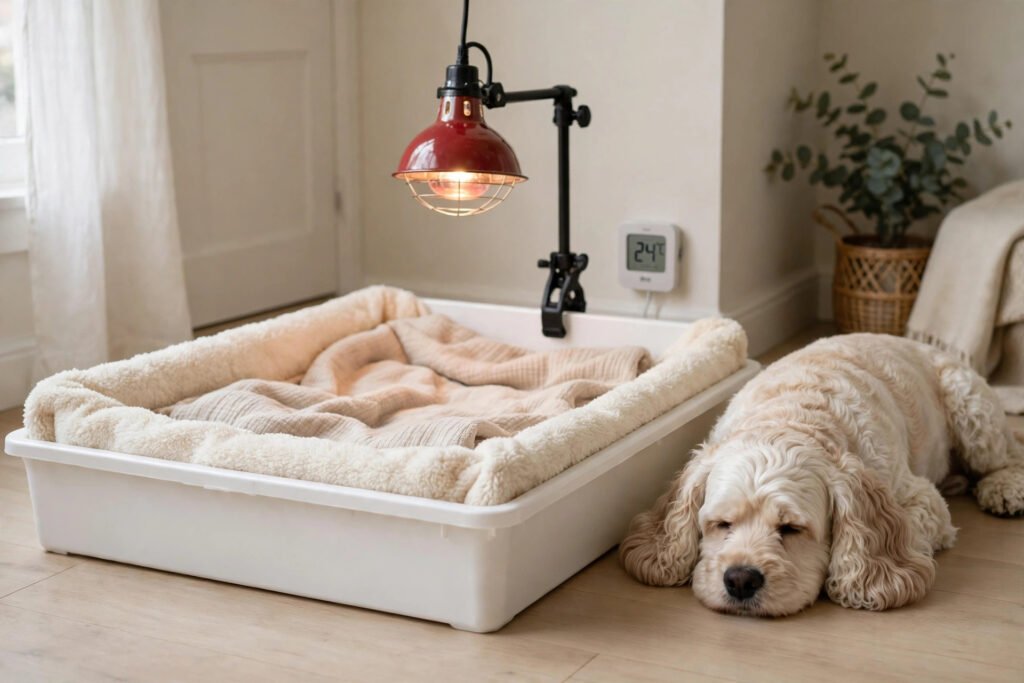
Have the whelping box ready at least two weeks before the due date, so she has time to get used to it. A dog that meets her box for the first time in labour may reject it and try to give birth under the bed.
Pick a quiet, warm, draught-free room away from household traffic. The box should be big enough for her to lie flat and stretch out, with sides high enough to keep the puppies in but low enough for her to step over. A rail around the inside, a few inches off the floor, helps stop her lying on a puppy.
Line it with clean, washable blankets or towels, and keep spares ready — you will change them often. Newborn puppies cannot keep themselves warm, so put a safe heat source in one corner only, such as a heat lamp hung where she cannot touch it. Heating one corner lets puppies crawl toward the warmth or away from it. Aim for roughly 75–80°F in the first days.
Gather a small kit beside the box: clean towels, a digital thermometer, a kitchen scale, a notebook for each puppy’s birth time and weight, and your vet’s and emergency clinic’s numbers. Encourage her to sleep in the box in the last week by feeding her near it and putting a worn T-shirt of yours inside.
 CockapooDaily
How Many Puppies? Cockapoo Litter Size
Cockapoos usually have 3 to 6 puppies, with first-time mothers often at the smaller end. Toy types tend to have fewer — often 2 to 4 — while standards more often reach 5 or 6. A litter of one is possible, and 7 or more is uncommon but not unheard of.
The only reliable count comes from an X-ray after about day 55. An ultrasound earlier gives a rough idea, but it can miss one or count one twice. That count matters at whelping: if the X-ray showed five puppies and only four have arrived, you know one is still to come. See our Cockapoo heat cycle guide for the season and timing that led here.
Signs Labour Is Near
Labour usually announces itself a day or two before it starts: restlessness, pacing, panting, digging at bedding, refusing food, or suddenly wanting to be glued to you — or, just as often, to hide alone. Her belly drops lower and her nipples are full.
The temperature drop is the most reliable sign. A Cockapoo’s normal temperature runs about 101–102.5°F. In the last week, take her rectal temperature twice a day with a digital thermometer. About 12 to 24 hours before labour it typically falls below 99°F, often to 98–99°F. Not every dog shows a clear drop, so treat it as a guide — but if you see it, stay close.
The Three Stages of Labour
Most Cockapoos manage all three stages without help, but knowing what each looks like tells you when to watch and when to act.
Stage one: preparation, 6–24 hours. The cervix dilates and contractions begin, but you cannot see them. She is restless, panting, shivering or nesting, and may vomit or refuse food. This is the longest stage — she looks uncomfortable but nothing visible is happening. Stay nearby and keep the room quiet.
Stage two: active delivery. She starts visibly pushing. A clear fluid sac may appear, followed by a puppy, usually within 30 minutes of strong straining. She will normally break the sac herself, lick the puppy to start its breathing, and chew through the cord. Puppies usually arrive every 30 to 60 minutes, though a calm rest of up to two hours can be normal if she is relaxed and not straining.
Stage three: the placenta. The afterbirth usually follows each puppy within 5 to 15 minutes — count them, one per puppy. She may eat them; that is normal, though it can upset her stomach. A retained placenta means calling the vet.
Between puppies, let her rest and nurse the ones already born. Keep the room warm, quiet and dim, and handle the puppies as little as possible in the first hours.
Red Flags: When to Call the Vet
Most Cockapoo births go smoothly, but these situations are emergencies — call your vet or the emergency clinic at once:
- Over 68 days from ovulation with no labour, or more than 24 hours past her due date.
- Strong straining for 30 minutes with no puppy, or weak straining for two hours with no progress.
- More than 4 hours between puppies while she is still restless or straining.
- Green or black discharge before the first puppy is born. (A little green tinge is common once puppies are being born.)
- Heavy bleeding, foul-smelling discharge, or a puppy stuck in the birth canal.
- She seems weak, collapses, trembles violently, or stops responding, or labour stops partway through.
Do not wait to see if it sorts itself out, and do not try to pull a stuck puppy yourself. Call first.
After the Birth: The First Hours
Once the last puppy and placenta are out, let her rest, offer food and fresh water, and check that every puppy is nursing and warm. Weigh each puppy and write it down — daily weights show whether a puppy is thriving.
The first eight weeks are a whole new stage. Our newborn Cockapoo care guide covers them week by week, picking up exactly where this article ends.
Frequently asked questions
How long are Cockapoos pregnant for?
About 63 days from ovulation, with a normal range of 58 to 68 days. Counted from mating it can look like 58 to 72 days, so treat a mating-day due date as an estimate.
What are the first signs of pregnancy in a Cockapoo?
Usually subtle: a brief dip in appetite or mild nausea around week three, then enlarged, darker nipples around day 25 to 30. The belly does not visibly round out until about week six.
How can I tell how many puppies my Cockapoo will have?
An ultrasound from about day 25 gives a rough idea, but the only reliable count is an X-ray after about day 55. Most Cockapoos have 3 to 6 puppies — toy types usually fewer, standard types usually more.
How do I know when my Cockapoo is about to give birth?
Watch for restlessness, panting, digging at bedding, loss of appetite and nesting in the last day or two, and take her rectal temperature twice a day from day 58. A drop below about 99°F usually means labour within 12 to 24 hours.
What should I do if my Cockapoo has been in labour for hours with no puppy?
Call your vet at once. Strong straining for 30 minutes with no puppy, or more than 4 hours between puppies while she is still restless or straining, are emergencies. Do not try to pull a stuck puppy yourself.
Conclusion
A Cockapoo pregnancy is nine weeks of small changes: quiet early weeks, the first real signs around week four, a rounding belly from week six, and a restless, nesting dog in the final days. Confirm it with an ultrasound from about day 25, switch to puppy food for the last three weeks, set up the whelping box two weeks early, and take her temperature twice a day from day 58. Know the three stages of labour and the red flags — the difference between a smooth birth and an emergency is usually how fast someone calls the vet. When the last puppy is out, our newborn Cockapoo care guide covers the first eight weeks.
Leave a Reply