
Feeling overwhelmed by your new Cockapoo puppy? The puppy blues are normal — and they pass. Learn the three drivers and the daily routine that actually helps.
Quick answer: Yes — the Cockapoo puppy blues are normal. Most new owners feel overwhelmed, guilty, or regretful in the first few weeks, usually because of biting, toilet accidents, and broken sleep. The feelings ease as a routine forms, typically within a few weeks. A wake-window and crate-nap schedule, consistent potty breaks, and a calm bedtime make the biggest difference.
You waited months for this puppy. You picked the breeder, bought the crate, read the books. Then the puppy arrived — and instead of the happy montage you imagined, you are standing in the kitchen at 2 a.m., covered in puppy teeth marks, mopping up the third accident of the day.
If that sounds familiar, here is the sentence you need to hear first: you have not made a mistake, and you are not a bad owner. You have the puppy blues, and they are one of the most common — and least talked about — parts of bringing a puppy home.
A University of Helsinki study found that just under half of puppy owners had a really tough time in puppyhood — and for most of them, it eased fairly quickly. The reason nobody told you is simple: nobody posts the crying-on-the-kitchen-floor part. They post the sleeping puppy in a basket.
This article does two things: it normalises what you are feeling, because the guilt is usually worse than the puppy, and it gives you one steady routine — built on our own guides — that gets you through the first few weeks.
What Are the Cockapoo Puppy Blues?
The puppy blues are the wave of regret, anxiety, overwhelm and exhaustion that hits many new owners in the first days and weeks after bringing a puppy home. The excitement wears off, the reality sets in, and suddenly the puppy you dreamed about feels like a second full-time job.
It usually looks like one or more of these:
- Lying awake wondering if you made the wrong decision — then feeling guilty for thinking it.
- Crying more than feels normal, sometimes without knowing exactly why.
- Feeling trapped, because your old life has vanished overnight.
- Resenting the puppy for a moment, then feeling awful about it.
- Googling “is it normal to regret getting a puppy” at 2 a.m.
None of this means you do not love your puppy. It means you are adjusting to a massive life change while sleep-deprived — and your puppy is adjusting too. It has just left its mother and littermates and is learning everything from scratch.
It also helps to know the timing. The first few days are often a honeymoon: the puppy is tired from the move and sleeps a lot. Then, usually in week two, the puppy finds its feet — the biting, the crying at night, the accidents — and that is when the blues hit hardest. The first four weeks home are usually the toughest, and for most owners it eases after that, as the routine forms and the puppy settles.
Why It Hits So Hard: The Three Drivers
1. The Biting
Cockapoo puppies bite, and it hurts more than anyone warns you about. They latch onto hands, clothes and ankles the moment you try to interact, and it can feel personal — as if your puppy does not like you.
It is not personal. Puppies play almost entirely through biting; it is how they explored the world with their littermates. Your puppy is not aggressive and not broken — it is a baby with needle teeth and no idea yet that human skin is fragile.
What makes it worse is reacting in the moment — yelping or pulling your hand away fast — which usually makes the biting more exciting. The fix is managing the situation before the bite happens: short play sessions, a toy in your hand instead of a bare hand, and calmly ending play the moment teeth touch skin. Our guide on how to stop Cockapoo puppy biting walks through the full method.
2. The Toilet Accidents
You take the puppy out. It pees outside. You praise it. Ten minutes later it pees on the rug. You start to wonder if it is doing it on purpose. It is not. A young Cockapoo puppy has a tiny bladder and almost no warning system yet, and being fully dry takes months, not days. Every accident you find is usually an accident you missed, not a puppy being stubborn.
The rule that works, the one Becky Baker used with Buddy the Cockapoo, is simple: outside every time the puppy eats, wakes from a nap, or finishes playing. Every time, no exceptions. It is boring and relentless, and it is also the fastest way to a dry house. Our Cockapoo potty training schedule lays out the hour-by-hour version so you do not have to guess.
Two things to stop doing: scolding the puppy for an accident you found after the fact — it cannot connect the two, and it only learns to hide from you — and switching methods every few days because the first one “did not work”. Pick one plan and stay with it for at least two weeks.
3. The Broken Sleep
This is the driver that makes the other two feel ten times worse. Puppies need to go out every two to three hours at night, so your sleep is broken into fragments — and sleep deprivation alone can mimic depression and anxiety. Everything feels heavier at 3 a.m. than at 3 p.m., and that is not weakness. That is biology.
Cockapoo puppies need around 18 to 20 hours of sleep a day at eight weeks old, but in short bursts, not one long night. Your job in week one is not to make the puppy sleep through the night — it is to make the nights boring and predictable so the puppy learns that night is for sleeping. Our Cockapoo puppy bedtime routine gives the step-by-step evening, and our guide to how much sleep Cockapoos need covers the age-by-age numbers.
If you share the puppy, take shifts — one person the first half of the night, the other the second. A single unbroken stretch of sleep, even four hours, can change how the whole next day feels.
The Survival Plan: A Routine That Actually Works
There is no secret trick. What works is a boring, steady routine, repeated daily — the same one the black Cockapoo puppy Brandy’s owner shared in her July 2026 reel, the routine that took her from regret to “I couldn’t imagine life without her” — built on our own guides.
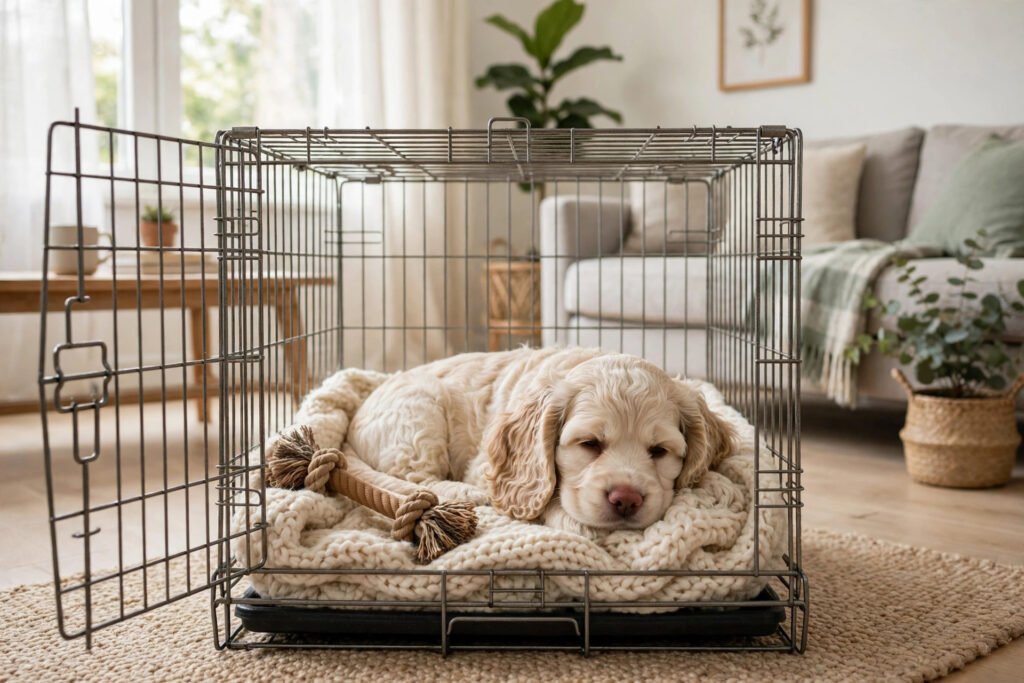
Wake windows and crate naps. A young puppy should be awake for about one to one and a half hours, then nap in the crate for about two. That is the whole day, on repeat: wake, potty, play, train a little, eat, potty, crate nap. An overtired puppy is a biting, zooming, crying puppy — most of the worst behavior in week two is simply a puppy that has been awake too long. The crate is not a punishment; it is the puppy’s bedroom. Our crate training guide covers the day-by-day plan for making the crate a place your puppy actually likes.
Lick mats and Kongs for settling. When your puppy is wired and you need twenty minutes of calm, a lick mat smeared with a little plain yogurt or a Kong stuffed with kibble and a smear of peanut butter does more than any command. Licking is naturally calming for dogs. Keep two or three ready in the freezer for the witching hour — that wild, bitey stretch in the early evening when every new owner wonders what went wrong.
Consistent potty breaks. Same door, same spot, same words, every time — after waking, after eating, after playing, before bed, and once or twice in the night. Our potty training schedule has the hour-by-hour version.
A steady bedtime. Same time every night, same wind-down: last potty break, a calm ten minutes, into the crate with a safe chew, lights low. Puppies learn the pattern within days. Our bedtime routine guide walks through it step by step.
One plan, not ten. The single biggest mistake new owners make is collecting advice from a dozen sources and mixing them together. Pick one trusted route — this one, or your trainer’s — and follow it for two weeks before judging it.
 CockapooDaily
Small Wins and Looking After Yourself
Count the wins. Keep a jar and some coins: add one every time your puppy makes you smile, five for something big — a pee outside instead of on the carpet, a night with only one wake-up. On the bad days, the jar is proof things are moving.
Keep one piece of your old life. Eat proper meals. Take a long shower. Watch a show you enjoy. Go for a walk without the puppy. Losing every part of your normal routine is what turns tiredness into despair, and keeping one small piece of it is maintenance, not selfishness.
Talk to someone who gets it. Puppy-owner communities online are full of people going through exactly this, right now. Saying “I cried today and I feel guilty about it” to someone who has been there is worth more than a hundred training videos. If you have a trainer, talk to them early — not at breaking point, but when the feelings first show up. And take real breaks: ask a friend or family member to puppy-sit for an evening. A few hours away is not abandoning it; it is how you come back patient enough to enjoy it.
The first seven days are the hardest part of the adjustment, not a preview of the next fifteen years. Our first-week home guide maps out what each day actually looks like, so you can see where you are in the tunnel.
How Long Does It Last?
For most owners, the worst of it peaks in the first three to four weeks and starts to ease as the routine forms. Around weeks eight to twelve, meals, naps and potty trips fall into a rhythm, the biting softens, and the nights stretch out — and the feelings ease with them. Most owners report significant improvement by about three months.
It does not get better in one dramatic moment. It gets better in small increments — one fewer accident, one longer nap, one night with a single wake-up — until one morning you realize you have not cried in a week and the puppy asleep on your feet is the best part of your day.
When Low Feelings Need a Real Conversation
The puppy blues are normal. But there is a line, and it matters to know where it is.
Talk to someone — your vet, your doctor, or a mental health professional — if:
- The low feelings are still there, or getting worse, past about three months.
- You feel low, anxious or numb most of the day, most days.
- You are struggling to eat, sleep or function even when the puppy is settled.
- You have thoughts of harming yourself or your puppy.
None of that makes you a bad owner. It makes you a person who needs support, and asking for it is the responsible thing to do — for you and for the puppy. Your vet can point you toward puppy support groups and certified trainers, and a trainer can tell you honestly whether a behavior problem is normal puppy behavior or needs a plan of its own.
One more thing: do not rehome your puppy in the first two weeks. The most intense regret peaks early and usually subsides. If, after months of consistent effort and real support, you genuinely believe the fit is wrong, that is a different conversation — with your breeder or a rescue, calmly and with help, not at 2 a.m. on your worst night.
Frequently asked questions
Is it normal to regret getting a Cockapoo puppy?
Yes. Just under half of puppy owners had a really tough time in puppyhood, according to a University of Helsinki study, and most new owners feel some regret or overwhelm in the early weeks. It does not mean you made a mistake — it means you are adjusting to a huge life change while sleep-deprived.
How long do the puppy blues last?
The worst of it usually peaks in the first three to four weeks and eases as a routine forms. Many feel significantly better by about three months. If the low feelings are still there or getting worse past three months, talk to your vet or doctor.
Why does my Cockapoo puppy bite so much?
Because it is a puppy. Biting is how puppies play and explore. It peaks in the early weeks and fades with age and consistency. Manage it before it happens — short play sessions, a toy in your hand, end play when teeth touch skin — and see our biting guide for the full method.
Will the puppy blues go away on their own?
Usually, yes — as the puppy learns the routine, sleeps better and bites less, the feelings ease with them. But “on their own” still means doing the work: wake windows and crate naps, consistent potty breaks, and a calm bedtime. The routine is what turns time into progress.
Should I rehome my puppy if I have the puppy blues?
Not in the first two weeks. The most intense regret peaks early and usually subsides as the routine forms. Give one consistent plan at least two weeks, get support from your vet or a trainer, and take real breaks. Only consider rehoming after months of genuine effort, calmly with your breeder or a rescue — never on your worst night.
Conclusion
The Cockapoo puppy blues are not a character flaw, and they are not a sign your puppy is broken. They are what happens when a huge life change, broken sleep, biting and toilet accidents all land at once — and nearly half of new owners go through them.
What actually helps is not trying harder or doing more. It is a steady routine, repeated daily: wake windows and crate naps, lick mats and Kongs, consistent potty breaks, and a calm bedtime. The routine is the fix, built on guides we have already written — the first week, the potty schedule, the biting method, the bedtime routine, the sleep numbers and the crate plan.
It gets easier — not in one dramatic moment, but in small wins, until the puppy asleep on your lap is the best part of your day. If the low feelings linger well beyond the first few weeks, talk to someone. And on the hard nights, remember: you are not the exception. You are the norm. You just did not know it, because nobody posts this part.
Leave a Reply