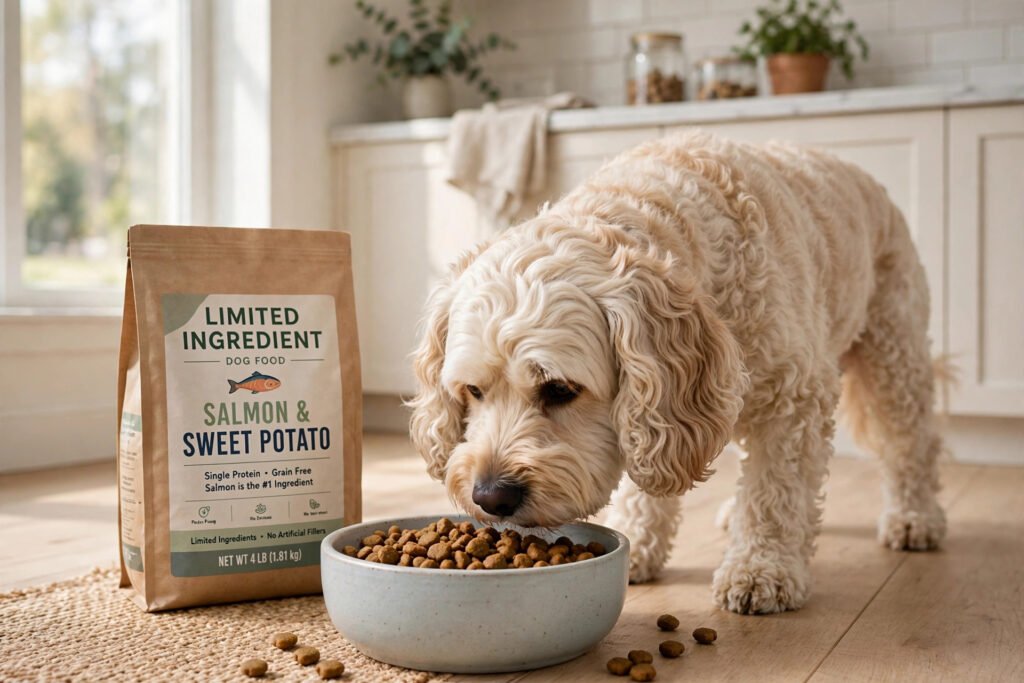
Best dog food for a Cockapoo with a sensitive stomach: limited-ingredient kibble, fresh food and top picks, plus the elimination test and 7-day switch plan.
Quick answer: Pick a limited-ingredient food with one novel protein — salmon or lamb — and one carb, such as sweet potato or rice. Feed it for 6 to 8 weeks, switching over 7 days, and judge by the stool: firmer within 2 weeks is progress. Top picks: Natural Balance L.I.D., Pro Plan Sensitive Skin & Stomach, and Open Farm salmon.
A Cockapoo with a sensitive stomach turns every meal into a gamble. One food brings firm stools and a happy dog. The next brings loose stools, gas, and a gurgling belly at 2 a.m. — and you are left guessing whether it was the food, the treat, or something your dog ate in the yard.
The fix is rarely a miracle food. It is a method: simplify the recipe, change one thing at a time, and judge the result by the stool. This guide explains the decision first — what kind of food actually helps, how to read a label, and how to run a proper food test — and then gives you the picks that fit a Cockapoo, with US prices and where to buy them.
What a Sensitive Stomach Means — and What It Is Not
A sensitive stomach is a pattern, not a single bad day. The signs are digestive: loose or soft stools most days, gas, a gurgling belly, occasional vomiting after meals, and a dog that is otherwise well — eating happily, playing, and holding its weight. If the same food keeps producing the same upset, and the dog is fine between meals, you are probably looking at a food sensitivity.
 CockapooDaily
That is different from a food allergy. An allergy is an immune response, and it usually shows on the skin first: itching, sore ears, red paws, constant paw licking. If your Cockapoo’s main symptoms are itchy skin, recurring ear infections, or paws that never stop being licked, the problem is more likely an allergy than a sensitive stomach. Our guide to Cockapoo food allergies explains the signs and the test for that — and the two conditions need different approaches, so it is worth knowing which one you are dealing with before you buy a new bag.
It is also different from an illness. Parasites, infections, and conditions such as pancreatitis cause the same loose stools and vomiting, and no food will fix those. If the upset comes with vomiting more than once, blood in the stool or vomit, weight loss, or a dog that will not eat, that is a vet visit, not a food switch. Our vomiting guide covers the red flags and what to do first.
One more thing to rule out before you blame the food: how much you are feeding. Overfeeding alone causes loose stools in dogs, and it is the most common owner mistake of all. If the portions have been creeping up — an extra scoop here, a few treats there — fix that first. Our feeding chart gives the amounts by size and age.
The 4 Kinds of Food That Help a Sensitive Stomach
There are four kinds of food that genuinely help a sensitive stomach, and they work in different ways. Knowing which one you need is the whole decision — most owners waste months trying random bags because nobody explained the categories.
| Type | What it is | Best for | Watch out for |
|---|---|---|---|
| Limited-ingredient kibble | One protein and one carb, short ingredient list | Most sensitive stomachs — the best first try | Check the “single protein” claim is real; some list chicken fat or egg further down |
| Fresh, gently cooked food | Human-grade ingredients, cooked gently, delivered fresh | Dogs that do badly on every kibble; fussy eaters | Cost; fridge and freezer space; subscription |
| Grain-inclusive sensitive formula | Rice or oatmeal based, often with added probiotics | Dogs that do fine on grains; the cheapest vet-trusted route | Check the protein — chicken is common, and if chicken is the suspect, pick salmon or lamb |
| Hydrolyzed / prescription diet | Proteins broken into pieces too small for the immune system to recognize | The diagnostic tool when nothing else works | Vet only; expensive; never start one on your own |
A limited-ingredient kibble is where most owners should start. It removes the most variables at the lowest cost, and if it works, you have your answer in weeks. Fresh food is the next step up when kibble keeps failing — fewer processed ingredients, and the protein and carb are exactly what the label says. A grain-inclusive sensitive formula is the budget-friendly option, and for many dogs it is all that is ever needed. A hydrolyzed diet is not a shopping choice at all: it is a medical tool your vet prescribes when the food trial has to be airtight.
Grain-free deserves a word of its own, because it is the most misunderstood label on the shelf. Grain-free is a format, not a fix. Rice and oatmeal are among the gentlest carbs a dog can eat, and many sensitive stomachs do better on them than on the potato and pea blends that replace grains in grain-free recipes. Go grain-free only if a grain is the actual trigger. The FDA has also investigated a possible link between grain-free diets and dilated cardiomyopathy (DCM), a heart condition, so grain-free is not a default to choose “just in case” — it is a specific answer to a specific problem.
How to Read a Label for a Sensitive Stomach
You do not need a nutrition degree to judge a bag. The first five ingredients tell most of the story, and the label has to be honest about them.
One named protein, first. Look for salmon, lamb, turkey, or beef as the first ingredient — a named animal, not “meat meal,” “poultry by-product meal,” or “animal digest.” If the food claims to be limited-ingredient, the protein should appear once. A bag that leads with salmon and then lists chicken fat and dried egg further down is not a single-protein food, whatever the front of the bag says.
One gentle carb. Sweet potato, rice, oatmeal, and barley are the easiest carbs on a sensitive gut. Sweet potato and pumpkin also add soluble fiber, which firms stools. If the carb list runs to four or five different starches, the recipe is not as simple as it looks.
Moderate fiber, from named sources. Beet pulp, pumpkin, and chicory root are the useful ones. A moderate amount of fiber firms loose stools; too much fiber can loosen them again, so a food that lists three fiber sources in the first ten ingredients is worth a second look.
Probiotics and prebiotics. Live probiotics and prebiotic fiber (inulin, chicory root) help some dogs hold a firmer stool, especially during a food switch. Look for named strains or “dried fermentation products” on the label — a vague “probiotics added” with nothing else is marketing, not a feature.
Moderate fat, not rich. Very rich, high-fat recipes are a common trigger for loose stools. If the food your dog is on now is very high in fat, a moderate-fat recipe is the first thing to try — and it is also why fatty table scraps and rich treats cause so many upset stomachs.
What to avoid. Artificial colors and flavors, vague ingredients (“meat and bone meal,” “animal fat” with no animal named), and long lists of fillers. And check the AAFCO statement on the back: it should say the food is “complete and balanced” for your dog’s life stage. Every food recommended in this article meets AAFCO nutrient profiles.
The Elimination-Diet Test: How to Find the Trigger in 6 to 8 Weeks
Guessing wastes months. A controlled food test finds the answer, and it is simpler than it sounds. The principle is one change, tested properly, with a written record.
Step 1: Pick one new food. Choose a food built on a protein and a carb your dog has not eaten before, if you can. For most Cockapoos that means salmon or lamb with sweet potato or rice — chicken and beef are the proteins most dogs have already eaten, and they are also among the most commonly reported triggers, so they make poor test foods.
Step 2: Feed only that food for 6 to 8 weeks. This is the part most owners get wrong. Only means only: no treats, no table scraps, no flavored chews, no rawhide, no “just one biscuit.” Every extra ingredient is another variable, and one biscuit a day is enough to ruin the test. If you need a training reward during the test, use small pieces of the test food itself as the treat.
Step 3: Keep a food diary. One line a day is enough: the date, what was fed, stool firmness on a scale of 1 to 5 (1 is watery, 5 is firm), gas, itching, and energy. A diary turns “I think it is better” into something you can actually judge, and it is what your vet will ask for if the test does not work.
Step 4: Judge at 2 weeks and at 6 to 8 weeks. Stools should be noticeably firmer within 2 weeks. By 6 to 8 weeks you have your answer: firm stools most days, less gas, no vomiting, and a dog eating well means the food works — keep it. If nothing has changed by 8 weeks, the trigger is probably not food, or the “new” food shares an ingredient with the old one. That is the point to see the vet, not to try a third random bag.
Feed the right amount throughout the test. Our feeding chart gives the cups by size and age — use it, because overfeeding during a food test looks exactly like a food that does not work.
How to Switch Foods Without Making Things Worse
Never switch a sensitive stomach cold turkey, unless your vet tells you to. A sudden change is itself a cause of loose stools, and it will make you think the new food failed when it was the switch that failed. Use 7 days:
| Days | Old food | New food |
|---|---|---|
| 1 to 2 | 75% | 25% |
| 3 to 4 | 50% | 50% |
| 5 to 6 | 25% | 75% |
| 7 | 0% | 100% |
If the stools loosen at any step, hold that ratio for 2 to 3 extra days before moving on. Most dogs settle at the new ratio and you can continue. If the stools stay loose after holding, the new food probably does not suit your dog — go back to the old food for a few days, then try a different protein rather than a different brand of the same protein.
A probiotic chew during the switch can help some dogs hold a firmer stool while the gut adjusts. It is a support, not a fix — if the food is wrong, no supplement will save it — but for a dog that always loosens up during a change, it is worth having. One option is in the picks below.
The Best Dog Foods for a Cockapoo With a Sensitive Stomach
This list was chosen on three rules: the food must be sold in the US, it must be a genuine sensitive-stomach or limited-ingredient formula (not a regular kibble with a sensitive label), and it must be complete and balanced under AAFCO. Prices are approximate at the time of writing and vary by store.
As an Amazon Associate I earn from qualifying purchases.
| Food | Type | Protein | Best for | Where to buy |
|---|---|---|---|---|
| Natural Balance L.I.D. Small Breed Salmon & Sweet Potato | Limited-ingredient kibble | Salmon | Best first try | Amazon |
| Purina Pro Plan Sensitive Skin & Stomach Small Breed Salmon & Rice | Sensitive formula kibble | Salmon | Best vet-trusted pick | Amazon |
| Open Farm Ancient Grains Wild-Caught Salmon | Premium kibble | Salmon | Best premium kibble | Amazon |
| Ollie | Fresh, gently cooked | Beef, chicken, turkey, lamb | Best fresh food | Direct subscription |
| Spot & Tango UnKibble | Fresh-dry | Cod & salmon, and 3 more | Best fresh food without a freezer | Direct subscription |
1. Natural Balance L.I.D. Small Breed Salmon & Sweet Potato — Best First Try
This is the food to try first, because it is the simplest recipe that still covers everything. Salmon is the only animal protein, sweet potato is the carb, and the ingredient list is short enough to read in one breath. It is grain-free, free of corn, wheat, and soy, and it is made in a small-breed kibble size, which suits a Cockapoo’s small mouth. The brand describes it as ideal for small breed dogs with sensitive stomachs, and at about $48 for a 12-lb bag — roughly $4 a pound — it is the cheapest proper limited-ingredient food on this list.
The one thing to know: it is fish-based, so if your dog has ever reacted to fish, pick the lamb version of the same line instead. Otherwise, this is the default starting point for the elimination test above.
Check the price of Natural Balance L.I.D. Small Breed Salmon & Sweet Potato on Amazon
2. Purina Pro Plan Sensitive Skin & Stomach Small Breed Salmon & Rice — Best Vet-Trusted Pick
Pro Plan Sensitive Skin & Stomach is the formula vets reach for most often, and the small-breed version is sized for a Cockapoo. Salmon is the first ingredient, rice and oatmeal are the gentle carbs, and it includes live probiotics and prebiotic fiber for digestive health — the two things most sensitive-stomach foods claim and few actually deliver. It also carries omega fatty acids for skin and coat, which matters because stomach and skin problems so often travel together in this breed.
The adult 30-lb bag usually runs about $75, which makes it the best value per pound here if you have the storage space. The 16-lb small-breed bag is the right buy for one Cockapoo. One caution: it is salmon-based, so the same fish warning applies as above.
Check the price of Purina Pro Plan Sensitive Skin & Stomach Small Breed Salmon & Rice on Amazon
3. Open Farm Ancient Grains Wild-Caught Salmon — Best Premium Kibble
Open Farm is the premium pick, and the one to try when the cheaper options have not quite worked. Wild-caught salmon is the first ingredient, the grains are ancient grains — oats, sorghum, quinoa, millet — and the recipe includes pumpkin, coconut oil, and salmon oil. It is free of peas, potatoes, and legumes, and the brand describes this recipe as great for sensitive stomachs or dogs with frequent loose stool. Every ingredient is traceable to its source, which is the brand’s whole selling point.
Expect to pay more per pound than Pro Plan or Natural Balance — this is the most expensive kibble on the list. What you are paying for is ingredient quality and a very short, clean recipe. If your Cockapoo’s stomach is sensitive but not truly reactive, this is often the food that finally settles it.
Check the price of Open Farm Ancient Grains Wild-Caught Salmon on Amazon
4. Ollie — Best Fresh Food
Ollie is fresh, human-grade food, cooked gently and portioned to your dog’s weight, age, and activity level. There is no kibble involved at all — the recipes are built from real meat, vegetables, and grains, formulated with vets, and they meet AAFCO profiles through actual feeding trials rather than calculated nutrient profiles. For a dog that has done badly on every kibble, fresh food is often the thing that works, because there is so little processing between the ingredient and the bowl.
Ollie is a subscription, ordered direct from Ollie’s website after a short quiz about your dog. The fresh meals are not sold on Amazon, so there is no Amazon link for them here. It costs several times what kibble costs, and it needs fridge and freezer space, so it is a commitment — but if two kibbles have already failed, it is the most sensible next step before a prescription diet. Ollie also offers a half-fresh plan, mixing fresh food with kibble, which cuts the cost while keeping most of the benefit.
5. Spot & Tango UnKibble — Best Fresh Food Without a Freezer
UnKibble is the middle ground between kibble and fresh food: human-grade ingredients, gently cooked and then dried, so it is shelf-stable and needs no fridge or freezer. It comes in four recipes — chicken and brown rice, beef and barley, cod and salmon, and turkey and sweet potato — and for a sensitive stomach the cod and salmon recipe is the pick: fish protein, sweet potato, grain-free, and no meat meals or powdered meat anywhere in the recipe. Dog Food Advisor gives UnKibble five stars.
It is sold direct from Spot & Tango as a subscription, with trial boxes starting at about $15 and plans from about $1 a day for a small dog. There is no verified Amazon product page for UnKibble itself, so there is no Amazon link here — order it direct from the brand. If the idea of fresh food appeals but the freezer logistics do not, this is the version that fits a normal kitchen.
Worth Adding During a Switch: Ollie Belly Rubs Probiotic Chews
A probiotic chew will not fix a wrong food, but it can steady a sensitive gut while you switch foods or run the elimination test. Ollie Belly Rubs are duck-flavored soft chews with five probiotic strains plus pumpkin seed and papaya leaf, aimed at dogs with irregular stools or upset stomachs. They run about $25 for roughly 60 chews — about 42 cents a chew — and they are sold on Amazon.
Two things to know: they are only for dogs over 12 months old, so they are not for puppies, and if your dog is on medication or has a diagnosed condition, ask your vet before adding any supplement.
Check the price of Ollie Belly Rubs Probiotic Chews on Amazon
One more name worth knowing: Royal Canin Digestive Care is another vet-recommended sensitive formula, sold through Chewy and pet stores. It is not on Amazon in a form we could verify, so there is no link here — but if your vet suggests it, it is a solid option.
When the New Food Does Not Work
If you ran the test properly and nothing changed, work through these three checks before buying another bag.
First, was the test really clean? One treat a day, a dental chew, a flavored medication, or table scraps all count as ingredients. If any of those happened during the 6 to 8 weeks, the test was not clean, and the result means nothing. Run it again, properly, before concluding food is not the problem.
Second, does the new food share an ingredient with the old one? Two different brands can still share the trigger — chicken fat in one, dried egg in the other, the same carb in both. Read both labels side by side and look for the overlap. If the overlap is chicken in any form, the next test food needs a protein your dog has never eaten.
Third, is it food at all? Worms, infections, and conditions such as pancreatitis cause exactly the same loose stools and vomiting, and they will not respond to any food. Pancreatitis, for example, causes vomiting and loose stools after fatty meals and needs vet treatment, not a different kibble. If two different single-protein foods have both failed, stop guessing and see the vet — the next step is usually a hydrolyzed diet trial under vet supervision, and that is a medical decision, not a shopping one.
When to See the Vet Instead of Switching Food
A food switch is for a dog that is otherwise well. These signs mean the vet comes first, not a new bag:
- Blood in the stool or vomit
- Vomiting more than once in a day, or vomiting that goes on for more than 24 hours
- Weight loss, or a dog that refuses food for more than a day
- A puppy under 6 months with diarrhea — small puppies dehydrate fast
- Lethargy, a painful belly, or a swollen abdomen
Our vomiting guide covers what counts as an emergency and what to do first. When in doubt, call the vet and describe the stool, the food, and how long it has been going on — that is a five-minute call that can save a bad week.
FAQ
How long does it take for a new food to settle a Cockapoo’s stomach?
Stools usually firm up within 2 weeks if the food suits your dog. A full answer takes the whole 6-to-8-week elimination test, because some triggers take longer to clear and some improvements are slow. If nothing has changed at all after 2 weeks, the food is probably not the answer — but give it the full test before you judge, unless the stools get worse.
Is grain-free better for a sensitive stomach?
Not automatically. Rice and oatmeal are among the gentlest carbs a dog can eat, and many sensitive stomachs do better on them than on the potato and pea blends that replace grains in grain-free recipes. Go grain-free only if a grain is the actual trigger — and remember the FDA has investigated a possible link between grain-free diets and dilated cardiomyopathy, so it is not a default to choose just in case.
Can I feed my Cockapoo chicken if it has a sensitive stomach?
Chicken is one of the most commonly reported food triggers in dogs, which is why it makes a poor test food. Start with salmon or lamb instead. If chicken has never caused your dog a problem, it may be fine — but the only way to know is the elimination test: feed a chicken-free food for 6 to 8 weeks, and if the stools firm up, you have your answer.
Is wet food or kibble better for a sensitive stomach?
The recipe matters more than the format. Wet food can help a picky eater and adds water to the diet, which helps some dogs. Kibble is easier to portion exactly — and exact portions matter during a food test — and it is better for teeth. Either works if the ingredients suit your dog, so choose the format your dog eats reliably and that you can measure accurately.
How much should I feed a Cockapoo with a sensitive stomach?
By weight and age, not by the bag’s guess — and overfeeding alone causes loose stools, so the amount matters as much as the food. Our feeding chart gives the cups by size and age, including how the amount changes for puppies, adults, and seniors.
Conclusion
A sensitive stomach is fixed by a method, not by a miracle bag. Simplify the recipe to one protein and one carb, test it properly for 6 to 8 weeks with no extras, switch over 7 days, and judge by the stool. Start with Natural Balance L.I.D. or Pro Plan Sensitive Skin & Stomach — both are salmon-based, both are sold on Amazon, and both are priced for a real household. If kibble keeps failing, fresh food from Ollie or Spot & Tango UnKibble is the next step. And if two good foods have both failed, or any red-flag symptom appears, the answer is the vet, not a third bag.
Pick one food, run the test, and write it down. That is how a sensitive stomach gets solved.


Leave a Reply