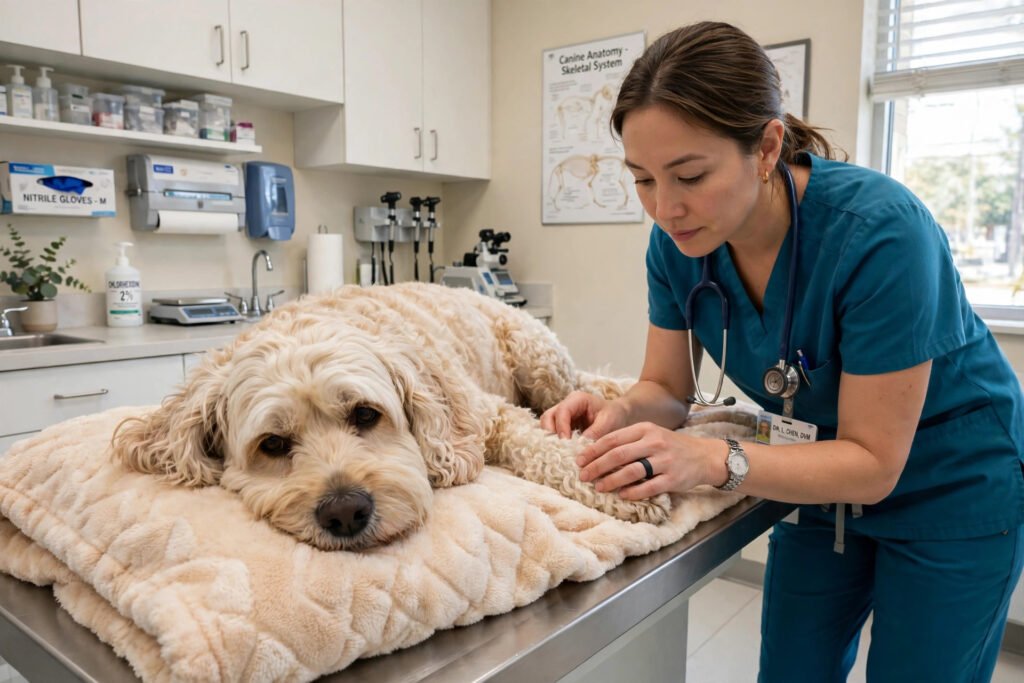
Cockapoo Addison’s disease is rare and easy to miss: vomiting, lethargy and weight loss that come and go. Signs, the ACTH test, treatment and crisis warnings.
Quick answer: Addison’s disease (hypoadrenocorticism) means the adrenal glands don’t make enough cortisol and usually aldosterone. Cockapoos inherit the risk from the Poodle side. The signs — vomiting, lethargy, poor appetite and weight loss — come and go, which is why vets call it “the great pretender.” The ACTH stimulation test confirms it, and lifelong medication gives most dogs a normal life.
Addison’s disease is the diagnosis most Cockapoo owners have never heard of — until their dog has been sick on and off for months and nobody can say why. A Cockapoo vomits on Tuesday, seems fine by Friday, skips dinner the next week, then bounces back again. The vet runs bloodwork, finds nothing definite, treats it as a stomach bug, and the cycle repeats. Months later the dog collapses, and only then does someone run the test that should have been run at the start.
That pattern is the disease itself. Addison’s disease in dogs is famous among vets as “the great pretender” because its signs are vague, they wax and wane, and they imitate a dozen more common problems. It is rare — Cornell University’s College of Veterinary Medicine puts the prevalence at roughly 0.06 to 0.28% of all dogs — but Cockapoos carry a real inherited risk from the Poodle side of the family, and Standard Poodles are one of the most over-represented breeds in the veterinary literature. This guide covers what the disease is, the signs owners miss, the bloodwork clues that should make a vet suspicious, the ACTH stimulation test that confirms it, what an Addisonian crisis looks like, and what daily life on treatment actually involves.
What Addison’s Disease Actually Is
Addison’s disease — hypoadrenocorticism — happens when the adrenal glands, two small glands that sit on top of the kidneys, stop producing enough of the steroid hormones the body needs. The two that matter are cortisol, a glucocorticoid that helps the body respond to stress, control blood sugar and digest food, and aldosterone, a mineralocorticoid that controls the balance of sodium and potassium and keeps blood pressure up.
 CockapooDaily
In most dogs the cause is the body’s own immune system gradually destroying the adrenal cortex, the outer layer of the adrenal glands where these hormones are made. VCA Animal Hospitals describes the most common cause as suspected immune-mediated destruction of the adrenal tissue. Less commonly the problem is in the pituitary gland in the brain, which stops sending the ACTH signal that tells the adrenals to work — that is secondary Addison’s, and it is rare.
The distinction that matters for owners is between the two forms of the disease:
| Form | What is missing | How common |
|---|---|---|
| Typical Addison’s | Cortisol AND aldosterone | Most cases |
| Atypical Addison’s | Cortisol only; sodium and potassium stay normal | Roughly 1 in 5 cases in recent studies |
Atypical cases are the hardest to spot, because the classic electrolyte clue — low sodium and high potassium — is absent. A dog can have atypical Addison’s with completely normal electrolytes, which is one more reason the disease gets missed.
Without cortisol, a dog cannot mount a normal stress response. A stressful event — boarding, a move, a thunderstorm, a vet visit, a new pet in the house — that a healthy dog handles easily can tip an Addisonian dog into a flare-up or a crisis. Without aldosterone, the body loses sodium and holds on to potassium, which can dangerously slow the heart. That is why the disease is serious, and also why, once diagnosed, it is so manageable: treatment simply replaces the missing hormones.
Why Cockapoos Are at Risk
Any breed can develop Addison’s disease, and mixed-breed dogs are actually diagnosed most frequently in absolute numbers. But certain breeds are significantly overrepresented, and the Standard Poodle is near the top of every list. According to Cornell University’s College of Veterinary Medicine, predisposed breeds include Standard Poodles, West Highland White Terriers, Bearded Collies, Great Danes, Portuguese Water Dogs, Labrador Retrievers, Rottweilers and Wheaten Terriers. The Cockapoo inherits that risk directly from its Poodle parent.
The numbers behind the risk are striking. Cornell notes that while the disease affects roughly 0.06 to 0.28% of dogs overall, it can be as prevalent as 10% in some breeds. One study of 1,722 Standard Poodles, cited by the Universities Federation for Animal Welfare, found 8.6% affected, with the disease estimated to be largely inherited. No genetic test exists yet for Addison’s in dogs, so a breeder cannot screen for it the way they can for progressive retinal atrophy — what matters is whether the breeder knows of the disease in the family line, which is one of the questions to ask a breeder before you buy.
Who gets it follows a clear pattern, confirmed across veterinary sources including VCA Animal Hospitals and the Merck Veterinary Manual:
- Age: young to middle-aged dogs, with a median age of about 4 years at diagnosis. Puppies are rarely affected, and cases in seniors are uncommon.
- Sex: roughly 60 to 70% of affected dogs are female, and most are under 7 years old at diagnosis.
- Size: the Poodle side matters more than the Cocker side — Standard Poodles carry the highest risk, and the risk passes to Poodle crosses.
A young adult female Cockapoo with vague, recurring stomach problems is exactly the dog in the highest-risk group, and exactly the dog whose symptoms get written off as a sensitive stomach.
The Signs Owners Miss
The single most important thing to understand about Addison’s disease is the pattern, not any one symptom. The signs come and go. A dog is sick for two days, fine for three weeks, sick again after a stressful weekend, then fine again. Owners describe it as their dog being “a bit off” — and because the dog keeps bouncing back, nobody pushes for an answer. Veterinary sources call this waxing and waning, and it is the hallmark of the disease.
The early signs
Early Addison’s usually starts with vague symptoms that flare after a stressful event — boarding, a move, a new pet, storms, a vet visit. Typical early signs include:
- Lethargy — more tired than usual, less interest in play or walks, sleeping more
- Reduced appetite — picking at food, skipping meals, then eating normally again
- Weight loss — gradual, sometimes noticed only when you feel the ribs more easily
- Vomiting and/or diarrhea — intermittent, sometimes with blood in severe cases
- Increased thirst and urination — including accidents in the house from a previously house-trained dog
- Shaking or trembling — without any obvious cause, sometimes after exercise
- Weakness — especially during or after exercise, or a general “flatness”
No single sign points to Addison’s. Vomiting, lethargy and a poor appetite could be a hundred things, and in a Cockapoo they usually are something simpler — which is precisely why this disease hides. The clue is the pattern: the same vague illness returning again and again, each time a little worse, with good days in between.
The pattern to remember
**The pattern that should make you suspicious:** your Cockapoo is sick, gets better on its own or with basic stomach treatment, then gets sick again a few weeks later — and the episodes cluster around stressful events like boarding, travel, fireworks or a house move. One stomach bug is normal. The same stomach bug three times in three months, in a young adult female Cockapoo, is a reason to ask your vet about Addison’s by name.
What to log before the vet visit
If you suspect a pattern, a simple log turns a vague worry into something a vet can act on. For two to four weeks, note the date, what happened (vomited, skipped a meal, seemed lethargic), and what came just before it (boarding, a storm, a long walk, a vet visit). Bring the log to the appointment. Vets diagnose Addison’s from patterns as much as from bloodwork, and a written record of waxing-and-waning illness after stress is far more persuasive than “she’s been a bit off lately.” Note also any vomiting that keeps coming back despite treatment, because recurrent vomiting with no clear cause is one of the most common presentations.
What It Looks Like in Real Cockapoos
Because the disease is rare in Cockapoos specifically, there are no large owner surveys to quote — but real Cockapoo owners have shared their dogs’ stories publicly, and the pattern in those stories matches the veterinary literature exactly.
One owner of a brown, curly-haired Cockapoo named Remy shared a month-by-month recovery story on Instagram after his Addison’s diagnosis: it took about a week for his appetite to come back, then he became “even more of a glutton,” with a bit more energy than before — likely from the steroid medication — and needed more playtime and training games before he would settle in the evening. A month on, he was back to his affectionate, cheeky self. It is a hopeful story, and a typical one: dogs that are diagnosed and started on treatment usually return to their normal personality within weeks.
A very different story comes from the owner of a black Cockapoo named Lucy Louise, who was diagnosed with Addison’s four years ago and receives regular hormone injections at home. On a recent Sunday morning Lucy suddenly went limp, cried, stared with wide eyes and could not walk — a suspected adrenal crisis — and her owner contacted the vet, discussed the possibility of a crisis, and started prednisone while monitoring her closely. Lucy’s story is the other side of the same disease: even well-managed dogs can crash, and the owner’s ability to recognize a crisis and act fast is what saves them.
Both stories carry the same lesson. Remy’s shows that diagnosis is the turning point — the dog that was fading comes back. Lucy’s shows that the work does not end at diagnosis — owners of Addisonian dogs need to know what a crisis looks like, because they may see one.
Why Vets Miss It Too
It is worth saying plainly: Addison’s disease is missed by vets as well as owners, and that is not a criticism of any individual vet. The disease is genuinely hard to spot. The 2018 ACVIM consensus on hypoadrenocorticism describes it as relatively rare but underdiagnosed, precisely because the signs are so easy to attribute to gastroenteritis. About 30% of dogs with Addison’s disease are diagnosed only when they arrive at the clinic in an Addisonian crisis — the disease is discovered at its worst moment, not its earliest.
The main reason is mimicry. Addison’s imitates several common conditions, and vets quite reasonably test for the common ones first:
- Gastroenteritis or a sensitive stomach — the most common misdiagnosis, because vomiting and diarrhea are the presenting signs
- Kidney disease — because bloodwork can show elevated kidney values (azotemia) and increased thirst and urination
- Inflammatory bowel disease (IBD) — because of chronic intermittent vomiting and diarrhea with weight loss
- Pancreatitis — because of vomiting, diarrhea and abdominal pain; if your vet is working through pancreatitis as a possibility, Addison’s belongs on the same differential list
Bloodwork can point the way, but only if the vet is looking for it. The classic pattern is low sodium and high potassium, and a sodium-to-potassium ratio below 27 is highly suspicious — normal dogs sit at 30 or higher. Other clues include anemia, low blood sugar, elevated kidney enzymes and low cholesterol. But about a fifth of cases are atypical, with normal electrolytes, and even in typical cases the electrolyte changes can be mild early on. The bloodwork pattern raises suspicion; it does not make the diagnosis. Only one test does.
How the Diagnosis Is Made
Diagnosis happens in two steps, and understanding them helps you advocate for your dog.
Step 1: the screening test — resting cortisol. A single blood sample measures the dog’s resting cortisol level. If it comes back above 2 micrograms per deciliter, Addison’s is effectively ruled out in a non-critical dog, and the vet moves on to other causes. If it comes back below 2, the vet proceeds to the confirmatory test. The resting cortisol is inexpensive and widely available, which makes it a useful first screen — but it cannot confirm the disease on its own.
Step 2: the confirmatory test — the ACTH stimulation test. This is the gold standard, and the only definitive test for Addison’s disease. The vet draws a baseline cortisol sample, injects synthetic ACTH (the hormone that tells the adrenal glands to produce cortisol), and draws a second sample 60 minutes later. A normal dog mounts a robust cortisol response. An Addisonian dog stays flat — usually under 2 micrograms per deciliter at both time points. That failure to respond is diagnostic.
Two practical points matter here. First, the test costs roughly $200 to $400, and the full diagnostic workup — including the bloodwork, imaging and rechecks that usually precede it — can run to about $1,500 in total. Second, steroids interfere with the test: if a dog has already been given corticosteroids other than dexamethasone, the test is not valid for at least a couple of days, so the vet needs to know about any steroid treatment before testing.
If your vet has not suggested Addison’s and your Cockapoo’s pattern fits, it is reasonable to ask directly: “Could we run a resting cortisol to screen for Addison’s?” Vets expect owners to ask about specific conditions, and a cheap screening test is an easy ask. The AAHA 2023 guidelines give stepwise diagnostic and monitoring algorithms for the disease, so a vet who follows them will recognize the request.
The Addisonian Crisis: The Emergency Every Owner Must Recognize
An Addisonian crisis is the moment the disease stops being a slow, vague illness and becomes a life-threatening emergency. It happens when the adrenal glands can no longer meet the body’s needs at all — usually under stress, illness or dehydration — and it kills within hours if untreated. Around 30% of dogs with Addison’s are diagnosed for the first time in the middle of a crisis, which is why every owner of a Cockapoo with unexplained recurring illness should know what one looks like.
A crisis typically involves about 90% of the adrenal cortex not functioning. The signs come on fast:
- Collapse or severe weakness — the dog cannot stand or walk
- Severe vomiting and diarrhea, sometimes bloody
- Very slow heart rate and weak pulse
- Low blood pressure — pale gums, cold extremities
- Dehydration and low body temperature
- Shaking, trembling or seizures — note that a collapse with shaking can look like a seizure, but the cause and the treatment are different, so describing exactly what you saw matters
If you see these signs, this is an emergency, not a wait-and-see situation. Get to the nearest emergency vet immediately and tell them your dog may be having an Addisonian crisis — or that Addison’s is suspected, if you know that. In the emergency room, treatment is aggressive IV fluid therapy, usually saline at a high rate, IV dexamethasone (chosen because it does not interfere with the ACTH stimulation test if blood is drawn early), and correction of the dangerously high potassium with calcium gluconate, dextrose and insulin if the heart rhythm is unstable. Dogs that reach the vet in time usually respond within 24 to 48 hours, and the crisis itself is very treatable — the danger is in not getting there.
After a crisis, the dog goes home on the same lifelong medication as any other Addisonian dog. A crisis does not mean the disease is worse or the prognosis is poorer; it means the disease was found late. What it should mean for the owner is a new routine: a stress-dose plan from the vet, an emergency supply of prednisone at home, and a note in the dog’s records that flags Addison’s disease at every visit.
Treatment: Daily Medication for Life
Addison’s disease cannot be cured, but it can be treated — and treated dogs usually live a normal life. Treatment replaces the missing hormones, and it is needed for the rest of the dog’s life. There are two parts, matching the two missing hormones:
Mineralocorticoid replacement (aldosterone). Most dogs receive DOCP — desoxycorticosterone pivalate, sold as Percorten-V or Zycortal — as an injection every 25 to 30 days, usually given by the vet. The alternative is fludrocortisone (Florinef), a tablet given twice a day, which provides both mineralocorticoid and glucocorticoid replacement in oral form. Which one your vet chooses depends on your dog’s response, your ability to give tablets reliably, and cost.
Glucocorticoid replacement (cortisol). Almost all dogs also need a low daily dose of prednisone, tapered to the lowest effective dose once the dog is stable. Dogs with atypical Addison’s — cortisol deficiency only — usually need just the prednisone, without the mineralocorticoid.
Three rules govern daily life on treatment:
- Never stop suddenly. Missing doses can trigger a crisis. If you run low on medication, call the vet before you run out, not after.
- Stress dosing is part of the plan. During illness, surgery, boarding or any major stress, the prednisone dose typically goes up to 2 to 5 times the maintenance dose, starting the day before the stressful event if possible. Your vet should give you a written stress-dose plan — ask for one if you don’t have it.
- Doses change over time. The DOCP dose is usually adjusted downward from the label dose once the dog is stable — only about 18% of dogs need the full label dose — and the fludrocortisone dose often increases over the first one to two years of therapy. That is normal, and it is why regular electrolyte rechecks are part of the routine.
Side effects are usually mild at the low doses used for Addison’s, but worth knowing: increased thirst and urination, increased appetite and panting can all appear if the prednisone dose is a little high, and your vet will adjust it. The goal is the lowest dose that keeps your dog well — not the highest dose that keeps the numbers perfect.
Living With Addison’s: Monitoring, Costs and Prognosis
A diagnosis of Addison’s disease changes the routine, not the dog. Most treated dogs return to their normal personality, appetite and energy within weeks, and the prognosis is excellent as long as the treatment protocol is followed and regular checkups happen. The disease becomes a manageable condition rather than a catastrophe — but it does demand consistency from the owner.
Monitoring. Expect electrolyte blood tests (sodium and potassium) regularly at first — weekly while the fludrocortisone dose is being adjusted, then every few months once stable — plus a recheck after any dose change, usually about 14 days later. Your vet will also want to see the dog after any illness or stressful event. Keep the medication schedule visible in the house, and keep a small card in your wallet or phone with the diagnosis, the medications and the stress-dose plan, so any emergency vet can act immediately.
Costs. This is a financially demanding disease, and owners should go in with open eyes. The initial diagnostic workup runs to about $1,500. Ongoing maintenance typically costs $50 to $200 a month depending on the medication, the dog’s size and the response to treatment — a small Cockapoo on fludrocortisone tablets is usually at the lower end, while a dog on monthly DOCP injections plus regular bloodwork sits higher. Over a lifetime, the total runs into thousands of dollars a year when monitoring and lab work are included. Pet insurance will not help if the diagnosis predates the policy, which is one more reason the disease is worth knowing about before you buy — and worth discussing when you are choosing cover.
Prognosis. With appropriate treatment, most dogs with Addison’s disease enjoy a substantially normal lifespan and quality of life. One study found a median survival of 4.7 years past diagnosis — a figure that reflects the age at which many dogs are diagnosed as much as the disease itself — and veterinary sources consistently describe the long-term outlook as excellent once the dog is stabilized. The disease does not inherently shorten lifespan or prevent a normal quality of life. What shortens it is a missed diagnosis, a missed dose, or a crisis that arrives too late. All three are preventable, and the owner is the one who prevents them.
Day-to-day life. An Addisonian Cockapoo can walk, play, train and travel like any other dog, with two adjustments: plan around stress, and never let the medication run out. Boarding, long car journeys, fireworks and house moves all deserve a stress dose the day before. A change of vet, a house sitter or a family member looking after the dog all need to know the diagnosis and where the medication is. None of this is difficult — it is just a routine, and routines are what Cockapoo owners are good at.
Can You Prevent It?
There is no way to prevent Addison’s disease, and no genetic test for it yet — the genes responsible have not been identified, according to the Universities Federation for Animal Welfare. What you can do is stack the odds before you buy, and stay alert afterward.
If you are choosing a puppy, ask the breeder directly whether Addison’s disease has appeared in their lines, and whether any related dogs have had unexplained recurring vomiting or lethargy. A good breeder knows their lines and will answer honestly; a breeder who has never heard of the disease in Poodles is a breeder who has not done their homework. Our questions to ask a breeder covers the health-testing questions that matter most, and Addison’s belongs on that list alongside PRA and hip scoring.
If you already own a Cockapoo, prevention means early recognition. Know the pattern — vague illness that comes and goes, worse after stress — and know the test — a resting cortisol screen, then an ACTH stimulation test. The earlier the diagnosis, the less the disease costs, in money and in risk. A dog diagnosed before its first crisis has a straightforward path to a normal life. A dog diagnosed during a crisis still usually recovers, but the journey is harder and more expensive.
Frequently Asked Questions
Can a Cockapoo live a normal life with Addison’s disease?
Yes, in most cases. With lifelong hormone replacement — usually a monthly DOCP injection or twice-daily fludrocortisone tablets, plus a low daily dose of prednisone — most dogs return to their normal personality, appetite and energy within weeks, and veterinary sources describe the long-term prognosis as excellent. The disease does not inherently shorten lifespan. What matters is consistency: never missing doses, keeping up with electrolyte rechecks, and using a stress dose during illness or major stress.
Is Addison’s disease in Cockapoos hereditary?
It is believed to be largely inherited, but the genes responsible have not been identified yet, so there is no genetic test for it. Standard Poodles are one of the most over-represented breeds — one study of 1,722 Standard Poodles found 8.6% affected — and Cockapoos inherit that risk from the Poodle side. If you are buying a puppy, ask the breeder whether Addison’s has appeared in their lines.
How much does Addison’s treatment cost each month?
Ongoing maintenance typically runs $50 to $200 a month in the US, depending on the medication, the dog’s size and the response to treatment. The initial diagnosis costs roughly $1,500 including bloodwork, the ACTH stimulation test and rechecks. Small dogs on fludrocortisone tablets tend to cost less than dogs on monthly DOCP injections plus regular electrolyte monitoring. Costs accumulate over a lifetime, so it is worth budgeting for the disease as a permanent monthly expense.
What is the difference between Addison’s and Cushing’s disease?
They are opposites. Addison’s disease is too little cortisol (and usually too little aldosterone) because the adrenal glands underproduce. Cushing’s disease is too much cortisol because the adrenal glands overproduce, usually from a pituitary tumor. Addison’s dogs are lethargic, lose weight and vomit; Cushing’s dogs drink and urinate excessively, pant, gain a pot-bellied appearance and lose hair. Both are diagnosed with hormone tests, but the treatments are completely different.
Can Addison’s disease be cured?
No, there is no cure. The adrenal glands do not recover, so the dog needs hormone replacement for the rest of its life. But “incurable” does not mean “unmanageable” — with daily medication and regular monitoring, most dogs live a normal lifespan with a good quality of life. The treatment replaces exactly what the body is missing, and once the dose is right, most owners say their dog is simply their dog again.
Conclusion
Addison’s disease is rare in Cockapoos, hard to spot, and entirely manageable once found. The risk comes from the Poodle side, the signs are vague and come and go, and the disease is famous among vets as “the great pretender” for exactly that reason. The pattern to remember is a young adult Cockapoo — often female — with recurring vomiting, lethargy and weight loss that flares after stress and keeps coming back. The test to ask for is a resting cortisol screen, followed by the ACTH stimulation test that confirms the diagnosis. And the outcome, once treatment starts, is usually a dog that lives a normal life on daily medication, with a stress-dose plan and an owner who knows what a crisis looks like.
Next steps: if your Cockapoo has had the same vague illness three times in three months, book a vet visit, take your symptom log, and ask about Addison’s by name. If your dog is already diagnosed, make sure you have a written stress-dose plan, an emergency supply of prednisone, and a note in the records that flags the disease at every visit. And if you are still choosing a puppy, ask the breeder about Addison’s in their lines — it is a question a good breeder will respect.


Leave a Reply