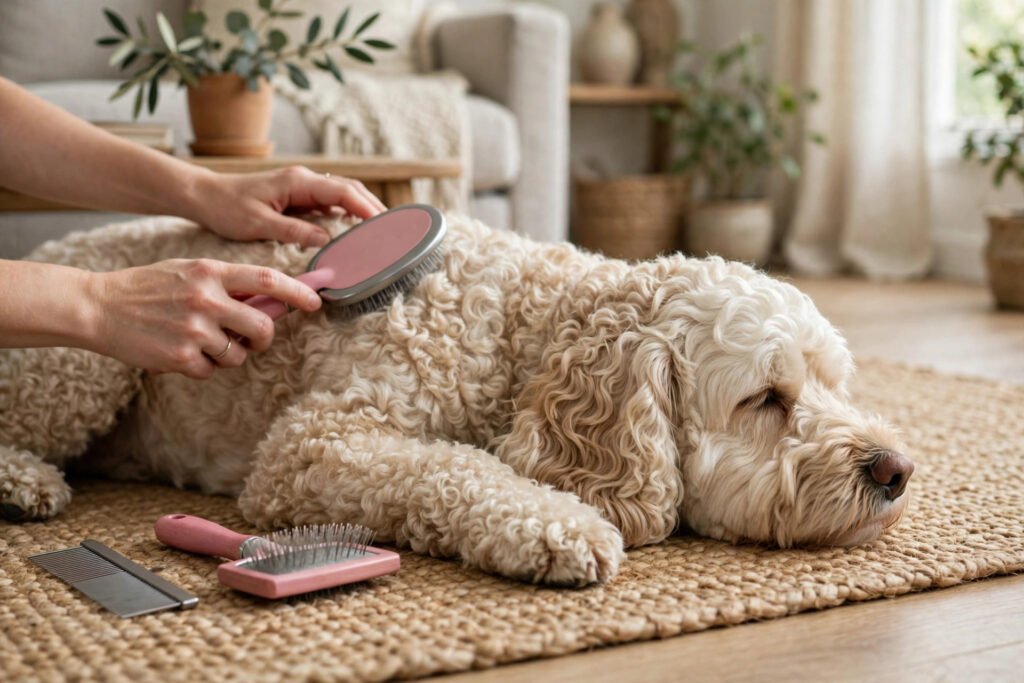
Matted Cockapoo fur hurts, and cutting it out is risky. Use this removal decision-tree to tell a knot from a felted coat — and know when to call a groomer.
Quick answer: A knot can be worked out at home with fingers and a dematting tool, working from the outside in while holding the base at the skin. A tight mat close to the skin belongs to a groomer, and a felted coat needs clipping off. Never use scissors near the skin, and never bathe a matted coat — water tightens mats.
Mats are the one grooming problem almost every Cockapoo owner meets sooner or later, and they are the one most owners handle wrong the first time. The coat looks fine on the surface, you run your fingers through it, and underneath — behind the ears, under the collar, in the armpits — there is a hard little clump that will not budge. Pull at it and your dog yelps. Reach for the scissors and you risk something far worse.
This guide is about removal, not prevention. Other pages will tell you to brush more often; this one tells you what to do once the mat is already there. You will learn how to tell a small knot from a tight mat from a felted coat, exactly what to try at home, when to hand the job to a groomer, and when the vet needs to see the skin underneath.
Knot, Mat, or Felted Coat? Tell Them Apart First
Owners use “knot” and “mat” as if they mean the same thing, and that is where most removal mistakes start. They are three different problems with three different answers.
- A knot is one or two small clumps of tangled hair, usually no bigger than a fingertip. You can still see individual hairs in it, and you can usually pull it apart with your fingers. Knots are a home job.
- A mat is several knots that have joined into a dense, solid clump, often sitting close to the skin. You cannot see through it or pull it apart by hand. It pulls on the skin every time your dog moves. Some mats can be worked out at home with a tool and patience; tight ones cannot.
- A felted coat is what happens when matting spreads across a whole area — or the whole dog. The coat becomes one solid sheet, like felt, tight against the skin. There is no home fix for a felted coat. It has to be clipped off, usually by a groomer, and the dog starts again with a short coat.
The test takes ten seconds: pinch the clump between your fingers and try to pull it gently apart. If hairs separate, it is a knot. If it holds together like a solid lump but you can still get a finger or a comb tooth underneath it, it is a mat. If you cannot get anything between the clump and the skin, it is felted — stop, and call the groomer.
The Removal Decision-Tree
This is the whole guide in one table. Find your situation, follow the action, and do not skip a step.
| What you have | What it feels like | What to do |
|---|---|---|
| Small knot, fingertip-size, away from the skin | Loose clump; hairs still separate | Home: fingers first, then a dematting tool, outside-in |
| Tight mat, coin-size or bigger, but you can get a finger under it | Solid lump; skin underneath is normal | Home with care, or groomer if your dog will not sit still |
| Tight mat flat against the skin, skin pulled up into it | Hard, no gap between mat and skin | Groomer only — never scissors, never pull |
| Several mats across one area (belly, ears, legs) | Coat feels lumpy over a wide patch | Groomer — book within a few days, before it felts |
| Felted coat, whole area or whole dog | Solid sheet, skin hidden | Groomer or vet clinic — clipping off is the kindest option |
| Any mat with red, sore, smelly or broken skin underneath | Pain, heat, smell, discharge, or your dog flinches hard | Vet first — the skin needs treatment before the coat |
Two rules sit above the whole table. First, never use scissors near the skin: mats pull the skin up into the tangle, so what looks like a safe cut can slice skin you cannot see. Second, never bathe a matted coat first — water makes mats tighter and harder to remove, and a wet mat dries into a harder one.
How to Remove a Small Knot at Home
Set aside 15 minutes, a quiet room, and a calm dog. Rushing this is how dogs learn to hate grooming, and a dog that has been hurt once will not sit still the next time.
- Hold the base. Pinch the hair between the knot and the skin with your fingers. This is the single most important step: it stops every tug from pulling on the skin.
- Work the edges with your fingers. Starting at the outside edge of the knot, tease a few hairs free at a time. Work from the outside in, never from the root outward — pulling from the root only tightens the tangle. A light spray of detangling spray or leave-in conditioner helps the hairs slide apart.
- Move to a dematting tool. Once the knot has loosened, use a dematting tool or mat splitter on the remaining core, still holding the base. These tools have small blades that cut through tangled hair without pulling. Use short, gentle strokes away from the body.
- Finish with a comb. Run a steel greyhound comb through the spot. If it slides through to the skin, the knot is gone. If it catches, there is still tangle left — go back to step 2 rather than forcing the comb through.
- Reward and stop. Give a treat, and stop while you are ahead. If a knot has not loosened after 10 minutes of patient work, it is not a small knot — it is a mat, and it belongs in the next section.
Work in short sessions if your dog is young or wriggly: two knots a day beats a 40-minute wrestling match that ends with a bitten hand and a dog that hides at the sight of a brush.
Tight Mats: What a Groomer Does Differently
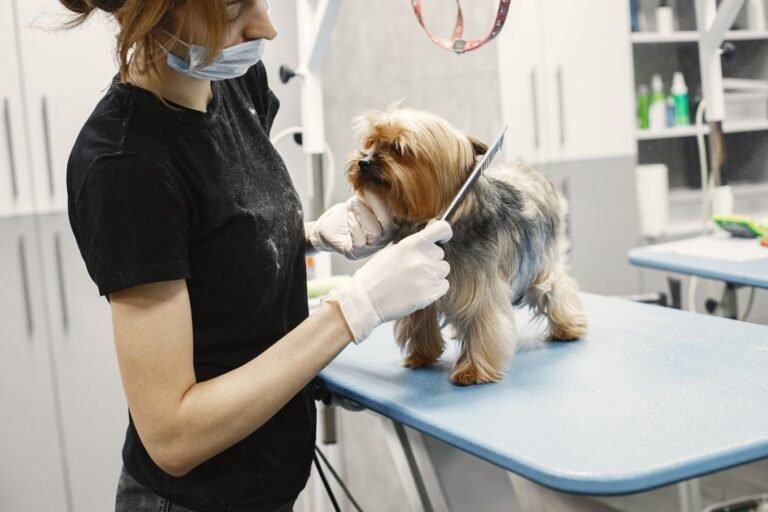
A groomer has three advantages you do not: a second pair of hands, professional clippers, and a dog that is (usually) calmer on a grooming table than on your lap. For a tight mat, the groomer will either split it carefully with a dematting tool, or — more often — clip under it with a close blade and lift it away without touching the skin.
Expect the groomer to shave a patch or an area rather than save the hair. That is the right call: saving a tight mat means 20 minutes of pulling on sore skin, and the coat grows back in weeks. If the matting is widespread, the groomer may recommend a full short clip — sometimes called a shave-down — and a fresh start. It feels drastic, but dogs visibly relax once the pulling stops, and the hair grows back.
Cost-wise, dematting is usually charged as extra time on top of a normal groom, and a badly matted dog can cost significantly more than a regular appointment. Our guide to how much it costs to groom a Cockapoo covers typical US prices and the annual math, so you can see what a dematting session adds. Book as soon as you find a tight mat — every week you wait, it gets tighter, and the bill (and the discomfort) grows with it.
One thing to ask when you book: tell the groomer honestly how bad the matting is. A groomer who expects a routine groom and finds a felted dog may not have the time slot for it, and a rushed dematting job is a painful one.
When the Vet Needs to Be Involved
Most matting is a grooming problem. Sometimes it is a skin problem wearing a grooming disguise, and those cases need a vet before anyone touches the coat.
Call your vet if you find any of these under or around a mat:
- Red, raw, or broken skin, or a sore that smells bad
- Swelling, heat, or discharge under the mat
- Your dog flinches, snaps, or cries when the area is touched
- A mat that has been there for weeks and the skin underneath looks dark, crusty, or wet
- Matting in a dog that has suddenly stopped grooming itself, gone off food, or seems unwell
Mats trap moisture against the skin, and trapped moisture breeds bacterial and yeast infections — sometimes called hot spots — that will not heal until the mat is gone and the skin is treated. A vet may need to clip the area under sedation if the dog is in pain, treat the infection, and check that nothing more serious is going on. This is also the moment to be honest with yourself: if matting keeps coming back in the same dog, ask the vet whether an underlying skin or coat problem is making it worse, rather than fighting the same mats every month.
Coat Type Changes Everything
Not all Cockapoo coats mat the same way, because not all Cockapoo coats are the same coat. The curlier the coat, the faster it mats — and the less forgiving it is once it does.
| Coat type | How it mats | What removal looks like |
|---|---|---|
| Curly (Poodle-like) | Fastest to mat; tight curls lock together, especially behind the ears and under the collar | Knots become mats quickly — check daily, act fast, expect groomer help more often |
| Wavy (the most common) | Mats at friction points: collar, harness, armpits, behind the ears | Most home-removable knots; mats need a dematting tool and patience |
| Flat or straight (Spaniel-like) | Slowest to mat; sheds more freely, so tangles often work themselves out | Knots are usually small and finger-removable; full matting is rare |
If you are not sure which coat your dog has, our guide to Cockapoo flat coat vs curly, wavy, and straight coats explains each type and how to tell them apart. The practical point is simple: a curly-coated Cockapoo that goes a week without brushing is a different situation from a flat-coated one that goes a week without brushing. Set your brushing routine — and your expectations — by the coat in front of you, not by a generic schedule. And if your dog barely seems to mat at all, check whether it is actually shedding more than you think: our honest answer to do Cockapoos shed explains why some coats drop hair freely while others hold it in and tangle.
The Puppy Coat Change at 8–12 Months
Here is the mat trap that catches first-time owners: the puppy coat and the adult coat are not the same coat, and the changeover is peak matting season.
Between about 8 and 12 months, most Cockapoos shed their soft puppy coat and grow in their adult coat. The two coats tangle together as the change happens, and the adult coat coming through is often curlier and denser than the puppy coat it replaces. A puppy that never matted at 6 months can be a matted mess at 10 months, with no change in how often you brush.
During the changeover, brush every day, not every few days, and pay special attention to the friction points — behind the ears, under the collar and harness, the armpits, and the belly. This is also the age when many owners book the first proper adult cut. If your puppy has not had a full cut yet, see our guide on when a Cockapoo should have its first haircut for the timing, and our 9 Cockapoo haircut styles will help you pick a shorter, lower-maintenance style to get through the changeover with fewer mats.
Never Bathe a Matted Coat First
This deserves its own section because it is the most common mistake in the whole topic, and it makes everything worse.
Water tightens mats. Wet matted hair contracts and locks together, and when it dries it sets harder than before. A bath that was meant to loosen a mat will turn a removable mat into a groomer-only mat — and if the coat is washed and then left to dry naturally, the mat can felt.
The order is always: brush first, then bathe. Work out every knot and mat you can find, run a comb through the whole coat to confirm it slides to the skin everywhere, and only then run the water. If you find a mat mid-bath, stop, towel-dry the area, and deal with the mat dry before you carry on. Our guide to how often to bathe a Cockapoo covers frequency and the full bath routine, including the drying step that stops new tangles forming while the coat is still damp.
Keeping Mats Away After Removal
Removal is the rescue; the routine is what stops the next one. The short version:
- Brush to the skin, not over the top. A slicker brush glides over a mat and leaves it untouched underneath. After brushing, run a steel comb through each section — if the comb stops, there is a tangle you missed.
- Hit the friction points every time. Behind the ears, under the collar and harness, armpits, belly, and the backs of the legs. Mats start in these spots far more than on the back or sides.
- Keep the coat at a length you can maintain. A long, beautiful coat that you brush twice a week will mat; a shorter cut you brush every other day will not. Be honest about the time you actually have, and choose the length to match it.
- Do not skip grooming appointments. A professional groom every 6 to 8 weeks catches the mats you miss and resets the coat before small tangles become big ones.
Frequently Asked Questions
Can I cut a mat out of my Cockapoo’s fur with scissors?
You should not cut a mat out with scissors, and you should never cut close to the skin. Mats pull the skin up into the tangle, so skin you cannot see sits inside the mat, and a scissor cut can slice it badly. If a mat will not come apart with fingers and a dematting tool, take your dog to a groomer — they will clip under the mat safely with clippers, which cut far less riskily than scissors near skin.
How do I remove a mat behind my Cockapoo’s ears?
Hold the base of the mat firmly against the skin with one hand, then tease the outer edges apart with your fingers, working from the outside in. Behind the ears the skin is thin and the hair is fine, so go slowly and use a little detangling spray. If the mat is tight against the skin or your dog flinches, stop and book a groomer — ear mats are one of the most painful spots to work on.
Will matted fur grow back after shaving?
Yes. Hair grows back, usually within a few weeks for a short clip, and the coat returns to its normal length within a couple of months. A shave-down feels drastic, but it is the kindest option for a felted coat, and most dogs are visibly more comfortable the same day. The coat that grows back is the same coat type your dog had before.
Why does my Cockapoo keep getting mats in the same spot?
Mats recur in friction spots — under the collar or harness, behind the ears, in the armpits — because those areas rub constantly. Try removing the collar indoors, switching to a harness that rubs less, and brushing those exact spots every day rather than brushing the whole dog less often. If the same spot mats even with daily brushing, ask your groomer whether a shorter cut there would help.
Is matted fur painful for a Cockapoo?
Yes. A mat pulls on the skin every time the dog moves, and tight mats can cut off airflow to the skin underneath, causing soreness, itching, and infection. Dogs with bad matting often become grumpy, stop enjoying being touched, or flinch when brushed. That is pain, not stubbornness — and it is why removing mats promptly matters more than removing them perfectly.
Conclusion
Matted fur is not a failure, and it is not a crisis — it is a decision. Small knot: fingers and a dematting tool, outside in, base held at the skin. Tight mat: groomer, soon, before it felts. Felted coat: clip it off and start fresh. Sore skin underneath: vet first. And whatever you do, do not reach for the scissors, and do not run the bath first.
Once the mats are out, the fix is a routine you can actually keep: brush to the skin, hit the friction points, and keep the coat at a length that matches the time you have. Your Cockapoo will not remember the mat. It will remember whether brushing hurt — so make the next session a gentle one.

Leave a Reply