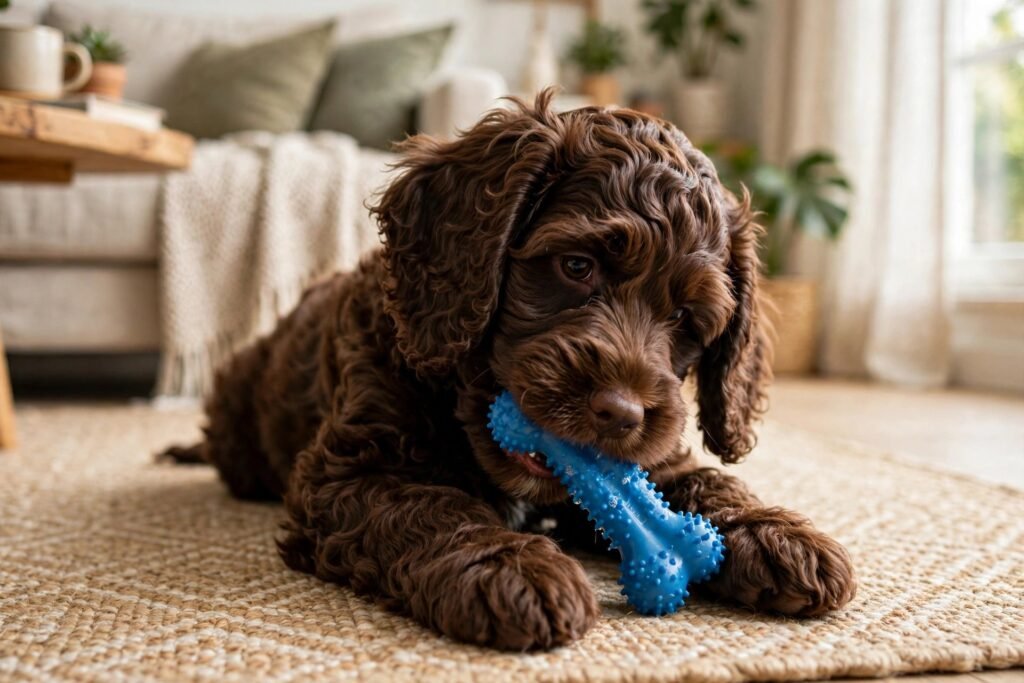
Cockapoo chewing shoes, furniture, and everything in reach? Find the cause — teething, boredom, anxiety, or hunger — and fix it with a chew-legal setup.
Quick answer: Cockapoos chew for a reason: teething, boredom, anxiety, hunger, attention-seeking, or simply because chewing feels good. Find the cause first, then fix it with a chew-legal setup: safe chews in rotation, enough exercise and mental work, and a calm swap every time your dog picks up something forbidden. Most chewing improves noticeably within 2 to 3 weeks of consistent training.
If your Cockapoo has eaten a shoe, a remote control, a corner of the sofa, or your favorite book, you are dealing with one of the most common Cockapoo complaints there is. It is also one of the most fixable, because chewing almost always has a cause, and causes have fixes. The mistake most owners make is trying to stop the chewing without asking why it is happening. A teething puppy, a bored adult, and an anxious dog left alone all chew, and they need three different answers.
Most pages on this topic list the same handful of reasons and stop at “give them a chew toy.” This guide goes further: it separates chewing from biting, helps you diagnose the exact cause, builds a chew-legal setup your dog will actually use, teaches the swap protocol that replaces scolding, covers the dangerous end of chewing that competitors rush past, and walks through chewing by age, from teething puppy to settled adult.
First: Chewing Is Not Biting
This distinction matters, because the two problems have different fixes and different articles on this site.
Chewing means destroying objects. Shoes, furniture legs, remote controls, socks, cushions, wooden table corners, and anything left at dog height. The target is a thing, and the dog is usually calm, focused, and enjoying itself.
Biting means mouthing people. Nipping hands during play, mouthing sleeves, jumping up and grabbing clothes, and puppy nipping that hurts even though the puppy means it as play. The target is a person, and the fix is about bite inhibition, calm greetings, and play rules.
If your problem is hands, sleeves, and nipping during play, read our guide to how to stop Cockapoo puppy biting instead, and come back here for the object-chewing part. If your problem is destroyed belongings, you are in the right place. Some dogs do both, and that is fine: fix the biting with the biting guide and the chewing with this one, in that order if you have to choose, because biting involves people and safety.
Why Does My Cockapoo Chew Everything? Find the Cause First
Watch when the chewing happens, what gets chewed, and what was happening just before. Then match the pattern to this table. Most dogs have one main cause and one secondary cause. Fix the main one first.
| Cause | Clues | First fix |
|---|---|---|
| Teething | Puppy under about 7 months; chewing anything hard or soft; drooling, mild fussiness, visible tooth loss | Frozen chews, soft rubber toys, and safe items to gnaw (see the age section) |
| Boredom | Chewing when nothing is happening; dog has energy to burn; destruction is casual, not frantic | More exercise, play, and mental work before alone time |
| Anxiety, including separation anxiety | Chewing mainly when you leave; damage near doors and windows; pacing, whining, drooling, or toileting with it | Calm-alone training in small steps; vet or behaviorist if the pattern is severe |
| Attention-seeking | Dog chews your things while looking at you, or starts when you sit down to work | Reward calm behavior; never reward chewing with a chase or a big reaction |
| Hunger | Chewing food-related items; dog on a new diet or recently fed less; scavenging and counter-surfing with it | Check portions with your vet; add a food puzzle so meals take longer |
| Confinement frustration | Chewing at gates, crates, leashes, or door frames; dog trying to get free or get somewhere | More freedom in safe stages, plus exercise before confinement |
| Lack of training | Dog was never taught what is legal to chew; everything at mouth height is fair game | The chew-legal setup and the swap protocol below |
| Medical causes (rarest) | Sudden chewing in an adult dog; chewing paired with vomiting, appetite changes, mouth pain, or behavior changes | Vet check first, training second |
Two cautions on this table. First, “boredom” is the most overused diagnosis in dog advice. Before you settle on it, check the anxiety row honestly. A dog that destroys things only when left alone is usually not bored. It is stressed. Second, medical causes are rare, but they are the reason sudden chewing in an adult dog deserves a vet visit rather than a new chew toy. Mouth pain, gut discomfort, and some hormonal conditions can all show up as chewing.
For the exercise side of the boredom fix, including age-by-age amounts, see how much exercise does a Cockapoo need. For the alone-time pattern, see can Cockapoos be left alone, and for the full anxiety protocol, see cockapoo separation anxiety.
Build a Chew-Legal Setup
“Give them a chew toy” fails when the toy is wrong, boring, or the only option. A chew-legal setup gives your dog better choices than your furniture, and it keeps those choices interesting.
Offer variety, not one toy. Dogs chew for different sensations: soft and squashy, firm and rubbery, edible and long-lasting, and things to shred. Offer a small rotation: a rubber chew toy that can be stuffed with food, a rope toy for tugging and gnawing, an edible chew such as a yak chew or a dried tendon (always supervised), and a food puzzle. Rotate the toys every few days. A toy that has been on the floor for a month is furniture now, not a toy.
Size it right. A chew that is too small can be swallowed, and a chew that is too big gets ignored. For a Cockapoo, that usually means small to medium chews matched to the dog’s size: toy Cockapoos need smaller chews than standards. If a chew fits entirely in your dog’s mouth, it is too small. Take it away.
Place chews where chewing happens. Put a legal chew near the sofa leg your dog targets, one by the door where you leave, and one in the crate or pen. Dogs chew what is in front of them. Make the right thing the easy thing.
Use food puzzles for meals. A dog that eats from a bowl in 90 seconds and then looks for something to destroy has a job vacancy. A stuffed rubber toy, a snuffle mat, or a slow feeder turns one meal into 15 minutes of legal chewing and thinking. This single change fixes more boredom chewing than any toy purchase.
Supervise new chews. Every new chew gets a supervised trial first. Watch how your dog chews it: does it gnaw calmly, or does it bite off chunks and swallow them? Destructible chews are only for active supervision. If your dog can destroy a chew in minutes and swallow pieces, that chew is wrong for that dog, however popular it is.
The Swap Protocol: What to Do in the Moment
This is the skill that replaces scolding, chasing, and prying things out of your dog’s mouth. Practice it when the stakes are low, so it works when the stakes are a leather shoe.
Step 1: Stay calm. Do not chase, shout, or lunge. Chasing turns the forbidden object into a game, and a frightened dog swallows faster. Walk over calmly.
Step 2: Offer the trade. Show a high-value treat or a legal chew, and let your dog sniff it. Say “trade” or “drop it” in a normal voice. The moment your dog opens its mouth, take the forbidden item and give the trade immediately. The trade must be worth it. A dry biscuit will not beat a shoe.
Step 3: Praise the drop, not the chew. Praise warmly the second your dog lets go. Then redirect to the legal chew and praise again for chewing that. You are teaching two lessons: dropping things pays, and the legal chew is where the good stuff happens.
Step 4: Manage the scene. Put the forbidden item away, out of reach, and leave a legal chew in its place. Training without management is a losing battle. If your dog can reach the shoe rack every day, the shoe rack will keep winning.
What if your dog will not trade? Do not pry the mouth open or wrestle the item away unless it is dangerous and about to be swallowed. For a dangerous item, stay calm, offer the best trade you have, and if the dog still will not drop it, call your vet for advice rather than forcing a confrontation. Then go back to practicing trades with low-value items until the swap is reliable.
What about deterrent sprays? Bitter-tasting sprays can help protect a specific target, such as one furniture leg, while training takes hold. They work for some dogs and not at all for others, and they never fix the cause. Use them as a shield on one or two targets, not as the plan. And never spray a deterrent on something your dog is supposed to chew.
For dogs that also destroy things when confined, the crate setup matters as much as the chew. See how to crate train a Cockapoo puppy for a calm-crate routine that keeps confinement from becoming frustration.
Danger Chews and Swallowed Objects: Read This Section Twice
Most chewing is an annoyance. Some chewing is an emergency. Learn this list before you need it.
Dangerous to chew or swallow. Electrical cords, batteries, medications, coins, socks and underwear, children’s small toys, cooked bones (they splinter), corn cobs, peach pits and other fruit stones, and anything containing xylitol (also labeled birch sugar), including some sugar-free gum and peanut butter brands. Check your peanut butter label: it should contain only peanuts, and possibly salt. Keep medications, batteries, and small objects behind closed doors, not just on high shelves, because Cockapoos climb and counter-surf better than owners expect.
Signs your dog swallowed something dangerous. Gagging or retching without producing anything, vomiting, drooling, pawing at the mouth, lethargy, loss of appetite, straining to toilet, a swollen or painful belly, or a sudden change in behavior after a chewing session. Socks are the classic case: a dog can swallow a sock whole and seem fine for hours. If you saw or suspect a swallowed object, call your vet or an emergency vet clinic right away and describe exactly what it was and when. Do not try to make your dog vomit unless a vet tells you to. Some objects cause more damage coming back up.
Rawhide caution. Rawhide chews are popular and controversial for a reason. Some dogs gnaw them safely for hours. Others soften them into chunks and swallow pieces that can block the gut. If you use rawhide, choose a size larger than your dog’s mouth, supervise every session, and remove the chew once it gets soft or small enough to swallow. Many owners simply skip rawhide and use rubber toys, yak chews, or dried tendons instead. That is a reasonable choice, and it removes one risk entirely.
Chewing by Age
Chewing changes as your dog grows. Match the fix to the stage.
Puppies (under about 7 months): teething. Puppies chew because it hurts not to. Baby teeth fall out and adult teeth come in, usually finishing around 6 to 7 months, and chewing relieves the pressure. Expect heavy chewing, drooling, and a short temper. Offer frozen washcloths (wet, twisted, frozen), frozen rubber toys stuffed with food, and soft chews. Keep shoes, cables, and children’s toys out of reach, because a teething puppy will find them. This stage passes, but the habits built in it do not: a puppy allowed to chew furniture freely becomes an adult that thinks furniture is legal.
Adolescents (about 7 to 18 months): testing. Chewing often surges again in adolescence, even in dogs that seemed past it. Energy is high, training is tested, and the dog is bigger and stronger. Keep the chew-legal setup, keep exercising, and keep practicing trades. Do not assume a relapse means training failed. It usually means the dog outgrew the old setup and needs a harder puzzle and more work.
Adults: cause-driven. Adult chewing almost always has a cause from the table above: boredom, anxiety, attention, or habit. Work the cause, not the age. An adult that has chewed for years can still learn a chew-legal setup, but it takes longer, usually a month or more of consistent management and training, because the habit is practiced.
Seniors: check the mouth. New or increased chewing in an older dog deserves a dental check. Broken teeth, gum disease, and mouth pain can all drive chewing, licking, and dropping food. Our dental guide covers what to look for, but the short version is this: if an older dog suddenly chews differently, see the vet before you buy a new toy.
What Not to Do
Do not punish after the fact. A dog scolded for a shoe chewed an hour ago learns nothing about shoes. It learns that you are sometimes angry when you come home, which can make alone-time anxiety worse, which can cause more chewing. Interrupt in the moment, swap calmly, manage the environment.
Do not use the muzzle as a punishment. A muzzle has real uses, such as short vet visits or safe introductions, fitted properly and introduced with training. It is not a chewing solution. A muzzled dog that wants to chew will chew the moment the muzzle comes off, and a dog left muzzled alone is at risk.
Do not rely on a single deterrent spray. Sprays help on one target for some dogs. They do not fix boredom, anxiety, teething, or habit. A plan that is only a spray bottle is not a plan.
Do not leave a destructive chewer loose and unsupervised with a new chew. New chews need supervised trials. A dog that destroys chews fast can swallow pieces, and a dog left alone with the wrong chew is a vet visit waiting to happen.
When to Call Your Vet or a Behaviorist
Call your vet promptly if your dog swallows or may have swallowed a dangerous object, vomits repeatedly, refuses food, becomes lethargic, strains to toilet, or shows a painful or swollen belly. Call your vet for a checkup if chewing starts suddenly in an adult dog, if it comes with appetite changes, mouth pain, drooling, or behavior changes, or if it is paired with vomiting or diarrhea. Ask for a behaviorist referral if chewing is compulsive (the same object, the same spot, for hours, and the dog cannot be interrupted), if it is tied to severe separation anxiety, or if it has not improved after a month of consistent training and management. A certified behaviorist can separate anxiety, compulsion, and habit in a way a tip list cannot, and your vet can rule out the medical causes first.
Frequently Asked Questions
Will my Cockapoo grow out of chewing?
Teething chewing passes, usually by about 7 months, but chewing as a habit does not pass on its own. A puppy that learns furniture is legal becomes an adult that chews furniture. The good news is that the same setup works at every age: legal chews in rotation, enough exercise and mental work, and a calm swap for forbidden items. Most dogs improve noticeably within 2 to 3 weeks of that routine.
Is rawhide safe for Cockapoos?
It depends on the dog, and that is the honest answer. Calm gnawers often handle rawhide fine. Fast, gulp-prone chewers can swallow softened pieces that may block the gut. If you use rawhide, supervise every session, choose a size larger than your dog’s mouth, and remove it once it softens or shrinks. If you would rather not take the risk, rubber toys, yak chews, and dried tendons are reasonable alternatives.
Why does my Cockapoo only chew when I leave?
That pattern points to anxiety or boredom rather than teething or habit. Chewing near doors and windows, paired with pacing, whining, drooling, or toileting indoors, suggests separation anxiety. Chewing that is casual and scattered suggests boredom and under-stimulation. The fixes differ: anxiety needs calm-alone training in small steps, while boredom needs more exercise, play, and food puzzles before you leave. See can Cockapoos be left alone for the alone-time framework.
Why does my dog chew walls and woodwork?
Wood chewing usually means teething, boredom, or anxiety, and sometimes a mineral or gut issue your vet should rule out if it is new or obsessive. Protect the area with a barrier while you train, offer a legal wood-alternative chew such as a coffee-wood chew under supervision, and check the cause table above. Chewing through drywall or plaster is a vet-visit sign, not just a training problem, because of what the dog may be swallowing.
Do bitter deterrent sprays actually work?
Sometimes, on some dogs, on some targets. They are a shield, not a solution: they can protect one furniture leg while training takes hold, but they do not fix boredom, anxiety, teething, or habit. If a spray does nothing after a few days of correct use, drop it and put the effort into the chew-legal setup and the swap protocol instead.
Conclusion
Your Cockapoo is not chewing everything to spite you. It is teething, bored, anxious, hungry, attention-seeking, untrained, or some mix of those, and it is using the only tool it has: its mouth. Find the cause in the table, build the chew-legal setup, practice the swap until it is boring, and manage the environment so the right choice is also the easy choice. Most chewing improves within 2 to 3 weeks of that routine, and teething chewing passes entirely. Keep the dangerous items locked away, supervise new chews, and call your vet early if the pattern is sudden, compulsive, or paired with illness. Give your dog something legal to chew, and your shoes will finally get to retire in peace.


Leave a Reply