
Comparing doodle mixes? See how Labradoodles, Goldendoodles, Cavapoos, Bernedoodles, Aussiedoodles, Maltipoos, and Sheepadoodles compare with a Cockapoo.
Quick answer: A “doodle” is any dog with one Poodle parent, so every doodle mix shares Poodle smarts and a low-shedding coat — but size, energy, and grooming vary. A Cockapoo (12–24 pounds) is the small end of the family. Labradoodles and Goldendoodles run 50–90 pounds; Cavapoos and Maltipoos stay under 20. Pick by your home, activity level, and grooming time.
You fell for a Cockapoo — and now you are wondering whether another doodle mix might fit even better. Fair question, because doodles are not interchangeable: a 70-pound Bernedoodle and a 12-pound Maltipoo share a Poodle parent and almost nothing else. Here are the seven mixes Cockapoo shoppers compare most, each measured against the Cockapoo you already know.
What Counts as a Doodle Mix?
A doodle is a cross between a Poodle (Standard, Miniature, or Toy) and another breed. The Poodle parent brings intelligence and a coat that sheds less than most dogs; the other parent sets the size, energy, and personality. That is why two doodles can feel like different species.
Two facts before you compare: no doodle is truly hypoallergenic — every doodle still produces dander and saliva proteins, so spend time with the actual dog before you commit. And no doodle is a recognized breed: the American Kennel Club recognizes none of them, including the Cockapoo, so puppies in one litter can vary widely in size, coat, and temperament, especially in first-generation (F1) crosses.
If generations confuse you, our guide to F1 vs F2 Cockapoos explains what F1, F1b, and F2 actually mean for coat and predictability. The same labels apply to every doodle on this list.
The 7 Other Doodle Mixes, Compared to a Cockapoo
1. Labradoodle (Labrador Retriever + Poodle)
The original doodle. Bred in Australia in the late 1980s as a low-shedding guide dog, the Labradoodle is still one of the most popular Poodle mixes in the US.
- Size: 50–70 pounds (Standard); Miniature versions run smaller.
- Coat and shedding: Curly to wavy, medium to long. Low shedding, but F1 Labradoodles shed more than later generations.
- Temperament: Intelligent, friendly, outgoing, and athletic. The Labrador side makes them eager to please and great with kids.
- Grooming: Brush several times a week and book a professional groomer every 6–8 weeks.
- Energy: High. Expect at least an hour of exercise a day, plus training or a job to do.
- Who it suits: Active families who want a bigger, sportier version of the Cockapoo’s friendly nature — and have the yard and the time for it.
Versus a Cockapoo: a Labradoodle is essentially a Cockapoo scaled up two to three times, with more energy and more coat to maintain. If you love the Cockapoo temperament but want a jogging and hiking partner, this is the closest big-dog match. Our full head-to-head: Cockapoo vs Labradoodle.
2. Goldendoodle (Golden Retriever + Poodle)
The most popular doodle in the US. Golden Retrievers bring a famously gentle, people-focused nature to the Poodle’s brains.
- Size: 50–90 pounds (Standard); Miniature Goldendoodles run 15–35 pounds and Mediums 30–45 pounds.
- Coat and shedding: Curly to wavy, medium to long. Low shedding, but again, no guarantees.
- Temperament: Friendly, smart, gentle, and playful. Often described as the easiest doodle for first-time owners.
- Grooming: Brush several times a week; professional grooming every 6–8 weeks. The coat mats fast if you skip brushing.
- Energy: High but manageable — about an hour of daily exercise, and they are happiest included in family life.
- Who it suits: Families with children, first-time owners, and anyone who wants a big, affectionate dog that is easy to train.
Versus a Cockapoo: a Standard Goldendoodle is roughly four times the weight of a Cockapoo, so it needs more space, more food, and more exercise. A Miniature Goldendoodle is the real rival: similar size, slightly calmer, and a little less Velcro-like. If size is your deciding factor, compare the Mini, not the Standard.
3. Cavapoo (Cavalier King Charles Spaniel + Poodle)
The Cavapoo is the Cockapoo’s closest cousin — a small, affectionate companion doodle, and the one most buyers shortlist alongside a Cockapoo.
- Size: 8–25 pounds, 9–14 inches tall.
- Coat and shedding: Curly, medium to long. Light shedding.
- Temperament: Outgoing, playful, curious, and gentle. Known as calm dogs, and often used as therapy animals.
- Grooming: Brush several times a week; professional grooming every 6–8 weeks.
- Energy: Low to moderate. Two short walks and playtime are usually enough.
- Who it suits: Apartment dwellers, seniors, families with young children, and first-time owners.
Versus a Cockapoo: this is the hardest call on the list. Cavapoos tend to be a touch calmer and more lap-dog-like; Cockapoos are a touch more playful and clownish. One health watch-out: heart disease (mitral valve disease) is common in Cavaliers, so ask any Cavapoo breeder for parent heart clearances. Our detailed comparison: Cockapoo vs Cavapoo.
4. Bernedoodle (Bernese Mountain Dog + Poodle)
The gentle giant of the doodle world — big, fluffy, famously patient, and the calmest large doodle for many families.
- Size: 60–100 pounds (Standard); Miniature Bernedoodles run 25–50 pounds.
- Coat and shedding: Curly, long. Low shedding, but the sheer volume of coat is a grooming commitment.
- Temperament: Playful, friendly, outgoing, and gentle. Patient with children and happy to lounge after exercise.
- Grooming: The heaviest on this list. Daily brushing is realistic for a Standard Bernedoodle, plus professional grooming every 6–8 weeks.
- Energy: Moderate. They enjoy walks and play but settle well indoors.
- Who it suits: Laid-back families with space, including a yard, who want a calm big dog and can handle the grooming bill.
Versus a Cockapoo: a Bernedoodle is the opposite end of the doodle size scale — five times the weight, far calmer, and far more grooming. One trade-off to know: Bernese Mountain Dogs have a short lifespan for their size, and that pulls the Bernedoodle’s expected lifespan down compared with small doodles. A Mini Bernedoodle closes the gap, but still needs more grooming than a Cockapoo.
5. Aussiedoodle (Australian Shepherd + Poodle)
The smartest and busiest doodle on this list — Australian Shepherds are working herding dogs, and that drive comes through loud and clear.
- Size: Up to 70 pounds (Standard); Miniature Aussiedoodles run 15–35 pounds.
- Coat and shedding: Wavy to curly, medium length. Low to moderate shedding.
- Temperament: Loyal, smart, energetic, and goofy. They bond hard with their people and need a job.
- Grooming: Brush several times a week; professional grooming every 6–8 weeks.
- Energy: Very high. This is the highest-energy mix here — an hour-plus of exercise plus training, puzzles, or a sport like agility.
- Who it suits: Active, experienced owners who want a training partner and can give the dog real mental work every day.
Versus a Cockapoo: an Aussiedoodle is what you get if you keep the Cockapoo’s intelligence and turn the energy dial to maximum. In an under-stimulated home they get bored fast — and a bored Aussiedoodle digs, chews, and herds the kids. If your household is calm and you are out most of the day, a Cockapoo is the safer pick.
6. Maltipoo (Maltese + Poodle)
 CockapooDaily
The smallest doodle on this list, and one of the most popular for apartments and city living. A Maltipoo is a Maltese crossed with a Toy or Miniature Poodle — two companion breeds, so unlike the Cockapoo there is no hunting or sporting dog in the mix at all. That shows in the dog you get: smaller, quieter, softer, and more of a lap dog.
Size: most Maltipoos weigh 5–12 pounds and stand 8–14 inches tall. A Miniature Maltipoo (bred from a Miniature rather than a Toy Poodle) can reach 15–20 pounds, which is the top end of the range in this article. Either way, a Maltipoo is the lightest dog on this list — roughly half the weight of a Cockapoo, and small enough to carry in one arm.
Temperament: friendly, outgoing, and gentle, and deeply attached to their people. Maltipoos are affectionate lap dogs that thrive on company, and they are usually the calmer of the two in a quiet house. Two honest caveats. First, they can be alert and barky — the Maltese side is quick to announce visitors, noises, and anything unusual, so a Maltipoo in an apartment needs early training on quiet cues. Second, they are fragile. A Maltipoo’s small bones do not forgive rough play, so homes with toddlers or boisterous young children need close supervision, and the dog itself can be nervous around loud, unpredictable activity. With older children, adults, and seniors, they are sweet and easy company.
Both breeds hate being left alone — expect separation anxiety if the dog is regularly left for a full working day, and plan for company, a walker, or daycare if you are out 8+ hours.
Coat, shedding, and allergies: curly to wavy and silky, and very low shedding — the Maltipoo is one of the lowest-shedding doodles on this list, because both parent breeds have hair rather than fur. That makes it a strong choice for allergy-sensitive households, but the same rule from the top of this article still applies: no doodle is truly hypoallergenic. Every dog produces dander and saliva proteins, so spend time with the actual dog before you commit. Our guide to are Cockapoos hypoallergenic explains why the coat is only half the allergy story, and do Cockapoos shed covers how the Cockapoo side of the comparison varies more from dog to dog.
Grooming: this is where the Maltipoo quietly costs more time than the Cockapoo. The coat is fine and silky, so it tangles and mats faster than a Cockapoo’s denser, wavier coat — brush three to four times a week at minimum, daily if you keep the coat long, and book a professional groomer every 6–8 weeks (a full groom in the US typically runs $55–$100). White and cream Maltipoos also need daily face wiping: tear staining shows on a light coat, and a quick wipe keeps it from setting in. Grooming costs for the Cockapoo side are covered in our Cockapoo grooming cost guide — expect the two bills to be similar per visit, with the Maltipoo needing more brushing between visits.
Energy and exercise: low to moderate. Short walks and indoor play are enough — about 30–45 minutes a day covers most Maltipoos, against 45–60 minutes for a Cockapoo. A Maltipoo is happy with a small yard or none at all, which is why it suits apartment life so well.
Trainability: easy, thanks to the Poodle in both dogs. Maltipoos learn commands quickly and want to please, and they are a good first dog for a calm owner. The one training job that takes patience is housetraining — small dogs have small bladders, and a Maltipoo puppy needs frequent, regular trips outside. Start bark training early too, or the alert barking above becomes a habit. For the Cockapoo’s side of the training picture, see our Cockapoo temperament guide.
Health and lifespan: Maltipoos usually live 12–15 years, often to 16 with good care — a little longer than a Cockapoo on average, as small dogs tend to outlive bigger ones. The conditions to ask a breeder about come from both parent breeds: patellar luxation (slipping kneecaps, the most common orthopedic issue in toy breeds), progressive retinal atrophy (PRA), dental disease (a lot of teeth packed into a small jaw, so daily brushing matters), tear staining, and white shaker syndrome — tremors seen in small white dogs, usually treatable. Very small puppies can also be prone to low blood sugar. Before you buy, ask for OFA patella evaluations, a cardiac exam, and an eye exam by a veterinary ophthalmologist on both parents, plus a prcd-PRA DNA test on the Poodle parent.
Cost: a Maltipoo puppy from a US breeder who health-tests both parents typically costs $1,500–$4,000. Ongoing costs usually run about $1,450–$3,450 a year for food, grooming, vet care, and insurance — a little less on food and about the same on grooming and vet care. Our guide to how much a Cockapoo costs gives the Cockapoo side of the same math.
Who it suits: apartment dwellers, seniors, singles, and families who want a tiny companion dog — and anyone with allergies who still wants a doodle. It is the best pick on this list for a quiet home and a first-time owner who wants a low-exercise dog.
Versus a Cockapoo: a Maltipoo is smaller, quieter, and a little more fragile than a Cockapoo — better for a calm adult household, less robust for rough-and-tumble play with young kids. Cockapoos are sturdier and more playful, need more exercise, and handle a busy family home better; Maltipoos are more of a lap dog, shed less, and fit a smaller space. Both need near-constant company and can struggle with being left alone. Pick the Maltipoo for a small, quiet home and the lowest-shedding companion; pick the Cockapoo for young children, a sturdier playmate, or longer walks. If you are torn between the two smallest doodles, our Cockapoo vs Cavapoo comparison covers the other small-dog rival the same way.
7. Sheepadoodle (Old English Sheepdog + Poodle)
A big, fluffy, playful family dog that looks like a panda and acts like a clown.
- Size: 65–85 pounds, 16–22 inches tall.
- Coat and shedding: Curly, medium length. Low shedding, but a very thick coat.
- Temperament: Active, friendly, playful, and smart. Great with children and other pets.
- Grooming: Daily brushing is the honest answer for a Sheepadoodle coat, plus professional grooming every 6–8 weeks. This is the most grooming-heavy coat on the list alongside the Bernedoodle.
- Energy: Moderate to high. Needs daily exercise and play, and does best with a yard.
- Who it suits: Families with space and time who want a big, goofy, affectionate dog and will commit to the grooming routine.
Versus a Cockapoo: a Sheepadoodle is a Cockapoo’s personality in a dog four times the size, with double the grooming. If you love the Cockapoo’s playful streak but have a big house and a bigger grooming budget, it works. If you want low maintenance, it does not.
At a Glance: Every Doodle Mix vs a Cockapoo
| Doodle mix | Size | Energy | Grooming | Best for |
|---|---|---|---|---|
| Cockapoo (your baseline) | 12–24 lb | Moderate | Brush 2–3× a week | Small homes, first-time owners |
| Labradoodle | 50–70 lb | High | Several× a week | Active families, service work |
| Goldendoodle | 50–90 lb | High | Several× a week | Families, first-time owners |
| Cavapoo | 8–25 lb | Low–moderate | Several× a week | Apartments, seniors, young kids |
| Bernedoodle | 60–100 lb | Moderate | Daily brushing | Calm families with space |
| Aussiedoodle | Up to 70 lb | Very high | Several× a week | Active, experienced owners |
| Maltipoo | 10–20 lb | Low–moderate | Several× a week | Apartments, seniors |
| Sheepadoodle | 65–85 lb | Moderate–high | Daily brushing | Families with a yard |
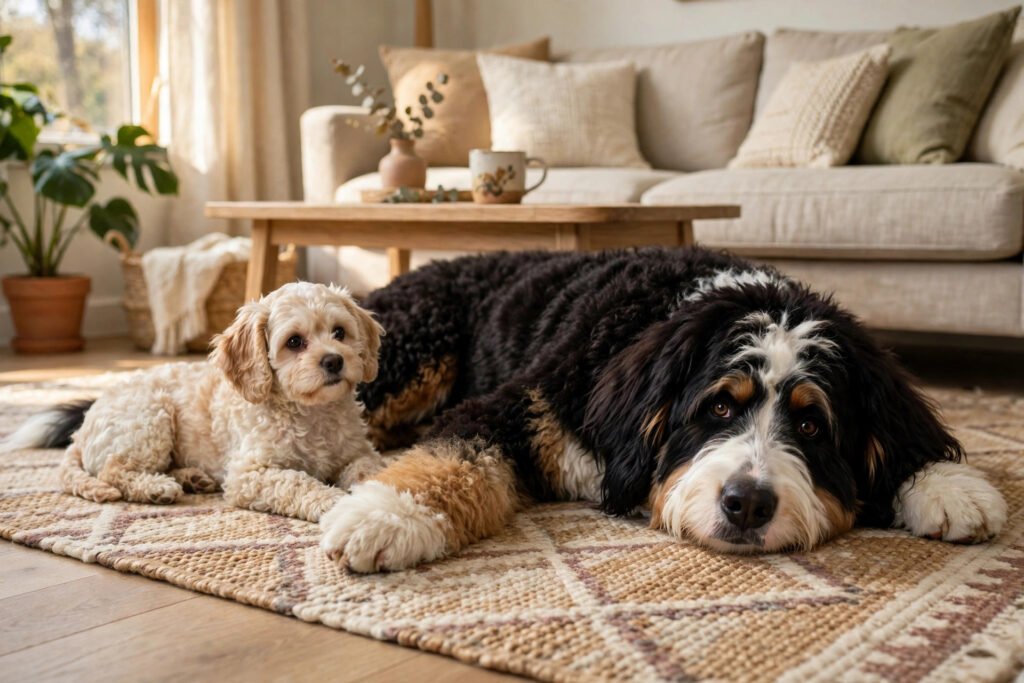 CockapooDaily
A Short Note on the Australian Labradoodle
You will see this name in breeder listings, and it is not the same dog as a Labradoodle. An Australian Labradoodle is a distinct multigenerational line developed in Australia from Labrador, Poodle, and Cocker Spaniel ancestry (plus a few other infusions early on), bred over many generations toward a consistent coat and temperament. A regular Labradoodle is simply a Labrador crossed with a Poodle. The Australian version is usually more predictable in coat and temperament — and usually costs more. If a pedigree mentions Australian Labradoodle ancestry, the key question is how many generations back the infusion sits and what it was bred for; our companion article in this series covers exactly that pedigree question.
Which Doodle Fits You? A 4-Question Decision Guide
1. How much space do you have?
Apartment or small home: Cockapoo, Cavapoo, or Maltipoo. House with a yard: any of them, including the big doodles.
2. How much exercise can you honestly give every day?
Under 45 minutes: Cavapoo, Maltipoo, or Cockapoo. An hour or more: Goldendoodle, Labradoodle, or Bernedoodle. An hour plus training or a dog sport: Aussiedoodle.
3. How much grooming will you really do?
Brushing two or three times a week is fine for a Cockapoo, Cavapoo, or Maltipoo. Daily brushing is the reality for Bernedoodles and Sheepadoodles — be honest with yourself before you choose one.
4. Who is in the household?
Young children: Goldendoodle, Labradoodle, Cavapoo, or Cockapoo. Seniors or a quiet home: Cavapoo or Maltipoo. An experienced owner who wants a training project: Aussiedoodle.
One last reality check: no doodle mix is a recognized breed, and a Cockapoo is not a purebred dog — it is a crossbreed, like every mix on this list. That is why doodles vary so much. Meet the parents, ask for health testing, and pick the dog whose size, energy, and grooming needs fit your actual life — not the one that looked cutest in a photo.
Frequently asked questions
What is the most popular doodle mix?
The Goldendoodle is the most popular doodle mix in the US, followed by the Labradoodle. The Cockapoo and Cavapoo are the most popular small doodles, and the Bernedoodle is the fastest-growing large doodle.
What is the calmest doodle breed?
For large doodles, the Bernedoodle is usually the calmest. For small doodles, the Cavapoo and Maltipoo are the calmest. The Aussiedoodle is the least calm — it is the highest-energy mix on this list and needs the most exercise and mental work.
Which doodle mix sheds the least?
No doodle is guaranteed low-shedding, and shedding varies by generation and individual dog. In general, curly-coated multigenerational doodles shed less than straight-coated first-generation (F1) crosses. An F1b cross — a doodle bred back to a Poodle — usually sheds less than an F1, because it carries more Poodle genes.
Which doodle is best for first-time owners?
The Goldendoodle and the Cockapoo are the easiest doodles for first-time owners: friendly, trainable, and forgiving of beginner mistakes. The Cavapoo is another good first choice for a small home. Avoid the Aussiedoodle as a first dog unless you are ready for a high-energy training commitment.
Are doodle mixes healthier than purebred dogs?
Not automatically. Crossing two breeds can reduce the risk of some inherited conditions, but each doodle still inherits health risks from both parent breeds — for example, hip problems from Labradors and eye conditions from Poodles. Always ask the breeder for health testing on both parents, whatever mix you choose.
Is a Maltipoo or a Cockapoo better for allergies?
The Maltipoo, usually. Both parent breeds have hair rather than fur, so Maltipoos shed very little and are one of the better doodle choices for allergy-sensitive households. Cockapoos shed more unpredictably because the Cocker Spaniel parent sheds. But no dog is truly hypoallergenic — spend time with the actual dog before you commit.
Are Maltipoos good with young children?
They are gentle with children, but they are fragile. A Maltipoo weighs 5–12 pounds, so rough play or an accidental fall can hurt it. They do best with older children who handle them gently, and with adults and seniors. For toddlers and boisterous young kids, the sturdier Cockapoo is the safer pick.
How long do Maltipoos live compared to Cockapoos?
Maltipoos usually live 12–15 years, often to 16 — a little longer than a Cockapoo on average, as small dogs tend to outlive bigger ones. The main health watch-outs are slipping kneecaps (patellar luxation), eye problems including PRA, dental disease, and white shaker syndrome — ask any breeder for health testing on both parents.
Conclusion
Every doodle mix starts from the same idea — Poodle brains plus another breed’s personality — but the result depends entirely on the other parent. The Cockapoo sits at the small, cuddly, moderate-energy end of the family. If you want bigger and more active, look at the Labradoodle or Goldendoodle. If you want calmer and bigger, the Bernedoodle. If you want smaller and calmer, the Cavapoo or Maltipoo. Choose by size, energy, and grooming — not by the photo.
Leave a Reply