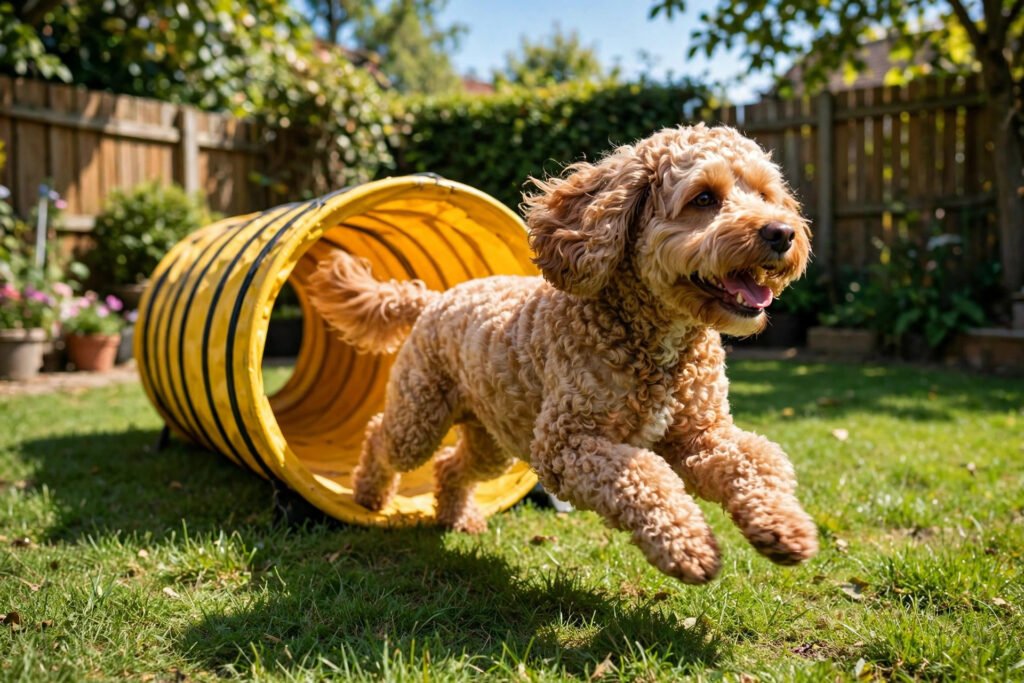
Is your Cockapoo good at agility? Yes — and this beginner guide covers when to start, foundation skills first, first equipment, and finding a US class.
Quick answer: Yes, Cockapoos are good at agility: they are smart, eager, and athletic for their size. Start foundation games at 8 weeks, keep jumps at ground level until about 12 months, and wait until growth plates close before full-height jumps, weave poles, and contact equipment. Dogs must be at least 15 months old to compete in AKC agility.
Agility looks like pure fun — a small dog flying through a tunnel, popping over jumps, weaving poles at speed — and for a Cockapoo it usually is. The breed was built for this kind of work in miniature: a Poodle’s brain and a Cocker Spaniel’s enthusiasm in a compact, athletic body. But agility is also the sport where beginners most often rush, and rushing is what hurts young dogs. The whole trick is knowing what to teach now and what to wait for.
This guide is the one that did not exist when we checked: no dedicated Cockapoo agility guide is published anywhere. The breed pages that mention agility do it in a single line, and the general agility guides never answer the Cockapoo questions — what size jump, when a small dog’s growth plates close, whether a Toy Cockapoo can keep up. Those are answered here.
Are Cockapoos Good at Agility?
Yes — and the reasons are the same traits that make them good pets. Cockapoos inherit the Poodle’s intelligence and the Cocker Spaniel’s eagerness to work with people, which is exactly the combination agility rewards. A dog that learns fast, loves a game, and wants to stay close to its handler has most of what the sport needs before it ever sees a tunnel.
 CockapooDaily
Their size is an advantage, not a limitation. A Cockapoo is light enough to turn tightly and quick enough to keep up on a course, and the jumps they face are low: most Cockapoos compete at 8 or 12 inches (see the jump-height table below), so the impact on landing is far less than for a large breed jumping 24 inches. Breed guides that compare Cockapoos with other breeds consistently note that they do well at agility, and owners in the UK Cockapoo Owners Club have been running Cockapoos in agility for years — one member’s Cockapoo, Florrie, started puppy agility classes at 7 months and was running full courses after her first birthday.
There are two honest limits. First, a Cockapoo is not a Border Collie: the fastest dogs in the sport are herding breeds built for sprinting and sharp turns, and a Cockapoo will rarely beat them on raw speed. That matters only if you plan to compete at the top level; for fun, for fitness, and for local trials, it does not matter at all. Second, Cockapoos are sensitive dogs that shut down under harsh handling. Agility trained with pressure, shouting, or repeated drilling will make a Cockapoo slower and more anxious, not faster. The sport suits them when it is trained the way they learn best: short sessions, food or toy rewards, and a handler who celebrates the try. If you want the fuller picture of what makes them quick learners, our guide on how smart Cockapoos are explains where that intelligence comes from — and where it has limits.
When Can a Cockapoo Start Agility?
This is the question that matters most, and the answer has three different ages in it: the age to start learning, the age to start jumping, and the age to compete. Mixing them up is how puppies get hurt.
A puppy’s growth plates — the soft cartilage at the ends of the long bones — are not closed until at least 12 months of age, and jumping on open growth plates can cause long-term damage. That is the American Kennel Club’s own guidance, and it is echoed by vets: the veterinarian and agility expert Joni L. Freshman advises starting no jumping training, no weave poles, and no contact obstacles until the growth plates are closed. The VCA animal hospitals make the same point in plainer terms: wait until your puppy reaches maturity before having them jump hurdles or compete in agility courses.
None of that means waiting a year to do anything. Foundation training — the flat-ground skills agility is built on — can start at 8 weeks. Here is the timeline:
| Age | What to do | What to avoid |
|---|---|---|
| 8–16 weeks | Foundation games: name response, targeting a hand or mat, following a lure, walking through a tunnel laid flat on the ground | Any jumping, any weaving, any climbing |
| 4–6 months | Recall, stay, and loose-leash basics; short tunnels; walking over a pole on the ground; body-awareness games on flat surfaces | Jumps above ground level, full weave poles, A-frame and dog walk at height |
| 6–12 months | Pre-agility classes; jumps with the bar on the ground or no higher than wrist height; contact equipment kept very low or flat; short, fun sequences | Repetitive jumping, full-height jumps, tight weaving, steep contacts |
| 12 months and up | Gradually raise jump height over weeks as strength and confidence build; introduce full weave poles and full-height contacts | Rushing to full height in a single session; training through tiredness or soreness |
| 15 months and up | Eligible to compete in AKC agility trials | Entering a trial before the dog is confident on every obstacle |
Two notes on that table. First, Cockapoos are small dogs, and small dogs mature faster than large ones — a Toy Cockapoo is essentially grown by 9 to 10 months. But “grown” and “growth plates closed” are not the same thing, and the safe, standard line is still about 12 months for full-height work. If you want certainty for your individual dog, your vet can confirm growth-plate closure with an X-ray. Second, the competition age is a rule, not a suggestion: dogs must be at least 15 months old to compete in AKC agility, and USDAA’s introductory classes open at 14 months.
One more timing point: do not start agility with a dog that is already carrying an injury or a joint problem. If your Cockapoo is stiff after rest, reluctant to jump onto the couch, or has been diagnosed with anything affecting the joints, sort that out with your vet first — our guide to Cockapoo joint problems covers the signs owners most often miss.
Foundation Skills First: What to Teach Before Any Equipment
Every good agility instructor says the same thing: spend the first 2 to 4 weeks on foundation skills before touching an obstacle. The dogs that struggle on course are almost never the ones that cannot jump — they are the ones that cannot recall, cannot wait, or cannot follow a hand target at speed. Teach these five first, in short sessions of 5 to 10 minutes:
1. Recall — coming when called, every time. On an agility course your dog is off leash, 20 feet away, with other dogs and people around. If recall is not solid, nothing else works. Train it as a game with high-value rewards, never as a command you repeat louder and louder. Our full Cockapoo recall training guide covers the step-by-step method, including what to do when your dog ignores you.
2. Stay and wait. Your dog needs to hold position at the start line while you walk out to lead the course, and to wait at the top of a contact obstacle until released. Practice short stays with a clear release word (“okay” or “free”), building duration slowly. A stay that falls apart at 10 seconds will fall apart at the start line too.
3. Targeting — nose or paw to a spot. Teach your dog to touch your open hand with its nose on cue (“touch”), and to run to a mat or target plate and put two paws on it. Targeting is the skill behind contact obstacles: the dog learns to run to the yellow contact zone at the bottom of the A-frame and dog walk instead of leaping off the top. Start on flat ground with a plastic lid or a small mat.
4. Focus and engagement. Agility is a team sport, and the team is you and your dog. Before each session, spend a minute on engagement games — hand-feeding a few treats, a quick game of tug, rewarding your dog simply for choosing to look at you. A Cockapoo that checks in with you between obstacles is a dog you can direct; a dog that has tuned you out is on its own course.
5. Following a lure and going around objects. Teach your dog to follow a treat in your hand in a curve, and to go around a cone, a chair, or a jump wing on cue. Going around things is the foundation of handling: most of agility is telling your dog which side of an obstacle to take, and “go around” is the first version of that conversation.
None of these needs equipment, a yard, or a class. They need a hallway, a handful of treats, and ten minutes a day. A puppy that arrives at its first agility class already able to recall, stay, and target is weeks ahead of one that arrives knowing nothing — and the class goes better for everyone, including the other dogs.
The First Equipment to Learn
Once the foundation is in place and your dog is old enough, introduce equipment one piece at a time, in this order — easiest and safest first. Each new obstacle gets its own short sessions before it is combined with anything else.
The tunnel. The best first obstacle, and the one most dogs love immediately. Start with a short play tunnel or a child’s tunnel, laid straight and fully open, with a helper or a line of treats luring the dog through. Keep it straight and short at first; curved tunnels come later. Puppies can walk through a flat tunnel from their first foundation class — it builds confidence with no impact at all.
Low jumps. Start with the bar on the ground, or with a jump so low your dog steps over it. The goal at first is not jumping — it is learning that a jump is a thing to go over, in a straight line, on your cue. Raise the bar gradually over weeks, never more than an inch or two at a time, and only once your dog is jumping the current height comfortably and confidently. A good rule from the AKC’s guidance: begin jump grids with bars on the ground and work up to full height slowly.
Weave poles. The hardest obstacle to teach and the last one to rush. For a beginner dog, start with just 2 poles, or with a channel of poles set wide apart so the dog can run straight through the middle. Full 12-pole weaving with the poles at competition spacing should wait until your dog is past 12 months — the twisting motion puts real stress on a growing spine and shoulders. Many trainers use 6 poles for fun-only dogs and never need the full set.
Contact obstacles — A-frame, dog walk, and seesaw. These are the big, impressive pieces, and they are also the ones that need the most care. Start with the equipment at its lowest setting, or with a plank flat on the ground, and teach the contact-zone behavior (two paws on, wait for release) before the height goes up. The seesaw deserves special caution: the tipping board and the noise frighten many dogs, so introduce it with the board held still and lowered slowly, rewarding every step. Never lure a nervous dog across a high seesaw — a single bad scare can take months to undo.
The pause table. The simplest contact obstacle: a raised table the dog jumps onto and holds position on for a few seconds. It teaches the stop-and-wait skill in a low-stress way, and it is a good confidence builder between harder obstacles.
A note on what to buy: you do not need a full competition course. A beginner needs a tunnel, two or three adjustable jumps, and a set of weave poles — everything else can wait until you know your dog loves the sport. Starter kits that bundle those pieces exist, and adjustable jumps matter: a jump that only goes to one height is useless for a dog that is still building up.
Your First 8 Weeks: A Beginner Plan
Here is a realistic first two months for a Cockapoo over 12 months old that already knows the basics. If your dog is younger, use the same plan but keep every jump at ground level and skip the weave and contact work until the age table above allows it.
| Week | Focus | Sessions |
|---|---|---|
| 1–2 | Foundation check: recall, stay, hand target, going around a cone. Reward every correct choice generously. | 5 minutes, twice a day |
| 3–4 | Tunnel: straight, short, with a lure. Low jump with the bar on the ground. Practice start-line stays. | 10 minutes, 3 times a week |
| 5–6 | Raise the jump bar a few inches. Add a second jump in a straight line. Introduce 2 weave poles, wide spacing. | 10–15 minutes, 3 times a week |
| 7–8 | Two-jump sequences with a tunnel. Contact plank flat on the ground, teaching two-paws-on. First short course of 3–4 obstacles. | 15 minutes, 3 times a week |
Three rules run through the whole plan. Keep sessions short: 10 to 15 minutes is right for a beginner, and a tired dog stops learning and starts making mistakes. End on a success: quit while your dog is still keen, after an easy win, not after a failure. And train on a safe surface: grass or rubber matting, never concrete or slippery floors, which turn a small slip into an injury.
Agility also counts as serious exercise, so fold it into your dog’s daily activity rather than adding it on top of a full day. Our guide to how much exercise a Cockapoo needs gives the by-age amounts — a training session replaces part of a walk, not all of it, and a puppy still needs its rest.
Setting Up Agility at Home
A backyard course is the cheapest way to practice between classes, and for a Cockapoo you do not need much space: a course of a tunnel, three jumps, and a set of weave poles fits in a typical suburban yard. What matters is safety, not size.
Surface first. Grass is best. If your yard is patchy or sloped, use interlocking rubber mats or a section of artificial turf over a flat area. Never train jumps on concrete, decking, or wet grass — Cockapoos are light, but a landing on a hard or slippery surface still jars joints.
Build or buy the basics. A play tunnel (the collapsible fabric kind sold for children works for a first tunnel), PVC jumps with adjustable cups, and a set of stick-in-the-ground weave poles are all you need. Keep jumps adjustable and lightweight: a jump bar should fall if your dog hits it, not stay rigid and trip them. Do not build a full-height A-frame or dog walk yourself unless you know the safe dimensions — badly built contact equipment is the most common cause of home-training injuries.
Keep it small and varied. Three or four obstacles rearranged in different orders teach more than ten obstacles run the same way every time. Change the sequence, change the direction, and sometimes train with just one obstacle and a big reward. Boredom is the enemy: a Cockapoo that has run the same course twenty times stops thinking and starts guessing.
Mind the weather. Train in the cooler part of the day in summer, and skip sessions in real heat — Cockapoos overheat faster than their enthusiasm suggests. In winter, check the ground is not frozen or icy before any jumping. And always warm your dog up with a few minutes of walking and gentle play, and cool down the same way: cold muscles and sudden jumping are a bad combination at any age.
Finding an Agility Class in the US
A class is worth joining even if you plan to train mostly at home. An instructor spots handling mistakes you cannot see, your dog learns to work around other dogs, and proper equipment is already there. Here is how to find the right one:
Where to look. The AKC and the USDAA both publish club and event directories, and many local dog training clubs run foundation and beginner agility classes. Search for “agility foundation class” plus your city, and check the club’s website for a beginner or foundations class specifically — not an intermediate class that happens to have a space. Your vet, your groomer, and local Cockapoo or doodle groups are also good sources of recommendations.
What to ask before you enroll. Does the class take beginners with no equipment experience? What age and vaccination requirements apply? (Most facilities require rabies and bordetella vaccines to be current.) How many dogs are in a class — six to eight is good, twelve is crowded for a beginner. And what training method do they use? Look for positive reinforcement: rewards for correct choices, no leash corrections, no forcing a nervous dog onto equipment. A good instructor’s first answer to a scared dog is “let’s make it easier,” not “push them through it.”
Cockapoos and competition registration. Cockapoos are mixed-breed dogs, and they can compete in AKC agility: the AKC has admitted mixed breeds through its Canine Partners program (listed as All-American Dogs) since 2010, and they compete alongside purebreds. Your dog needs to be enrolled and measured for a jump height card before entering a trial, but that is paperwork for later — no registration is needed to take a class or train for fun.
What a good first class looks like. Expect the first sessions to be almost entirely flatwork: recalls, stays, targeting, and going around cones, with maybe a tunnel by week two or three. If a class has your dog jumping full height in the first session, that is a red flag — find another class. Good instructors are in no hurry, because they know the foundation is what makes the fast dog later.
What Height Does a Cockapoo Jump?
Jump height in AKC agility is set by the dog’s height at the withers — the top of the shoulder blades — measured by an official. The divisions that matter for Cockapoos are:
| Height at withers | AKC Regular jump height | AKC Preferred (lower option) |
|---|---|---|
| 11 inches and under | 8 inches | 4 inches |
| Over 11 to 14 inches | 12 inches | 8 inches |
| Over 14 to 18 inches | 16 inches | 12 inches |
Most Toy Cockapoos (around 10 inches at the withers) jump 8 inches. Most Miniature Cockapoos (around 13 to 14 inches) jump 12 inches. Standard Cockapoos (around 15 to 18 inches) usually jump 16 inches, though a taller Standard may measure into the 20-inch division. These are rough guides — your dog’s official measurement decides, and a young dog’s height card is temporary until age two, when a permanent measurement is taken.
The Preferred option is worth knowing about: any dog can enter Preferred, which jumps one height lower, with a slightly more generous course time. It is a good choice for an older dog, a less confident dog, or a beginner handler who wants a gentler first trial. There is no shame in it — plenty of experienced handlers run Preferred with dogs that could jump Regular.
Other organizations use different height tables (USDAA, CPE, and UKI all have their own), but the pattern is the same: small dogs jump low, and every organization offers a lower-height option. Check the rulebook of the organization you plan to enter before your first trial.
Common Beginner Mistakes
Most agility problems are handler problems, and most of them are fixable in a week once you see them:
- Starting jumps too early. The single most common mistake, and the one with real consequences. A puppy that jumps full height at 6 months may look fine — the damage from open growth plates shows up months or years later. Wait for 12 months, and let your vet confirm if you are unsure.
- Training too long. A 30-minute session with a beginner dog is not dedication, it is drilling. Ten to fifteen focused minutes beats half an hour of fading attention every time. If your dog’s enthusiasm drops, you have already gone too long.
- Repeating a failed obstacle. If your dog refuses the tunnel three times, the answer is not a fourth attempt at the same setup — it is an easier version (shorter tunnel, better lure, more space) or a different obstacle entirely. Come back tomorrow.
- Running before the foundation is solid. A dog that cannot hold a stay at the start line will break it on course, and a dog that cannot recall will visit the judge instead of the next jump. Foundation skills are not a warm-up you skip; they are the sport.
- Comparing your Cockapoo to a Border Collie. Your dog will probably never be the fastest on the course, and that is fine. Agility for most Cockapoo owners is about fitness, confidence, and the bond — and on those measures, Cockapoos are among the best dogs in the sport.
- Forgetting the rest of the dog’s life. Agility is one activity, not a whole life. A dog that trains hard but is bored the rest of the week will still chew the furniture. Keep the walks, the play, and the calm-alone training going alongside the course work.
Is Agility Right for Every Cockapoo?
Almost — but not quite every dog, and not at every age. Agility suits healthy, confident Cockapoos of any size, from Toy to Standard, and dogs can keep enjoying it well into their senior years at lower heights and easier courses. But there are dogs for whom it is the wrong choice, or the wrong choice right now:
- Puppies under 12 months can do foundation and flatwork, but not full-height jumping, weaving, or contacts. That is a delay, not a refusal.
- Dogs with joint, back, or heart problems should be cleared by a vet before starting. A dog with a known joint issue, a history of back pain, or a heart murmur needs an individual answer, not a general guide.
- Very nervous or fearful dogs may find a busy class overwhelming. For these dogs, start with one-to-one sessions or a quiet foundations class, and build confidence slowly — or choose a calmer sport like scent work first and come back to agility later.
- Overweight dogs should lose the extra weight before jumping. Every extra pound multiplies the impact on landing, and a dog that is already carrying too much weight is the one most likely to be hurt by it.
If any of those apply, talk to your vet before your first class. The vet who knows your dog’s weight, joints, and history can give you a start date that a general article cannot.
Frequently Asked Questions
Are Cockapoos good at agility?
Yes. Cockapoos combine Poodle intelligence with Cocker Spaniel enthusiasm, and they are light, quick, and eager to work with their handler — the exact traits agility rewards. They will rarely outrun a Border Collie at the top level, but for fun, fitness, and local trials they are excellent, and they compete at low jump heights of 8 to 12 inches in most cases.
What age can a Cockapoo start agility training?
Foundation training — recall, stay, targeting, and walking through a flat tunnel — can start at 8 weeks. Low jumps with the bar on the ground and pre-agility classes can start around 6 months. Full-height jumps, weave poles, and contact obstacles should wait until the growth plates close, at about 12 months. Dogs must be at least 15 months old to compete in AKC agility trials.
Can a Cockapoo compete in agility competitions?
Yes. Cockapoos compete in AKC agility as All-American Dogs through the AKC Canine Partners program, which has admitted mixed breeds since 2010, and they also compete in USDAA, CPE, and UKI events. Your dog needs an official measurement and a jump height card before entering a trial, and must be at least 15 months old for AKC trials.
What equipment do I need to start agility at home?
A tunnel, two or three adjustable jumps, and a set of weave poles are enough for a beginner. Train on grass or rubber matting, keep jump bars light enough to fall if hit, and do not build full-height contact equipment yourself unless you know the safe dimensions. Start with a class first — you may find you need less equipment than you think.
Is agility safe for a Toy Cockapoo?
Yes, with the same age rules as any Cockapoo: no full-height jumping or weaving before about 12 months. Toy Cockapoos are small and light, and they usually jump just 8 inches in AKC competition, so the impact is low. The main risk for a Toy is the same as for any small dog — slippery or hard surfaces — so train on grass or matting and keep sessions short.
Conclusion
A Cockapoo is a natural for agility: smart enough to learn the course, eager enough to love it, and small enough to jump low and turn tight. The path is simple once you know the ages — foundation games from 8 weeks, low equipment from 6 months, full-height jumping and weaving only after about 12 months, and competition from 15 months. Teach recall, stay, and targeting before you touch an obstacle, introduce the tunnel first and the weave poles last, and find a positive-reinforcement class in your area rather than figuring it all out alone.
Next step: spend this week on the foundation skills — a solid recall and a hand target will do more for your future agility dog than any piece of equipment. When you are ready for a class, check the AKC and USDAA club directories for a beginner foundations course near you, and keep sessions to 10 or 15 minutes while your dog is learning. The course will still be there next week; your dog’s joints will thank you for the wait.


Leave a Reply