
Is your Cockapoo drinking more, panting all the time or growing a pot belly? Learn the signs of Cushing’s, how vets confirm it and life on daily medication.
Quick answer: Cushing’s disease means your Cockapoo makes too much cortisol, a stress hormone, usually from a small benign pituitary tumor. Signs creep in slowly: drinking and peeing more, a bigger appetite, a pot belly, panting, thinning fur and weak hind legs. Vets confirm it with the Low Dose Dexamethasone Suppression test, and most dogs live well on daily trilostane.
Cushing’s disease does not arrive like an emergency. It arrives like old age — more water in the bowl, one more trip outside at night, a rounder belly, a dog that pants on a walk it used to enjoy. Owners blame the years, and the signs have often been there for months before anyone names the disease.
That is what happened to Nellie, a nine-year-old Cockapoo whose owner tells her story on freyathecockapoo.com. Diagnosed in 2023, Nellie had shown the classic signs in hindsight: lethargy, going off food, drinking ridiculous amounts of water and peeing constantly.
Real Cockapoo owners are asking the same questions right now: on JustAnswer, one owner asked about a little Cockapoo whose belly is very bloated though she is not overfed, and who waddles on her back legs; another about an eight-year-old with Cushing’s and raised liver enzymes; a third about a nine-year-old panting constantly.
What Cushing’s Disease Is, in Plain Words
Cushing’s disease — vets also call it hyperadrenocorticism — is a condition where the body is exposed to too much cortisol for too long. Cortisol is a natural steroid hormone made by the two adrenal glands, small glands near the kidneys. In a healthy dog it rises and falls as needed; in a dog with Cushing’s it stays high.
Most cases start in the brain: a small, usually benign tumor on the pituitary gland, a pea-sized gland at the base of the brain, tells the adrenal glands to keep making cortisol. This pituitary-dependent form accounts for roughly 85% of cases; the other main form is an adrenal tumor.
A third, drug-induced form comes from long-term high-dose steroids such as prednisolone — vets call this iatrogenic Cushing’s, and the fix is to reduce the dose under guidance.
Cushing’s mostly affects middle-aged and older dogs, which is why it gets mistaken for aging. Vets estimate it affects around three in every 1,000 dogs. Cockapoos are not known to be at special risk, but they live long lives — and a long-lived dog is the one most likely to reach the age Cushing’s appears.
The Slow-Onset Signs Owners Miss
No single sign proves Cushing’s, and every sign on its own has an innocent explanation — the pattern is what matters. Vets call the classic signs the five P’s: polyuria, polydipsia, polyphagia, panting, and a pot belly. Watch for three or more together, creeping in over weeks or months.
Drinking and peeing more
This is usually the first sign, and the easiest to miss. Your Cockapoo empties the water bowl faster, asks to go out more, needs a trip outside at night again, or starts having accidents indoors after years of being house-trained. Cortisol stops the kidneys conserving water, so the dog drinks more and pees it straight back out. Mention a clear, lasting rise in water intake to your vet.
A bigger appetite that never switches off
Cortisol stimulates appetite, so a dog with Cushing’s often acts hungry all the time: begging, scavenging, stealing food it used to ignore. Nellie’s owner puts it well: the disease drives hunger, so the dog thinks she is hungry, and the owner has to resist feeding her because it is a want, not a need. A suddenly food-obsessed Cockapoo is showing a symptom, not a personality quirk.
A pot belly
The pot belly is the sign owners worry about most, and the one most often misread as simple weight gain. It is not just fat: the liver enlarges, fat gathers inside the abdomen, and the abdominal muscles weaken. The result is a pendulous, sagging belly on a dog whose ribs and legs may be getting thinner. The little Cockapoo in the JustAnswer Q&A is the textbook example: very bloated, not overfed, waddling on her back legs because her belly is so big. A belly growing while the legs and spine feel bonier is a red flag.
Panting, even at rest
Panting is one of the most common findings in Cushing’s, and one of the most dismissed — a dog pants when hot, excited or tired, so constant panting gets blamed on the weather or the walk. In Cushing’s, cortisol levels that should fall at night stay high, so some dogs pant through the night. The nine-year-old Cockapoo in the recent JustAnswer thread was panting constantly, and the vet’s advice was to rule out Cushing’s first. Panting at rest, indoors, in cool weather, or at night deserves a vet’s attention.
Thinning fur and fragile skin
The coat changes slowly: fur thins, often symmetrically along the flanks and belly, and the skin underneath becomes thin, sometimes darker, and slow to heal. Recurrent skin and urinary infections are common, because cortisol suppresses the immune system. Our guide to Cockapoo hair loss and bald patches covers the common causes — Cushing’s belongs on that list when hair loss arrives with thirst, appetite or a pot belly.
Weak hind legs and a waddle
Muscle wastage shows first in the hind legs: the dog struggles on stairs, hesitates before jumping onto the sofa, tires quickly, or develops the waddle the JustAnswer owner described — the back legs swinging wide to carry a heavy belly on weakening muscles. Owners often read this as arthritis or old age, and sometimes it is. But weakness that arrives with drinking, eating and a pot belly is a pattern, not a coincidence.
Lethargy and the bloodwork clue
Early on, some dogs go quiet and lose interest in food — Nellie was lethargic and off her food before her diagnosis — which seems to contradict the ravenous appetite other dogs show. Both are real; the point is change. Many owners first hear the word Cushing’s from a blood test: routine bloodwork often shows raised liver enzymes. That is what happened with the eight-year-old Cockapoo whose owner asked about Cushing’s alongside elevated liver enzymes. Raised liver enzymes alone do not diagnose Cushing’s, but in an older dog with the signs above, they point toward hormone tests. See our Cockapoo common health problems guide for the other conditions common in older Cockapoos.
How the Vet Confirms It
No single test proves Cushing’s on its own: your vet puts together the history, the exam, routine blood and urine tests, and then specific hormone tests — only for dogs showing the typical signs.
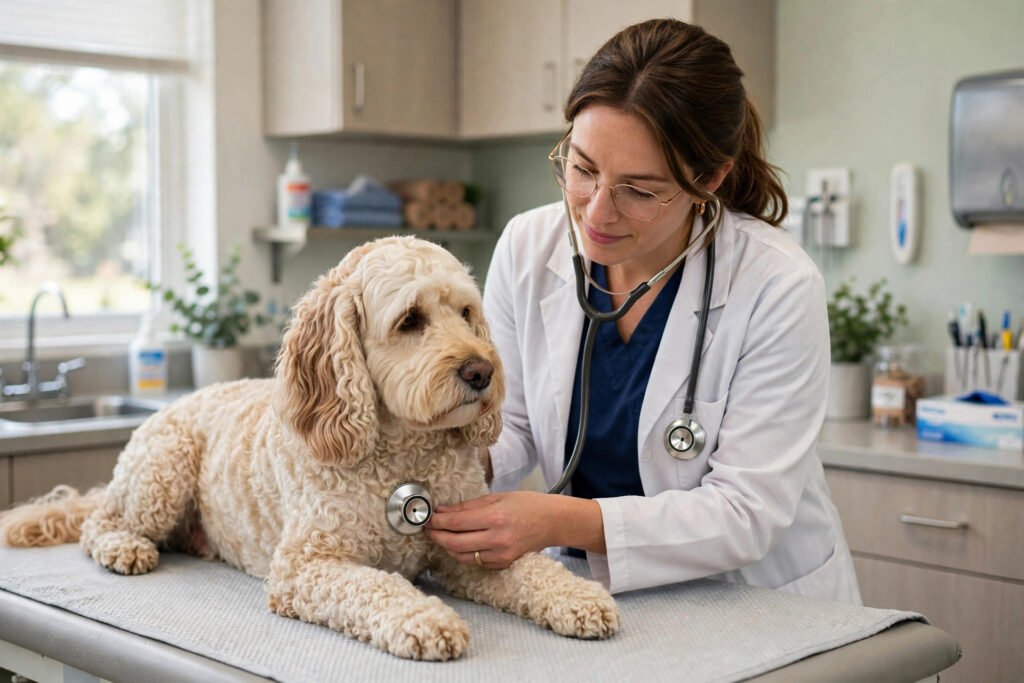
The main confirmatory test is the Low Dose Dexamethasone Suppression test (LDDS). Your vet takes a blood sample to measure cortisol, then gives a small injection of dexamethasone, a synthetic steroid. In a healthy dog, that switches cortisol production off. In a dog with Cushing’s, it does not switch off, and cortisol stays high. The vet takes further blood samples over the next eight hours — one morning at the clinic, and a clear answer in most cases.
The LDDS is the preferred screening test because it catches roughly 85 to 100% of cases, and it can sometimes point to the cause — pituitary or adrenal. Its weakness is specificity: a stressed or unwell dog can give a false positive, so your vet reads it alongside everything else. The ACTH stimulation test takes about two hours and is the test vets use to monitor treatment, though it can miss mild cases. Your vet may also suggest an abdominal ultrasound to check the adrenal glands for a tumor.
The LDDS takes eight hours, so your Cockapoo will spend most of the day at the clinic. Ask in advance about drop-off and pickup times, whether your dog can have breakfast, and the total cost — the test, bloodwork and ultrasound are usually billed separately. Our Cockapoo vet visit schedule explains routine checks at each age; a Cushing’s workup sits on top of those, not instead of them.
 CockapooDaily
Daily Life on Medication
A Cushing’s diagnosis is not a death sentence, and it is not a cure either. For the commonest form — the pituitary tumor — the disease is managed, not removed: the goal is to bring cortisol down to a normal level, control the symptoms, and give the dog a good quality of life.
The first-line medication is trilostane (Vetoryl): a tablet given with food, usually once or twice a day, starting at a low dose. It blocks cortisol production in the adrenal glands. Within one to three weeks, the drinking and peeing ease and the appetite settles. The pot belly and coat take longer, and hind-leg strength comes back slowly.
Monitoring is part of the treatment. Your vet rechecks bloodwork — usually an ACTH stimulation test or a pre-pill cortisol measurement — about 10 to 14 days after starting, and again after any dose change, then every few months. The dose has to sit in a narrow window: too little and symptoms return, too much and cortisol falls too far. Never adjust the dose yourself. If the signs come back, tell your vet promptly.
One warning every owner on trilostane must know: if your dog suddenly goes off food, vomits, has diarrhea, or becomes weak, cortisol may have dropped too low. Stop the medication and call your vet the same day.
Day to day, life with a Cushing’s Cockapoo is mostly normal. The hunger does not switch off entirely, so mealtimes need discipline: measured portions, no extra treats because the dog looks hungry. Keep water freely available; restricting it is dangerous. Keep walks gentle and regular, help with stairs or the car if the hind legs are weak, and groom gently.
Trilostane is a daily, lifelong medication, and the recheck blood tests add up — ask for a monthly estimate at the start. Surgery can cure the disease only when the cause is a tumor on one adrenal gland; for the great majority, the daily tablet is the treatment.
What It Is NOT: Diabetes, Kidney Disease and Old Age
Cushing’s shares its headline signs with other conditions, which is exactly why it gets missed.
Diabetes. Diabetes also causes drinking, peeing and a big appetite, and it is the condition most often confused with Cushing’s. A diabetic dog usually loses weight despite eating more, and may develop cloudy eyes — cataracts are a diabetes sign, not a Cushing’s sign. If your Cockapoo’s eyes are clouding over, read our guide to Cockapoo eye problems and tell your vet. Read our guide to Cockapoo diabetes. Bloodwork separates the two quickly — diabetes shows high blood sugar, Cushing’s does not.
Kidney disease. Kidney disease also makes a dog drink and pee more, but it usually brings weight loss, a poor appetite and vomiting, while Cushing’s brings a big appetite and a pot belly. Drinking more and eating less points toward the kidneys; drinking more and eating everything in sight points toward Cushing’s. Our Cockapoo kidney disease guide covers the signs, the FN gene test, and daily care.
Old age. Slowing down, sleeping more and struggling on stairs are all signs of age — but old age does not make a dog drink twice as much water, beg constantly for food and grow a pot belly while its legs waste away. When several changes arrive together in a dog over seven or eight, that is not “just getting old” — run bloodwork. Our senior Cockapoo care guide covers what really is normal aging.
When to See the Vet
Book a vet appointment promptly — this week, not next month — if your Cockapoo shows three or more of the signs in this guide, or if any one sign is strong and new: a clear jump in water intake, new nighttime toilet trips or indoor accidents, a belly swelling while the legs thin out, constant panting at rest, or symmetrical hair loss with thin skin. Take notes before you go — water intake, peeing frequency, when the changes started, any weight change — because vets diagnose Cushing’s from patterns.
Call the vet the same day if your dog stops eating, vomits repeatedly, becomes very weak, or cannot pass urine. If your dog is already on trilostane and shows poor appetite, vomiting, diarrhea or weakness, stop the medication and call immediately. Do not test for Cushing’s at home or change any steroid medication without your vet.
Frequently asked questions
What are the first signs of Cushing’s disease in a Cockapoo?
Drinking and peeing much more than usual is usually the first sign, followed by a bigger appetite, panting, a pot belly, thinning fur and weak hind legs. Three or more together is the point to book a vet visit.
How is Cushing’s disease diagnosed in dogs?
Your vet starts with a history, an exam and routine blood and urine tests. The confirmatory test is the Low Dose Dexamethasone Suppression test (LDDS): a blood sample, a small dexamethasone injection, then further samples over eight hours.
How long can a Cockapoo live with Cushing’s disease?
Many dogs live well for years after diagnosis on daily trilostane. The pituitary form is not curable with medication, but it is controllable, and the drinking, appetite and panting usually improve within weeks. Lifespan depends on the dog’s age, cause, and other health problems.
What medication do dogs with Cushing’s disease take?
The standard treatment is trilostane (Vetoryl), a tablet given with food once or twice a day, for life. Your vet rechecks bloodwork about 10 to 14 days after starting, after any dose change, then every few months. Never change the dose yourself, and stop the drug and call your vet at once if your dog goes off food, vomits, or becomes weak.
Can Cushing’s disease in dogs be mistaken for diabetes?
Yes, because both cause heavy drinking, frequent urination and a big appetite. A diabetic dog usually loses weight despite eating more and may develop cataracts — a diabetes sign, not a Cushing’s sign. Bloodwork separates them quickly, since diabetes shows high blood sugar and Cushing’s does not.
Conclusion
Cushing’s disease is easy to miss because it arrives slowly, disguised as old age: a little more water, a little more food, a rounder belly, a dog that pants and tires sooner than it used to. But the pattern is learnable. If your Cockapoo is drinking and peeing more, eating ravenously, panting at rest, losing fur or growing a pot belly while its back legs weaken, do not file it under aging. Book a vet visit, describe the pattern, and ask about the Low Dose Dexamethasone Suppression test. A diagnosis opens the door to a daily tablet, regular rechecks, and years of good life for most dogs. Nellie, diagnosed in 2023 and still lively at nine, is proof of that.
Leave a Reply