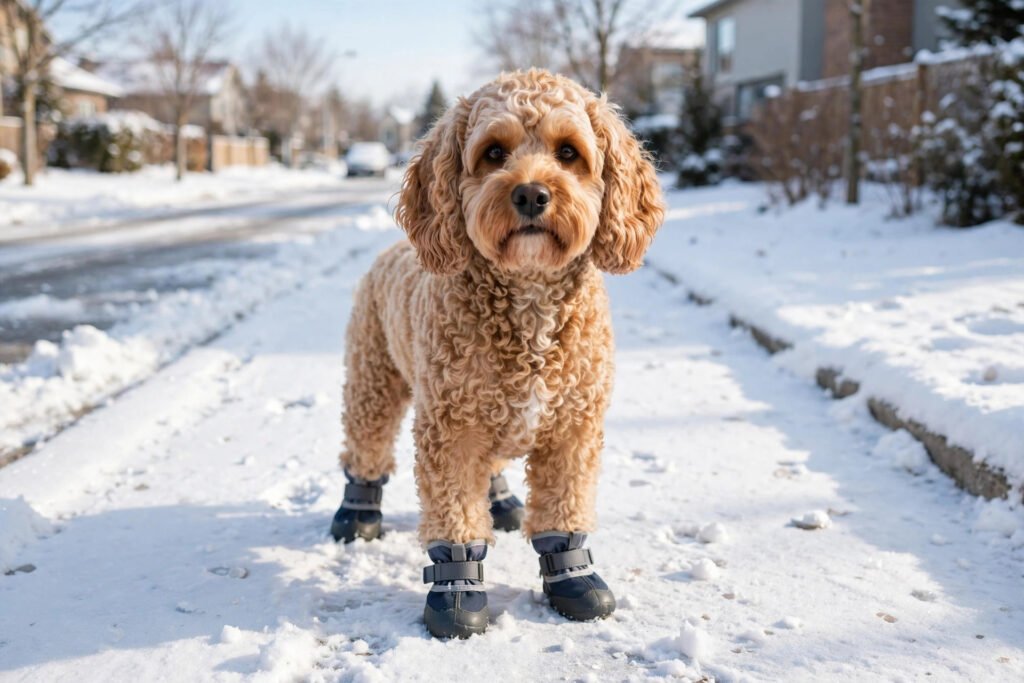
Do Cockapoos need winter boots? Learn how salt, ice and snow hurt their paws, paw wax vs boots, boot sizing, training tips, and the best picks.
Quick answer: Most Cockapoos benefit from winter paw protection, especially on salted sidewalks. Their furry toes trap snow and ice, and road salt burns pads and is toxic if licked off. Boots are the best protection on salted or icy ground; paw wax works for short walks in light snow. Measure all four paws standing, and train indoors first.
Your Cockapoo loves winter walks — until ten minutes in, it stops, lifts a paw, and chews the ice packed between its toes. Back home its pads are red and caked in salt, and it licks them clean, swallowing the chemicals that burned them.
Cockapoo paws are more vulnerable in winter than most owners realize: long, curly fur traps snow between the toes, where it refreezes into painful ice balls. With the right protection — boots, wax, or both — your Cockapoo can enjoy winter walks.
Do Cockapoos Need Boots in Winter?
Not every Cockapoo needs boots on every walk — a healthy adult on clean, unsalted snow is usually fine barefoot. Boots earn their place once any of these are true:
- You walk on salted sidewalks or roads. Most US sidewalks are treated with rock salt or chemical ice melt. Salt dries and cracks pads; de-icers can burn them.
- Walks over 15 to 20 minutes in freezing weather. Paws are among the first places frostbite appears, and small dogs lose heat through them fast.
- Your Cockapoo gets snowballs between its toes. If your dog stops to chew its feet every few minutes, it needs help — boots, wax, or a trim between the pads.
- Your dog is a puppy, a senior, or has a health condition. Puppies, seniors, and dogs with poor circulation feel the cold sooner and recover slower.
- Your Cockapoo has sensitive or already-cracked pads. Once pads are damaged, every salty walk reopens them.
If none of these apply — a short walk on clean snow in your own yard — bare paws plus a good rinse are usually enough. For how cold is too cold for a walk, see our guide on whether Cockapoos get cold in winter.
Cockapoo paws are extra vulnerable for three reasons: hair between the toes traps snow, most Cockapoos weigh only 12 to 25 pounds so small paws lose heat fast, and many are clipped short through winter, removing insulation from legs and feet.
What Winter Does to a Cockapoo’s Paws
Road salt and ice melt. Rock salt dries out pads, causing cracking, redness, and soreness. Chemical de-icers — calcium chloride, magnesium chloride, urea-based melts — are worse and can burn skin. The Pet Poison Helpline calls calcium salts the most severe irritants among ice-melt ingredients, on skin and paws as well as swallowed. The danger does not end on the walk: dogs lick their paws clean at home, swallowing residue that can cause thirst, vomiting, diarrhea, and lethargy. Rinse paws after every walk, boots or not.
Ice, snowballs, and frostbite. Sharp ice crust can cut pads, and dogs slip on ice like people do — keep your Cockapoo off frozen ponds and lakes. Snow packs into the fur between the toes, melts slightly, then refreezes into hard lumps; the dog chews at them, packing in more snow and risking swallowing salt. Trimming the fur between the pads short before winter is the best fix, boots or no boots. In deep cold, frostbite can affect toes and pads — pale, gray, or bluish pads that feel cold and hard, with pain as it warms up. If you suspect frostbite, warm the paw slowly with lukewarm (not hot) water and call your vet.
Signs Your Cockapoo Needs Paw Protection
On a walk, watch for a lifted paw, shifting weight foot to foot, prancing in place, refusing to walk, stopping to chew at the feet, or limping that eases indoors. After a walk, check for red or cracked pads, swelling between the toes, sores where ice balls formed, salt crystals in the fur, and excessive licking once home — a sign of soreness and a way of swallowing salt.
Any of these signs regularly means your setup is not enough. Shorten walks, add protection, and check paws after every outing until the signs stop. If pads are cracked and bleeding, swollen, or pale and hard after cold exposure, call your vet.
Paw Wax vs Boots: Which Is Better?
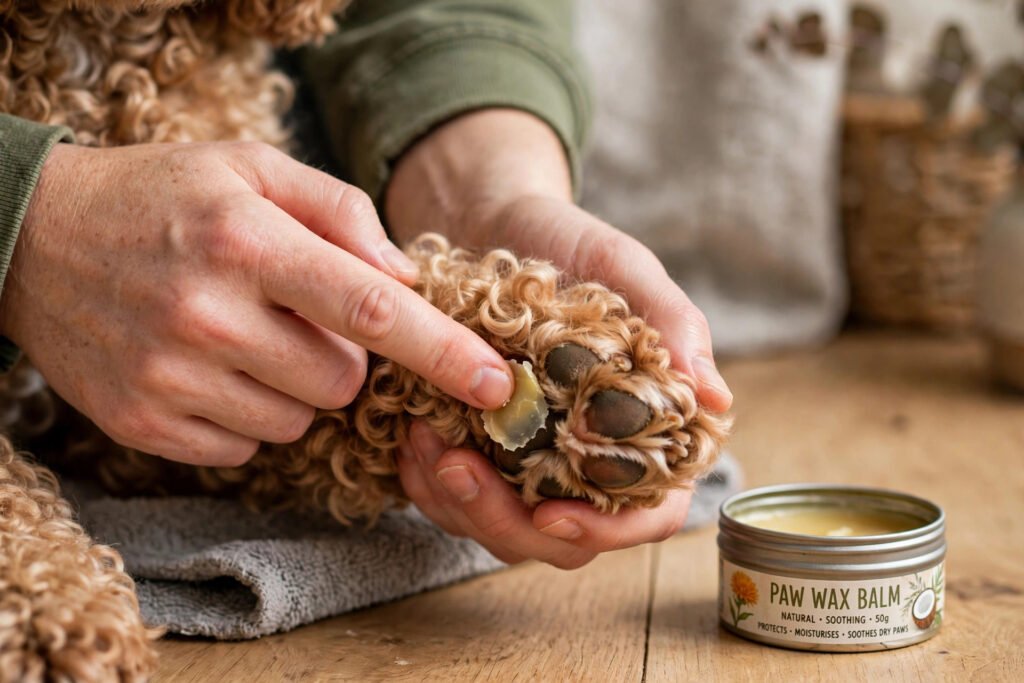
Paw wax is a thick cream rubbed onto the pads and between the toes before a walk; boots enclose the whole paw. Both help, but they are not equal.
| Factor | Paw wax / balm | Boots |
|---|---|---|
| Salt protection | Partial — a thin film that wears off | Best — salt never touches the pad |
| Ice and snowballs | Reduces snow sticking between toes | Stops them almost completely |
| Frostbite protection | Very little | Real warmth, especially insulated boots |
| Sharp ice, rough ground | None | Full — the sole takes it |
| Dog acceptance | Easy — most dogs barely notice it | Needs training |
| Best for | Short walks, light snow, boot-hating dogs | Salted sidewalks, long walks, deep cold |
Boots protect better, wax is easier — many owners use both. If your Cockapoo refuses boots, wax plus a strict rinse routine is far better than nothing. But on daily-salted sidewalks, wax alone is not enough: the film thins out, and salt gets through.
 CockapooDaily
How to Measure Your Cockapoo’s Paws for Boots
Most bad boot reviews come down to one thing: the wrong size. Boots fail because they slip off or rub. Never size from body weight or breed charts alone — measure the paw.
Step 1: Trace the paw standing up. Put paper on a hard floor and have your Cockapoo stand on it — a lifted paw measures narrow, which is why boots bought that way feel a size too small. Trace around the paw, fur included, and measure the widest point in inches. Do all four paws: fronts are usually wider.
Step 2: Match width to the maker’s chart. Use the width against that boot’s size chart, never a generic one. Between sizes, follow the maker’s tiebreak — most say size down, some run small and say size up. Width decides, not weight.
Step 3: Check the fit at home. One finger should fit between boot and leg at the strap — snug, not tight. The boot should not twist, and toes should not be cramped. Check for rubbing before the first real walk.
Cockapoo sizing guide
A starting point — always measure:
| Cockapoo size | Weight | Paw width | Boot size |
|---|---|---|---|
| Toy Cockapoo | Under 12 lb | 1.5–2 inches | XS–Small |
| Miniature Cockapoo | 13–18 lb | 2–2.5 inches | Small |
| Standard Cockapoo | 19–30 lb | 2.5–3 inches | Small–Medium |
A miniature with wide front paws may need Small fronts and XS backs — normal, and why boots sold in pairs are so useful for this breed.
The Best Winter Boots and Paw Protection for Cockapoos
As an Amazon Associate I earn from qualifying purchases.
Four picks: a budget boot, a premium hiking boot, a thin rubber boot for salt, and a wax for dogs that refuse boots. Check price and size chart before you buy.
1. QUMY Dog Boots — best budget everyday boot
Why it fits: lightweight and water-resistant, with a molded rubber sole, a wide opening for wiggly paws, and two adjustable reflective Velcro straps. It keeps salt, slush, and cold off the pads at a fraction of the premium price. Sizing note: sets of four, eight sizes; most miniatures take small, most standards medium.
2. Ruffwear Grip Trex — best for traction and long walks
Why it fits: the boot every 2026 roundup names first for traction. A Vibram outsole grips ice and packed snow, mesh uppers keep paws dry, and the closure cinches at the narrowest part of the leg — the spot that decides whether a boot stays on. Sizing note: sold in pairs, so fronts and backs can differ; 2-inch suits most miniature and standard Cockapoos.
3. PawZ Rubber Dog Boots — best for salt, simplest to use
PawZ Rubber Dog Boots, Medium, pack of 12
Why it fits: a thin, natural-rubber boot that pulls on like a balloon and seals against salt, slush, and mud. No straps, nothing to break, and most dogs accept them faster than structured boots; a torn one is no drama in a 12-pack. Sizing note: Medium (2.5–3 inches) fits most standards; Small (2–2.5 inches) fits most miniatures. No insulation — a salt barrier, not a cold-weather boot.
4. Musher’s Secret Paw Wax — best for dogs that refuse boots
Musher’s Secret Dog Paw Wax, 60g
Why it fits: the original sled-dog paw wax, made from food-grade natural waxes with vitamin E. It forms a breathable barrier against salt, ice, and snowballing, moisturizes cracked pads, and is safe if licked — the fallback for the dog that tolerates nothing on its feet. Sizing note: none — a pea-sized amount per paw; a 60g tin lasts most owners a full winter.
How to Get a Boot-Hating Cockapoo Used to Boots
Most Cockapoos hate boots at first. The high-stepping “boot dance” is normal, not a sign the boots are wrong. Never force all four on and head straight out on day one — that is how dogs learn to hate boots permanently.
Days 1–2: Touch and treat. Let your Cockapoo sniff the boots, touch its paws, hold a boot near a paw, and give a treat — twice a day. Boots predict treats.
Days 3–4: One boot, indoors. Put one boot on a front paw, treat, let your dog walk around the house a minute or two, then take it off and treat again. If your dog freezes, lure it forward with a treat. Keep sessions to 5 minutes.
Day 5: Two boots, then four. Add the second front boot, then the backs. Let your dog walk, play, and eat in the boots — most walk normally within 10 to 15 minutes.
Days 6–7: Short outdoor trips. Take a 5-minute walk on a familiar route — yard first, then sidewalk. Treat generously, then build up to normal walks over the next week.
If your Cockapoo still refuses, try thin rubber boots like PawZ, which feel closer to bare paws, or a sock underneath to stop rubbing. Some dogs will never wear boots — for those, use paw wax, trim the fur between the pads, shorten walks on salted ground, and rinse paws after every walk. For calmer winter walks, see our Cockapoo leash training guide.
The Winter Paw-Care Routine After Every Walk
Boots and wax reduce the damage; this routine removes what gets through. Do it after every walk — it takes two minutes.
- Rinse the paws. Dunk each paw in lukewarm water, or wipe with a damp cloth, to remove salt and de-icer residue — salt left on paws gets licked off and swallowed.
- Dry thoroughly, including between the toes. Wet fur between the toes is where ice balls start. Pat dry and check for grit or salt crystals in the fur.
- Check the pads. Look for cracks, redness, swelling, or cuts — catching one early means a few days of balm; ignoring it means a vet visit.
- Apply balm to dry pads. A thin layer of paw wax after the walk moisturizes pads dried by cold and salt. Apply after drying, not before.
- Trim the fur between the pads. Keep the hair between the toes short through winter so snow has nothing to cling to — trim with blunt-tipped scissors or ask your groomer. Keep nails short too: long nails make dogs slip on ice. See our guide on how to trim Cockapoo nails.
Rinse paws after walks, but save full baths for when needed — over-bathing strips coat oils. See how often to bathe a Cockapoo. While handling the head, check the ears too — see how to clean Cockapoo ears.
When to See the Vet
Most winter paw problems are mild. See your vet for pads cracked and bleeding, sores not healing in a few days, swelling or discharge between the toes, pale or bluish pads that feel cold and hard (possible frostbite), limping over a day, or vomiting, diarrhea, or lethargy after a walk (possible salt ingestion). If your Cockapoo has eaten much rock salt or ice melt, call your vet or Pet Poison Helpline right away.
Frequently asked questions
Do Cockapoos really need boots, or is it just for looks?
It is not just for looks. Boots are genuinely useful on salted sidewalks, icy ground, and long cold walks — and Cockapoos, with furry toes and small paws, benefit more than most. But a short walk on clean snow is fine. Let the ground decide.
Can I use Vaseline on my Cockapoo’s paws instead of paw wax?
Vaseline is sometimes suggested, but it does not stay on well in snow and slush, and it offers little protection against chemical de-icers. A dog-specific paw wax like Musher’s Secret is made from food-grade waxes, stays on better, moisturizes cracked pads, and is safe to lick.
How do I stop snowballs forming between my Cockapoo’s toes?
Three things: trim the fur between the pads short before winter, apply paw wax before the walk so snow slides off, and use boots on snowy days. After the walk, soak paws in lukewarm water to melt ice balls out gently — never pull frozen lumps off the fur.
My Cockapoo freezes and will not walk in boots. What do I do?
This is normal for the first few days. Go back to the indoor plan: one boot at a time, short sessions, lots of treats, and let your dog walk around the house in them first. If yours still refuses, try thin rubber boots, or switch to paw wax plus a rinse routine.
Are dog boots safe to leave on all day?
No — boots are for walks only. Leaving them on indoors traps moisture and softens pads. Take them off when you get home, rinse and dry the paws, and let the feet breathe.
Conclusion
Cockapoo paws take a beating in winter — salt burns them, ice cuts them, snowballs pack between furry toes, and cold dries and cracks them. But that does not mean giving up winter walks. Boots are the best protection on salted or icy ground, paw wax is a good fallback, and the two-minute rinse-and-check after every walk does as much as any product. Measure the paws, train indoors first, and let the ground decide: clean snow, bare paws are fine; salted sidewalks, boots on.
Leave a Reply