Is your Cockapoo bored? Learn the 10 signs, what boredom turns into, and a practical enrichment menu — puzzles, scent games, frozen Kongs, rainy-day ideas.
Quick answer: A bored Cockapoo shows it within days: chewing, digging, barking, pacing, whining, and following you from room to room are the classic signs. Cockapoos are smart dogs, so they need 10 to 20 minutes of mental work a day on top of walks — food puzzles, scent games, snuffle mats, frozen Kongs, and trick-training sessions, rotated so they stay new.
A Cockapoo that has had a good walk and still stares at you, sighs, and then goes to chew the table leg is not being naughty. It is bored. Cockapoos were made from two working breeds — the Poodle and the Cocker Spaniel — and both were bred to think, search, and work alongside people all day. A modern Cockapoo gets a walk or two, a bowl of food, and then hours of nothing. That gap between what their brain was built for and what their day actually offers is where boredom lives, and boredom is where most Cockapoo behavior problems start.
This guide is the prevention article. It shows you how to spot boredom early, how to tell it apart from anxiety and from simply not enough exercise, and how to build an enrichment routine that fits a real day — including rainy days, workdays, and puppies. The behavior problems boredom causes already have their own guides on this site, and this article links to them rather than repeating them.
Why Cockapoos Get Bored So Easily
Three things about the breed stack up against a quiet, uneventful day. First, they are smart: a Cockapoo that figures out a puzzle feeder in two minutes on Monday will solve it in thirty seconds by Friday, and then look at you as if to ask what is next. Second, they are spaniels at heart — the Cocker Spaniel half was bred to search, sniff, and flush game out of cover, and a nose that never gets to work is a dog with its strongest sense sitting idle. Third, they are people dogs: a Cockapoo left in a room with a pile of toys but no person and no task will often ignore the toys and come and find you instead. That is not clinginess. It is a dog asking for a job.
 CockapooDaily
None of this means a Cockapoo needs constant entertainment. It means their day needs a few short bursts of something to think about, spread out, rather than one long walk and then nothing. Ten to twenty minutes of mental work a day, split into two or three short sessions, changes most bored dogs noticeably within a week.
10 Signs Your Cockapoo Is Bored
Not every sign means boredom — some of these also show up with anxiety or pain — but when several appear together in a dog that is otherwise healthy and getting its walks, boredom is the first thing to check.
| # | Sign | What it looks like | What it usually means |
|---|---|---|---|
| 1 | Destructive chewing | Table legs, shoes, cushions, remote controls | The dog is making its own entertainment |
| 2 | Digging | Holes in the yard, scrabbling at the garden door | A self-rewarding activity — digging feels good and passes time |
| 3 | Excessive barking | Repetitive, monotonous barking at nothing in particular | Self-stimulation: barking is something to do |
| 4 | Pacing and restlessness | Walking the same route around the house, unable to settle | Pent-up mental energy with nowhere to go |
| 5 | Following you everywhere | Room to room, including to the bathroom | You are the only interesting thing in the house |
| 6 | Whining and attention-seeking | Short, high-pitched whines, sighing, nudging your hand | A direct request: do something with me |
| 7 | Loss of interest in toys | Sniffs a toy, walks away, or plays for thirty seconds | The toys are all familiar — nothing new to figure out |
| 8 | Licking and chewing itself | Licking paws, furniture, or walls | A soothing, repetitive behavior that fills empty time |
| 9 | Humping and frantic play | Humping beds, sudden wild bursts in the evening | Over-arousal from a day with too little to do |
| 10 | Sleeping all day, then wired at night | Flat and sleepy by day, restless and loopy after dinner | The classic “witching hour” — a day with no mental work in it |
The evening pattern in row 10 is one owners describe again and again: a Cockapoo that snoozes calmly all day, then flips a switch after dinner and becomes restless, barky, and unable to settle. In a recent owner discussion about brain games for a 9-month-old Cockapoo, the owner described exactly this — a dog that walks beautifully in the day, then spends the evening scrabbling at the garden door, barking, and shredding his bed, too alert to sleep. The dog was not under-exercised. It was under-stimulated, and the evenings were when the bill came due.
Two signs are easy to misread. Sleeping more than usual can look like a calm, content dog, but a dog that sleeps all day because there is nothing worth staying awake for has switched off, not relaxed. And a dog that destroys things only when you leave the house may not be bored at all; it may be anxious, which is a different problem with a different fix.
Boredom, Anxiety, or Not Enough Exercise? How to Tell Them Apart
The fixes are different, so the diagnosis matters. Here is the quick decoder.
It is probably boredom if: the behavior happens whether you are home or not, it stops the moment you offer something interesting (a puzzle, a game, a training session), and the dog is otherwise relaxed — loose body, normal appetite, sleeps well at night once it has had something to do.
It is probably anxiety if: the behavior happens mainly when you leave, and comes with stress signals — panting, drooling, pinned ears, pacing at the door, refusing food while you are gone, or destroying things near exits. A bored dog chews the table leg because it is there; an anxious dog chews the door frame because you went through it. If the problem is worst when you leave, read our guide to can Cockapoos be left alone for the hours-by-age plan and the separation anxiety plan.
It is probably not enough exercise if: the dog is restless and fizzy all day, pulls hard on the lead, and settles noticeably after a longer walk — but the effect wears off within an hour or two. Exercise and enrichment are not interchangeable: a tired body with a bored brain will still find trouble. Most Cockapoos need both, and the mental work is usually the missing half.
One more check before you assume boredom: a sudden change in behavior — a normally settled dog that starts pacing, licking, or destroying things out of nowhere — is worth a vet visit. Pain, itching, and some medical problems look like boredom from the outside, and no puzzle feeder fixes those.
What Boredom Turns Into
Boredom rarely stays as boredom. Left alone, it hardens into habits, and habits are much harder to undo than boredom is to prevent. This is the chain most owners see:
Chewing. The first and most common outlet — chewing feels good, passes time, and is always available. If chewing is already the problem, our guide to why Cockapoos chew everything covers the causes and fixes in full; this article does not repeat them.
Digging. Digging is self-rewarding: the dirt moves, the smells change, and sometimes there is a root or a bug at the bottom. The fixes — including giving the dog a legal place to dig — are in our guide on how to stop a Cockapoo digging.
Barking. Bored barking is repetitive and monotonous, aimed at nothing in particular. It is the dog entertaining itself with the only tool it always has. Our guide to do Cockapoos bark a lot covers the full range of barking causes and the quiet-training plan.
Whining, humping, and pacing. These are the overflow behaviors — what a dog does when the first three outlets are blocked or not enough. Whining and humping each have their own guides on this site; both list boredom as a leading cause, and both point back here for the enrichment fix.
The point of this article is to break the chain at the start. Fix the boredom and most of these behaviors fade on their own, because the dog no longer needs them.
The Enrichment Menu: 5 Types That Cover Everything
Enrichment is not one activity. It is five kinds of activity, and a good week includes a little of each. Most of them cost nothing, and none of them needs a special purchase to start.
| Type | What it satisfies | Examples | Time |
|---|---|---|---|
| Food puzzles | Problem-solving, working for food | Stuffed Kongs, wobble toys, sliding puzzles, muffin-tin game | 10–20 minutes |
| Scent games | The spaniel nose, foraging | Snuffle mats, scatter feeding, hide-the-treat, scent trails | 5–15 minutes |
| Training and tricks | Learning, thinking, working with you | New tricks, “find it,” settle training, recall games | 5–10 minutes |
| Chewing and licking | Calming, self-soothing | Frozen Kongs, lick mats, long-lasting chews | 15–30 minutes |
| Social and play | Companionship, movement | Fetch, tug, hide-and-seek, playdates, new walking routes | 10–30 minutes |
A useful rule of thumb from dog trainers is that 10 to 15 minutes of problem-solving or scent work can leave many dogs as satisfied as a much longer walk. A Cockapoo that has worked for its breakfast through a puzzle usually naps afterward, while one that ate from a bowl in ninety seconds is ready for trouble by 9 a.m.
Start with the easiest type for your dog: food puzzles for a food-motivated dog, scent games for a nose-led one, training for a dog that lives for you. There is no wrong first step — the only mistake is doing the same single activity every day until it becomes as boring as the bowl was.
DIY Puzzle and Scent Games (Free, From Your Kitchen)
You do not need to buy anything to start. These five games use things already in the house, and each one takes under five minutes to set up.
1. The muffin-tin game. Put kibble into the cups of a muffin tin, then cover each cup with a tennis ball or scrunched-up paper. Your Cockapoo has to move the covers to get the food. Start with only two or three cups covered so the dog learns the idea, then cover them all.
2. The rolled-towel puzzle. Lay a towel flat, scatter treats across it, roll it up, and let your dog unroll it with nose and paws. For a harder version, tie the rolled towel in a loose knot. This is the game the UK Cockapoo Owners Club recommends as a first puzzle.
3. The cardboard box puzzle. Put treats and scrunched-up newspaper into a cardboard box, tape it shut, and cut a few holes in it. The dog has to tear, paw, and nose its way in. Use a box the dog can destroy safely — no staples — and supervise the first few times.
4. Hide the treat. While your dog waits in another room, hide treats around one room — under a cushion, behind a chair leg, on a low shelf. Then let the dog in and say “find it.” Start with easy, visible hides and make them harder over days. This is the single best game for the spaniel nose, and it costs nothing.
5. The shell game. Put a treat under one of three cups, shuffle them slowly, and let your dog choose. Most Cockapoos work this out in a few rounds. Speed up the shuffle only once the dog is choosing correctly most of the time.
A practical note on all five: use part of the dog’s normal meal, not extra treats, wherever you can. Scatter half the breakfast kibble across the towel or into the muffin tin instead of putting it in the bowl. The dog eats the same amount of food, but it takes fifteen minutes instead of ninety seconds — and the calories stay the same.
Snuffle Mats, Frozen Kongs, and Lick Mats
These three are the workhorses of Cockapoo enrichment, and each one does a different job.
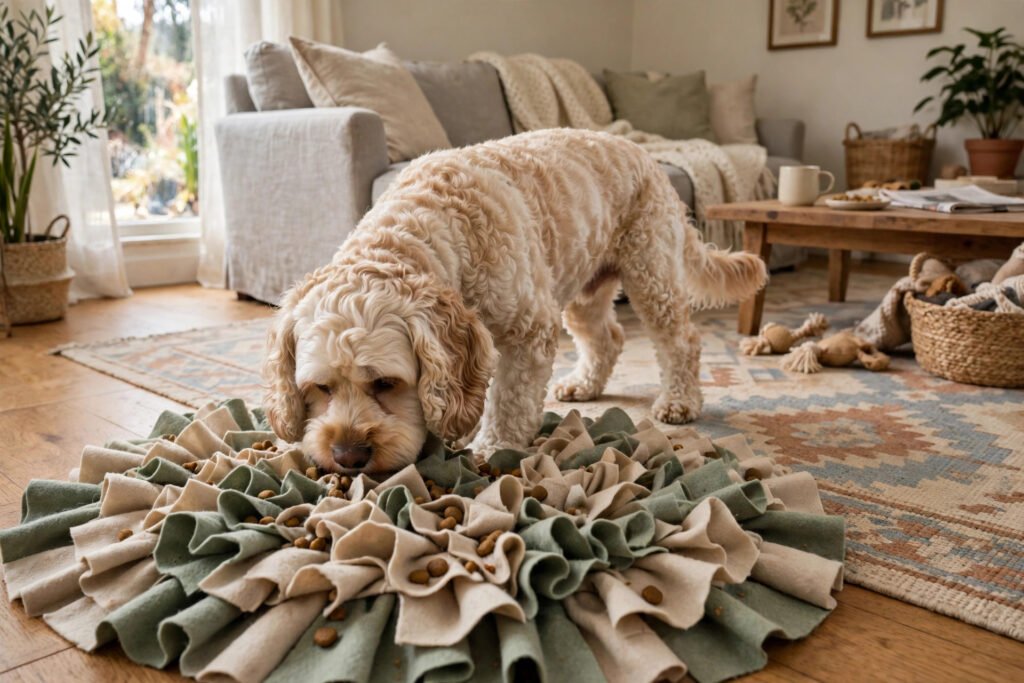
Snuffle mats are fabric mats with folds and flaps that hide kibble or treats. They turn a meal into a foraging session, which is exactly what the spaniel half of a Cockapoo was bred to do. They are easy to make — strips of fleece tied through a rubber mat — or cheap to buy. Use them for one meal a day, and wash them regularly: food gets trapped in the folds.
Frozen Kongs are the best tool for a dog that needs to settle. Fill a Kong with the dog’s kibble mixed with a little plain yogurt or wet food, plug the small end with a smear of xylitol-free peanut butter, and freeze it overnight. A frozen Kong takes a Cockapoo 20 to 30 minutes to work through, and the licking is calming — one of the best things to offer before you leave the house, or during the evening witching hour. Make two or three at a time so one is always ready in the freezer. Always check that any peanut butter you use is xylitol-free — xylitol is toxic to dogs.
Lick mats are flat silicone mats you spread with plain yogurt, mashed banana, or wet food. Licking releases calming endorphins, and a lick mat keeps a Cockapoo still and happy while you brush it, trim its nails, or dry it after a bath. They are also the lowest-calorie option of the three, because a thin smear goes a long way.
The worry owners raise most often about all three is the food: if every enrichment activity involves food, does the dog end up eating too much? It came up directly in the owner discussion mentioned above — the owner liked the snuffle mat and lick mat but did not want to keep loading them with food. The answer is to treat enrichment food as part of the daily ration, not on top of it. Take the kibble out of the bowl and put it into the puzzle, the mat, or the Kong. If a game needs high-value treats, use tiny pieces and cut back the next meal slightly. Balance food enrichment with non-food enrichment — training, scent games without food, and play — so not every activity runs through the stomach. If your dog is gaining weight, talk to your vet about the daily calorie amount before adding more food-based games.
Trick Training: 5 Minutes That Tires a Cockapoo Out
Training is enrichment, and it is the type most owners underestimate. Five minutes of learning something new tires a Cockapoo out more reliably than another lap around the block, because learning is hard mental work.
Start with tricks that are easy to teach and fun to show off: high five, give paw, spin, touch (nose to your hand), and “find it” on cue. Teach one trick at a time, in sessions of about five minutes, two or three times a day. Keep the sessions short on purpose — a Cockapoo that is still keen at the end of five minutes will be keen again tomorrow, while a dog drilled for twenty minutes will switch off and stop offering behavior.
Three training rules that make the difference:
- Reward the thinking, not just the result. The moment your dog tries something — offers a paw, looks at the cup, moves toward the target — mark it with a “yes” and a treat. Dogs that are rewarded for trying keep trying.
- End on a win. Stop after a success, not after a failure. If the dog gets it right twice in a row, that is a good place to stop.
- Raise the difficulty slowly. A puzzle your dog solves instantly is not enrichment; a puzzle it cannot solve at all is frustration. The sweet spot is a challenge the dog can crack in a few minutes with effort. If it gives up and walks away, make it easier and rebuild.
Once the basics are solid, chain tricks together — spin, then high five, then settle on the mat — and the sequence itself becomes the puzzle.
Rotating Toys: The Cheapest Fix There Is
Most Cockapoos do not have too few toys. They have too many toys, all available, all the time — and a toy that is always there is a toy that is invisible. The fix costs nothing: rotate them.
Keep two or three toys out at a time and put the rest in a box. Every two or three days, swap the ones that are out for different ones from the box. A toy that has been away for a week comes back as a new toy.
A few rotation rules:
- Rotate by type, not just by toy. Keep one chew toy, one puzzle or treat toy, and one soft toy or ball out at a time, so the dog always has a different kind of thing to do.
- Retire broken toys promptly. A toy with stuffing coming out or a squeaker exposed is a choking and blockage risk. Check toys every time you rotate.
- Do not buy your way out of boredom. A new toy every week is an expensive habit. Rotation, puzzles, and your time beat a bigger toy box every time.
One exception: a comfort toy — the soft toy or blanket a puppy sleeps with — stays out permanently. That is not a play toy, it is security.
Rainy-Day Indoor Ideas
Bad weather is when boredom bites hardest, because the walk gets shorter and the dog stays inside longer. A rainy-day plan is worth having ready before the rain starts.
- Indoor scent trail. Drag a treat along the floor to lay a scent trail, then hide a small pile of treats at the end. Start with short trails in one room and build up to trails that wind through the house.
- DIY obstacle course. Chairs to walk around, a broom handle across two boxes to step over, a blanket tunnel to crawl through, a cushion to climb on. Keep jumps low or skip them entirely — this is a thinking game, not an agility course, and puppies should not be jumping repeatedly.
- Hide-and-seek with you. Hide behind a door or around a corner and call your dog once. When it finds you, celebrate. This game builds recall at the same time as it burns energy.
- The “which hand” game. Hide a treat in one closed fist, offer both fists, and let the dog nose the right one. Simple, fast, and surprisingly tiring for a dog that has to think.
- Bath-time enrichment. A lick mat stuck to the side of the bath or shower keeps a Cockapoo happily occupied while you wash it — and turns a chore most Cockapoos dislike into something they tolerate, or even enjoy.
The rainy-day rule is simple: on a day when the walk is short, the indoor enrichment must be longer. Two puzzle sessions and a training session replace the missing half of the walk.
A Simple Weekly Enrichment Plan
You do not need a complicated system. One food puzzle, one scent game, and one training session a day, plus toy rotation and a longer activity at the weekend, covers it. Here is a week that fits around work:
| Day | Morning (5–10 min) | Evening (10–15 min) | Notes |
|---|---|---|---|
| Monday | Breakfast in a snuffle mat | Muffin-tin game | Start the week with scent work |
| Tuesday | Breakfast in a puzzle feeder | Trick training: one new trick | Keep the session to 5 minutes |
| Wednesday | Scatter feeding in the yard | Frozen Kong | The Kong covers the witching hour |
| Thursday | Breakfast in a rolled towel | Hide the treat around the house | Make the hides a little harder |
| Friday | Breakfast in a snuffle mat | Trick training: chain two tricks | End the week on a win |
| Saturday | Long walk with sniffing time | DIY obstacle course or fetch | The weekend is for the big outing |
| Sunday | Frozen Kong | Toy rotation day + a calm chew | Swap the toys out for the new week |
Notice what the plan does not include: no extra food, no expensive equipment, and no hour-long sessions. The enrichment is built out of the dog’s normal meals and a few minutes of your time, spread across the day. If a day goes wrong and you miss a session, skip it and pick it up tomorrow. Consistency over weeks beats perfection on any single day.
For puppies, keep everything shorter and simpler: two or three minutes per session, easy puzzles, and no repeated jumping. Puppies tire fast and frustrate fast, and a frustrated puppy learns that puzzles are not worth trying. Build the difficulty up as the puppy grows.
Enrichment Mistakes to Avoid
- Too much food. The most common mistake, and the one that turns a good idea into weight gain. Enrichment food comes out of the daily ration. Weigh the food if you are unsure.
- Too hard, too fast. A puzzle the dog cannot solve is not enrichment, it is frustration — and a frustrated Cockapoo will chew the puzzle, then the furniture. Start easy and build up.
- Leaving a frustrated dog alone with a puzzle. Stay nearby for the first few tries. If the dog is getting upset, make it easier or help it along. A puzzle should end with a win.
- Unsupervised balloons and string. Some older guides suggest tethering a balloon for the dog to chase. Balloons pop, and the pieces are a choking risk; string and ribbon are a blockage risk if swallowed. Skip both.
- Using enrichment as a substitute for company. A frozen Kong buys you thirty minutes, not a workday. A Cockapoo left alone for eight hours with a puzzle is still a lonely dog. If long absences are the issue, the answer is a dog walker, daycare, or a changed routine — not a better puzzle.
- Forgetting the off switch. Enrichment should end with the dog settling down, not more wired than before. Use calm activities — lick mats, chews, gentle scent games — in the evening, and save the wild games for the morning.
Frequently Asked Questions
How do I know if my Cockapoo is bored?
Look for a pattern, not a single sign. A bored Cockapoo usually shows several of these together: chewing things it should not, digging, repetitive barking, pacing, following you from room to room, whining, and losing interest in toys it used to love. The clearest test is the enrichment test — offer a puzzle, a scent game, or a five-minute training session, and see if the behavior stops. If the dog settles into the activity and then naps, boredom was the problem.
How much mental stimulation does a Cockapoo need per day?
Most Cockapoos do well on 10 to 20 minutes of mental work a day, split into two or three short sessions, on top of their normal walks. That can be one meal fed through a puzzle or snuffle mat, a five-minute trick-training session, and a scent game in the evening. It does not need to be an hour, and it does not need to be the same activity every day — variety is part of what makes it work.
Can enrichment replace walks?
No — but it can replace part of a walk on a bad-weather day, and it is often the missing half on a normal day. Walks give a Cockapoo exercise, fresh smells, and new sights; enrichment gives it thinking, problem-solving, and foraging. A dog that gets long walks and no mental work will still be bored, and a dog that gets puzzles and no walks will still be restless. Most Cockapoos need both.
What is the best enrichment toy for a Cockapoo?
There is no single best toy, because the best toy is the one your dog has not solved yet. Start with a stuffed Kong and a snuffle mat — the two most useful for this breed — and add a sliding or spinning puzzle once your dog cracks the easy ones. Rotate them so they stay interesting, and keep some of the daily food for the toys rather than adding extra treats. If your dog destroys puzzle toys rather than solving them, start with easier puzzles and supervise until it learns the idea.
My Cockapoo is bored but will not play with puzzle toys — what should I do?
Make the puzzle easier and the reward better. Start with treats visible and easy to reach — a muffin tin with only two cups covered, a towel loosely rolled with treats poking out — and let the dog win quickly a few times. Some dogs need to be shown the idea: lift the cover yourself, let the dog eat the treat, and repeat until it tries. If your dog ignores food puzzles entirely, try scent games instead (hide the treat is often the game that clicks first), or try training — some Cockapoos would rather work with you than work alone. If the dog will not engage with anything and seems flat or withdrawn, talk to your vet: a sudden loss of interest can be a health problem, not boredom.
Conclusion
A bored Cockapoo is not a bad dog — it is a smart, busy-brained dog with nothing to do, and it will find something to do whether you choose it or not. The fix is smaller than most owners expect: 10 to 20 minutes of mental work a day, built out of the dog’s normal meals and a few minutes of your time, spread across food puzzles, scent games, trick training, and toy rotation. Start with the easiest game, use the food the dog already eats, and watch for the change — a Cockapoo that has worked for its breakfast usually naps afterward, and one that has had something to think about in the evening usually settles instead of pacing the house.
If boredom has already turned into a specific behavior, go to the guide for that behavior next — chewing, digging, and barking each have their own full fix. But if you catch it early, this article is the whole answer: give the dog a job, and the job stops being your furniture.


Leave a Reply