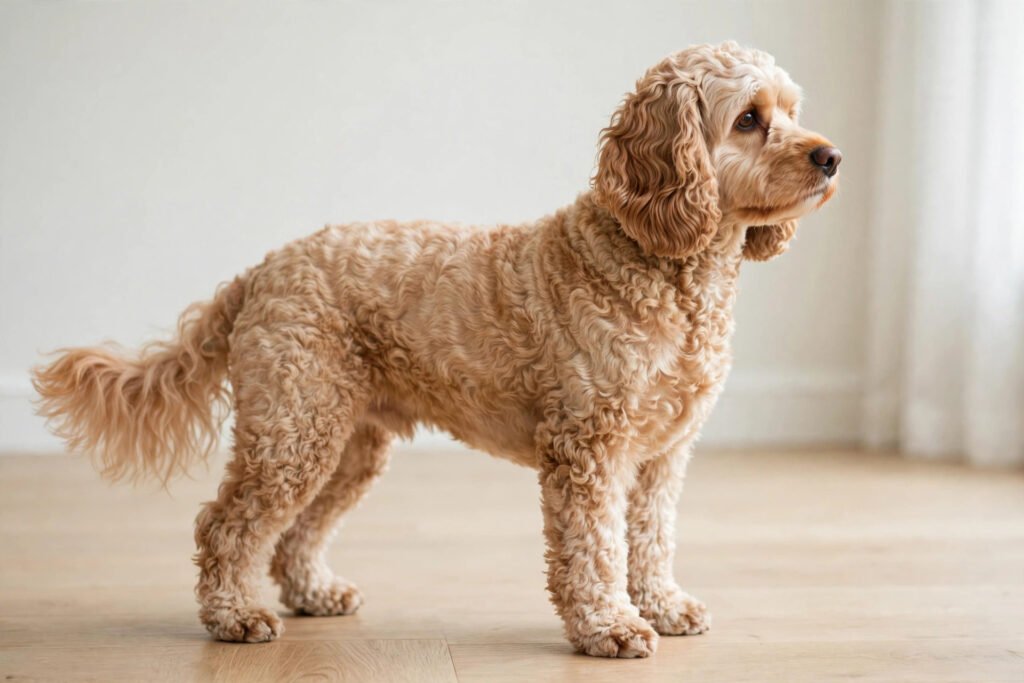
Cockapoos are born with long tails, but some arrive with docked tails. Learn the difference, US vet guidance, and what to ask a breeder before you choose.
Quick answer: Cockapoos are born with long, fluffy tails, usually 8 to 10 inches long. A docked tail is much shorter, about 4 inches, because part of it was removed when the puppy was 2 to 5 days old. Docking is not medically necessary for a pet Cockapoo, and the American Veterinary Medical Association opposes docking done solely for looks.
If you have seen two Cockapoos side by side, you may have noticed something odd: one has a long, feathery tail that waves behind it, and the other has a short stub. Neither dog is a different breed, and neither tail is a birth defect. The difference is docking, a procedure some breeders still perform on newborn puppies and others have stopped doing entirely.
Most pages on this topic are short: a paragraph saying Cockapoos can have either tail, and then they stop. This guide goes further. It explains what a natural tail looks like, what docking actually involves, where US vets and US law stand, the exact questions to ask a breeder, how to read your dog’s tail signals, and how to groom around the tail you have.
What Is a Docked Tail?
Docking means removing part of a dog’s tail, usually when the puppy is only a few days old. In Cockapoos, docking is most often done between 2 and 5 days after birth. Two methods are used: a surgical cut, or a tight band placed around the tail that cuts off blood flow until the end of the tail drops off days later. Docking an adult dog is a different matter: it is a full surgical amputation under anesthesia, with a longer healing time, and it is normally done only for a medical reason, such as a serious injury or disease. If anyone suggests docking an adult pet Cockapoo for looks, ask your vet first.
A short tail on an adult Cockapoo almost always means the tail was docked as a newborn. Cockapoos are very rarely born with naturally short tails. So if your puppy arrives with a stub, that decision was made by the breeder in the puppy’s first days of life, before you ever met the dog.
What Does a Natural Cockapoo Tail Look Like?
Left alone, a Cockapoo tail is long and fluffy. When relaxed, it usually points straight out behind the dog or hangs in a gentle curve. When the dog is excited, it rises and wags freely. Because Cockapoos are a mix of Cocker Spaniel and Poodle, the exact look varies: some tails curl lightly over the back, some hang straighter like a Spaniel’s, and some stand more upright like a Poodle’s. The feathering, the longer hair along the tail, also varies with coat type, from a light fringe to a full plume.
Natural tails are usually about 8 to 10 inches long, though the range is wide, roughly 3.5 to 16 inches depending on the dog’s size and which parent breed it favors. A smaller Cockapoo tends to have a shorter tail than a larger one, just as it tends to be shorter overall. For the size picture, including how height and weight vary across Toy, Miniature, and Standard crosses, see our guide to how big Cockapoos get.
 CockapooDaily
Natural vs Docked Tail: A Quick Comparison
| Feature | Natural tail | Docked tail |
|---|---|---|
| Length | Usually about 8 to 10 inches | Usually no more than about 4 inches |
| Look | Long, fluffy, feathered | Short stub, often with a small tuft |
| When decided | Never altered | First 2 to 5 days of life, by the breeder |
| Breed standard | Accepted by the American Cockapoo Club | Also accepted, at about 4 inches when docked |
| Wagging | Full range of motion and signal | Shorter wag, still readable with body language |
| Grooming | Needs regular brushing to prevent mats | Less hair, but the stub still needs checking |
| Health need | None | No medical benefit for a pet dog |
The American Cockapoo Club position is worth knowing because it surprises many buyers: the tail can be left long or docked like the parent breeds, and when docked it should be about 4 inches long. The Cockapoo is not recognized as a breed by the American Kennel Club, so there is no AKC conformation standard that requires a Cockapoo to have a docked tail. A natural tail does not make a Cockapoo any less of a Cockapoo.
Why Do Some Breeders Dock Cockapoo Tails?
Docking is a tradition inherited from the parent breeds. Both Cocker Spaniels and Poodles were traditionally docked, originally for working reasons: the idea was that a shorter tail was less likely to be injured in brush, brambles, or rough terrain while hunting. Older beliefs also claimed docking prevented rabies or strengthened the back, ideas modern veterinary science does not support.
Today, for a companion Cockapoo, the reasons breeders give are different:
Tradition and looks. Some breeders like the classic docked silhouette they associate with Spaniels and Poodles, and some buyers expect it because that is what they have seen before.
Cleanliness. A shorter tail collects less dirt, burrs, and debris. This is a real, if modest, grooming convenience, though a natural tail is easy to keep clean with regular brushing.
Injury prevention. Some breeders argue a long tail is more likely to be stepped on or caught in a door. Veterinary guidance, however, notes that most pet dogs never suffer a tail injury serious enough to justify removing part of the tail in advance.
Habit. Some breeders dock simply because that is what they have always done with their litters, and because the parent breeds’ standards still describe docked tails.
None of these reasons is a medical need for a family pet. That distinction matters for the next section.
US Practice and Vet Guidance
In the United States, cosmetic tail docking is still legal in most states, and it remains common enough that many Cockapoo puppies in breeder listings are described as having docked tails. That is why US breeder listings dominate search results for this keyword: the phrase “docked tail” appears in for-sale ads far more often than in advice articles.
Veterinary guidance points the other way. The American Veterinary Medical Association (AVMA) opposes ear cropping and tail docking of dogs when done solely for cosmetic purposes, and it encourages removing these procedures from breed standards. The AVMA’s reasoning is straightforward: a surgical procedure done only for appearance has no medical benefit to the dog, and the dog gains nothing from the altered look. Many US breeders now agree, and a growing number advertise natural, undocked tails as a selling point.
US law is a patchwork, not a single national rule. There is no federal ban on cosmetic docking. A few states restrict who may perform it: Maryland and Pennsylvania, for example, require docking to be done by a licensed veterinarian or under veterinary supervision, with rules that depend on the puppy’s age. Other states have considered bans that did not pass. This article is not a legal guide, and rules change, so if the legal side matters to your decision, check your own state’s current rules or ask your vet.
The practical takeaway for a US buyer is simple. Docking is a breeder decision made before you choose a puppy, not something you can easily undo later. If tail length matters to you, ask before you commit, not after you bring the puppy home.
What to Ask a Breeder About the Tail
Ask these questions before you place a deposit. A good breeder will answer them plainly, whichever policy they follow:
Do you dock tails, leave them natural, or decide litter by litter? This tells you whether you have a choice at all.
Who performs the docking, and when? Docking should be done by a veterinarian in the puppy’s first days of life. Be cautious of a breeder who docks litters themselves without veterinary involvement.
Can I choose a puppy with a natural tail? Some breeders keep some litters natural. If tail length matters to you, this is the question that saves disappointment.
Is the tail length listed in the puppy’s records? A docked tail, a natural tail, and any tail injury should all be noted, so your vet has an accurate history.
What does the price cover, and does tail type change it? Tail length should not be a reason to pay more. If a breeder charges extra for a docked or natural tail, ask what else that price includes, and compare it against the full first-year budget in our guide to how much a Cockapoo costs.
How do you handle a puppy with a tail injury? This reveals how carefully the breeder watches newborn litters, docked or not.
Red flags are a breeder who will not say who docked the tails, who offers to dock an older puppy for you, or who claims docking is required for a Cockapoo to be registered or healthy. None of those claims holds up: docking is not a registration requirement for Cockapoos, and a natural tail is not a health problem.
Do Docked Tails Affect Wagging and Communication?
A tail is one of a dog’s main communication tools, and docking shortens that tool without removing it entirely. A docked Cockapoo still wags, still tucks its tail when nervous, and still raises it when alert. What changes is how easy those signals are for other dogs, and for you, to read at a distance.
Here is how to read the main tail signals, docked or natural:
Loose, wide wag with a wiggly body. Usually happy, relaxed, and friendly. This is the classic Cockapoo greeting wag.
High, stiff, fast wag with a tense body. Alert, aroused, or unsure, not necessarily friendly. Read the whole dog: stiff legs, hard eyes, and a forward posture mean caution, even if the tail is moving.
Low or tucked tail. Fear, anxiety, or submission. A tucked tail paired with cowering or avoiding eye contact means the dog wants space.
Still tail, held out straight. Focus or uncertainty. The dog is assessing something. Give it a moment rather than pushing closer.
No wag at all. Some dogs wag less by personality, and a very short or curly tail can be harder to see moving. A sudden stop in wagging in a dog that normally wags a lot, especially with a limp or painful tail, is worth a vet check.
Wagging direction has also been studied: research in dogs suggests wags biased to the dog’s right side tend to go with positive feelings, while left-biased wags tend to go with negative ones. This is interesting, not a diagnostic tool. The reliable read is always the whole dog: tail plus body posture, ears, face, and context together.
One practical point for docked dogs: other dogs read tail signals too, and a very short tail gives them less to read. That does not make a docked Cockapoo antisocial, but it is one more reason to watch early greetings with unfamiliar dogs and to let your dog approach at its own pace.
Grooming Around the Tail
Tail grooming is simple, but it is the area owners most often skip, and skipped tails mat fast.
For a natural tail: brush the tail 2 to 3 times a week with a slicker brush, working through the feathering in sections from the base outward. Check behind the tail and around the base, where mats hide, especially after walks in wet grass or brush. At bath time, wash and fully dry the feathering; damp, matted tail hair can irritate the skin underneath. A groomer can thin or shape the plume, but ask for a natural, feathered finish unless you want a clipped look.
For a docked tail: there is less hair, but the stub still needs attention. Check the tip for redness, scabs, or sensitivity, and brush the small tuft gently so it does not mat against the body. Keep the area around the base clean after bathroom trips, since a short tail sits closer to the rear.
For both tail types: look at the tail during every grooming session. Check for cuts, burrs, ticks, bald patches, or a tail that suddenly hangs limp. A limp tail that appears after swimming or heavy exercise can be “limber tail,” a painful but usually temporary condition that deserves a vet call. A tail that is repeatedly banged against walls and furniture can develop “happy tail,” a split at the tip that bleeds and is slow to heal because the dog keeps wagging. Both conditions are easier to catch early if you handle the tail regularly, so make tail checks part of brushing from puppyhood.
Tail feathering also comes in many colors, and a tail can carry a different shade or marking than the rest of the coat. If you are curious about how coat colors and markings vary across the breed, see our guide to Cockapoo colors.
Docking Rules in Other Countries
If you are buying from abroad, moving overseas, or simply wondering why Cockapoos in other countries almost always have long tails, the picture is very different from the United States.
United Kingdom. Cosmetic docking is heavily restricted. Docking is generally banned, with a narrow exception for certain working dogs, such as some spaniels, docked by a vet before 5 days old and certified for lawful work. A pet Cockapoo in the UK will normally keep its natural tail, and UK breeders list puppies as undocked as a matter of course.
Netherlands and much of Europe. Cosmetic docking is banned in the Netherlands, with medical reasons as the exception, and similar bans or heavy restrictions apply across much of Europe, including Germany, Sweden, Norway, and Finland. A Cockapoo from these countries will normally have a natural tail.
Canada. There is no single national rule. Several provinces have laws against cosmetic docking, and most provincial veterinary associations prohibit their members from performing it, but the details vary by province, and Ontario has lagged behind the rest. A Canadian puppy’s tail depends on its province and its breeder, so ask the same breeder questions as in the United States.
Taiwan. By contrast, Taiwan appears in country-by-country listings as unrestricted for tail docking, meaning no ban is recorded there. That does not mean docking is common for pet Cockapoos in Taiwan, only that buyers there cannot assume the same restrictions as in the UK or the Netherlands.
The US angle stays the same whatever the comparison: in the United States, a Cockapoo’s tail length is a breeder choice made in the first days of life, and the AVMA opposes docking done only for looks. If you move abroad with a docked dog, check the destination’s import and veterinary rules well in advance, since a docked tail that is unremarkable in the US can raise questions elsewhere.
Frequently Asked Questions
Do all Cockapoos have docked tails?
No. Cockapoos are born with long tails, and many breeders now leave them natural. Some breeders still dock, so Cockapoo puppies can arrive with either a long tail or a short stub. Neither is a fault, and neither affects the dog’s health as a pet.
How can I tell if my Cockapoo’s tail was docked?
A natural tail is long, usually about 8 to 10 inches, and moves through a full range. A docked tail is a short stub, usually no more than about 4 inches, often with a small tuft at the tip. If you are unsure, your vet can tell from the tail’s length and shape, and the breeder’s records should note it.
Is tail docking painful for puppies?
Docking removes part of the tail, and veterinary guidance treats it as a painful procedure, even in very young puppies. The older idea that newborn puppies do not feel it because their nervous systems are undeveloped is not supported by current veterinary understanding. This is one reason the AVMA opposes docking done solely for cosmetic purposes. For any specific puppy, ask your vet rather than relying on breeder folklore.
Can an older Cockapoo’s tail be docked?
Technically yes, but only as a surgical amputation under anesthesia, with a longer and more painful recovery than newborn docking. Vets normally do this only for a medical reason, such as a severe injury, a tumor, or a tail that cannot heal. Docking an adult pet Cockapoo for looks is not standard practice, and you should discuss it with your vet before considering it.
Does a docked tail affect balance or wagging?
A docked Cockapoo can still wag, run, and balance normally. The tail is a communication tool and a small balance aid, but dogs adapt well to a shorter tail. What changes is readability: a short tail gives other dogs, and you, fewer signals to read, so watch body language as a whole rather than the tail alone.
Conclusion
A Cockapoo’s tail tells a story about its breeder, not about its quality as a pet. Natural tails are long, fluffy, and expressive, usually about 8 to 10 inches. Docked tails are short stubs of about 4 inches, decided in the puppy’s first days of life. US vet guidance opposes docking done only for looks, US law leaves the choice mostly to breeders, and other countries restrict or ban it. Whichever tail your Cockapoo has, the work is the same: ask the breeder honest questions before you commit, learn to read the tail signals you have, and keep the tail brushed, checked, and healthy. That is what turns a small detail into a dog you understand better.


Leave a Reply