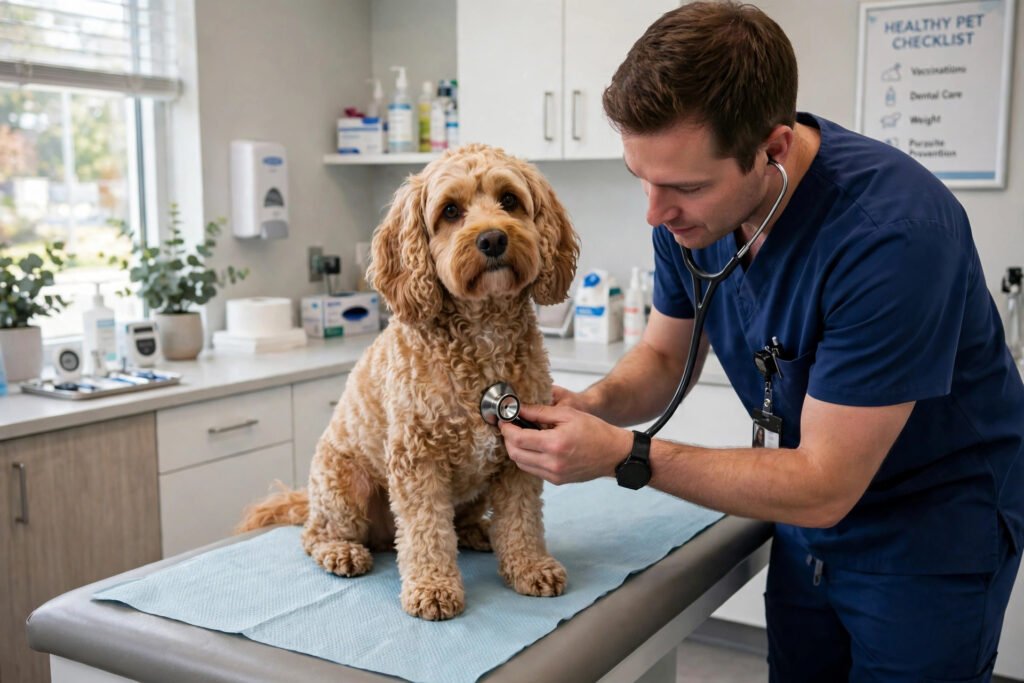
Most Cockapoos live long, healthy lives, but ear infections, allergies, and joint problems are common. Learn the warning signs and prevention steps.
Quick answer: Most Cockapoos are healthy dogs that live 12 to 15 years, but they are prone to ear infections, skin and food allergies, dental disease, luxating patella, and eye conditions such as cataracts and progressive retinal atrophy. Weight control, weekly ear checks, daily tooth brushing, and breeder health testing prevent more problems than any treatment can fix.
If you are researching Cockapoo health before buying a puppy, or you already have one and want to know what to watch for, this guide gives you the honest picture. Cockapoos are generally healthy, and most of the problems below are manageable — especially when caught early. The difference between a minor issue and an expensive one is usually how quickly an owner spots the warning sign and acts on it.
One important caveat first: this guide helps you recognize problems and prevent them. It does not diagnose your dog. If you see a warning sign below, call your veterinarian rather than trying to treat it at home.
The Big Picture: Generally Healthy, With a Few Predictable Weak Spots
Cockapoos inherit traits from both parent breeds — the Cocker Spaniel and the Poodle — and their health risks come from both sides. The floppy, hairy ears come largely from the Cocker Spaniel side and explain the breed’s most common problem. The small size explains the joint and dental problems. The Poodle side contributes several inherited eye conditions.
That mixed heritage is not all bad news. Crossbreeds often avoid the worst extremes of either parent breed, and many Cockapoos live into their mid-teens with no serious illness at all. The goal of this guide is not to worry you. It is to rank the risks honestly, so you spend your attention — and your vet budget — where it matters most.
 CockapooDaily
Common Problems: What Most Owners Will Actually Deal With
These are the conditions Cockapoo owners are most likely to encounter. They are common, they are usually manageable, and prevention genuinely works for most of them.
Ear infections
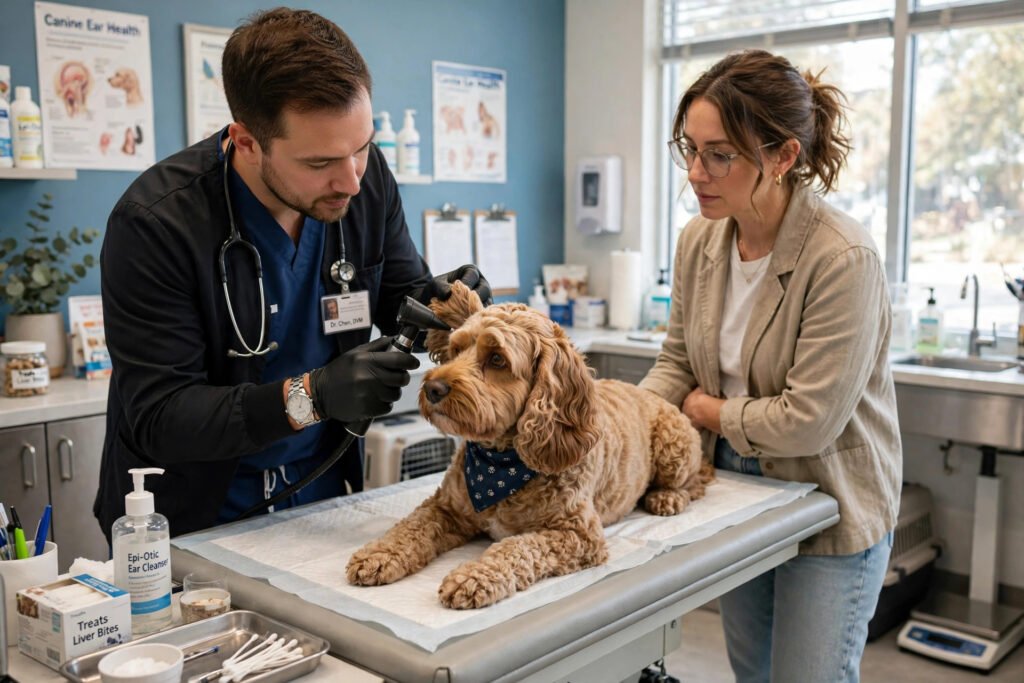
Ear infections are the single most common Cockapoo health problem, and they are the one most owners underestimate. Floppy ears trap warmth and moisture, and hair inside the ear canal traps debris on top of that. The result is an ideal environment for yeast and bacteria.
Warning signs: head shaking, scratching at the ears, rubbing the ears on furniture or the floor, redness or swelling inside the ear, a bad smell, dark discharge, or pain when you touch the ear.
Prevention: check the ears weekly, keep them dry after baths and swimming, and clean them with a veterinarian-approved solution when your vet shows you how. Do not poke cotton swabs deep into the canal — that pushes debris further in. If infections keep coming back, ask your vet about allergies, because recurring ear infections are often an allergy symptom rather than a standalone ear problem.
For the full picture, including cleaning steps and when an infection needs urgent care, see our guide to Cockapoo ear infections.
Skin and food allergies
Allergies are the second most common issue, and they are frequently the hidden cause behind itching, paw licking, recurring ear infections, and stomach upset. Cockapoos can develop food allergies (often to a specific protein), environmental allergies (pollen, dust mites, grass), or both.
Warning signs: itching that does not settle, red or irritated skin, licking or chewing the paws, recurring ear infections, vomiting, diarrhea, or soft stools that keep returning.
Prevention: feed a complete, balanced diet and change foods slowly; bathe regularly with a gentle, dog-safe shampoo; wipe paws after walks during pollen season; and keep flea prevention current, since flea allergy can look exactly like a food or environmental allergy. Do not start an elimination diet on your own — it only works if it is strict, and your vet should supervise it.
Our guide to Cockapoo food allergies and their symptoms explains how vets separate food allergy from environmental allergy, so you do not spend months guessing.
Dental disease
Small jaws and crowded teeth make Cockapoos prone to plaque buildup, gum disease, and tooth loss. Dental disease is easy to ignore because it builds slowly — and it matters more than most owners realize, because bacteria from infected gums can affect the heart, liver, and kidneys over time.
Warning signs: bad breath that does not improve, red or bleeding gums, tartar buildup along the gum line, dropping food, chewing on one side, or reluctance to eat hard food.
Prevention: brush your dog’s teeth daily with dog toothpaste (never human toothpaste), offer veterinarian-approved dental chews, and schedule professional cleanings when your vet recommends them — typically every 6 to 12 months for dogs prone to buildup. Daily brushing is the single most effective step, and it costs almost nothing.
Luxating patella (slipping kneecap)
Luxating patella means the kneecap slips out of its groove in the thigh bone. It is common in small breeds, including Cockapoos, and it ranges from mild to severe. Vets grade it from 1 to 4: grade 1 means the kneecap is loose but stays in place during normal movement, while grade 4 means it is permanently out of place and cannot be pushed back.
Warning signs: a skipping step or brief hop on one back leg, occasional limping that comes and goes, reluctance to jump or climb stairs, or stiffness after rest.
Prevention: keep your dog at a healthy weight, avoid repetitive jumping from heights (use ramps or steps for cars and tall beds), and build leg strength with regular, moderate exercise rather than sudden bursts. Mild cases often need only weight control and monitoring; severe cases may need surgery, which is why early detection matters — a grade 1 problem caught young is far easier to manage than a grade 4 problem found late.
Hip dysplasia
Hip dysplasia is a malformation of the hip joint that is strongly inherited. It is less common in Cockapoos than in large breeds, but it still occurs, and it can appear early — some affected dogs show stiffness or lameness before six months of age, while others show no signs until they are older.
Warning signs: wobbling or discomfort when standing, stiffness after rest, reluctance to run or climb stairs, a bunny-hopping gait, or lameness in a back leg.
Prevention: choose a breeder who screens breeding dogs with hip X-rays (see the checklist below), keep your puppy at a healthy weight, avoid over-exercising a growing puppy on hard surfaces, and do not let a puppy repeatedly jump from heights. Weight control is the most powerful tool you already have: every extra pound loads a faulty joint further.
Obesity
Obesity is not a breed-specific disease, but it is one of the most common Cockapoo problems because it makes almost every other problem worse. Extra weight strains joints, worsens breathing, increases anesthesia risk, and shortens lifespan. Cockapoos are enthusiastic eaters and very good at begging, which makes portion control a real discipline test.
Warning signs: you cannot easily feel the ribs under a thin layer of fat, there is no visible waist when viewed from above, or your vet has flagged weight gain at consecutive visits.
Prevention: measure food rather than free-feeding, count treats as part of the daily total, keep daily exercise consistent, and weigh your dog regularly. If you are unsure how much to feed, your vet can calculate it for your dog’s size and activity level.
Eye Conditions: Cataracts, PRA, and Glaucoma
Eye problems deserve their own section because several different conditions affect Cockapoos, they can look similar to an untrained eye, and some of them are emergencies.
Cataracts cloud the lens of the eye. They can be hereditary or age-related, and they range from a small cloudy spot that barely affects vision to a fully opaque lens. Warning signs: a cloudy, bluish-gray haze in the pupil, bumping into furniture, or reluctance to go down stairs or into dark rooms. Some cataracts need only monitoring; others can be removed surgically by a veterinary ophthalmologist.
Progressive retinal atrophy (PRA) is an inherited disease in which the retina gradually degenerates, leading to blindness over time. There is no cure, but dogs adapt remarkably well to vision loss when their home environment stays consistent. Warning signs: night blindness or difficulty seeing in low light, dilated pupils, and bumping into objects, often starting between 1 and 4 years of age for some forms (a late-onset form, PRA-rcd4, averages diagnosis around 10 years). Because PRA is genetic, breeder DNA testing is the real prevention — see the checklist below.
Glaucoma is increased pressure inside the eye, and it is the eye emergency on this list. It is painful, it can cause sight loss quickly, and it needs same-day veterinary care. Warning signs: a suddenly red, painful, or swollen-looking eye, watery discharge, squinting, pawing at the eye, or a visibly enlarged eyeball. If you see these signs, do not wait for a routine appointment.
A related but less serious issue is entropion, where the eyelid rolls inward so that skin and hair rub the surface of the eye. It usually shows up in puppies from around eight weeks of age, often as recurrent eye irritation, and it is usually fixed with a simple corrective surgery.
Rare but Serious: Know Them, Don’t Fear Them
These conditions are uncommon, but they are serious enough that knowing their warning signs is worthwhile. Competitor guides usually either omit them or inflate them into scare lists. The honest position is in between: unlikely for any individual dog, but worth a vet visit if the signs appear.
| Condition | What it is | Warning signs |
|---|---|---|
| Familial nephropathy | Inherited kidney developmental abnormality that can lead to early kidney failure | Excessive thirst, increased urination, weight loss |
| Mitral valve disease | Heart valve disease that can progress to heart failure if unmanaged | Coughing, exercise intolerance, rapid breathing, fainting |
| Phosphofructokinase deficiency | Inherited enzyme deficiency affecting red blood cells | Fever, dark or discolored urine, anemia, especially after vigorous exercise |
| Sebaceous cysts | Non-cancerous, oil-filled lumps under the skin | Lumps under the skin, swelling or redness around a lump, discomfort when touched |
None of these should drive a puppy-buying decision on their own. All of them are reasons to choose a breeder who health-tests, and to take new symptoms seriously rather than waiting to see if they pass.
The Breeder Health-Test Checklist
Most inherited Cockapoo problems can be reduced — not eliminated — by choosing a breeder who tests the parent dogs. Before you commit to a puppy, ask for evidence of these checks. A reputable breeder will show you results willingly; reluctance is itself an answer.
- Eye testing: current eye examination for both parents, plus DNA testing for PRA (including PRA-rcd4) where available for the parent breeds.
- Patella evaluation: veterinary grading of both parents’ kneecaps (grades 1 to 4, as described above).
- Hip screening: hip X-rays scored for both parents.
- DNA panel: breed-appropriate genetic screening covering the inherited conditions relevant to Cocker Spaniels and Poodles.
- General health records: vaccination, deworming, and veterinary examination records for the litter, plus a written health guarantee.
- The parents themselves: meet at least the mother, check her weight, coat, ears, and temperament, and ask how previous litters have done as adults.
No test guarantees a healthy puppy. Cockapoos are a crossbreed, and even well-tested parents can produce a puppy that develops a problem. But a breeder who tests is stacking the odds in your favor, and a breeder who does not is asking you to take the risk blind.
Prevention routine at a glance
- Every day: tooth brushing, eyes-and-skin glance, measured food, exercise
- Every week: ear check, paw and coat check, weight check
- Every month: flea and parasite prevention, nail check
- Every 6–12 months: vet wellness visit, dental assessment, weight review
Prevention-First Care: The Routine That Covers Most of It
If this whole guide were reduced to one routine, it would be this:
- Every day: tooth brushing, a glance at eyes and skin, measured food, and regular exercise.
- Every week: an ear check (and cleaning when needed), a paw and coat check, and a quick weight and body-shape check.
- Every month: flea and parasite prevention on schedule, and a nail check.
- Every 6 to 12 months: a veterinary wellness visit, dental assessment, and weight review — more often for seniors.
- Throughout life: a healthy weight, prompt vet visits for new symptoms, and records of anything unusual so your vet sees the pattern, not just one bad day.
This routine also explains why several of our other guides exist. Ear care, allergy management, and senior care each deserve their own detail, and this article deliberately links to them rather than repeating them. A dog that is not eating, drinking, or behaving normally, or that shows a sudden change in any symptom above, should see a vet promptly — waiting rarely makes a health problem cheaper or simpler.
For the long view, including what changes as your Cockapoo ages, see how long Cockapoos live and our guide to senior Cockapoo care. And if your dog suddenly starts snorting or honking, that is usually a different, mostly harmless issue — see Cockapoo reverse sneezing before you panic.
Frequently Asked Questions
What is luxating patella in Cockapoos? A joint condition where the kneecap slips out of place — common in small-breed dogs, including Cockapoos. The classic sign is a sudden skip or limp for a few steps, then the dog carries on as normal; if you notice your Cockapoo limping or favouring a leg, book a vet check.
Are Cockapoos prone to obesity? Yes — Cockapoos are prone to overeating, so weight management is essential. Measure food rather than free-feeding, count treats inside the daily calories, and weigh your dog regularly; extra weight makes joint problems like hip dysplasia and luxating patella worse.
What eye problems should I watch for in a Cockapoo? Progressive retinal atrophy (PRA, gradual sight loss), cataracts (clouding of the lens), and glaucoma (painful pressure build-up in the eye). Night-vision problems, bumping into things, cloudy eyes, or a red, painful eye all need a vet visit — glaucoma can damage vision fast if it is not treated.
Do Cockapoos get heart disease? They can — Cocker Spaniels and Poodles are both prone to heart conditions, including mitral valve disease, patent ductus arteriosus, and cardiomyopathy. Heart disease is most commonly seen in older Cockapoos, which is why a vet listening to the heart at every check-up matters.
What is Cockapoo rage syndrome? The name owners use for sudden onset aggression syndrome (SOAS), linked to the Cocker Spaniel side of the breed — a dog that suddenly snaps with no warning. It is rare, and any sudden aggression should be checked by a vet first (pain and medical causes come first), then by a qualified behaviourist if the vet finds nothing physical.
What is the most common health problem in Cockapoos?
Ear infections. Floppy, hairy ears trap moisture and debris, creating the perfect conditions for yeast and bacterial infections. Weekly ear checks, keeping ears dry after baths and swimming, and treating recurring infections as a possible allergy sign will prevent most cases.
Do Cockapoos have a lot of health problems?
No — Cockapoos are generally healthy and typically live 12 to 15 years. Most owners will deal mainly with ear infections, allergies, and dental care. Joint and eye conditions are less common but worth screening for, and choosing a health-tested breeder lowers the odds further.
Are Cockapoos prone to hip dysplasia?
They can be, though it is less common than in large breeds. Hip dysplasia is inherited, so breeder hip screening matters. Keeping your dog at a healthy weight and avoiding excessive jumping in puppyhood are the two prevention steps owners control directly.
What health tests should a Cockapoo breeder do?
At minimum: eye examinations and PRA DNA testing, patella grading, hip X-rays, and a breed-appropriate DNA panel for both parents, plus full veterinary records for the litter. Ask to see the actual results, not just a verbal assurance.
When should I take my Cockapoo to the vet urgently?
Seek same-day care for a suddenly red, painful, or swollen eye (possible glaucoma), difficulty breathing, fainting, uncontrolled bleeding, a swollen abdomen, or any sudden collapse. For new limping, itching, ear odor, or appetite changes, book a prompt routine visit and note when the symptom started.
Conclusion
Cockapoo health is mostly a story of a few predictable problems handled well. Ear infections, allergies, dental disease, and weight gain are common but largely preventable with a steady routine. Luxating patella, hip dysplasia, and eye conditions are less common but real, and they are exactly why breeder health testing matters before you bring a puppy home. The rare-but-serious conditions on this list are unlikely for any individual dog — but knowing their warning signs means you will act fast if they ever appear.
The prevention-first rule is simple: check ears weekly, brush teeth daily, keep weight under control, choose a breeder who tests, and call your vet early when something changes. Do that, and most Cockapoos reward you with a long, healthy life.


Leave a Reply