
When do cockapoos calm down? There are two calm-downs: maturity (1–3 years) and senior slowdown (7+). Age-by-age energy timeline, how to get there sooner, and the neutering myth.
Quick answer: Most cockapoos noticeably settle between 1 and 3 years old — with the biggest change around age 2 — as training and maturity kick in. A second, age-related slowdown comes at 7+ years. But “calm” for this breed never means couch potato: expect a playful, social adult, just one with an off-switch. Consistent training and the right exercise mix can bring the calm noticeably sooner.
Search “when do cockapoos calm down” and you’ll get two wildly different answers: “1 to 2 years” and “7 years.” Both are true — they’re describing two completely different things. Once you see the distinction, the timeline makes sense.
Two Calm-Downs, Not One
| Calm-down | When | What it is |
|---|---|---|
| Maturity | 1–3 years | The brain catches up with the body. Training sticks, impulse control develops, the off-switch appears. This is the one owners are asking about. |
| Senior slowdown | 7+ years | Age-related mellowing. Less stamina, longer naps, grayer muzzle. Biology, not behavior. |
Every page that says “7 years” is describing old age. Every page that says “1–2 years” is describing growing up. Nobody on page 1 separates them — which is why the answers look contradictory. From here on, “calming down” means the maturity one.
The Honest Answer: 1–3 Years (Biggest Change ~2)
The consensus across breeders, trainers, and experienced owners: you’ll see the first real settling somewhere in year two, with continued mellowing through year three. By 3, most cockapoos are recognizably adult dogs — still bouncy when excited, but capable of lying quietly while you work, walking without pulling your arm off, and greeting guests without launching at their faces.
The honest caveat: individual variation is wide. Some calm at 18 months; some take until 3. Training quality moves the needle more than genetics.
Age-by-Age Energy Timeline
0–6 months: The land shark. Maximum chaos, minimum control. Biting, zoomies, zero attention span. This is normal — see how to stop cockapoo puppy biting. Your job is management and foundation, not calm.
6–18 months: The adolescent. Often wilder than puppyhood — bigger, faster, stronger opinions. Boundary-testing, selective hearing, and the “second fear period” (roughly 6–14 months) where a confident puppy suddenly startles at familiar things. Regression in training is normal here. This is the stretch that breaks owners; it’s also the stretch where training pays the most.
1–3 years: The young adult. The brain’s impulse-control wiring finishes developing. Training starts working reliably instead of situationally. Energy is still high, but it’s now channelable — this is the agility, fetch-marathon, hiking-buddy phase.
3–7 years: The adult. The sweet spot. Playful and social, but with a genuine off-switch. Settles in the house, explodes appropriately at the park.
7+ years: The senior. The second calm-down. Shorter walks, longer naps, less interest in chaos. Adjust exercise down and enjoy the mellowest version of your dog.
The calm-down timeline at a glance
- 0–6 months: The land shark — maximum chaos, minimum control; biting and zoomies are normal.
- 6–18 months: The adolescent — often wilder than puppyhood; boundary-testing peaks.
- 1–3 years: The young adult — impulse control finishes developing; training starts working reliably.
- 3–7 years: The adult — the sweet spot: playful and social, with a genuine off-switch.
- 7+ years: The senior — the second calm-down: shorter walks, longer naps.
 CockapooDaily
Why Are They So Hyper in the First Place?
It’s not a flaw — it’s the job description. Cockapoos combine two working breeds: the Poodle’s sharp intelligence and the Cocker Spaniel’s famously endless field energy. The result is a dog bred, twice over, to work all day and think while doing it. A bored cockapoo isn’t being naughty — it’s an unemployed working dog inventing its own job, usually involving your shoes.
This heritage also explains why they “remain puppy-like well into their adult years.” Playfulness isn’t immaturity in this breed; it’s temperament.
Physical vs Mental Maturity: The Hidden Gap
Here’s what trips up owners at 12–18 months: the dog looks grown but the brain isn’t done. Physical maturity arrives around a year; mental maturity — reliable impulse control, emotional regulation — takes until 2–3.
During the gap you’ll see:
– Training that works at home but evaporates at the park (arousal overrides learning)
– Boundary-testing: rules the puppy accepted get re-litigated
– The second fear period: sudden spookiness about things that were fine before — stay calm, don’t force confrontation, keep it positive
None of this is regression in the permanent sense. It’s the brain remodeling. Stay consistent and it resolves.
 CockapooDaily
What “Calm” Actually Looks Like (Manage the Expectation)
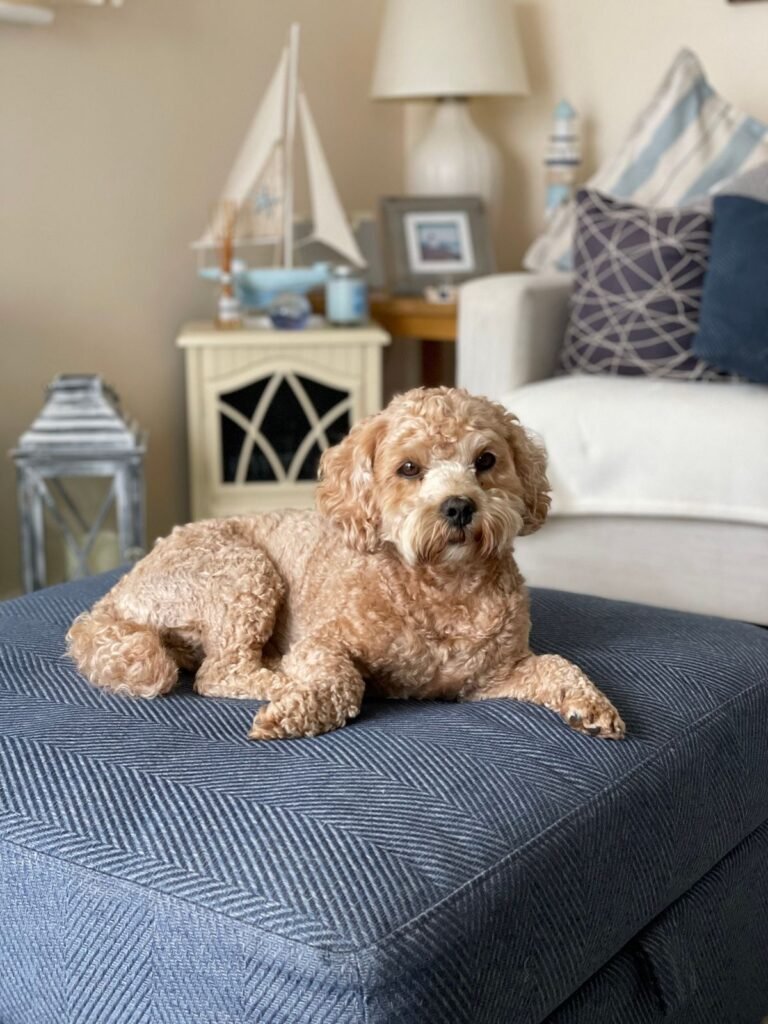
Let’s prevent disappointment: a calm cockapoo is not a calm Labrador. Realistic adult-cockapoo calm looks like:
– Settles on a bed while you work — after morning exercise
– Greets guests enthusiastically but recovers in minutes, not hours
– Walks nicely most of the time
– Still zooms after baths, still play-bows at other dogs, still steals socks occasionally
If you wanted a dog that naps 20 hours a day, this was never that breed — and most owners, once through the adolescent storm, report missing the peak-energy days. The goal was never a different dog. It was this dog, with an off-switch.
How to Get There Sooner: The Levers That Work
1. Impulse control is the mechanism. “Training” doesn’t calm dogs by tiring them — it builds the brain’s braking system. Three commands do most of the work: sit (the pause button), leave it (the redirect), and settle/place (the off-switch). A dog that can hold a settle while exciting things happen is a dog that’s learning to regulate arousal. Practice daily in gradually harder contexts.
2. Match exercise to age.
| Age | Daily exercise | Notes |
|---|---|---|
| Under 6 months | 5 min per month of age, 1–2x daily | A 4-month-old gets ~20 min walks. Growing joints — no forced running. |
| 6–12 months | 30–45 min | Add fetch, tug, swimming as joints allow |
| 1–7 years | 30–60+ min | The full menu: hikes, fetch, agility, swimming |
| 7+ years | 20–30 min, gentler | Shorter, softer surfaces; watch for stiffness |
3. Tire the brain, not just the legs. Fifteen minutes of nose work (snuffle mat, “which hand” game, hiding treats) exhausts a cockapoo more than a long walk. Mental fatigue is the shortcut: a physically tired dog is fit; a mentally tired dog is calm. Puzzle feeders (Kong Classic, Nina Ottosson puzzles), frozen Kongs, and toy rotation all count.
4. Enforce rest. An overtired adolescent is indistinguishable from a hyperactive one. Puppies need 16–20 hours of sleep; adolescents still need 14+. A crate or pen for enforced naps isn’t punishment — it’s the off-switch you’re installing.
5. Never punish energy. Punishing a dog for being energetic doesn’t teach calm — it teaches anxiety about expressing itself, which usually leaks out as worse behavior. Redirect, don’t suppress.
Energy or Anxiety? (The Diagnostic)
What looks like hyperactivity is sometimes distress wearing a costume. Check before you train harder:
| High energy | Anxiety / boredom | |
|---|---|---|
| Destructive behavior | Rare; plays hard then crashes | Chews, digs, barks mainly when alone |
| Alone time | Settles after initial excitement | Pacing, drooling, escape attempts, distress vocalizing |
| Settles after exercise? | Yes — a good walk produces a calm dog | No — still wired, or crashes into restless sleep |
| Fix | More structured exercise + impulse training | Alone-time training, enrichment while away, possibly vet behaviorist |
Separation anxiety needs a different protocol than excess energy. Training a truly anxious dog harder just makes a fitter anxious dog.
Alone-time limits: puppies max ~2 hours; healthy adults 4–6 hours. Beyond that, even a well-adjusted cockapoo — a deeply social breed — will struggle. Don’t leave; arrange.
The Neutering Myth
“Will neutering calm my cockapoo?” It’s one of the most-asked adjacent questions, so let’s settle it: neutering mainly affects hormone-driven behaviors (roaming, marking, some mounting). It does not meaningfully change overall energy level, playfulness, or excitability — vets are consistent on this, and calling it a calm-down strategy sets up disappointment. Hormones take about a month to clear post-surgery, and some dogs are temporarily more hyperactive during recovery. Neuter for the health and population reasons your vet recommends — not as a behavior fix.
Individual Variation: Know Your Dog’s Lean
Not all cockapoos are built the same:
– Poodle-leaning pups (tighter curls, lankier): often sharper mentally — learn faster, but also invent mischief faster. Need more brain work.
– Cocker-leaning pups (wavier coat, sturdier): often the higher-octane athletes — bigger exercise appetite, slightly slower to mature.
– Toy vs miniature: toys can be more intense per pound — small doesn’t mean calm.
– Show vs field lines: field-line spaniel heritage means a bigger engine. Ask your breeder which lines your pup comes from — it predicts the energy budget.
None of this changes the timeline much, but it changes what “enough exercise” means for your specific dog.
Frequently Asked Questions
When do cockapoo puppies get easier? The first real improvement comes around 6 months, when the puppy can hold its bladder longer and starts to settle between play sessions — but the settled adult temperament takes 12–18 months. Most owners say the hardest stretch is 4–9 months, and the dog that comes out the other side is a different animal.
Why does my 8-month-old cockapoo seem to have forgotten all its training? Adolescence. Between about 6 and 12 months, Cockapoos go through a second difficult phase: selective hearing, boundary-testing, and a surge of energy that can make a well-trained puppy look untrained. It is normal, it passes, and the answer is to keep training consistently rather than start over.
How can I help my cockapoo settle in the evenings? Give the last walk earlier in the evening, then run a calm hour before bed: no high-energy play after dinner, a chew or a lick mat, dim lights, and the same wind-down routine every night. Puppies that are wound up at 9 pm are usually overtired, not under-exercised.
Can a cockapoo be calm and still need 60 minutes of exercise? Yes. A calm adult Cockapoo is not a low-maintenance dog — adults still need 45–60 minutes of daily exercise plus mental enrichment, and skipping it brings the hyperactivity back. Calm means the energy is channelled, not gone.
At what age do cockapoos generally start to calm down?
Noticeably around 2 years old, continuing through year 3. The senior slowdown arrives at 7+.
Do cockapoos ever calm down?
Yes — with training and maturity, reliably. But they remain a playful, social, energetic breed for life. “Calm” means an off-switch, not a personality transplant.
Why is my cockapoo so hyper?
Two working breeds’ worth of energy plus intelligence, often plus undertired body or brain. Check exercise, mental stimulation, sleep, and the energy-vs-anxiety diagnostic above before assuming it’s just age.
Can training really help with high energy?
Yes — it’s the biggest lever you control. Impulse-control training (sit, leave it, settle) builds the arousal-regulation that is calmness, and it can bring the settled adult noticeably sooner.
Do cockapoos calm down after being spayed or neutered?
Not meaningfully. Neutering affects hormone-driven behaviors, not general energy or playfulness. Don’t count on it as a calm-down strategy.
When do cockapoos stop barking so much?
Demand barking usually fades with the same 1–3 year maturity curve as general excitability — assuming it’s trained rather than inadvertently rewarded.
The Bottom Line
Two calm-downs: maturity at 1–3 years (the one you’re waiting for) and senior mellowing at 7+. Between now and then, the levers are impulse-control training, age-right exercise, mental work, enforced rest — and realistic expectations about what “calm” means for a breed that was designed to be joyful. Survive adolescence with consistency intact, and the dog on the other side is worth every chewed shoe.
Next: Energy needs fuel — see how much exercise a cockapoo really needs for the full breakdown.



Leave a Reply