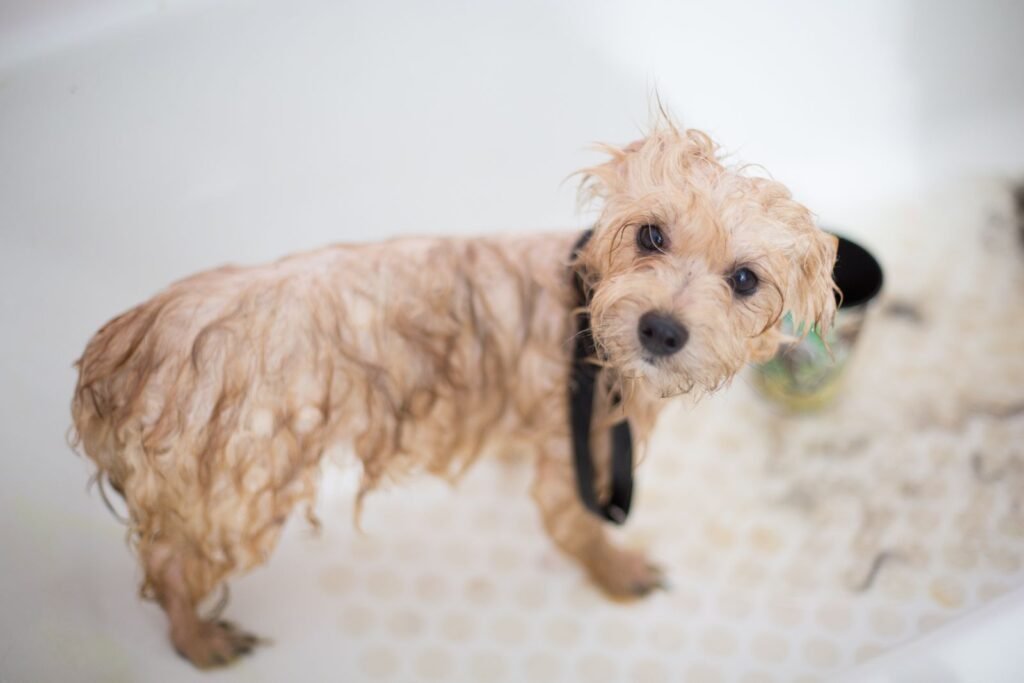
How often should you bathe a cockapoo? Every 4–6 weeks for most — but the real answer depends on coat type and lifestyle. Decision framework, puppy schedule, and over-bathing signs.
Quick answer: Most cockapoos need a bath every 4–6 weeks. But the “right” number depends on your dog: curly coats and active outdoor dogs lean toward every 3–4 weeks; straight coats and couch potatoes can go 6–8. Puppies need less frequent, gentler baths. If the coat smells, feels oily, or itches — it’s time regardless of the calendar.
You’ve probably seen three different answers: every 2–3 weeks, every 4–6 weeks, or “once every couple of months.” They’re all from real sources — and they’re all answering slightly different dogs. This guide resolves the conflict and gives you a way to pick the right number for your cockapoo.
Why Everyone Disagrees
| Source says | They’re picturing |
|---|---|
| Every 2–3 weeks | A very active dog, or a maximum-cleanliness routine |
| Every 4–6 weeks | The average pet cockapoo (the consensus) |
| Once every couple of months | A low-activity dog with a healthy coat |
The disagreement isn’t about science — it’s about which dog each writer imagined. A farm dog that swims daily and a apartment couch potato genuinely need different schedules. So instead of a sixth opinion, here’s how to find your dog’s number.
Finding Your Dog’s Number: The Decision Framework
Start at the baseline, then adjust:
Baseline: every 4–6 weeks. This suits the average cockapoo and is what most groomers recommend.
Bathe more often (every 3–4 weeks) if:
– Tight curly coat (traps dirt and odor faster)
– Swims regularly, hikes, or plays in mud
– White or light coat (shows dirt sooner — and you’re likelier to notice)
– Allergies — your vet may recommend more frequent bathing with a gentle shampoo
Bathe less often (every 6–8 weeks) if:
– Straight or silky coat
– Mostly indoor lifestyle
– Skin tends toward dryness or flaking
The tiebreaker: ignore the calendar and check the dog. The signs-it’s-time list below beats any schedule.
Bathing Frequency by Coat Type
| Coat type | Typical frequency | Notes |
|---|---|---|
| Curly (tight poodle-like curls) | Every 3–5 weeks | Traps dirt and odor; needs conditioner every time |
| Wavy (loose waves, most common) | Every 4–6 weeks | The baseline dog |
| Straight (sleeker coat) | Every 5–8 weeks | Shows dirt less, dries faster, but still needs the routine |
Puppies vs Adults
Puppies under 6 months need less frequent, gentler baths — every 6–8 weeks is plenty unless they get into something. Use lukewarm water (not warm), a soft stream rather than a strong spray, and gentle motions with the direction of hair growth. Keep it short and positive: you’re building a lifetime attitude toward baths here, not achieving show-ring cleanliness.
One exception: muddy puppy paws don’t require a full bath — see the spot-cleaning routine below.
Seasonal Adjustments
Summer: Heat, swimming, and outdoor adventures usually mean more baths — many owners shift to every 3–4 weeks. Rinse with plain water after swims (more on that below) to stretch the time between full shampoos.
Winter: Dry indoor heating dries skin faster, so this is the season to bathe less, not more — stretch toward the 6–8 week end if the coat allows, and always use conditioner. Muddy paws get spot-cleaned rather than triggering full baths.
After Swimming: Rinse or Full Bath?
This is one of the most-asked real-world questions, and almost nobody answers it: rinse with plain water after every swim; save the shampoo for the scheduled bath.
- Pool: Chlorine dries the coat — rinse thoroughly with fresh water, no shampoo needed each time.
- Lake/river: Rinse well; shampoo only if the dog smells swampy afterward.
- Ocean: Always rinse — salt is the harshest of the three. A full shampoo is reasonable after beach days.
Frequent full shampoos after every swim is the fast track to dry, flaky skin. Water rinse + thorough drying does the job.
 CockapooDaily
Between Baths: The Spot-Cleaning Routine
Full baths are for the whole dog; daily life mostly dirties three zones. Handle them without a bath:
- Paws: Rinse or wipe after muddy walks. A shallow paw-washer cup by the door beats a full bath every time.
- Belly and legs: A damp microfiber cloth wipes off most mud once it’s dried (dried mud brushes out; wet mud smears).
- Face: Daily wipe with a damp cloth — doubles as tear-stain prevention. (See our cockapoo tear stain guide.)
- Rear: Quick sanitary wipe as needed, especially for longer cuts.
Unscented grooming wipes work for all of the above when you’re away from a tap.
Signs You’re Over-Bathing
Too many baths strip the natural oils that keep skin and coat healthy. Watch for:
– Dry, flaky skin or dandruff that wasn’t there before
– Itching and scratching with no other cause
– Dull, brittle-feeling coat
– Skin looks pink or irritated after baths
The fix: stretch the interval by a week or two, switch to a moisturizing oatmeal shampoo, and never skip conditioner on curly coats.
Signs You’re Under-Bathing
- The “dog smell” is noticeable from a few feet away
- Coat feels oily or sticky to the touch
- Itching, especially after outdoor play (pollen and dust build up)
- Visible dirt that brushing doesn’t remove
- Tangling faster than usual (dirty coat mats faster)
 CockapooDaily
Choosing the Right Shampoo
Not all dog shampoos do the same job:
- Everyday: A gentle, sulfate-free dog shampoo. This is the default bottle.
- Dry/itchy skin: Oatmeal-based or moisturizing formula.
- Sensitive skin: Hypoallergenic, fragrance-free.
- Deep clean (rarely): A clarifying shampoo — occasional use only; too stripping for routine baths.
Non-negotiable rules: Never use human shampoo (wrong pH — it irritates dog skin and strips oils). Always follow with conditioner on curly and wavy coats; it’s not optional for these coat types. And rinse like you mean it — soap residue left in a dense coat causes itching that gets blamed on everything else.
The Bath, Step by Step
- Brush first — always. Never bathe a matted dog; water tightens mats into felt that’s nearly impossible to remove. Ten minutes with a slicker brush and metal comb.
- Protect ears and eyes. Cotton balls loosely in the ears keep water out; a washcloth (not direct spray) for the face.
- Lukewarm water, 80–90°F. Wet the coat thoroughly, working down to the skin — dense coats need longer than you think.
- Shampoo to the skin. Massage in the direction of hair growth. Two light lathers rinse cleaner than one heavy one.
- Rinse thoroughly. Then rinse again. Residue is the #1 cause of post-bath itching.
- Conditioner. Mid-length to ends, leave per the label, rinse.
Use a non-slip mat — a slipping puppy panics, and one bad experience echoes for months.
Drying: Don’t Skip It, Don’t Air-Dry
This is where most home baths go wrong. Never let a cockapoo air-dry — damp dense coat is a matting and mildew factory, and several sources link it to fungal skin issues.
- Towel-dry first, squeezing (not rubbing) — rubbing creates tangles.
- Blow-dry on cool or low heat, holding the dryer 6+ inches away.
- Brush while drying — this is the professional secret. Drying + brushing simultaneously straightens the coat and prevents every tangle from setting.
- Dry fully, right down to the skin. A coat that looks dry on top can be damp underneath — part the fur and check.
A high-velocity dryer is the groomer’s tool and worth it if you bathe at home regularly; otherwise a regular dryer on cool works with patience.
Floppy Ears Need Extra Attention
Cockapoo ears trap moisture — after every bath (and swim), gently dry inside the ear flaps with a soft cloth or cotton ball. Trapped dampness is the classic setup for ear infections, which this breed is already prone to. Never probe into the ear canal; the visible flap area is enough.
Frequently Asked Questions
Can I let my cockapoo air dry?
No — air-drying a dense, curly coat invites matting and can encourage fungal skin problems. Towel dry, then blow-dry on cool while brushing.
Should I brush my cockapoo wet or dry?
Both, at different times: brush before the bath (dry, to remove tangles) and during drying (damp, to prevent new ones). Never brush a dirty dry coat aggressively — that’s how you break hair.
Can I use human shampoo on my cockapoo?
No. Human shampoo has the wrong pH for dog skin — it irritates and strips natural oils. Use a dog-specific shampoo; they’re formulated for the difference.
How do I know if my cockapoo needs a bath?
The smell test (noticeable from a few feet), oily feel, itching after outdoor play, or dirt that brushing won’t remove. The calendar is a guide; the dog is the answer.
Can I groom my cockapoo at home instead of a groomer?
Bathing and brushing, absolutely. Full haircuts are a bigger skill — many owners handle baths at home and leave clipping to a professional every 6–8 weeks. (See cockapoo haircut styles.)
The Bottom Line
Every 4–6 weeks is the honest baseline — then adjust for coat type, lifestyle, and season, and let the dog’s coat override the calendar. Never bathe a matted dog, never air-dry, and remember that a quick rinse or spot-clean handles most of daily life. Get the frequency right and the coat largely takes care of itself.
Next: Bathing and brushing go together — see when your cockapoo should have its first haircut to complete the grooming picture.
Can I bathe my cockapoo once a week? For most Cockapoos, no — weekly baths strip the natural oils from the coat and skin and can leave the skin dry and itchy. Once a week is only right if your vet advises it for a skin condition, or for a puppy that keeps rolling in mud. A bath every 4–6 weeks is enough for most adults.
How often should I bathe my cockapoo puppy? Puppies under 8 weeks old do not need baths at all. From 2 to 6 months, a bath every 4–8 weeks is fine, using a gentle puppy shampoo and lukewarm water. As with adults, bathe on need — mud, a swim in dirty water, or a smell — rather than on a fixed schedule.
What kind of shampoo is best for a cockapoo? A gentle, dog-specific shampoo that is soap- and detergent-free, made for dogs’ skin pH. Never use human shampoo: it is the wrong pH for dog skin and dries the coat out. For curly coats, a shampoo with conditioner (or a separate light conditioner) keeps the curls soft and less tangle-prone.
What happens if I bathe my cockapoo too often? Over-bathing strips sebum, the natural oil that protects skin and coat, and disrupts the skin’s pH and microbiome. The signs are dry, flaky or itchy skin, a dull coat, and skin infections that keep coming back. If you already see those signs, stretch the gap between baths and ask your vet about a moisturising shampoo.
Can I rinse my cockapoo with water only between baths? Yes — a lukewarm water rinse (or a wipe-down with a damp cloth) is fine for muddy paws or a dusty coat between baths, and it does not strip oils the way shampoo does. Dry the coat thoroughly afterwards, especially the ears, because a damp ear is where infections start.

Leave a Reply